


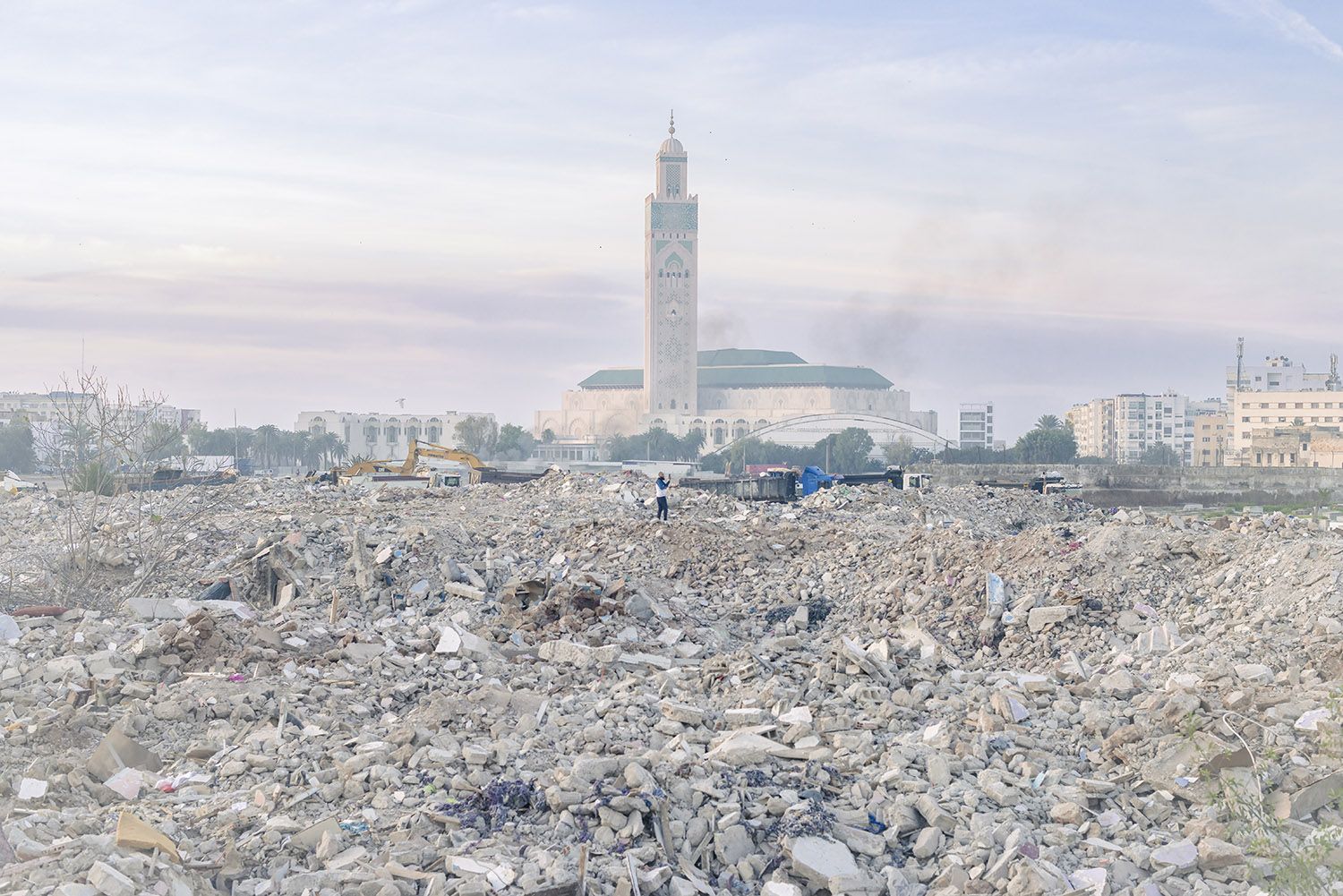
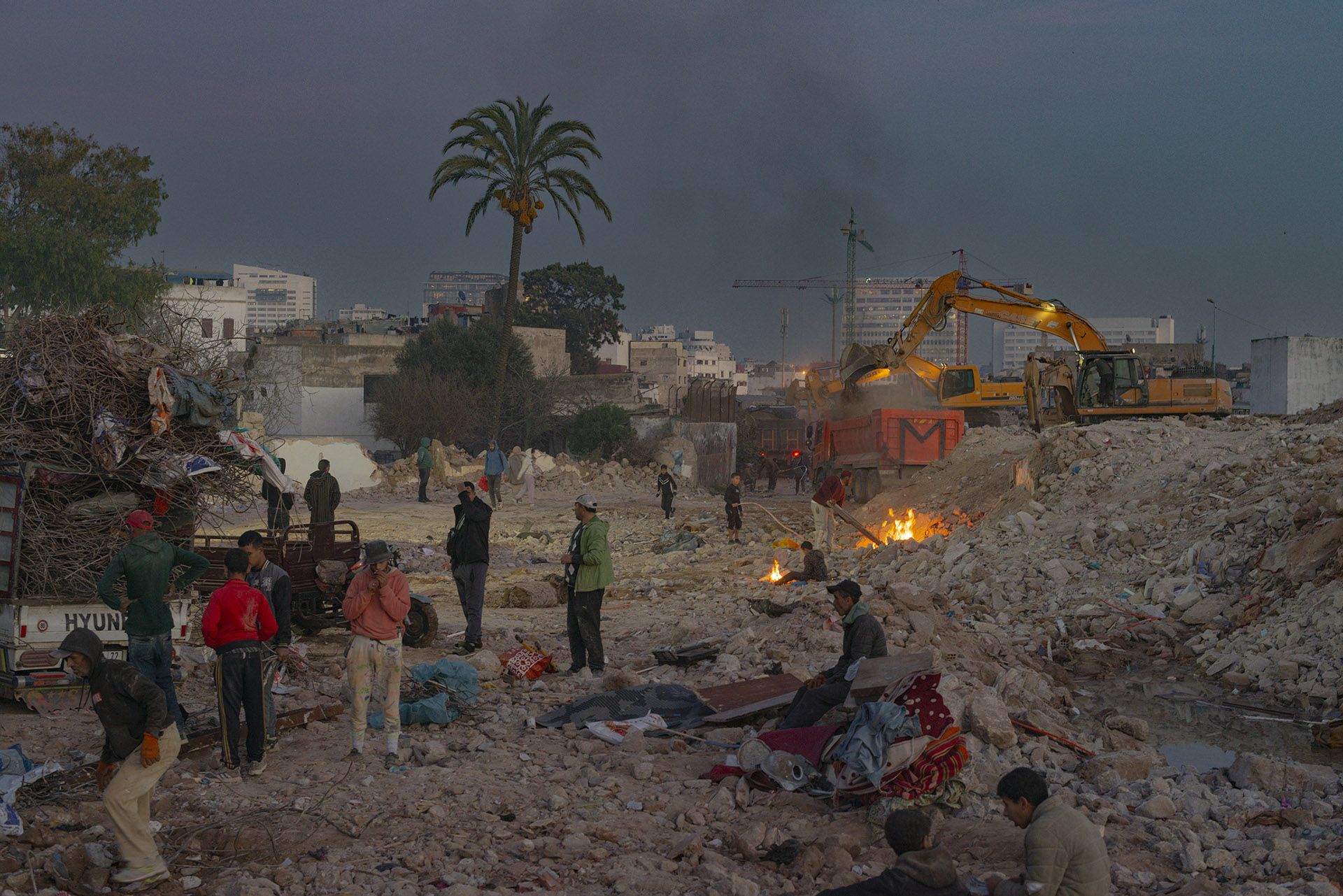
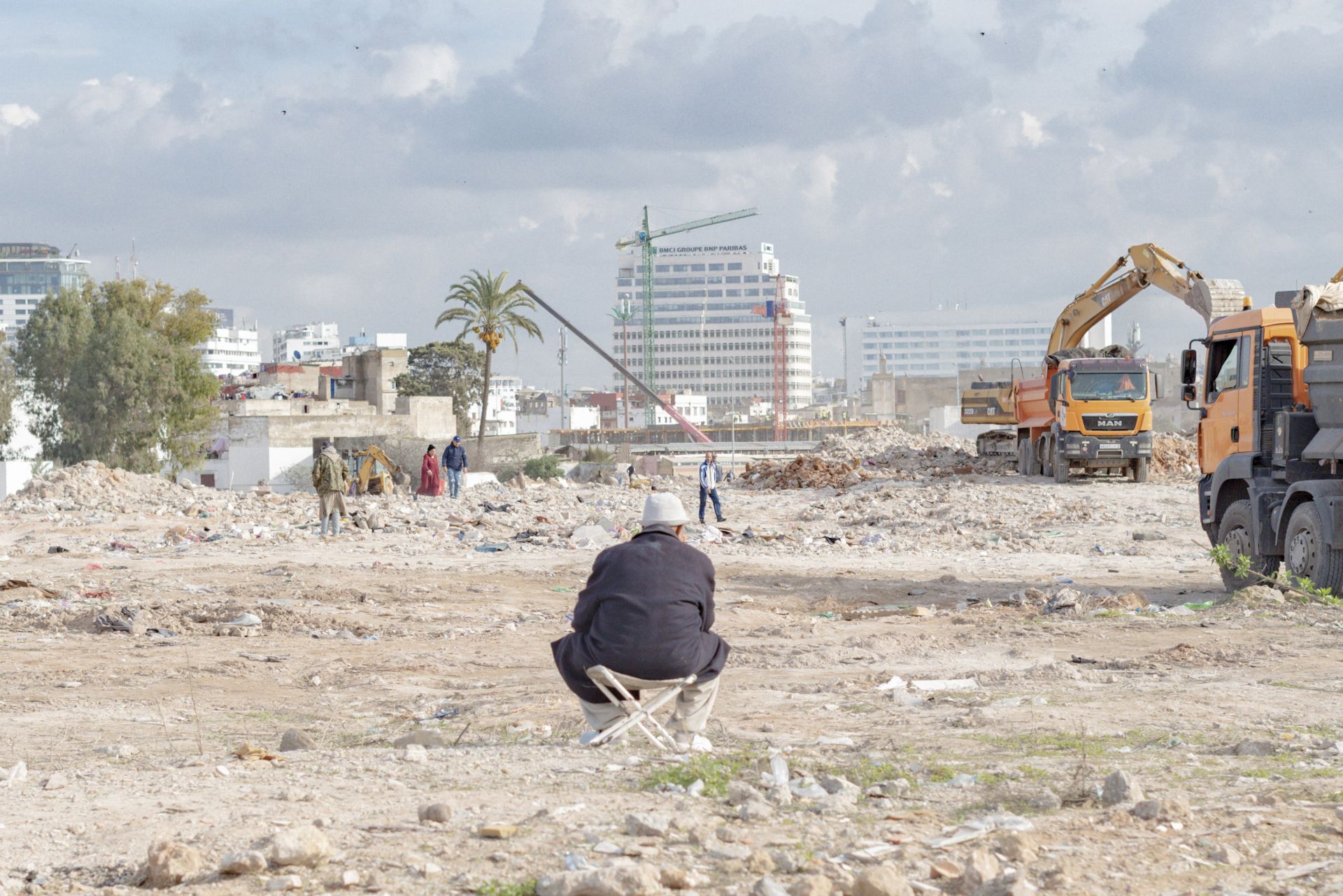

Before the bulldozers came, Zahra’s seaside neighborhood of L’Ocean, in Rabat, was lively, thrumming with the pulse of traffic and people out on the streets as they did their shopping and went to work. The 21-year-old student (whose name has been changed) would amble out to the rocks at the waterfront to sit and listen to music, or invite friends over to her house to watch the sunset from her terrace. Sometimes they would sit for tea or coffee at Cafe Versailles, the old building’s red walls covered with artwork and decorative mouldings. Little statues stood between the cafe’s compact tables. “It was really beautiful inside,” she said.
But now the Cafe Versailles is gone, along with many of the shops and homes in L’Ocean, turned into heaps of concrete and rebar.
“It’s almost as if people are living through a war,” Zahra told me over the phone. “Everywhere I look, I see rubble, people crying and screaming.”
Over the past year, hundreds of buildings in Rabat have been demolished as part of large-scale urban redevelopment of the city’s coastline. For Zahra, the year has been defined by uncertainty, wondering when the excavators will come for the home she shares with her grandmother. Though the outlines of the project are well known, for residents of the neighborhoods facing redevelopment, the decisions about whether and when their houses will be demolished often arrive with just a few weeks’ notice. For those with few means, the elderly or disabled, it is hardly enough time to find another place to live and move all their belongings. Many homes come down with the furniture still inside.
From her bedroom window, she looks out over the destruction. In a photograph she sent, a nearby building has been reduced to its bare concrete skeleton, surrounded by excavators and piles of rubble; in the background, the Atlantic glitters. Abandoned buildings nearby have been occupied by squatters, and pieces of damaged walls now regularly fall into the streets.
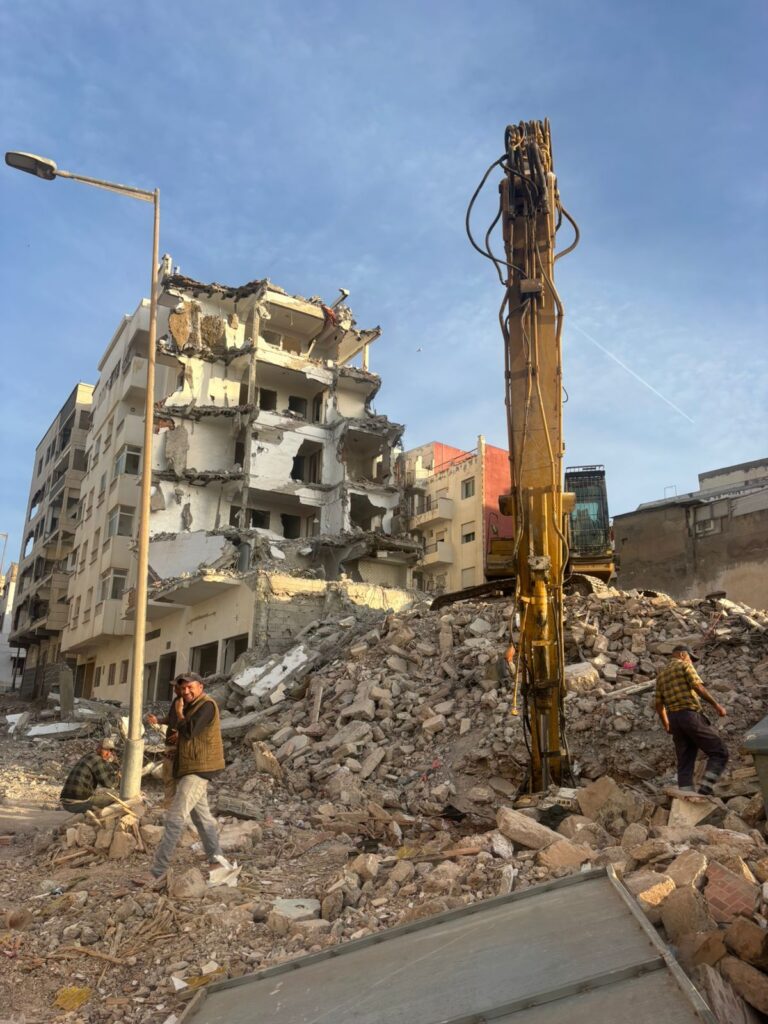
Public transport has almost completely come to a halt, electricity and water are frequently cut off, and essential services and facilities, such as pharmacies and shops serving residents, have been destroyed.
Rabat is not the only city in Morocco where residents have seen their houses destroyed in the name of progress. Over the past year, similar scenes have played out in cities across the kingdom, in Casablanca, Marrakech and Fez, as neighborhoods are cleared to make way for redevelopment. “The scale and speed of the demolitions are unprecedented,” said Souad Brahma, the president of Morocco’s human rights organization AMDH. She told New Lines that tens of thousands of families have already been displaced since the start of 2026. “It is primarily families from vulnerable communities who are being affected.”
The government’s justification is that the demolitions are, in part, a matter of public safety. Collapsing buildings are a real and oftentimes lethal problem in Morocco. Last December, 22 people were killed in Fez when two adjacent houses collapsed, and a few months later, at least nine more died in another building collapse in the same city. Officials point to cases like these to argue that clearing deteriorating housing is an urgent public good.
But the speed and scale of what’s happening in cities like Rabat and Casablanca point to something bigger than safety inspections. Redevelopment plans that stalled for decades are suddenly being pushed through as Morocco is racing to prepare for the 2030 World Cup, which it will co-host with Spain and Portugal. The Kingdom is pouring billions of dollars into infrastructure, hotels and transit meant to help it welcome tens of millions of tourists over the next few years.
Ahead of the 2030 World Cup, the government has also allocated 18.6 billion dirhams (about $2 billion) to build 62,000 homes and clear informal settlements in and around Casablanca. The plans build on an initiative called “Villes Sans Bidonvilles” (Cities Without Slums) which was launched more than 20 years ago to replace informal settlements with safer housing. After moving slowly for years, however, the programme has suddenly accelerated.
Yet while the government claims that the aim is to modernize the country, boost the economy and make neighborhoods safer for the people who live in them, for many residents caught up in the demolitions, the reality looks different. They are losing their homes, livelihoods and connections to the neighborhoods where they have built their lives. Residents describe notices arriving that demand eviction within days, compensation falling far short of market value, and replacement housing, when it materializes at all, in neighborhoods hours away from the lives and routines they’ve built.
That loss is felt deeply in L’Ocean, one of the first neighborhoods to grow up outside Rabat’s old medina. “This neighborhood has a memory,” said Mohamed Achaari, Morocco’s former minister of culture, who lives in the newer part of L’Ocean, so far spared from demolition. On the phone, he vividly describes how L’Ocean carries the imprint of the Spanish and Andalusian families who helped shape it. Now, they’re being forced out.
Achaari, who is also a renowned writer, is not opposed to redevelopment. What troubles him is how it’s being carried out. The authorities simply say, “Your house will be demolished, you will receive compensation, and you must leave.” But it isn’t that simple, he said. “There are people who spent their childhood here, who are deeply attached to these places.” Residents are offered no way of “preserving or coming to terms with the shared memory that is disappearing.” They are neither consulted nor properly informed, he argues. “People don’t want to be merely the objects of change; they want to be its subjects.”
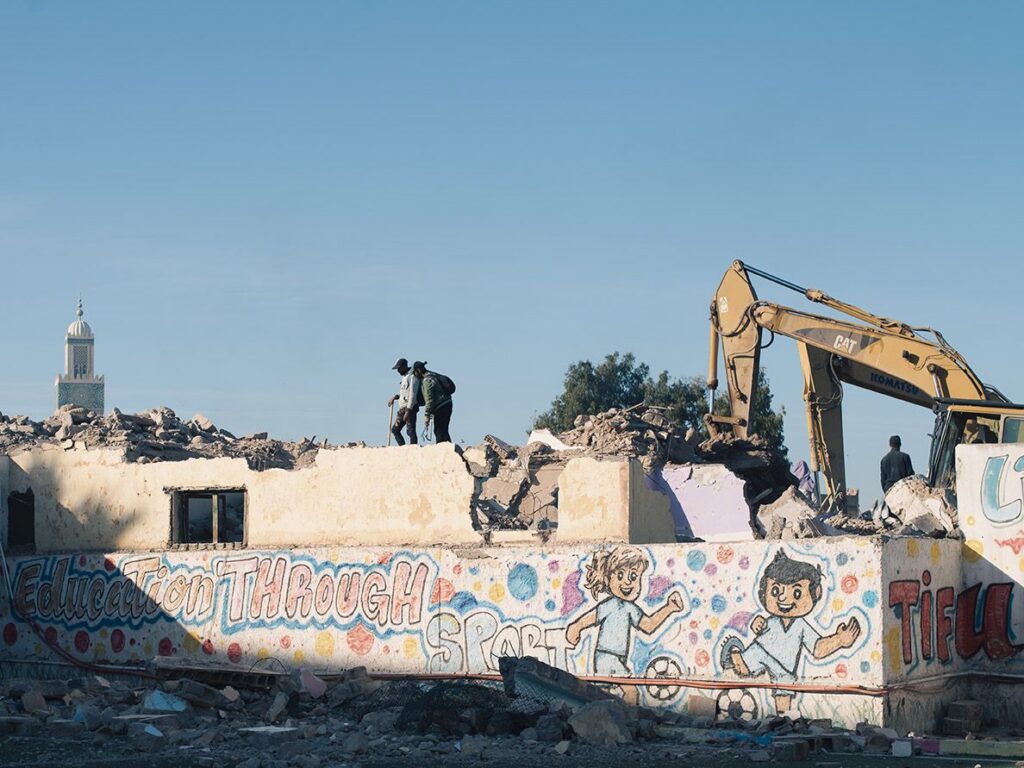
Residents of L’Ocean say that there was little meaningful consultation or involvement with the people who lived there over the government’s redevelopment plans. There was no clear moment when they were shown the full scope of what was planned for their neighborhood. Instead, they began to understand the scale of the transformation as demolition work moved closer to their homes.
In 2025, the government approved an urban plan to transform Rabat’s seafront with new housing, leisure facilities and commercial development. As part of that broader redevelopment, demolitions began in a nearby district that had housed military families, just a short distance from L’Ocean. But soon the demolition work crept toward L’Ocean, then began in earnest in the neighborhood. Reporting by the economic outlet Medias24 later found that the demolitions in L’Ocean had extended beyond the boundaries laid out in the 2025 urban plan.
Many of the homes cleared over the past year in L’Ocean were not the crumbling buildings that officials often point to when justifying the demolitions. Apart from the neighborhood’s historic buildings, “the vast majority of the homes being demolished are relatively modern residential properties,” said Farouk Mahdaoui, a lawyer and Rabat city councillor who represents affected residents. He said more than 10,000 families have been displaced from Rabat since the end of 2024, most of them from L’Ocean.
For officially registered properties, Mahdaoui said, the government offers compensation of around $130 per square foot. Residents argue that that falls far short of the actual market value of their homes.
Zahra’s grandmother, who at 77 still works as an administrative assistant, bought her apartment as a divorcee after years of scrimping and saving. When the demolitions picked up, the family decided to commission an independent valuation of her apartment. The figure that came back was nearly $220 per square foot, almost 70% higher than what the government was offering.
Meanwhile, prices across the city have climbed sharply, driven in part by the demolitions themselves. “Everyone is trying to buy a home now,” Zahra said. “My mother and uncle have already taken out loans to help my grandmother find a new house.” She said that apartment prices start at roughly 25,000 Moroccan dirhams per square meter ($249 per square foot at current exchange rates). For a 1,000-square-foot apartment she and her grandmother are looking for, that means a minimum price of about 2.3 million dirhams, or $249,000.
“And that’s only for an old apartment,” she said. “In the popular neighborhood where we used to live, it’s almost impossible. Houses there are even more expensive,” Zahra added.
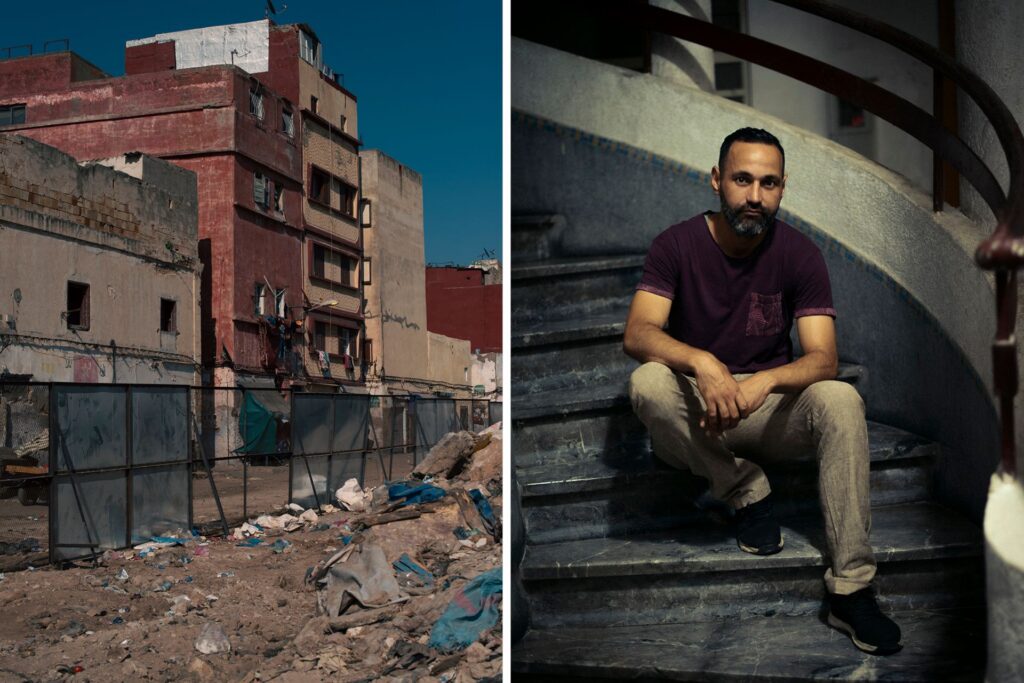
Just over an hour’s drive south from Rabat along Morocco’s Atlantic coast, Casablanca rises from the shoreline, a bustling city of more than 3 million people and the country’s economic heart. Here, vulnerability exists alongside the kingdom’s ambitious vision for the future: Gleaming skyscrapers rise above bustling local markets. Rapid development is reshaping neighborhoods where many families have lived for generations.
It is 9:30 p.m. in Casablanca when Saad Mosleh gets home from work in Errahma, a suburb on the city’s outskirts. Errahma was built about 20 years ago to absorb residents displaced by redevelopment projects closer to the center, and today Mosleh rents an apartment there with his partner after his home in Casablanca’s Medina, the city’s historic walled quarter, was demolished.
Mosleh is an event planner, organizing everything from birthday celebrations to private galas, work that often takes him to the city center. Now, getting to those clients means piecing together two tram lines and a bus — an hour-and-a-half journey each way.
Before the demolitions, “we lived close to the beach, schools, shops and cultural centers,” Mosleh said over the phone. But it wasn’t just the convenience of the place, “it was a way of life,” he said, recalling the childhood friends, first love and first steps that unfolded there, and the summers he spent swimming along the Atlantic waterfront. Now, the medina lives mostly in his memory.
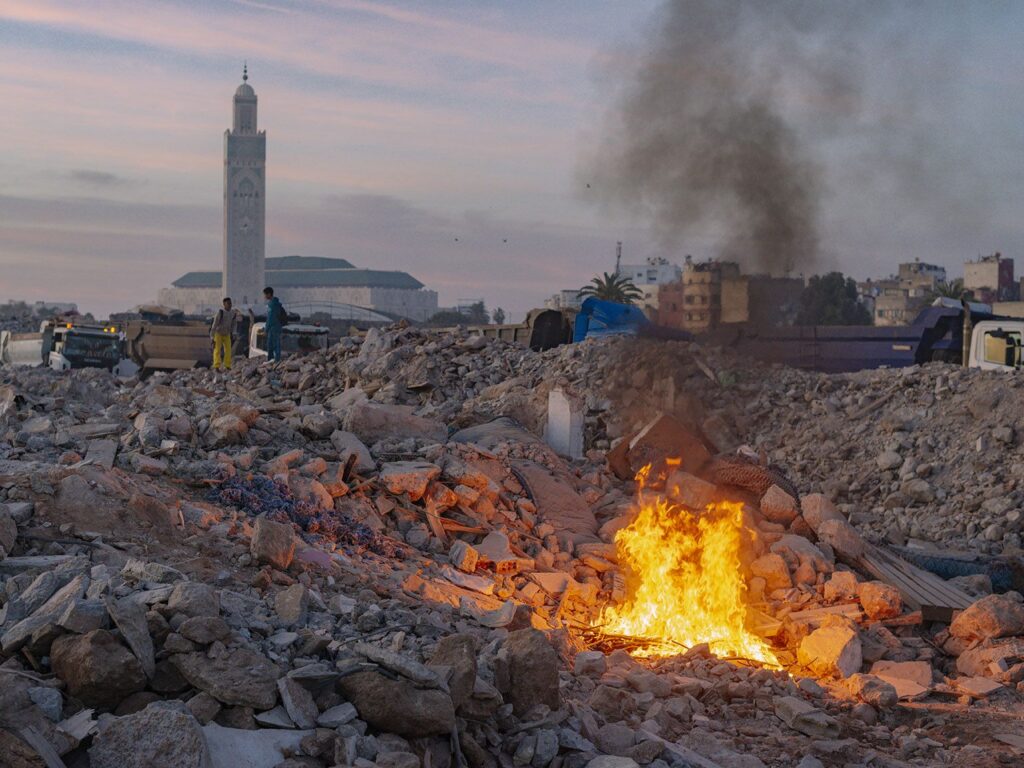
Mosleh’s former home stood on the site where the Royal Avenue project is set to rise: a boulevard stretching nearly a mile, planned to include hotels, shops, fountains, a business district, a national theater and a convention center. The idea for the megaproject goes back to the early 1990s, when King Hassan II began building his eponymous mosque, one of the largest in the world, just outside the walls of the medina, one of Casablanca’s most densely populated districts. But the project soon expanded to become an urban renewal effort that encompassed much of the surrounding area.
When the project started, it was slated to affect roughly 12,000 households; 30 years on, that number is perhaps double, though advocates don’t have concrete figures. Hundreds of buildings inside the project footprint have already come down over the past three decades, but the last wave of demolitions appears to be outpacing anything that came before. An analysis by New Lines of satellite imagery taken between August 2025 and May 2026 shows that more than 35 acres, roughly the size of 26 football fields, within the Royal Avenue project area have been demolished.
Mosleh’s own house was swept up in 2024. “We were told only 20 days in advance that our house was supposedly unsafe,” he said. “Just seven days before the demolition, we submitted an engineering report proving that it was structurally sound.” The report made no difference. The demolition went ahead, and Mosleh, like hundreds of others, has spent nearly two years fighting the decision through Morocco’s courts, a case that remains unresolved.
Government relocation promises have offered little relief in the meantime. Around 16,550 apartments in the suburb of Nassim, about 6 miles from the project area, are supposed to eventually be sold to displaced residents, and until then the government has promised affected families 9,000 dirhams ($964) to cover six months of rent. But according to Yasmine Zaki, a lawyer and provincial representative of the Party of Progress and Socialism, the new housing on offer is often financially out of reach, consisting of subsidized apartments built roughly 19 miles from central Casablanca.
Buying one costs around 100,000 dirhams, plus another 20,000 dirhams in notary and registration fees, a sum that is out of reach for many families in the medina. Government statistics put Morocco’s unemployment rate at around 13%. The situation is particularly challenging for young people: Youth unemployment stands at around 37% and remains one of the country’s most pressing concerns. Despite the existence of minimum wage legislation, Zaki said that many families in the medina earn less. Nationwide, more than half the population works in the informal sector, often without formal wage protections. Some residents are being offered compensation at a tenth of what their properties are actually worth, according to Zaki. Many homeowners therefore “refuse to accept the offer,” she said.
But even the paltry compensation isn’t guaranteed. Houses that have been declared unsafe, like Mosleh’s, don’t qualify for compensation. “It simply doesn’t make sense that so many homes are suddenly being declared unsafe immediately after Morocco announced it would host the 2030 World Cup,” Zaki said.
While many houses in Rabat’s L’Ocean neighborhood are relatively solid, homes in Casablanca’s medina are often far more precarious: cramped, ageing structures packed into a dense maze of narrow streets. But for many residents, these homes are also places of work and a source of income. “Many of the buildings had three or four stories, with small shops on the ground floor that were either rented out or run by the owners themselves,” Zaki said. The new housing on offer doesn’t come with that same advantage. Other families relied on the medina’s proximity to businesses and wealthier neighborhoods for work, earning a living as cleaners, drivers and other service workers. Now, they’re left to commute for hours to reach the same clientele.
Kenza Chraibi, president of the Sidi Belyout district council, where the Royal Avenue project is located, rejects the idea that the safety inspections are pretextual. “The project is primarily intended to protect human lives,” she told New Lines, arguing that the redevelopment shouldn’t be viewed simply as a real estate scheme.
According to Chraibi, authorities inspected buildings across the project area to determine which were at risk of collapse, and 1,910 households currently living in officially unsafe buildings are registered under the project. The criteria for compensation, she said, are based on “objective rules,” and differences in payouts reflect “different legal, property and administrative situations.”
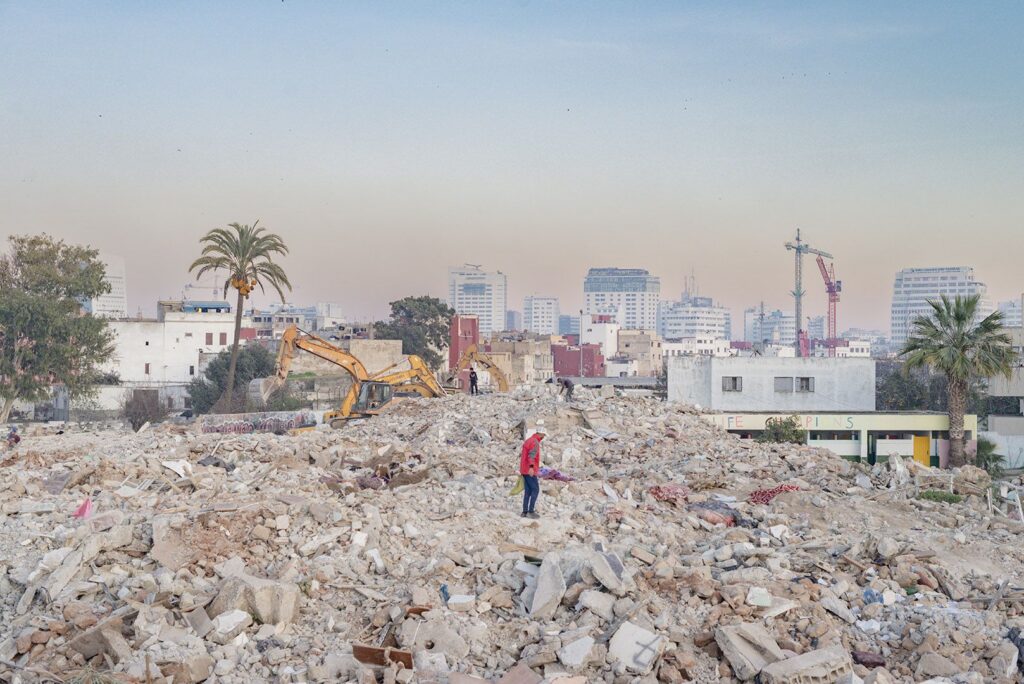
Stefano Portelli, a researcher in urban anthropology at Spain’s UNED University in Madrid, who has spent more than 20 years studying the social fallout of urban redevelopment, said the decline of neighborhoods isn’t just a matter of age or shoddy construction; it’s a slow-motion effect of decades spent under threat of demolition. “If you leave a neighborhood under the threat of demolition for 20 years, investment simply stops. Banks won’t issue mortgages, and homeowners stop renovating their properties,” he said. The result, over time, is a kind of self-fulfilling prophecy: neglected buildings that make demolition look like the only responsible option, even though the neglect was largely produced by the threat of demolition itself.
Beyond the economic effects of urban redevelopment, Portelli points to something less visible but equally significant: the way demolitions and mass evictions shatter popular culture, usually rooted in working-class neighborhoods.
Nowhere is that more visible than in Casablanca’s medina. Portelli recently went to visit the Boussou family, a veritable dynasty of musicians and teachers of Gnawa, the spiritual and artistic practice developed by enslaved West Africans from the Sahel that has become one of Morocco’s great cultural exports. The family had founded a cultural center dedicated to Gnawa in the medina in the 1980s, which had become a sort of headquarters for the music that, as Said Boussou said, “can take you to another world.” In January, the center was razed, along with their family home.
The family had lived in the home for 60 years, and the center had long been a meeting place for established Gnawa musicians from around the country and further afield who came for music festivals and to be among their spiritual kin. “Unfortunately, the Royal Avenue project eventually led to its demolition,” Said said.
The family had known for decades that redevelopment was planned, but the uncertainty dragged on. Restrictions on buying, selling and renovating properties, he added, left families in a difficult position. When the demolition finally came, however, they had little time to prepare. Said said the family was given just two days to leave. His 87-year-old mother and his brother Hassan’s family now live on the outskirts of the city.
Said argues that residents should have been given adequate time, compensation and alternative housing before being evicted. Instead, he said, “They had not even prepared where people were supposed to go.”
Eventually, residents were offered apartments, but Said said the conditions were inadequate. The family was offered a 614-square-foot apartment that needed renovation, he said, and would have required them to pay more than 70,000 dirhams ($7,500), in addition to the deed, water and electricity installations, and renovation costs.
“It is not only about economic necessity, because houses are everywhere,” he said. What matters is the connection between people and the places where they have built their lives. “When you take people away from their neighborhoods, you are taking them away from the places where they have their roots,” he said. “It is about a very important part of a person’s identity.”
Become a member today to receive access to all our paywalled essays and the best of New Lines delivered to your inbox through our newsletters.