


From the center of the coastal city of Vlora, Albania’s third-largest urban center, the car I was in headed north along Rruga e Pishave, a long ribbon of asphalt cutting through a pine forest. Every so often, a ramshackle roadside stall appeared, selling children’s floaties, beach towels and the ubiquitous crimson flags bearing the black double-headed eagle of Shqiperia, “the Land of Eagles,” as Albanians call their country.
Beyond the expanse of Mediterranean pines, we passed the abandoned ruins of the old caustic soda plant, once one of the largest industrial complexes in communist Albania. Part of the site has been repurposed as a storage and handling facility for petroleum products arriving from Patos-Marinez, Europe’s largest onshore oil field. Even now, oil is transported from the depot to the terminal of the Petrolifera Italo Albanese company aboard CKD T 770 locomotives — virtually indestructible machines built in the former Czechoslovakia between the late 1960s and the 1980s.
At the end of this postindustrial tableau, we entered a 6-mile stretch of disordered terrain, where derelict woodland met aging Soviet-era trains, before the landscape shifted abruptly, as if time and space had suddenly accelerated. The asphalt turned into hard-packed dirt and gravel strewn with white stones. It felt like open countryside. Cows grazed between the dusty track and crystal-clear water, surrounded by ocher and brown limestone outcrops sculpted smooth by the wind. Across the water rose the island of Sazan.
We had arrived at the Vjosa-Narta Protected Area, the epicenter of the country’s biggest controversy in recent times. A $6 billion development project planned for the area by Jared Kushner and Ivanka Trump has sparked mass protests across the country and an unprecedented anti-corruption probe. If completed, it would permanently alter one of the most pristine protected landscapes left on the European continent. And Albanians are furious at what they see as the surreptitious hijacking of their country, pitching it into what has come to be called the Flamingo Revolution.
“How can they imagine building a resort for billionaires in a place like this? How could they think we would simply stand by, that we would not defend this land with our nails and our blood?” Aulon Harizaj, a 37-year-old civil engineer who was born and raised in Vjosa-Narta, told New Lines.
“For those of us who grew up here, this place is much more than a nature reserve. It is our identity. I remember when we were kids, my grandfather used to bring me here to fish. We’d climb into his old Golf, and I’d put on a Michael Jackson cassette. On a good day, we might catch a sea bass, a gilt-head bream, sometimes a few mullets. … We’d spend [time] watching the flamingos, and in the evening we’d hitch rides back to Vlora in the beds of old Saurer trucks coming from the factory.”
The area contains Europe’s last wild river delta. For more than 270 kilometers, the Vjosa flows uninterrupted by dams or other artificial barriers. Together with the nearby Narta Lagoon, the delta provides an untouched habitat for more than 1,100 species, including the critically endangered Balkan lynx, the Mediterranean monk seal, one of the rarest mammals on Earth, and thousands of pink flamingos that gather in the delta’s shallow waters, particularly during migration season between October and March.
The Vjosa Delta and the wider Narta Lagoon form a crucial stop along the Adriatic Flyway, one of the planet’s most important migratory corridors, linking Central and Northern Europe with Africa. For millions of birds, this wetland system is an essential refuge during transcontinental journeys. Every year, hundreds of species pass through, including threatened birds such as the Dalmatian pelican, the black stork and the Egyptian vulture, one of Europe’s most endangered migratory raptors, which nests along the rocky walls of the Vjosa Valley.
According to environmental groups and local activists, this ecosystem would be irreversibly damaged by Kushner’s multibillion-dollar project, backed by Gulf sovereign capital, including investors from Saudi Arabia, Qatar and Abu Dhabi, as well as the Albanian oligarch Shefqet Kastrati. To provide the project with a suitable legal framework, Albanian Prime Minister Edi Rama pushed a new law on protected areas through Parliament in February 2024. The legislation weakened environmental safeguards, opening previously protected land to development, including sections of the Vjosa-Narta Delta. It also introduced exemptions allowing the construction of airports, energy infrastructure and commercial tourism complexes deemed strategically important to the country, even within national parks and protected ecosystems.
Vjosa-Narta is not the only place in Albania where the developing tourism industry has come into conflict with local communities. In the coastal area of Rrjoll, in the north of the country, plans for the luxury resort Blue Borgo, financed by Albanian tycoon Bashkim Ulaj, sparked months of protests, with several local families claiming ownership rights over land included in the project. There, too, the area had previously enjoyed environmental protections that allowed only low-impact tourism. Following the 2024 legislative changes, however, the concept of “excellence tourism” was introduced, a provision that permits the construction of high-end hospitality developments even within protected areas.
“When the fences went up in early May, we could hardly believe it,” said Kosta Xhaho, a physician and activist with Protection and Preservation of Natural Environment in Albania (PPNEA), Albania’s oldest environmental organization, where he works primarily on the protection of marine biodiversity. “For a long time, we had publicly warned that something major was being prepared here, but we never thought they would cross the red line so suddenly.” After secretive deliberations and business dealings, construction in the protected area began quietly almost overnight, in early May, when the tractors began leveling the sand dunes in the heart of the protected area, and workers laid the concrete posts that would later support the iron fencing used to cordon off the site.
It was PPNEA, together with a network of local activists and the efforts of Besjana Guri and her organization Movement for Water, Environment and Integration (LUMI), that first drew public attention to what was happening in Vjosa-Narta, helping launch the mass protests.
And what began as an environmental campaign has evolved into a broader protest against Rama’s government, a movement that encapsulates years of accumulated frustration with a prime minister who has been in power since 2013.
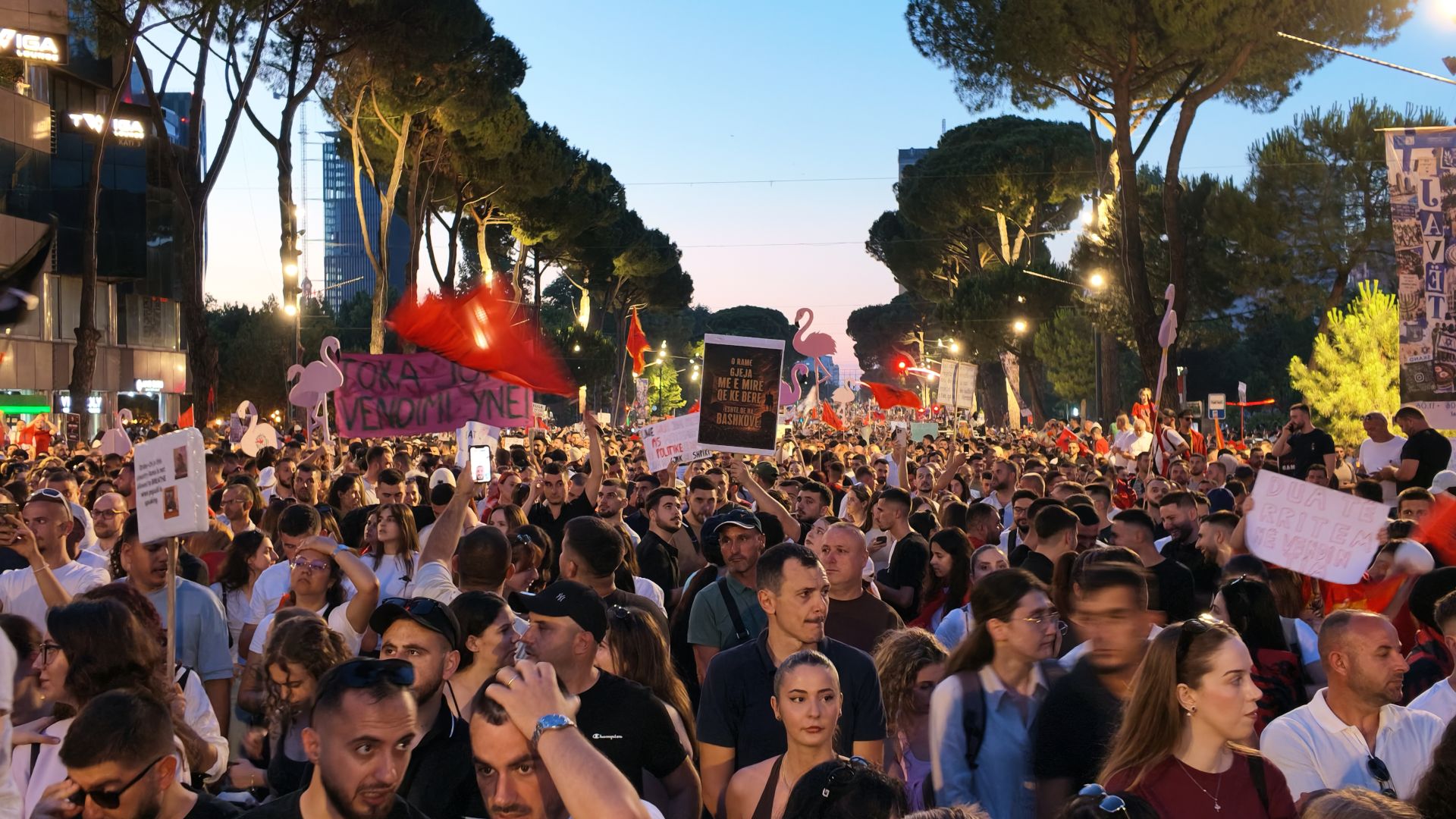
Since May 30, thousands of people have gathered in Tirana every day at 6 p.m. to protest. Marching peacefully from Skanderbeg Square, the capital’s main plaza, to Rama’s office, demonstrators have formed a procession so long that in recent days it has stretched for half a mile along the Deshmoret e Kombit (Martyrs of the Nation) Boulevard.
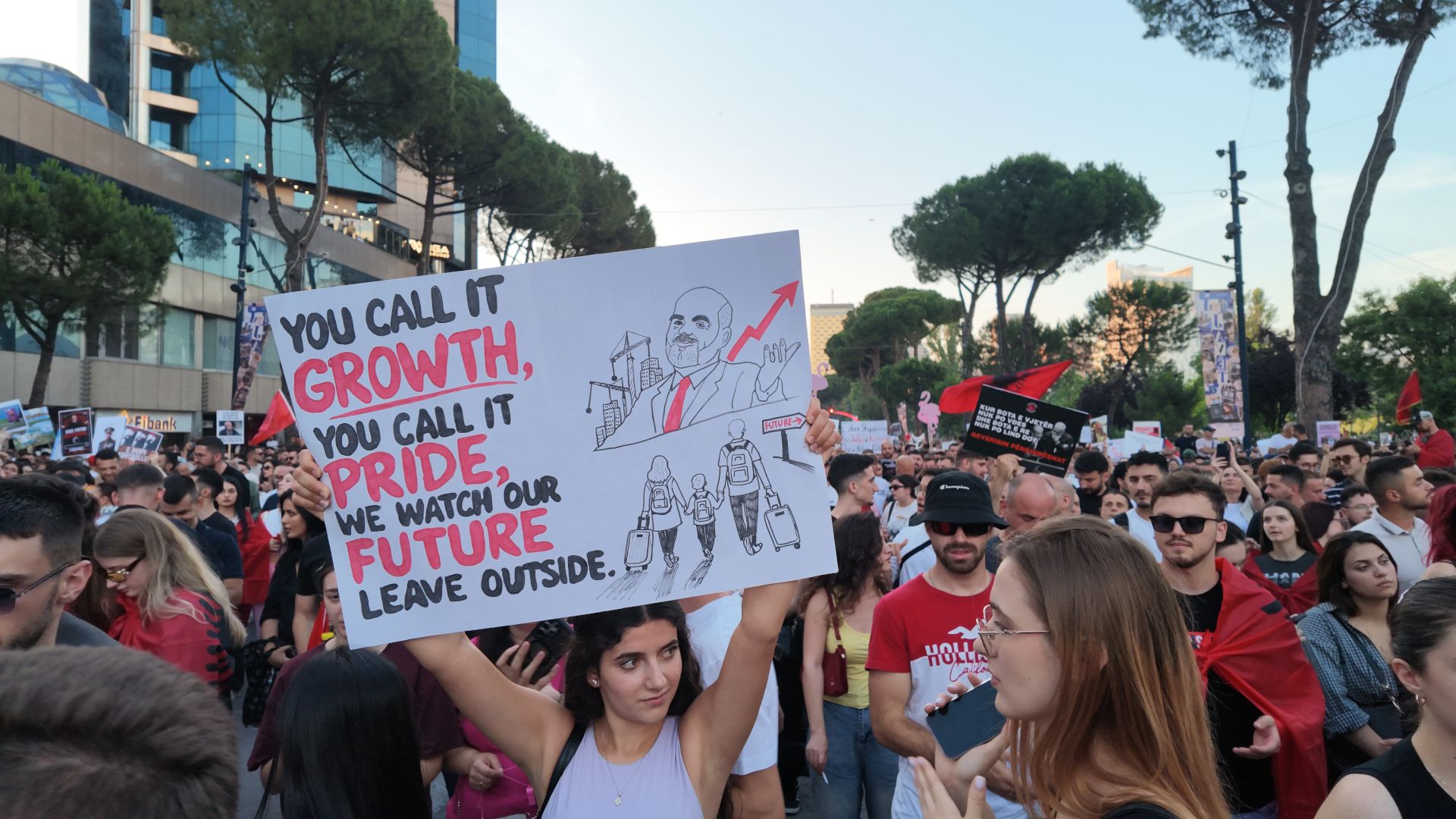
Increasingly, protests resemble a civic awakening in a country that, over the past 15 years, has lost nearly 1 million people, according to Eurostat data based on residence permit applications filed by Albanian citizens in European Union countries. Most of those who left were under 30, departing for Italy, Germany and France in search of opportunities unavailable at home.
It is a devastating demographic hemorrhage, fueled by a seemingly endless succession of corruption scandals and by the nexus linking political power, money laundering and a construction boom that has dramatically reshaped the Albanian capital.
The scale of corruption allegations surrounding Rama’s government is difficult to overstate. Over the past five years alone, several major scandals have implicated current or former members of his Cabinet.
In 2021, Lefter Koka was sentenced to prison after prosecutors alleged that, while serving as environment minister under Rama, he received more than €5 million in bribes to circumvent legal procurement procedures for the construction and operation of waste-to-energy incinerators in Fier and Elbasan, causing significant financial damage to the state. The affair became one of the largest corruption scandals in Albania’s history. It was compounded by the fact that the Elbasan incinerator never became operational and remains idle, while the facility in Fier was never completed, leaving behind what environmental groups describe as a major environmental hazard.
The same scandal also engulfed Arben Ahmetaj, for years one of Rama’s closest political allies. From 2013, Ahmetaj held a succession of senior government positions, including deputy prime minister, minister of economy, minister of economic development, minister of tourism and deputy minister for energy. That career came to an abrupt halt in July 2023. After being removed from government by Rama and facing a formal arrest request from the country’s Special Structure Against Corruption and Organized Crime (SPAK), Ahmetaj fled to the United Kingdom, where he remains today. The most recent and politically explosive case is that of Belinda Balluku, the former deputy prime minister and minister of infrastructure and energy, removed from office by Rama in February 2026 after becoming the target of an investigation into what prosecutors describe as the largest corruption scandal in Albania’s history. According to SPAK, Balluku was part of a network accused of manipulating several of the country’s most important public procurement procedures, including the €190 million contract for the Llogara Tunnel in southern Albania that opened in July 2024 — the longest tunnel in the country, at 3.7 miles. In March, SPAK requested Balluku’s pretrial detention, arguing that she posed a risk to the integrity of the investigation through potential witness intimidation and possible manipulation or destruction of evidence.
Parliament, however, voted on March 12 against lifting her parliamentary immunity, shielding her from detention. She nevertheless remains suspended from holding public office and is subject to a travel ban, with her passport confiscated pending the outcome of the proceedings.
These are the kinds of subjects, corruption and politics, discussed in the car on the road between Vlora and Tirana, a journey that Aulon and his friends, Annamaria and Deona — both in their 30s, and living and working in Vlora — make at least twice a week. It is a round trip of more than 180 miles: over four hours on the road to reach the capital and take part in the protests, returning home after midnight, only to wake up the next morning, go to work and set off again in the afternoon in time for the 6 p.m. march in Tirana. They are far from alone. In recent weeks, Albanians from across the country have been making the same journey to join the demonstrations. Some, like Aulon, have even returned from abroad to be part of what they see as a historic moment.
“I had only been in Copenhagen for a few weeks,” Aulon said, adding that he had been considering moving there permanently. But “then I saw what was happening [in Albania]. It was stronger than me. I had to come back.”
Annamaria feels much the same. An Italian woman of Albanian heritage who returned to Vlora a few years ago to work in the tourism sector. “For the first time in many years, these protests have given people hope,” she said. “For a long time, we lived in a state of resignation, as if nothing in Albania could ever change, as if corruption was our destiny and young people had no choice but to leave. Then, suddenly, people stood up against a government willing to sell our land to American investors. It was like a spark, like waking up all at once.”
One of the clearest indicators of the state of Albanian democracy is the country’s media landscape. According to the 2026 World Press Freedom Index, Albania remains classified as a “problematic” country with regard to press freedom. The 2025 annual report published by BIRN Albania, the investigative journalism organization that forms part of the Balkan Investigative Reporting Network, together with the Center for Science and Innovation for Development (SCiDEV), an independent think tank, paints a similarly troubling picture. “Journalists in Albania continue to face pressure, intimidation and limited access to information,” the report notes. “A significant number of journalists reported having experienced threats or intimidation related to their work. Many stated that they do not feel fully free to carry out their professional duties without fear of repercussions or political pressure.” There is also the question of media ownership.
In Albania, the country’s leading media outlets are controlled by a small group of business figures with close ties to the political establishment and substantial interests in heavily regulated sectors such as construction and real estate development.
According to data collected by the Media Ownership Monitor (MOM), an international research initiative focused on transparency and media pluralism, four ownership groups — the Frangaj family, the Hoxha family, the Hysenbelliu family and Carlo Bollino — control 86.94% of the audience share in the free-to-air television market. Many of Albania’s major media groups are also controlled by entrepreneurs active in construction, real estate, infrastructure and public concessions. This was highlighted in the 2025 OSCE report “Advancing Media Ownership Transparency Reform in Albania”.
The resulting conflict of interest may help explain a broader pattern. Albania’s largest media outlets rarely subject the government to sustained criticism. Coverage of the ongoing protests, for example, has been limited across much of the national media landscape. And three of the country’s largest media groups, Klan, Top Media and Vizion Plus, have been granted the status of “strategic investor” in connection with projects in tourism, infrastructure and real estate development. The designation was introduced under a law “On Strategic Investments in the Republic of Albania,” which entered into force on Jan. 1, 2016. Publicly, the legislation was presented as a mechanism for attracting major domestic and foreign investment in sectors considered essential to economic development, including energy, infrastructure, agriculture and, above all, luxury tourism. Critics argue that in practice, it has evolved into a powerful instrument of political influence.
Under the law, final evaluation and approval of projects seeking strategic investor status rests with the Strategic Investment Committee, a collegial body within the Council of Ministers, chaired directly by the prime minister. In effect, decisions regarding which projects receive access to the law’s benefits are centralized within the office of the head of government. Those benefits are considerable. The state may transfer public land and state-owned property to strategic investors through long-term lease agreements of up to 99 years, in some cases for the symbolic price of €1. Public institutions are required to grant priority treatment to approved projects, accelerating the issuance of licenses, construction permits and environmental authorizations. The government may also finance and build supporting infrastructure necessary for the operation of private developments, including access roads, water networks, sewage systems and electricity connections. Additional incentives include exemptions from infrastructure impact taxes, exemptions from property taxes, and substantially reduced VAT rates for developers building four- and five-star hotels and resorts deemed strategically important for the growth of Albania’s tourism sector.
To understand the opaque relationship linking political power, media ownership and the construction sector, it is enough to look at the projects that have received strategic investor status over the past decade. Companies linked to Lori Hoxha, CEO and owner of Top Channel (and not related to Albania’s former communist dictator Enver Hoxha), obtained the designation for the development of a luxury hotel and a large residential complex in one of Tirana’s most exclusive and expensive commercial districts.
In 2022, the same status was granted to the White Roads hotel project in Dhermi, on Albania’s southern coast. The project was associated with companies linked to Aleksandër Frangaj, owner of TV Klan. As part of the arrangement, the government granted the project 9,157 square meters of public beachfront land under a long-term lease at the symbolic price of €1.
The Dulaku family, which controls the television broadcaster Vizion Plus and the Tring media platform, two of the country’s most influential media outlets, also benefited from the law. In 2021, companies linked to the family obtained strategic investor status for two major tourism developments. The first, Gone Perivol in Dhermi, is a luxury complex combining a hotel, private villas and hospitality facilities, with an estimated value of €32.5 million and exclusive long-term use of the adjacent beach. The second, San Pietro, is a vast tourism development located on the Adriatic coast north of Durres. Spread across more than 80 acres, the project combines an internationally branded five-star hotel with hundreds of villas intended for the luxury residential market.
There is no evidence that any of the companies involved acted unlawfully or obtained these benefits improperly. However, the fact that some of Albania’s largest media groups have also been among the beneficiaries of a government-controlled investment scheme has raised broader questions about transparency, conflicts of interest and media independence.
The strategic investment law is closely intertwined with the protests that have erupted over the Kushner-Trump resort project in the Vjosa Delta. Faced with mounting public opposition and growing criticism from European institutions, Rama has announced his intention to repeal the legislation. The European Parliament has repeatedly expressed concern that the law’s fast-track procedures may circumvent environmental oversight, particularly in protected coastal areas, while creating conditions that undermine transparency and media independence.
“Thirteen years ago, I was one of Edi Rama’s biggest supporters. I was in love with him as a politician. I truly believed he would bring Albania into the future. He seemed like a great man,” said Ektor, a 73-year-old retiree who has joined the demonstrations every day for weeks. “The reality is that he isn’t even like the politicians we had before. Maybe he’s worse.”
A painter, visual artist, basketball player and former bohemian in the Paris of the 1990s, Rama built his political career during his 11 years as mayor of Tirana. He became internationally known for repainting the capital’s drab communist-era apartment blocks in bright colors and for expanding urban green spaces. His energetic and highly visible style convinced many Albanians that he could be the leader who would carry the country into the future and, above all, into the European Union. That promise, many of his critics now argue, has gone unfulfilled. Over time, Rama has come to embody many of the same traits associated with his predecessors: recurring scandals, limited transparency and an increasingly centralized style of governance.
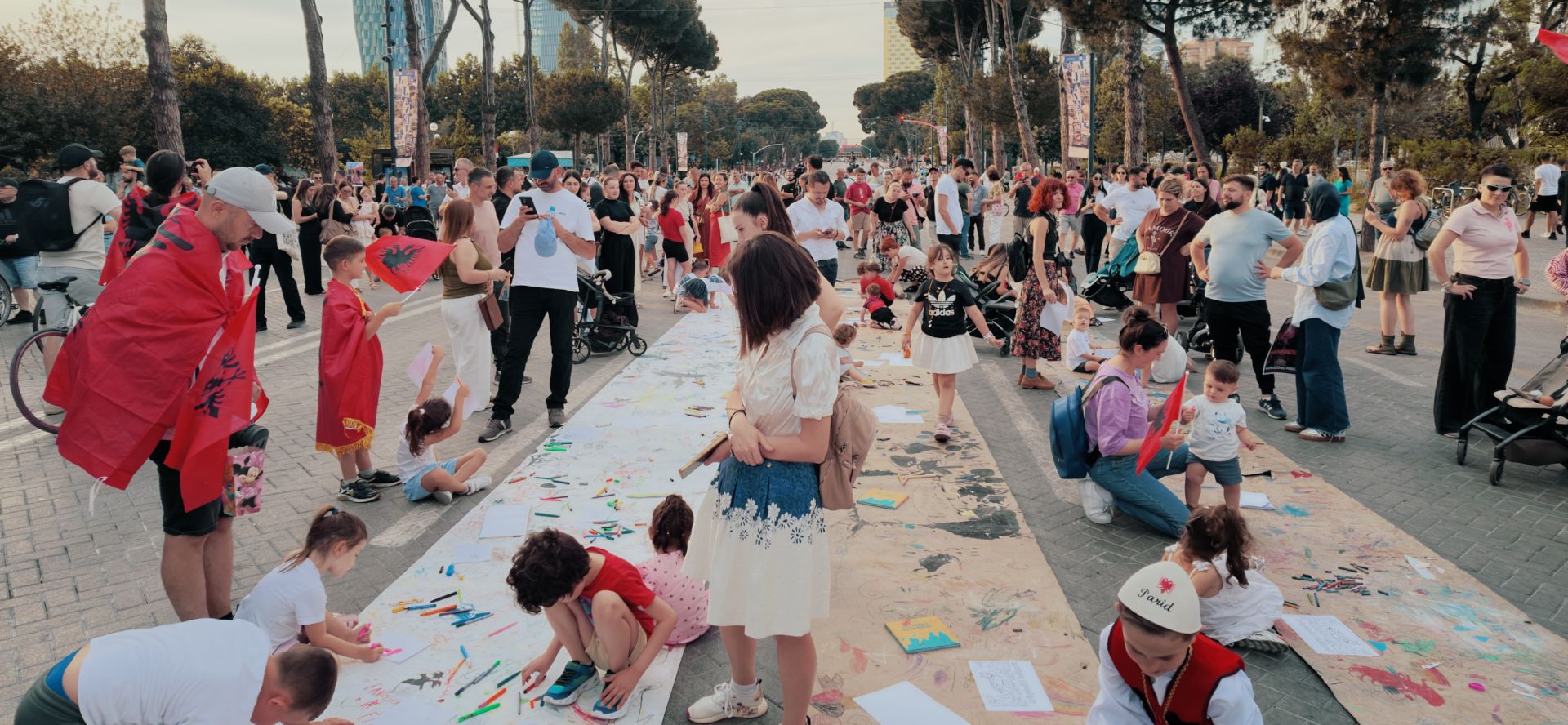
Perhaps it is this sense of disappointment that explains the extraordinary breadth of the movement gathering each evening outside the Albanian government’s headquarters. The crowds are overwhelmingly young, but they also include families with children, teachers, factory workers, physicians and business owners. The mix is strikingly diverse. Many of those taking part are not particularly political. For some, it is the first demonstration they have ever attended. They come from every corner of the country carrying signs that read “Albania Is Not for Sale” and “Rama Ciao.” They chant slogans such as “Down With the Oligarchy” and “New Albania.”
Elsewhere, scenes like these might be taken for granted as part of ordinary democratic life. In Albania, however, they carry a very different weight.
Albanians born before the 1980s remember all too well the totalitarian system of Enver Hoxha, who ruled the country for 46 long years, from 1944 to 1990, at the helm of one of Europe’s most repressive communist dictatorships. His regime condemned Albania to near-total isolation. Generations grew up amid fear, division and relentless indoctrination, terrified of being sent to labor camps or denounced to the secret police, the infamous Sigurimi, by a neighbor who might overhear a critical remark about “Uncle Enver,” as the dictator liked to be called, during a family dinner.
Everything was controlled by the regime. Hoxha cultivated one of the most pervasive personality cults of the 20th century. A staunch orthodox Stalinist, he was portrayed by state propaganda as the “Father of the Nation.” School textbooks were rewritten to present him as the sole founder of Albanian communism and the singular architect of the country’s liberation from Nazi and Fascist occupation, erasing the contributions of other partisan leaders. He was celebrated as a universal genius whose judgment was considered infallible on every subject, from economics and agriculture to literature and military strategy. Alongside the giant statues and busts erected in public squares across the country, citizens were compelled to arrange enormous white stones on hillsides and mountain slopes to spell out words visible from miles away: “Enver,” or slogans expressing devotion to the leader. In 1967, Albania became the world’s first officially atheist state, banning all religious practice. The void left by religion was effectively filled by the dogma of the state, the party and Hoxha himself. Under such conditions, genuine civic engagement was virtually impossible.
When the communist dictatorship finally collapsed in February 1991, the transition to pluralist democracy proved slow and painful. Decades of authoritarian rule had profoundly damaged the country’s democratic culture, leaving behind weak institutions, fertile ground for corruption and successive waves of youth emigration. Perhaps most importantly, they reshaped the way many Albanians related to political power. Authority came to be seen less as wedded to public accountability and more as a straightforward expression of command.
The result was a kind of resigned acceptance of the country’s political trajectory, a belief that democratic dysfunction was simply inevitable. More often than not, the response was political apathy. That is one reason why street protests remain exceptionally rare in Albania. Over the past decade, only two or three demonstrations of significant size have taken place before the marches that erupted in recent weeks. What is happening now represents something entirely new, a form of collective mobilization whose scale and sense of community have no real precedent in the country’s recent history.
The people gathering each evening in Tirana are demanding structural change. They want a different Albania, one where their own emigration becomes a choice rather than a necessity. Within that broader vision, the immediate demands to repeal the amendments to the protected areas law and halt the Vjosa-Narta resort project have become a powerful symbol. They serve as a rallying point for a movement that increasingly represents a wider rejection of what many protesters see as the Albanian political establishment’s long-standing mismanagement of public affairs. For that reason, the chants, slogans and speeches are not only directed at Rama, the Socialist Party and the current government.
They also target the opposition Democratic Party and its most prominent figure, Sali Berisha, who served for more than a decade as prime minister. These are the leaders and parties that have dominated Albanian politics since 1991. Increasingly, they are being rejected by the crowds, whose defining chant has become: “Rama në burg, Berisha në burg” — “Rama in prison, Berisha in prison.”
“In all my years working to protect nature in Albania, I have never seen anything like this,” said Besjana Guri, founder of LUMI. “There are children playing. There are young Albanians, often described as apathetic, marching through the streets and shouting, ‘Get up from the cafe, come with us.’ For the first time, we feel that change might actually be possible,” she added, echoing a sentiment I encountered over and over among Albanians.
“This is about democracy,” Xheni Karaj, a leading figure in Albania’s LGBTQ+ rights movement, told New Lines over coffee near Pazari i Ri, Tirana’s historic market. “The wind is changing. People used to be afraid of losing their jobs or facing consequences if they joined a protest. Now there are so many of us. That changes everything.”
The protests have become of interest in Brussels. On June 15, European Commissioner for Enlargement Marta Kos expressed serious concerns about the luxury resort planned for the island of Sazan and the Vjosa-Narta lagoon, formally urging Albania to refrain from actions that could jeopardize its path toward European Union membership. Kos also revealed that she had sought and received assurances from the Albanian government that a rigorous environmental impact assessment would be carried out, a commitment that Rama has reiterated in several interviews with international media. In a separate report published on June 17, the European Parliament called on the Albanian government to immediately halt all new authorization procedures, construction permits and development projects within protected areas. The report also urged the repeal of the amendments to the Protected Areas Law adopted in 2024, describing these measures as essential conditions for the continuation of Albania’s accession process.
For many young Albanians, European integration remains a defining aspiration. According to a survey conducted by the Open Society Foundation, 86.2% consider Albania’s accession to the European Union to be very important.
Throughout the weeks of demonstrations, Rama has largely kept a low profile, limiting his public appearances while continuing to insist that the project will move forward and be completed responsibly. He has repeatedly emphasized what he describes as the project’s strategic importance for Albania while downplaying the significance of the protests. Speaking on June 17 on the sidelines of the German Eastern Business Association Annual Conference in Berlin, which he attended as a guest of honor, Rama attributed much of the unrest to the distortions of the digital age.
“Algorithms reward anger far more generously than truth,” he said. “Digital crowds can become more influential than democratic institutions, and entire realities can be constructed before facts have had time to emerge. Environmental catastrophe was presented as an established fact. Corruption was declared proven before any evidence existed. Conspiracy theories multiply by the hour. Claims become headlines. Headlines become truths. Truths become dogmas. And anyone asking for evidence is treated as a suspect.”
For now, regardless of Rama’s public statements and his continued insistence that the Kushner-Trump project is of critical importance to a former communist country seeking to enter the high-end tourism market, the fences surrounding the Vjosa Delta have already been removed. The heavy machinery that had begun work on the site, damaging more than half a mile of protected sand dunes in the process, has disappeared. The reversal is almost certainly the result of both the protests and the anti-corruption investigation launched by SPAK, which since late May has been examining the 2024 changes to the area’s protected status as well as questions surrounding land ownership within the Vjosa-Narta protected area.
The billionaire resort envisioned by the power couple has an origin story that now feels almost surreal. As Ivanka Trump recently recounted, the idea was born during the summer of 2024, when they were sailing along the Adriatic coast and became so captivated by the landscape that they began imagining a luxury resort for multimillionaires.
What would have been difficult to imagine at the time was how the ambitious dream of two American billionaires would spark a peaceful uprising unprecedented in scale and ambition, and still spreading through Albania.
Become a member today to receive access to all our paywalled essays and the best of New Lines delivered to your inbox through our newsletters.