

Hosted by Faisal Al Yafai
Featuring Rashid Khalidi
Produced by Finbar Anderson
Listen to and follow The Lede
Apple Podcasts | Spotify | Podbean
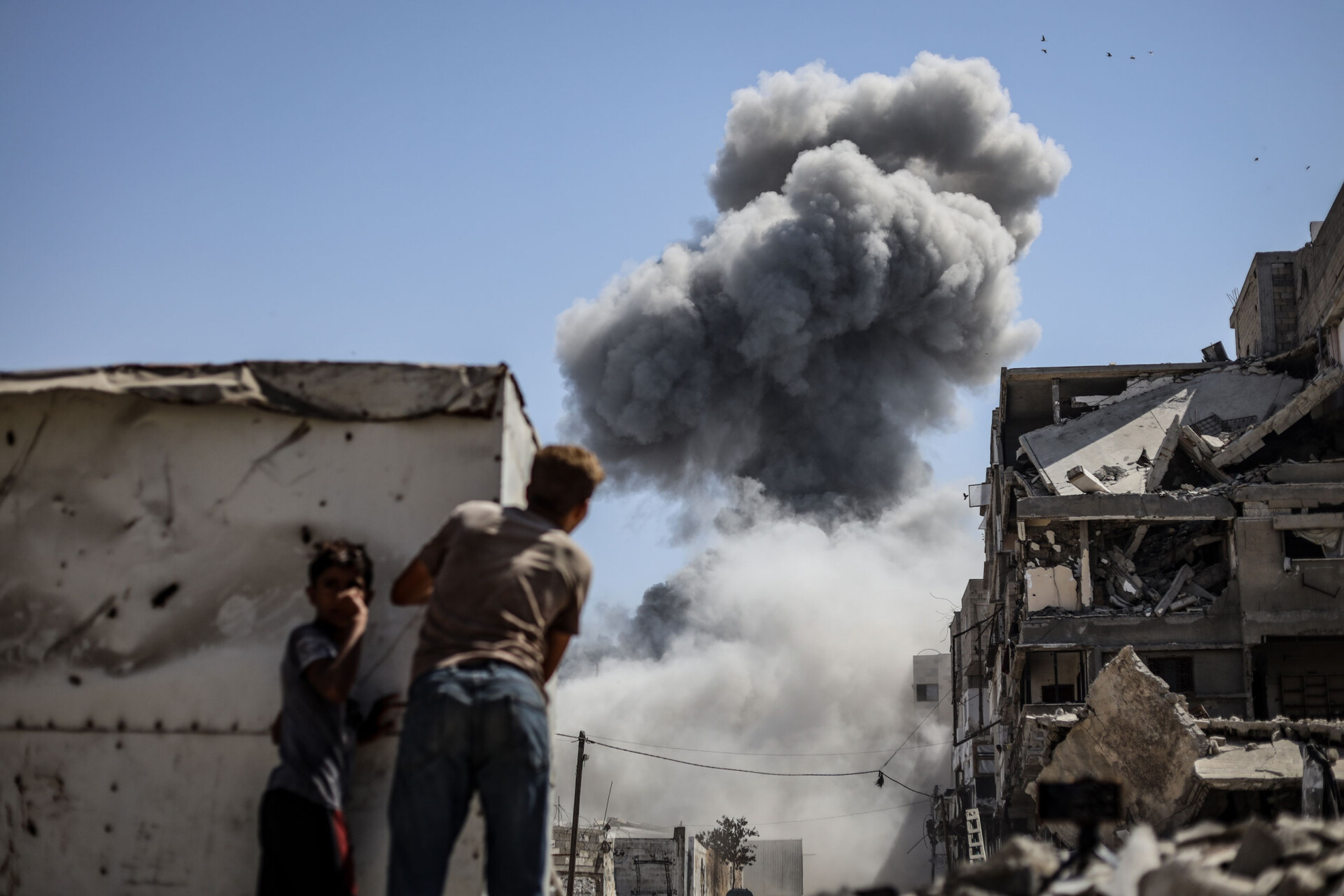
Rashid Khalidi, the Edward Said professor emeritus of modern Arab Studies at Columbia University, has been studying Palestine for five decades, over which time he has become one of the most respected scholars of the country worldwide. However, he concedes that in the two years since the Hamas attacks of Oct. 7, 2023 and the devastating subsequent Israeli war on Gaza, it has been hard to maintain an academic distance.
“It was hard to look at it as a historian because we have family [in Palestine],” he tells New Lines’ Faisal Al Yafai on The Lede. “It was very immediate and very personal to us and our family, and it was not possible to look at it with any measure of objectivity.”
“It’s one of the worst periods in Palestinian history.”

Almost 70,000 people inside Gaza have been reported killed during the current war and a recent U.N. report found that Israel had been committing genocide. While it is undoubtedly a terrible low point, Khalidi says that Palestinians have had little cause for optimism over the past two decades.
“It’s one of the worst periods in Palestinian history because it’s a period of strategic indecision and drift,” Khalidi says. “It’s a period of the collapse of the Palestine national movement, it’s a period of appallingly poor leadership, it’s a period of a lack of any vision of a future for Palestine on the part of Palestinian leaders.”
Khalidi notes that the current war bears many similarities to the violence that was enacted against Palestinians almost a century ago. “What Israel is doing now is a distillation of tendencies in Zionism and in Israeli practices, which go right back to the 1930s when the military forces that became, later on, the Israeli army were formed by the British,” he says.
But while he sees echoes of the past in today’s violence, he worries that the war today is also taking alarming new directions. “I would ascribe a certain degree of the violence and the extreme anguish of this genocide to technology. But I would also ascribe it to a progressive degradation of norms that were established after World War II to prevent some of these kinds of things,” he says.
Considering the past two years of war, Khalidi says, “They’re not just killing people in Gaza. They are destroying a legal fabric that would prevent atrocity, that would prevent war crimes, that would prevent genocide. The American government and the Israeli government, together with the complicity of European and Western governments are systematically destroying the structure of international humanitarian law that was erected after World War II.”
Khalidi is cautious in his assessment of a mooted ceasefire, and considers any true resolution of the conflict decades away. Indeed, he believes the situation is currently so far away from any kind of settlement that he shrugs off talk of a “one-state” or “two-state” solution as premature. “I think you have to start with principles,” he says. “Once you accept those principles — complete equality, of every form of equality — then you build a solution based on where you are at that stage.”