

“But there is this one guy.”
“Oh?”
“Yeah. … He’s the only reason I have right now to be hopeful about any of the horrifying stuff we’re talking about.”
“Who is it?”
“Well, he’s running for mayor, and the election is tomorrow. His chances are kind of slim, but he understands all of this, and he hasn’t been shy about it. Plus he’s around the same age as me, represents this neighborhood, I’m a member of his party, and he’s not afraid to say he’s Muslim.”
“And he has a chance?”
“Yeah. It’s slim, but it’s definitely possible.”
It was June 23. I was seated across the table from my mother-in-law. “Tant Afaf” had come to stay with us to help out with our just-born daughter, who haplessly lounged between us in her bassinet as we went back and forth about the state of the world. I broke into a rant about dehumanization and an unjust system that perpetuated it here and abroad. I had grown wholly disillusioned with politics but more principled in my commitment to social justice, which underpinned Zohran Mamdani’s affordability agenda. I exhaled and looked around the room sheepishly; I realized my voice had steadily risen, my skin had reddened and my sweat had beaded.
She scanned me with what felt like legitimate concern.
“Well, I hope he wins tomorrow.”
A little over 24 hours later, after checking poll results off and on throughout the night and eventually accepting there’d be no news before the morning, I stood in my underwear brushing my teeth. My phone, a victim of consistent neglect in those days of early fatherhood, sat on a shelf, gasping for life at 1% battery. It had been a long day. I popped my retainers in and climbed into bed.
“Well, why don’t I take a look just one more time?”
I ambled back into the bathroom. My phone was still on. I refreshed the New York Times results page.
He’d won.
I dashed back into our bedroom and gently shook my wife awake.
“He won.”
“What?”
“Zohran — he won!”
“WHAT.”
“Yes!”
A victory party was happening at the oft-frequented, longtime Astorian fixture, Bohemian Hall Beer Garden, which was due to close within the hour. I threw on the nearest milk-stained outfit, grabbed a Citi Bike and pedaled over as fast as I could.
In a daze, I wandered about the expanse of fellow Mamdani supporters, running into a few long-lost acquaintances, all of us residing somewhere on a scale of pure shock to utter rapture. I was sharing my unlikely attendance with one such acquaintance, explaining that I was fully in bed with my retainers in when …
I reached into my mouth.
“Oh my god, I’m still wearing them now!”
I held them out to her and her husband, whom I was meeting for the first time, nonplussed by the understandable physical space now growing between us.
Here I was, overnight, ready to give that ugly system that runs on dehumanization another chance all over again. I hadn’t felt this way since Barack Obama won the presidency in 2008.
But Mamdani has almost nothing in common with Obama.
I was 22 when Obama was elected president. A senior in college preparing to graduate, I had a firm grasp on neither my identity nor my political views. That being said, my parents raised me to understand what it meant to be Egyptian, Muslim and acutely aware of the injustice of the Israeli occupation and Western intervention in the Middle East. Some aspects of this identity and sense of justice lay dormant, while others were on full display. I clashed with classmates, teachers and professors about the way the “War on Terror” was waged and how it fanned the flames of militancy rather than defeating it. In high school, I joined fellow students to make black bracelets out of electrical tape in protest against the Iraq War. I proudly fasted the full length of the holy month of Ramadan. But I also did a lot of negotiating. I had spent the better part of the 2000s residing in primarily white cities, towns, schools and social groups. I never told my teammates on the track team that I had just visited the location of our meet a week prior, but in observance of Eid with my family, where, early in the morning before going to school, we performed our holiday prayers on the same rubber flooring that hosted our indoor 4×4 relay team. I tried to play along with terrorist jokes or laugh when friends referred to the aromatic scent of delicious food in our home as a “bad smell.”
So when a Black man with the middle name Hussein won the presidency after acknowledging the follies of the Iraq war and a bit more humanity toward Palestinians than his predecessors (which wasn’t much but still very appreciated), he might as well have been the second coming of Christ.
Obama made me feel seen, not just with respect to his foreign policy, but with his identity. As a 38-year-old, it almost seems silly to type this, but I felt energized by the way my identity and interest in social justice in the Arab world could play an integral role in the better America he imagined. Within a few months of graduating, I switched career paths into international relations in the Middle East. I explored my identity through living in Egypt on my own, studying its history and politics while getting closer to my extended family. Eventually, I nudged the remaining aspects of my identity out of the shadows. I found the confidence to hold friends accountable for racist jokes and the courage to post photos on social media that included female relatives who wore the hijab. Ten years ago, I changed the name I go by to better match its Arabic pronunciation. Meanwhile, my commitment to social justice became more principled and transcended the Israeli occupation and human rights in the Middle East to include issues like universal health care, trans rights and government regulation.
But when Obama’s presidency concluded, I felt let down. He did not bring the systemic change he promised at home or abroad. He was a cautious centrist with a progressive edge, and it was his identity rather than his politics that had ushered me through a door and onto a path I realized he was never on. A path that had taken me from “progressive only on Palestine” to “Democratic Socialist.” I now saw Obama and the Democratic establishment as a party that selectively applied social justice to politically feasible, marginalized identities without contextualizing them within a larger agenda of systemic change
By 2024, I was burned out. I had supported both of Bernie Sanders’ presidential campaigns and watched as the Democratic establishment came together to defeat him. In subsequent years, I watched those same Democrats continue to pair surface-level reforms with unprincipled identity-based rhetoric. Meanwhile, Republicans were busy trafficking in lies that stoked racism toward these same identities with hits like “the great replacement theory,” the idea that Democrats were turning everyone’s children trans, and their belief that teaching students about slavery was “critical race theory.” The result was a 2024 election where Democrats took the bait, tacking back to the center and leaving their already hollow gestures for dead. Both parties seemed completely comfortable with allowing Israel to continue its genocide and billionaires to continue privatizing their gains while socializing their losses. It all felt so hopeless.
But then came Zohran Mamdani.
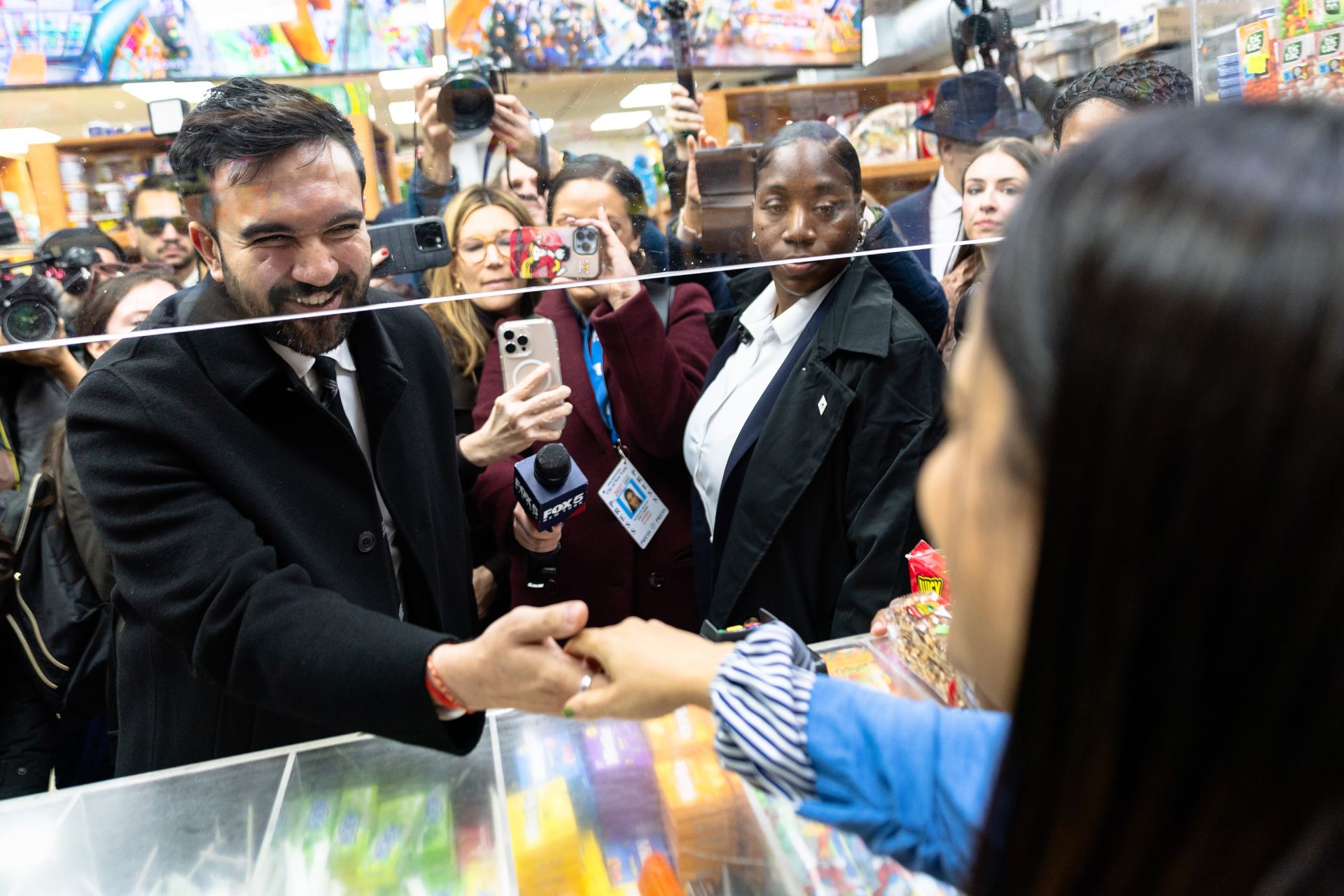
I first encountered Mamdani when I briefly served as a member of my community board, a hyperlocal board of volunteers appointed by a borough president to oversee, hear and sometimes approve decisions impacting their neighborhood. Elected officials sometimes attend meetings themselves or appoint staff members to speak on their behalf. But Mamdani, the state assemblymember for our board, was present at nearly every meeting. I was struck by his sincerity and availability. He had his finger on the pulse of minor issues, such as road maintenance and small business needs in the community, as well as major ones like the implementation of federal initiatives on the local level. He would often attend with staff members and ask them to step in to address a board member’s question. I eventually left the community board but kept up with Mamdani. I watched him propose a fare-free bus pilot and organize a local soccer tournament in Astoria to raise funds for Gaza. In 2021, he went on a 15-day hunger strike to secure $350 million in debt relief for New York City taxi drivers. The value of the drivers’ medallions — or permits to operate cabs — had plummeted, in part due to the rise of the rideshare industry, and they were on the hook for exorbitant amounts of debt, with some of those at risk of default committing suicide. Striding around the neighborhood in his kurta, eating with his hands, referencing his membership in the Democratic Socialists of America and fasting for Ramadan, he never watered down his identity.
Mamdani’s run for mayor seemed divinely calibrated to the conclusion of the journey I began in 2008. And yet, I was skeptical. Surely he was too young? Too bold? Too focused on the need for systemic change and the endemic nature of social injustice to the city’s multitude of livability challenges? A mayoral candidate with this agenda in New York City was going to be up against the merciless real estate industry, powerful high-income earners and long-dominant corporations. Then there were his identities. I had learned how to bring my full self out of the shadows, but I wasn’t running for office. Wouldn’t the Democratic establishment and Republicans alike prey on his marginalized labels?
But then I watched him knock on 1.5 million doors, half of what Beto O’Rourke did across the whole state of Texas when he ran for Senate in 2018. He walked 13 miles across the entirety of Manhattan. He continued his work as an assemblymember, missing very few days until his campaign ramped up in May. And then there was his agenda and platform. It was hyperfocused on affordability, which, when unraveled into specific policies, is a byproduct of social justice: freezing the rent, five city-run grocery stores, a Department of Community Health and Safety, 5% of the city budget for libraries, universal child care, raising corporate and high-income earner tax rates, etc.
I could not believe that this same platform and his appearances also took on highly politicized identity-based issues impacting marginalized New Yorkers and Americans more broadly. The kinds that establishment Democrats supposedly went too far with. There were plans to support LGBTQ+ New Yorkers, or “Trump proof” the city on his campaign page. Then there was the time he went to the State Assembly to bark questions in the face of visiting border tsar Tom Homan that highlighted his inhumane policies. But there is an authenticity that comes with knocking on 1.5 million doors, having near-perfect attendance and walking 13 miles that makes Mamdani’s commitment to social justice credible. Rather than divorcing identities from systemic change, he has made it clear that they stem from this same commitment. Identity isn’t such a lightning rod of an issue when paired with the substantive reform voters are so desperate for.
And yet, I still wasn’t sure. I prayed for his victory but remained at arm’s length from his campaign.
I wasn’t 22 anymore. I had tried mutual aid groups, canvassing for candidates, failed runs for office and career tracks to take action. A few years ago, I took a step back from these low-paying, labor-intensive obligations and started a job at a major cultural institution. I vowed never to canvas for anyone ever again, and I definitely did not want to attend any more community board meetings.
Instead, I focused on my values and donating to causes I was passionate about. I learned how to rely on my values to seek and turn down opportunities or even, in rare cases, end friendships. My wife and I began to discuss the idea of living in a country more aligned with these values. Why burn our resources and livelihood on struggle and frustration?
I was ready to live the rest of my life that way until Mamdani won the primary. In how many other countries could a candidate like that win this election? As I biked home from the beer garden that night, a gushing wave of enthusiasm broke loose in my mind. I wanted to get involved.
As his general election campaign moved forward, he continued to resist identity politics. In July, Mamdani offered a simple explanation of his strategy when he replied to threats of arrest, deportation and denaturalization from Donald Trump. He initially explained that Trump’s comments were because he could be the first immigrant, Muslim and South Asian mayor of New York City. But then he switched gears, clarifying that Trump’s comments were intended to distract from what he was fighting for: affordability and working people, people that Trump claimed to fight for before he betrayed them with a tax bill limiting their access to health care and food stamps. This was because it was easier for Trump to “fan the flames of division than to acknowledge” this betrayal. A different Democratic candidate might have wasted time playing into Trump’s trap and focused only on their identity and the intersectionality among other marginalized Americans, but Mamdani didn’t. He knows his identity, he’s not compromising it, but he’s also not using it as a substitute for the social justice New Yorkers need.
So yes. I love seeing Mamdani’s Instagram stories on Eid, his face popping out of a flower as a nasalized silky voice melodically purrs “Eid Mubarak” repeatedly with a “Vote Now” banner going across the screen. It speaks to that kid who couldn’t even tell his teammates he had just bowed his head in prayer on the same ground they were sprinting on. And I loved that legendary moment when he corrected Andrew Cuomo, a storied figure in the Democratic establishment, decades his senior, who is now running against him as an independent and coordinating with Trump after losing to him as a Democrat. “The name is Mamdani, M-a-m-d-a-n-i.” It spoke to all those moments us folks with unusual names spent in school, waiting for the teacher to get through the alphabet to the letter K, and preparing for just how we’d correct what we knew would be a brutal mispronunciation. And absolutely — that image of Mamdani, Egyptian-American comedian and actor Ramy Youssef, and recently detained Palestinian activist Mahmoud Khalil, their smiling faces reflecting the joy of a raucous crowd of fans and supporters at Youssef’s comedy show, sent tears of belonging down my face. All three of them, in their own ways, had endured their journeys, and so many were ready to accept them, to accept me, and the millions of other hyphenated Americans across the country who had done the same.
But you know what I love more?
That, in spite of pro-Israel groups’ attempts to smear Mamdani as an antisemite, he garnered so many Jewish votes in the primary. That he does not explain his tax policy with terms like “evil corporations” but rather the blatant injustice that someone making $50,000 a year has the same tax rate as someone making $50 million. He doesn’t get rattled when CNN’s Erin Burnett asks if his five city-run grocery stores could eventually be on “every corner” the way they were in the Soviet Union. He just tells her that it’s a pilot, so if it’s successful, it will scale up; if it’s not, it will be discontinued. Raising the corporate tax rate? It’s just enough to match what New Jersey’s doing. Arrest Netanyahu? Why wouldn’t he seek to use the legal means at his disposal to arrest someone wanted by the International Criminal Court?
In the last phase of campaigning, smears against Mamdani have reached an identity-focused, valueless, racist fever pitch. Of particular note were comments from Cuomo confirming his belief that Mamdani would celebrate another 9/11 — and the failure of Democratic leaders like Chuck Schumer or Kristin Gillibrand, who have yet to endorse their nominee, to condemn Cuomo’s language. In response to this, Mamdani issued a fiery rebuttal that focused on his identity as a Muslim, the way so many of us have had to live in the shadows and the need for us to finally step out of them, including him. His statement chilled me to my core, the words sending me into a few long-discarded memories of traumatic experiences with racism.
But he did not need to make it.
Mamdani has been out of the shadows since he first became my assemblymember. His focus on social justice and its authentic manifestation across affordability, dignity and the rights of marginalized humans both here and abroad, while never disavowing his identity, is precisely why, blinded by my euphoria, I forgot to take my retainers out before I frantically pedaled my way to the beer garden that night in June.
I know his words were valuable to many of our fellow Muslims, but I hope he knows that a lot of us are already out here with him, ready to move forward with his agenda at the conclusions of our own trials and tribulations, with identities best served by his honest commitment to social justice.
Mamdani’s impending win or loss this week is irrelevant to what his candidacy means to me. It’s not that he’s magically reversed everything I ranted to my mother-in-law about the day before the primary. It’s that even in this country’s darkest moments, there is always a chance that this American experiment in multiculturalism and democracy for all may not be doomed after all. Mamdani’s candidacy is a reminder of the role of social justice within this American experiment, not as a catchphrase conveniently attached to the identity of the day, and not as a harbinger of part two of the Red Scare, but rather as a set of values that yield a humane approach to the most basic aspects of everyday life — or in Mamdani’s words: a city we can afford.
Become a member today to receive access to all our paywalled essays and the best of New Lines delivered to your inbox through our newsletters.