


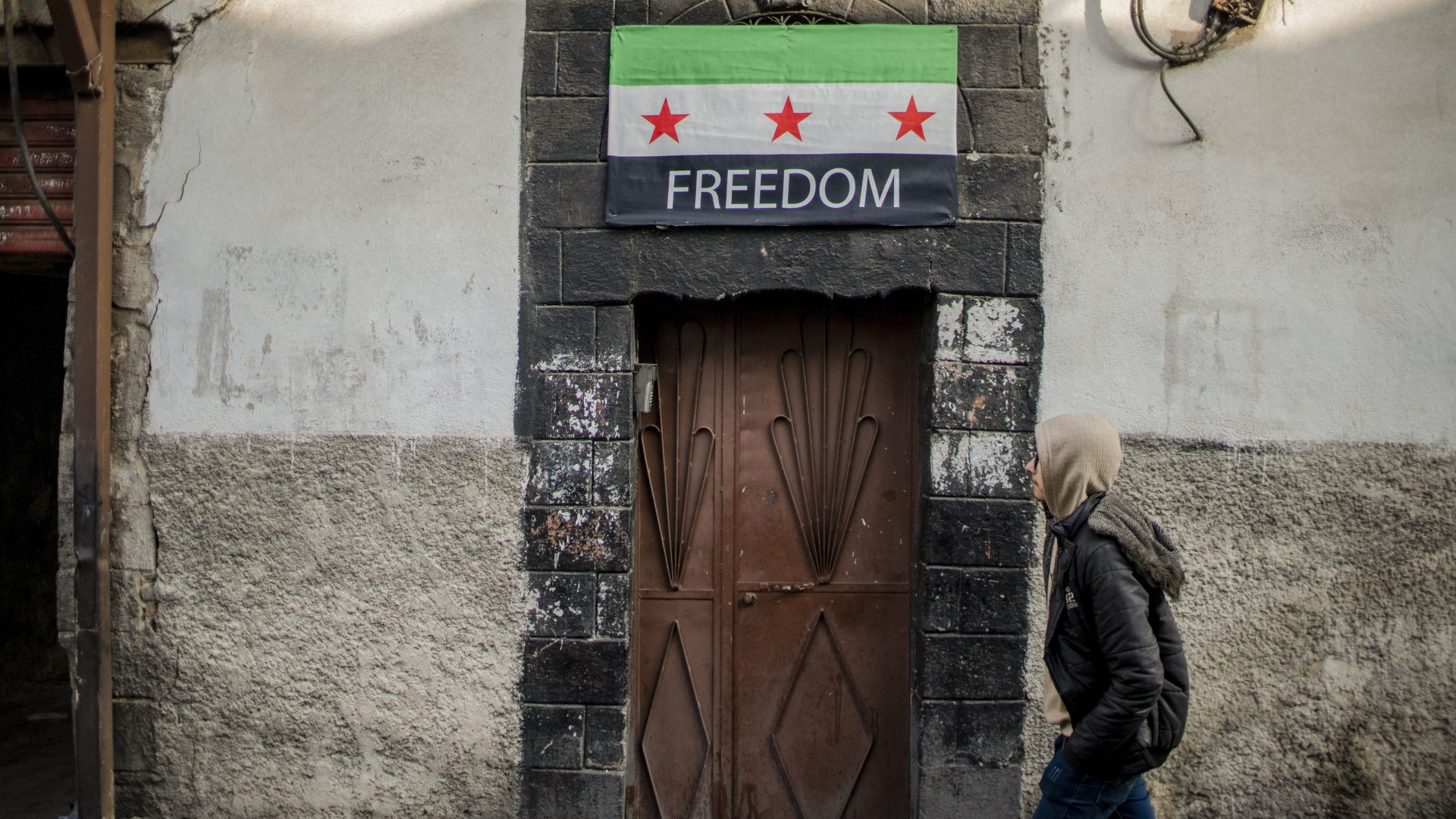
The Syrian regime collapsed on day 628 of the 903 days I spent in captivity. From my cell on a militia base in Iraq, I watched the news coverage for hours and wept with joy. For 14 years, since the first days of the 2011 Arab Spring, I had followed the Syrian uprising and ensuing civil war. Over the years, as I built a network of connections with Syrians, first online and then in person, my emotional connection to the place and its people deepened. I learned Arabic, gained expertise on the Levant and was in the process of conducting field research for my doctoral dissertation when members of Kataeb Hezbollah, an Iraqi militia group that is backed by Iran, abducted me from a street in Baghdad. There is little in my background to explain how I, an Israeli woman born in the Soviet Union, came to be in that place, nor why I felt such a deep emotional connection with Syrians and their struggle.
My first interactions with non-Palestinian Arabs began in late 2008, when I joined Twitter and began following pro-democracy activists across the Middle East, many of whom gradually became online friends. Over the next decade, my network of connections across the Middle East expanded and my interest in Syria deepened. Simultaneously, I became a human rights activist. A few years ago, I started working toward my doctorate in the politics department at Princeton University.
I followed the Arab Spring protests online from the time they broke out in Tunisia in late 2010. I spent hours watching avidly as throngs of brave men and women faced water cannons, batons, bullets and tanks to topple the corrupt, violent authoritarian regimes that ruled them. Given the brutal repression of the Assad regime, I remember asking my Syrian friends whether they thought the wave of uprisings, which had already spread to Egypt and Bahrain, would reach their country. They were skeptical. They cited the transgenerational trauma of the 1982 Hama massacre, when the Syrian army under Hafez al-Assad, the father of Bashar al-Assad, besieged the city of Hama for nearly one month, massacring thousands of regime opponents and disappearing thousands more.
I felt my own skepticism give way to hope on Feb. 17, 2011, as I watched a video, shared online by a friend from Damascus, of a protest that took place that day in the city’s al-Harika market. Police officers had beaten a shop owner; in response, a spontaneous large gathering of Damascenes began chanting, “the Syrian people will not be humiliated.” The people had broken through the barrier of fear. Protests erupted again on March 15, 2011, in Damascus and March 18 in the southwestern city of Daraa, gradually spreading to most parts of Syria.
I continued to follow the protests against regimes across the Middle East. They were successful in Tunisia and Egypt, but uprisings in other countries were violently crushed or simply lost momentum and fizzled out. Yet Syrians kept protesting, despite the increasingly brutal response of the Assad regime. At first, I followed only Syrians who knew English. But as the regime systematically targeted the liberal educated elite who led the protests, the people I was following closely and learning from were either killed or arrested, or fled the country. In 2014 I decided to learn Arabic, in order to follow events in Syria that were reported only in that language and to communicate with people inside the country who did not know English.
I began writing articles in Hebrew and English for Israeli media outlets and think tanks. I joined demonstrations in front of the Russian Embassy in Tel Aviv and other locations to protest Russia’s complicity in the atrocities of the Assad regime, and I organized fundraisers in Israel and among friends across the world for communities in need inside Syria. Over the years, my network of friends and contacts in Syria grew. Like the early protesters before them, several were killed or arrested by the Syrian regime. Several were also killed or kidnapped by rebel factions, the Islamic State group or the Syrian Democratic Forces.
Through my research, I sought to amplify the voices of Syrians whose views were rarely presented in media coverage or analysis, to shed light on dynamics that have gone largely overlooked. Producers of knowledge have an immense responsibility to avoid reproducing narratives put forward by the elites. Such narratives serve the interests of the powerful and not necessarily those of their subjects.
Civil wars appear from the outside as deeply divisive events, and they are, but I found that people can hold very ambiguous positions amid the bloodshed. I wrote about Syrians in rebel-held areas who lost faith in the rebels and about former rebel fighters who, despite their loathing for Turkey, became mercenaries for Turkish-backed forces battling against the Kurdish militias. I interviewed and wrote about Syrian Alawites, the ethnoreligious minority to which the Assad family also belongs, who felt trapped between the regime and the radicalized opposition groups fighting to topple it. I interviewed Syrians who showed obedience to the regime while cursing it in private for reducing them to grinding poverty and hunger.
On March 21, 2023, while conducting fieldwork in Iraq for my doctoral research, I was kidnapped from a street in Baghdad by a group of Kataeb Hezbollah militiamen. KH is a pro-Iranian faction that is nominally under the control of the Iraqi prime minister’s office, but in fact obeys decisions made by its own command structure, with significant influence from commanders in Iran’s Islamic Revolutionary Guard Corps.
For the first four and a half months of my captivity, I was held at a militia black site on the outskirts of Baghdad. Upon arriving at the facility, I was stripped and searched, which is when the kidnappers noticed the tattoos on my arms that indicated my support for the Syrian uprising. As an Iran-backed group, KH opposed the rebels and supported the Assad regime. I had both tattoos inked in Sadr City, Baghdad, in 2022. On my right arm there is a tattoo in the shape of Syria that also spells “freedom” in Arabic in the colors of the Syrian revolution flag, now the official Syrian flag. On the right shoulder there is an Arabic calligraphy tattoo designed by a Syrian friend that reads, “The revolution is a right, and rights do not die [are eternal].” This phrase was written on a banner raised in 2011 at one of the first protests at the al-Omari Mosque in Daraa City and often repeated by the activist Raed al-Fares, a friend who was killed in 2018. Raed’s friends and colleagues believe the killers were from Hayat Tahrir al-Sham (HTS), the rebel group that broke from al Qaeda in 2016, under the leadership of Ahmad al-Sharaa, then known by the nom de guerre Abu Mohammed al-Jolani, who is now the president of Syria (HTS denies responsibility for the assassination).
At first, the kidnappers did not know I had Israeli citizenship, since I entered Iraq on my Russian passport. The tattoos seemed to confirm their suspicion that I was a foreigner sent to Iraq to foment protests against the militia-backed political order in Iraq. The axis of Iranian-backed groups to which KH belongs believed that protests in Iran, Iraq, Lebanon and Syria were Western-backed conspiracies, rather than genuine popular revolts against corrupt, oppressive regimes.
Throughout my period of captivity in the first prison, the kidnappers pretended they were not a rogue militia, but representatives of the Iraqi state. They claimed to have access to the intelligence capabilities of the state, and insisted they had all the information to prove that I had supposedly committed espionage. Since they knew everything about me, they said, I should just confess. They claimed to have photos and recordings, yet failed to produce them when I asked to see or listen to them. During one of the interrogations, several of the masked men demonstrated intimate knowledge of the city of Aleppo. In 2016, Iran deployed thousands of Iraqi Shiite militia members to besiege the city and to ethnically cleanse its eastern sections and several of its suburbs. Iraqis who moonlight as pro-regime mercenaries in Syria can only be militia members.
A month into my captivity, the kidnappers managed to break into my phone, which is how they found evidence of my Israeli citizenship. They began torturing me to extract confessions. I tried to convince them to look me up online so that they would see the articles and social media posts I had written, which demonstrated my deeply critical positions on Israel’s policies, but they refused to do so. The torturers repeatedly hung me from the ceiling by my handcuffed wrists, a method known in Syria as “tashbih” and in Iraq as “taaliq,” and beat my knees with a stick. The immense pressure that hanging with my hands behind my back placed on my spine caused two disks in my back to herniate. My captors whipped my feet, a torture method known as “falaqa,” which also caused lasting damage. The pain in my back, knees and feet left me unable to sit or stand, so I spent most of my time in captivity lying down. In an effort to stop the torture, I began offering fake confessions, trying to guess what type of stories would fit the odd conspiracy theories these men believed in.
Gradually, the torture became worse, in part because I consistently avoided naming any Iraqi acquaintances whom they might decide were accomplices to the espionage conspiracies I was supposedly running across Iraq. Instead, I claimed I had carried out all the spying activity on my own. The torturers were unconvinced. Between the torture sessions, I would be left by myself for days in solitary confinement, underfed, haunted by the memories of the previous sessions and fearing the future ones. I tried to keep my mind busy by coming up with new crazy conspiracies they would find believable, and thinking about my academic research. But over time, escaping and thinking about research became increasingly difficult.
I was confident the torturers would not beat me to death. They had kidnapped me for a ransom and wouldn’t risk losing it. I was confident that this ordeal would end one day, but as time went on and their methods of torture became more brutal, I felt I might lose my mind. I was emotionally numb. I felt I would never be happy again, that the memories of the torture would remain lodged in my mind. I felt that such a life, without the ability to think clearly and be happy again, was not worth living.
In those dark moments, two Syrian friends came to my rescue. Both had been imprisoned by the Assad regime and had survived torture that was much worse than what I was undergoing. Now free, they are loving husbands and friends. Both are also brilliant researchers. I remembered their love for me and felt it in that cell, as I lay on a pile of blankets, staring at a wall covered in splatters of blood from previous prisoners. I knew that if my friends were able to overcome months of torture that often kills the victim, and still return to feeling and loving, to pick up their lives again and go on to become fantastic researchers, then so could I. My friends’ example of resilience helped me endure and not break. Just when I felt that I could not take the torture anymore, that I would start giving names of innocent Iraqis to stop the pain, I was moved to the second prison and the torture stopped.
I learned only after my release that one of the friends I thought of so often as a means of surviving those months of torture, Muhammad Hassan, lost his job with Al-Modon, a Qatari-funded newspaper, because he openly posted a loving, supportive comment on his X account after the news of my kidnapping became public.
In the second facility, a KH base along the border with Iran, the senior commander ordered that I be treated well. I was given books, medical care and plenty of food. At the end of 2023, they gave me a TV with Arabic-language channels, including Syria TV, a pro-opposition news channel. That is how I learned about the outbreak of protests in Idlib against HTS, and the daily protests in Sweida, which was nominally under the Assad regime’s control.
I was surprised that the rebels decided to launch an offensive on Aleppo in November 2024. I feared for the fate of the civilians in Idlib, whom the regime and Russia would target every time the rebels launched an offensive on regime military positions. When the Iranian-commanded Shiite militias fled the front lines en masse, I understood the regime would finally fall. The Syrian army was weak and could not hold out on its own without the support of Iran and Russia.
As the rebels began to advance toward Damascus, I was glued to the TV in my cell, watching in tears as Syrians celebrated in the streets of Hama and Homs, returning home after years of displacement. I felt immense joy at seeing the release of prisoners, emaciated yet elated at having lived to see freedom from the regime’s notorious prisons.
On the night of Dec. 7-8, I stayed awake in my cell, knowing that the liberation of Damascus was imminent. I wanted to witness history in the making. Suddenly, a breaking news bulletin came on the screen of Syria TV stating that opposition fighters were approaching Sednaya Prison, the place that Amnesty International called a “human slaughterhouse,” where tens of thousands of prisoners were tortured to death or executed. Despite the lasting pain from those months of torture, I was so excited that I could not remain in a prone position. I stood up from the mattress and remained standing, shaking and crying for hours with pure joy at seeing the prisoners released from Sednaya and ordinary Syrians out on the streets to celebrate the fall of the murderous dictator. Only when my adrenaline dropped did I realize I had been standing for hours, but had felt no pain.
The day after Damascus was liberated, Mazen al-Hamadeh’s body was found in a morgue; the marks on his corpse spoke to severe torture. Mazen was also a personal friend. We met in the U.S., when he came to speak to audiences after the screenings of the documentary “Syria’s Disappeared,” in which he features prominently, describing the torture he survived in Sednaya Prison. He and I stayed in touch until February 2020, when he unexpectedly decided to leave the Netherlands, where he had sought asylum, and return to Damascus. There, he was arrested and once more imprisoned in Sednaya. Mazen survived almost four years of indescribable horrors, only to be killed by the regime as the rebels neared Damascus.
For weeks after Damascus was liberated, though I was still a captive in Iraq, I felt the exultation of Syrians who spontaneously came out all over their country to express their joy, to speak openly to media outlets now allowed to report without restrictions, and to return home after years of internal displacement. Despite my own circumstances, I felt blessed to have lived to bear witness to such joyful days of history being made.
The euphoria dissipated gradually. I have researched HTS for years, documenting their shift away from jihadism and Salafism owing to the extreme pragmatism of the group’s leader, al-Sharaa, and his close circle of advisers. But there was one element that remained constant throughout those years of emerging pragmatism, and that was HTS’ unwavering authoritarianism. This approach became evident with the March 2025 Constitutional Declaration, which concentrated immense power in the hands of the president, al-Sharaa, and failed to institute a separation of powers. The constitutional declaration followed the March 2025 coastal massacres, when government forces carried out a series of deadly attacks on Alawite civilians, and preceded the July Sweida massacres, when government forces and Bedouin militias massacred Druze citizens.
I was deeply disturbed but not surprised when, in March, the al-Sharaa government’s security forces massacred hundreds of Alawite civilians.
Syrian victims of the Assad regime mistakenly believed that, because the ousted dictator was an Alawite, the entire Alawite sect was complicit in and supportive of the regime’s crimes. Those massacres committed in March by government forces were in reaction to a large-scale, organized attack by supporters of the ousted regime. That attack triggered a sense of existential danger within the Syrian leadership and the Sunni population that supported the new government led by al-Sharaa.
But the massacres committed in Sweida against the Druze were a different matter. The Druze were not supporters of the ousted Assad regime. They had participated in the protests against the Assad regime, and Druze men had avoided compulsory service in the regime’s army, while the governorate hosted hundreds of thousands of displaced Sunnis from neighboring Daraa when they fled regime bombardment during the civil war. After the fall of the regime, Sweida joined in the celebrations that unified nearly all Syrians. Now this unity is being undone.
The invasion of Sweida, with thousands of troops accompanied by tanks, was a premeditated decision on the part of the government in Damascus. By contrast, the massacre on the coast was a government response to a well-planned attack committed by insurgents still loyal to the deposed Assad regime. The al-Sharaa government’s decision to invade Sweida is a manifestation of the HTS leadership’s tendency to solve political disputes with violence. The circumstances leading up to the invasion were unsuccessful negotiations between Damascus and Sheikh Hikmat al-Hijri, the religious leader of the Druze sect in Syria. Al-Hijri, as well as Sweida civil society, demanded real power-sharing with Damascus. The Druze wanted the right to appoint a governor of Sweida, and they wanted changes to the authoritarian constitutional declaration. The government in Damascus was willing to allow Druze to ensure their own security through the integration of Druze factions into the General Security Service, but would not accept any genuine power-sharing or amendments to the constitutional declaration.
Worse yet, after Israeli airstrikes forced the Syrian army to withdraw from Sweida and halt their rampaging, Damascus still did not abandon the use of force as the solution to the crisis. Instead, it turned to inciting armed Sunni tribes to head to Sweida to subdue the Druze, demonizing the Druze as traitors and agents of Israel for welcoming the Israeli intervention that halted the massacre.
The Syrian government’s invasion of Sweida was a heartbreaking event. I witnessed on the television in my cell not just the horrors of the slaughter, but also the deep fissures it created between Syrians who, just months prior, were sharing in the joy of liberation. I saw the Israeli government bomb the center of Damascus, seeking to destabilize the newly formed Syrian government, which is still the only alternative to chaos and a wide-scale sectarian war in the country.
Still, Dec. 8, 2024, the day of Syria’s liberation, remains the happiest day of my life, happier than the day of my own liberation on Sept. 9, 2025. On the day of my release from captivity, I was mostly preoccupied with the realization that I had left behind in my cell the notebook containing my research notes, painstakingly developed over my 903 days in captivity.
The new Syrian government responds to public pressure and cares about public opinion, unlike the Assad regime. The current authorities also draw their legitimacy from the 2011 revolution, which called for freedom and an end to a corrupt and unaccountable regime, so they will be more careful about resorting to widespread repression, the hallmark of Assad rule. Whatever comes next for Syria will be better than the horrors of the Assad era. Syrians now have the opportunity to shape their own future.
The article is dedicated to the memory of my friends Muhammad al-Qassem, killed in al-Ghadfa, Idlib, Sept. 11, 2014; Raed al-Fares, killed on Nov. 23, 2018, in Kafranbel, Idlib; and Mazen al-Hamadeh, who was killed in Sednaya Prison and almost lived to see Syria liberated. May the Syria that rises from the ashes be worth their sacrifice.
Become a member today to receive access to all our paywalled essays and the best of New Lines delivered to your inbox through our newsletters.