

Baba had a bad heart valve. It needed to be replaced.
The day of my father’s operation, my brother and I checked him into the hospital in Herzliya, just north of Tel Aviv, where we were greeted by a string of clerks, doctors and nurses who seemed to represent the gamut of Israeli society. A middle-aged woman with a Slavic accent directed us to the appropriate floor. The attending physician was an Ashkenazi professor in scrubs, all smiles. “What a nice family,” he said, before moving on to the next patient. He was followed by a Palestinian Muslim nurse wearing a colorful hijab in a floral pattern, who took my dad’s blood pressure. We recognized her accent — from Qalansawe, an Arab town in the Triangle region, a cluster of Palestinian villages adjacent to the Green Line that divides Israel from the West Bank, which is where we’re originally from. She was followed by a religious Jewish nurse — a settler, judging by the elaborate style of her tichel, or headscarf. “Valve replacement surgeries have become routine,” she said. “Your dad’s in good hands.” Everyone was kind, warm and well-mannered.
The religious Jewish nurse was followed by a young religious Jewish man who took blood samples. He was dressed in a style associated with West Bank religious settlers: sandals, a short-sleeved button-up shirt, a small crocheted yarmulke and a scruffy beard. Finally, a Jewish physiotherapist, who could have been the professor’s son — white, clean-shaven, young and secular — arrived to go over postoperative breathing exercises with my dad.
I wondered: Had the Jewish men served in Gaza?
I am a Palestinian citizen of Israel. I left the country alone as a teenager, in 2008, to study at an international boarding school and ended up in Canada, where I completed my doctorate, and where I still live today. I visited Israel frequently and maintained personal and professional connections for many years, but the number of trips dwindled through the COVID-19 pandemic and stopped completely on Oct. 7, 2023. My trip to Jaffa this past summer, to be with my dad while he recovered from heart surgery, was the first since the Hamas-led massacre that triggered Israel’s two-year genocide in Gaza.
I anticipated certain changes. I knew Israeli society had slid further to the right — an ongoing process, which started long before Oct. 7. I was braced for that. But the subtle, counterintuitive ways in which Israelis and Palestinians have changed, the ways they have adapted to life in the shadow of genocide, surprised me.
My family members are among the descendants of Mandatory Palestine’s Arab residents who ended up within Israel’s boundaries after the 1948 war, or Nakba. Palestinian citizens make up about 20% of Israel’s population; the remainder is almost entirely Jewish. While we face serious societal challenges and structural disadvantages as second-class citizens in a Jewish state, we are near the top within the rights hierarchy that makes up Israeli apartheid; we are one step below Israel’s Jewish citizens, but have more rights than other Palestinian populations under Israeli rule, in East Jerusalem, the West Bank and Gaza.
I was born in 1991, in Tayibe, a Palestinian town in the Triangle area, which falls inside Israel’s 1948 demarcation lines. In 1995, after the Oslo Accords were signed, my parents moved to Jaffa, full of hope for the promise of coexistence. Jaffa, which is officially part of Tel Aviv, offered better jobs for them and better schools for their children. They managed to enroll my siblings and me in an elite, secular, Jewish school — no small feat, given that Israel’s education system is segregated. But they made it happen, partly through connections. Catering to Tel Aviv’s bohemian upper-middle classes, the school emphasized secular, cosmopolitan and environmentally conscious values. Still, as in other secular Israeli schools, Zionism was omnipresent. We were taught patriotic songs about the biblical Land of Israel. We learned about the brave Zionist pioneers, who drained the swamps, fought Arabs and dysentery and built the Jewish state. We attended annual Remembrance Day ceremonies, commemorating the Israeli soldiers who had fallen in the country’s many wars. We were asked which Israeli army units we wanted to serve in when we were older.
We were told that the Zionist pioneers had arrived in an empty land. Yet here I was, living proof it had not been empty. We were not taught about the systematic ethnic cleansing of Palestine in 1948. We were not told that the remaining Palestinian population, including my grandparents, was subjected to harsh military rule for 18 years, between 1948 and 1966. We were not taught about the Kafr Qasim massacre of 1956, in which the border police killed 49 Palestinian citizens who were residents of the Triangle area — 19 men, six women and 23 children — in an attempt to trigger a second Nakba. I absorbed and internalized these facts through family.
I was one of just a few Palestinian children who attended the school, and the only one in my age group. I gravitated toward like-minded kids from an early age — the ones with liberal parents, who, when conscription time came, either refused or found ways to dodge military service. I developed thick skin. My parents tried to instill a sense of Palestinian identity within us. They arranged for my siblings and me to take private Arabic lessons. We listened to Abdel Halim Hafez, Fairuz and Sabah Fakhri on road trips. We attended anti-government protests with my dad during the Second Intifada, in the early 2000s. And while my parents’ efforts to undo much of what we learned in school bore fruit, there was only so much they could do to stop us from assimilating into Israeli Jewish culture. My schoolmates and my closest friends were all Jewish Israelis. I learned, lived and dreamed in Hebrew.
I was nervous about visiting Israel during the military assault on Gaza, at this time of heightened nationalism. I’d heard about Palestinian citizens getting arrested for expressing sympathy with Gaza on social media or for a “like” in response to someone else’s post, and had seen videos of police brutality against Palestinian citizens protesting the war. I had spent the last two years thinking and writing about Gaza while protesting the genocide from afar, growing more and more alienated from the country that issued my passport. I was worried I’d be taken aside for questioning at the airport, over a post on social media or an article I had published.
To my surprise and relief, passing through border control and customs was a smooth process; it had been recently automated for Israeli citizens, who had only to scan their passports at a turnstile before entering the arrivals hall. Foreign nationals still have to line up and speak to an immigration officer. Outside, my mother was waiting for me in her car.
The oppressive, humid summer heat hit me as soon as the sliding doors of the terminal opened. The air was thick and smoggy, full of dust and salt, the atmosphere yellow and hazy. As I searched for my mother, I noticed that car door handles were decorated with small yellow ribbons, to indicate support for the return of the hostages. I then noticed stickers — hundreds of them, on benches, utility boxes and doorways — commemorating soldiers who had been killed on, and since, Oct. 7. They included their names, pictures and, usually, an inspirational quote.
I found my mom, and we headed to my parents’ place in Jaffa.
The Tel Aviv metropolitan area had grown unimaginably dense since I left, 17 years ago. The perspective engendered by my long absences between visits made the gradual changes, invisible to family and friends, easy for me to spot. The traffic had always been slow-moving, but now it was truly unbearable. There were new bike lanes and the new light-rail system had replaced Jaffa’s once dank commercial thoroughfare. The city now felt manicured, modern and well funded, but it was much busier, too, with far more people crowding its sidewalks and the newly pedestrianized road, making it difficult to navigate. There was an unending stream of people, buses, cars, e-bikes, smells and sounds. The once quiet, small city had become a crowded, cacophonous, densely populated metropolis.
The accelerating gentrification of Jaffa was immediately noticeable. Before 1948 it was a Palestinian metropolitan center with a rich cultural life, but the city had been almost completely depopulated during the Nakba. The newly established Israeli army pushed the remaining Palestinian population into a ghetto in Ajami, a neighborhood in the southern part of Jaffa, while the government housed freshly arrived Jewish immigrants in abandoned Palestinian houses. Tel Aviv absorbed Jaffa (Yafo in Hebrew); officially, the city is called Tel Aviv-Yafo. But while the now-twinned cities were no longer separate, they were certainly treated unequally. During the decades that followed 1948, the Tel Aviv municipal authorities neglected Jaffa. Piles of rubble from the war were left uncleared, while municipal services like garbage collection and street cleaning were provided only intermittently. But 20 years ago, the property developers “discovered” Jaffa, with its beautiful old homes and beachfront properties. They restored Arab homes in select, historic neighborhoods, with great attention to detail, under strict municipal guidelines. Many of the original Palestinian owners of these homes fled to Gaza in 1948. Some may have visited decades ago, between 1967 and the First Intifada, which broke out in 1987. During those two decades, Palestinians in the occupied territories had relative freedom of movement. They could visit Israel, but none of them, neither the homes’ original owners, nor their descendants facing genocide today, were ever allowed to return permanently.
The day I landed, I went for a stroll in my parents’ now upscale neighborhood, in northern Jaffa, near the old flea market. On my last visit prior to Oct. 7, I had already noticed a growing uneasiness, a new kind of tension, in Jaffa’s streets. The memory of the intercommunal riots of May 2021, when a mob of far-right Jewish Israelis attacked and beat to death a Palestinian man in Jaffa, was still fresh. And yet, despite the trauma and the fears, life went on. When I visited in August 2021, soon after the COVID-19 lockdown was lifted, the flea market was lively as ever, its bars and cafes overflowing with patrons.
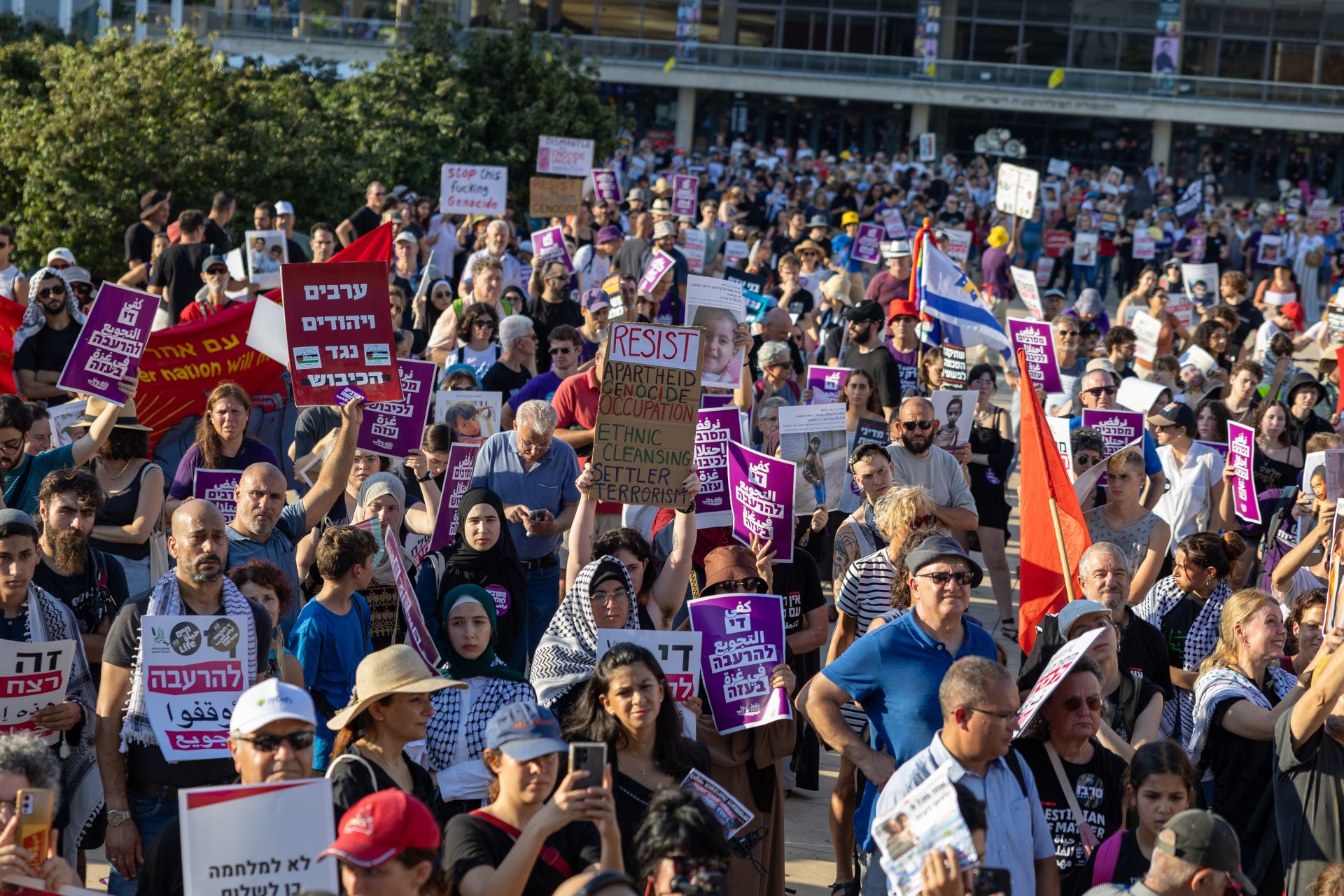
Not this time. I landed on a Friday afternoon and expected to find the neighborhood crowded with weekend visitors, as I remembered it. But now, in July 2025, it was eerily quiet. The war was ongoing and thousands demonstrated weekly in Tel Aviv for a ceasefire that felt elusive at best, though thousands more believed that the war must continue until “total victory,” as Prime Minister Benjamin Netanyahu obliquely described his goal. The same stickers that I had seen outside the airport arrivals hall were pasted on the facades of closed shops. There were still 20 surviving hostages in Gaza; signs calling for their release hung from unkempt balconies. On a lamppost, I saw a sticker calling for an end to the genocide in Gaza; it was the only one I saw on that trip. Secular Jewish hipsters who lived in the neighborhood were running their weekend errands, which was a familiar sight. There were also some religious-nationalist settlers from the West Bank, guns slung over their shoulders, who had settled in Jaffa, on a mission to expand their presence in Palestine’s historic Arab cities. That was new.
Most of the familiar bars had closed, but some had been replaced by new establishments. There was a new hummus restaurant, owned and run by a settler. And a new shawarma store, also owned and run by a settler. Many familiar establishments, perhaps most, were shuttered. The flea market stood empty and silent. It’s been this way since the war started, my parents told me. Jewish Israelis are scared of the “mixed” city, which is still home to tens of thousands of Palestinian citizens of Israel. This highly gentrified part of Jaffa was now heavily populated by Jewish Israelis, but the weekend “hummus tourists,” people from nearby all-Jewish towns who used to visit on Friday and Saturday to shop and eat, were notably absent.
Baba said the nurses were at first confused by my brother and me, because we spoke Hebrew between ourselves, without an accent.
Israel is a deeply segregated country. The exclusion of Palestinians from Jewish spaces goes back to Zionism’s early days and is still enforced today, in a variety of legal, institutional and cultural ways. Most obviously, Palestinians and Jews live in different cities and towns, while in the few shared cities, they live in separate neighborhoods. This is the outcome of decades of official segregation, whereby land and property were confiscated from Palestinian citizens, and their towns and cities were prevented from expanding. It is also the result of semiofficial practices and cultural norms; these are a local version of the redlining and racist attitudes that historically prevented Black citizens of the U.S. from buying in majority-white neighborhoods, which in Israel keep Arabs out of Jewish spaces. There are, however, some points of interface — spaces through which Palestinians and Jews are funneled, in spite of the state’s segregationist policies. These include institutions like the court system, academia and the health care system.
When I visited my father in the recovery room on Saturday, a couple of days after his surgery, I was surprised to discover that Arabs had taken over the hospital. Israeli law imposes fines on employers that require Jews to work on the Sabbath. To avoid paying the fines, employers, like the management of this private hospital, assign Palestinian nurses, cleaners and even security guards to replace Jewish staff on the Sabbath and holy days. These shifts come with extra pay, which is a welcome incentive for people who come from an economically deprived section of the population. The all-Palestinian staff, speaking Arabic between themselves, were running the place without any visible signs of fear. Jewish patients were suddenly, visibly, a minority in the hospital’s common spaces.
I shouldn’t have been surprised. Palestinians are overrepresented in the medical field. Oct. 7 changed many things, but not the need to make a living, avoid a fine, or seek medical care when sick. Did I expect the hospital’s Arab staff and patients to hide their identities? To speak Hebrew between themselves, as my brother and I did? That would have been silly. Still, the audible presence of Arabic, and the assertive presence of Arabs, in spite of the racist incitement spewed at them from the television in the waiting room (a guest on a news program was saying: “We must level Gaza City until they learn their lesson. … There are no innocents in Gaza”), took me by surprise.
At the hospital, people seemed polite and decent to one another. In general, ordinary Israelis, Jews and Arabs, seemed much more patient than I remembered in their ordinary interactions, much more than their stereotype would suggest. Between Jews, there was widespread solidarity. Everywhere I looked on the streets, there were banners that blared: “Together, we shall win!”
I suspected this newfound politeness only ran so deep, masking deeper anxieties.
The war has put some distance between me and my Jewish Israeli friends, but not because anything specific was said. There was just a general sense of anxiety and unease, perhaps a mutual suspicion. Some of my close friends never served in the army (a couple refused and were almost thrown in jail; most obtained a doctor’s note diagnosing a physical or psychological condition that made them unfit to serve, which got them an honorable discharge), but others did. Few of my casual high school friendships survived my friends’ military enlistment, but some closer childhood friends stayed in my life, despite their military service. Moral and ideological differences strained these relationships, with distance growing around periods of heightened tension like military operations in Gaza and the May 2021 Arab-Jewish riots. Still, I cherished my remaining friendships, filtered, as they were, by these periods of moral dissonance and ideological difference.
I had tried to stay in touch with all of my Jewish Israeli friends throughout the Gaza war, through disagreements and tough conversations, but contact still trended downward. Perhaps age had something to do with the distance, too; now in our mid-30s, we were all beginning to settle down, get married and have children. I saw my homecoming as an opportunity to reconnect.
Though some of my old friends are anti-Zionist Jews who became refuseniks, or conscientious objectors to military service, most — both the draft dodgers and those who enlisted — are on the liberal Zionist spectrum. Like many in Tel Aviv, they are cosmopolitan, bohemian and, mostly, Ashkenazi. They vote for Meretz, the left-Zionist party that failed to win enough votes to gain a seat in parliament during the last election. They cherish their liberal values, but they cannot imagine Israel as anything but a Jewish state. Most of them lead comfortable, upper-middle-class lives, working in the tech industry at multinational companies like Facebook, Google and Microsoft.
Growing up, we talked politics frequently. We argued and sometimes demonstrated together. We lived through the Second Intifada and Israel’s rightward turn, and we dreamed of emigrating together to better, more liberal places. But most of them stayed in Israel, firmly rooted in their society. I was, and still am, surprised that the war did not spur them to leave, particularly given that many other Israelis have made the move. Why had they not? Why raise your kids under the threat of war? Why bring them up in a country committing — and a society where so many applaud — genocide?
Several beers into our first hangout, I asked how they’re coping with all of this; how it feels to be living there. I meant living in the shadow of genocide, alongside its perpetrators. But they assumed I was asking about the 12-day Israel-Iran confrontation in June, which ended less than a month before my arrival. It had been terrifying, they said. They were glad it had not lasted any longer than it did. “What a crazy country, where war is normalized, and people go on with their lives, as if nothing ever happened,” said my friends. They debated whether Iran still posed a military threat. “I wouldn’t rent an apartment without a reinforced room,” one friend said (since the early 1990s, newly built Israeli apartments must by law include one reinforced room, usually designated as a bedroom or office, which is a de facto bomb shelter).
I clarified that I had been referring to the war in Gaza, which was then still ongoing, and the table turned silent for a few minutes. I stared at them as they twirled their glasses. When the conversation resumed, two of my more leftist friends came out with some very harsh words about the government, the war and Israeli society more broadly. Others focused on the hostages. They felt betrayed. The hostages were the main issue for them; 20 were then known to be still alive and in Gaza. “The state is breaking the social contract by failing to return them,” they said. All lamented this right-wing government; if only we could replace it, they said, as though Netanyahu and his coalition were the single, root cause of Israel’s problems. They had all considered emigrating, they said. “But it’s tough, you know,” they added. “It’s scary.” My friends have the means to emigrate. They are rich, and some have foreign passports. But what, they said, would they do without their families? Their support networks? One of them, referring to the prime minister by his nickname, proclaimed, without a hint of irony: “If Bibi is elected one more time, I’m out of here!” Netanyahu is Israel’s longest-serving prime minister; he has been elected seven times.
They were well aware of the horrors unfolding in Gaza. When the topic was brought up, many spoke like my anti-Zionist comrades, here in Canada. But in the end, the atrocities committed in Gaza, just 45 miles away, didn’t touch them. They were as unaffected as my Canadian friends and I, living 6,000 miles away. Out of sight, out of mind.
“So how can one go on living as part of a collective that is carrying out annihilation?” asked Israeli human rights lawyer Michael Sfard recently. “How do you wake up in the morning and look in the eyes of the grocer just back from reserve duty, the soldier at the café, or the neighbor hanging up a ‘together we will win’ sign?” Some Jewish Israelis, including many secular, liberal Zionists, have just begun to grapple with these questions, and with the implications of the genocide.
Palestinian citizens of Israel deal with a different set of questions. The genocide is not carried out in their name. They see themselves as potential targets, next in line. How can you carry on living among those perpetrating genocide against your own people? Should you even try? As I saw on my visit, most have no other choice. They go to work, they acquire professions, they get sick and go to the hospital alongside and within Israeli society. In many ways, they are an integral part of it.
Palestinian citizens have historically taken pride in their steadfastness, which is called “sumud” in Arabic. It refers to the ability to hold on, to live and thrive on their land, under and in spite of Israeli apartheid. We take pride in our ability to contain and navigate contradictions, without sacrificing moral and national principles. Throughout the war, and during my visit, I noticed these convictions being tested; they were pushed to their limits. For many, the price is simply not worth paying anymore. Sumud be damned; the silencing, repression and threats have become too much to bear. While most Palestinians have no choice but to stay and adapt, because they lack the wherewithal to leave, those with means have begun exploring other options. The number of Palestinian friends and relatives who have spoken openly with me about moving, who have asked me for advice about immigrating to Canada, has risen exponentially. I know of many who have already moved, because of the war, to Greece, Cyprus and beyond.
This is a new and worrying development, not only because of the broader Palestinian tragedy of uprootedness and exile, but also because this community, Israel’s Palestinian citizens, is a key constituency, with untapped potential to transform Israeli politics for the better. It is a politically vibrant community, home to egalitarian intellectuals, parties and organizations that stand at the forefront of democratic politics in Israel-Palestine. Any meaningful alternative to the Israeli right will inevitably have to include Palestinian citizens as partners, not least because they constitute a fifth of Israel’s population. The numbers don’t add up any other way.
Sfard, the human rights lawyer, charts a way forward, urging Jewish leftists who are concerned with what’s happening in Gaza to confront their family members, co-workers and friends. He tells Israelis to raise their voices, not only “against the war,” not just for a “ceasefire deal” or the hostages, but to take a principled position against genocide. I came back from this visit thinking that many of my childhood friends, the liberal Zionists, were almost there. This constituency is not large, it must be acknowledged. But it can make a meaningful difference. We need them, just as they need us, as political allies.
But perhaps it’s too late. Perhaps there’s little to be gained, at least in the short and medium terms, from Israel’s liberal Zionist constituency. They’ve had a million and one chances to stand with us. The damage is done, a genocide has happened and we all watched it unfold in real time, and everyone who has stood silent throughout is complicit. Perhaps this constituency does not deserve our energy. Perhaps we should concentrate, instead, on strengthening alliances with international partners.
With my father recovering well at home, I prepared to head back to Canada. The day before my flight, my brother and I went out for lunch at Abu Hassan, a famous hummus restaurant close to my parents’ home. I’ve been here countless times, sharing cheap meals with friends after school. Back then, the place was packed; you had to wait in line and share tables with strangers. Not today. I flipped through my notebook, trying to make sense of this visit. I took a moment to reflect on my relationships with family, friends and this land. I’m glad I came, and I am proud of what I’ve managed to keep. But now, sitting here quietly with my brother in the half-empty restaurant, I couldn’t help but lament all that I had lost.
Become a member today to receive access to all our paywalled essays and the best of New Lines delivered to your inbox through our newsletters.