


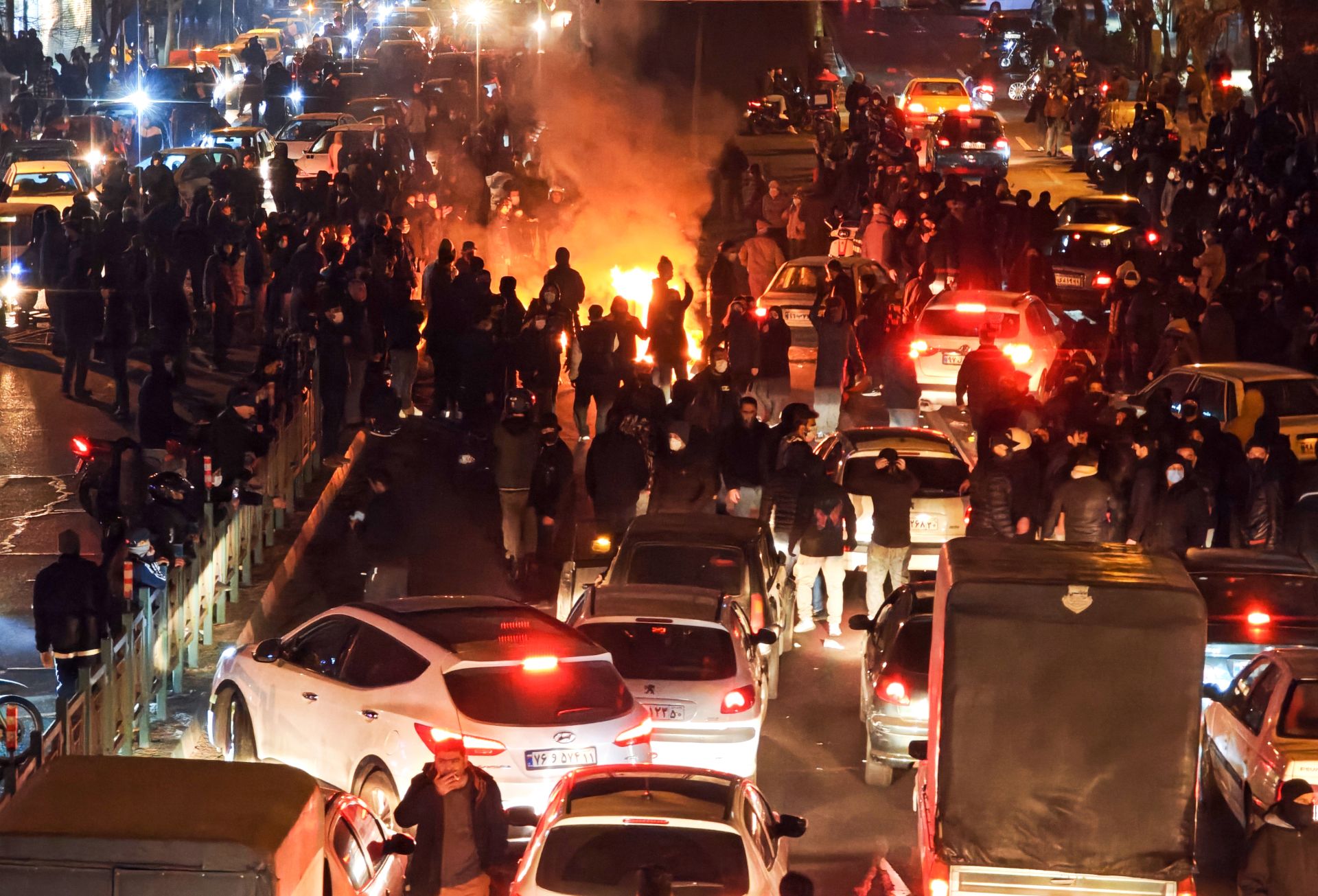
Note by Nilo Tabrizy: During my reporting on Iran over the past decade, there have been brief moments when the regime has imposed communications blackouts. I first experienced this during the Bloody Aban protests in December 2019 and January 2020. These protests started over an increase in fuel prices, but grew into calls for the regime’s downfall. State forces responded with lethal violence, killing at least 321 people.
At the time, it was only a few days of darkness.
Steadily, the state’s blocking of internet access for Iranians increased. During the 2022 “Woman, Life, Freedom” uprising, the blackouts rolled for weeks at a time. And again during the 12-day war in June 2025, the Islamic Republic clamped down on access, claiming it was due to ongoing military operations and wartime conditions.
For reporters covering Iran from afar, the internet is our lifeline. It’s how we access eyewitness videos that often document state killings and other human rights abuses. It’s how we maintain connections with our sources, who exchange messages with us at great personal risk.
This year, Iranians have been suffering under darkness again, excluded from the world in the most severe manner yet. On Jan. 8, during the massacre of Iranian protesters, the regime cut off access and left Iranians totally isolated for 20 days.
The day the internet resumed (albeit with decreased speed and continued state surveillance), I got a message from a contact of mine. Normally, I would describe this person’s hair or face or gender, but I have to protect their identity. But what I can tell you is that this person spent years in Evin Prison, targeted for being a labor activist. When I told him I wanted to write about him, he told me he already had a pseudonym in mind — Bijan.
Bijan is cheeky, an intellectual, filled with ideas for screenplays and documentaries. An absolute chatterbox. When he was finally connected again in late January, Bijan sent me an essay over Telegram that he wanted me to publish. He told me that the experience of losing access to the internet reminded him of his days of solitary confinement in Evin Prison.
Since Feb. 28, the day that the United States and Israel began heavy airstrikes over Iran, I have not been able to get hold of him. A message I sent to him on Telegram hours after the bombing began remains undelivered.
In those few weeks between the massacre and the war, I noticed a change in Bijan. From the moment that we met, over pixelated videos and strings of Telegram chats, he always spoke rapidly; thoughts on thoughts racing to spill out of his brain. But after the 20 days of the communications shutdown after the January massacre, I noticed he was stalled. Bijan had a hard time making conversation. After the first call we had in late January, when some connectivity resumed, we only spoke for 10 minutes — a far cry from our usual hour-long calls. After we hung up, he wrote to me that he wasn’t used to speaking like this anymore. That maybe the next time we spoke, he needed to sit down and organize conversation topics.
I want to share with you Bijan’s essay, which he titled “Graffiti on the Wall of a Solitary Cell.” I want you to learn through his words and feelings, and experience how this sense of strangulation and isolation has affected him. And really, I just want you to get to know him, in case we can never speak freely together again.
Jan. 17, 2025.
It’s been 10 days since our communications were completely cut off. In economics, politics, management, social sciences and almost every field that you can name, the most important indicator of a society’s liveliness is its level of connectivity. The terrifying ease of this disconnection amounts to our expulsion from every domain of collective existence and wisdom.
Our situation today is not unlike the logic of a solitary cell. That is why solitary confinement is called “white torture” [a form of psychological and sensory deprivation] — because it suddenly tears the individual from all their social context and reduces them to a biological minimum; and it does it by imposing a sense of helplessness and humiliation.
Filling the days has become a difficult task. Suddenly, you neither have a job nor a connection to your network of social relations. In a [prison] cell, you can only pace and wander in your own imagination. These days, some have emptied out all their [kitchen] cabinets to clean them; some are sewing quilts; others prepping loads and loads of herbs for cooking later. But getting through evenings is almost impossible. When the darkness arrives, the fear of how to make it till tomorrow creeps over us. Sleep disorders and insomnia, which have stayed with us since the 12-day war, have now become a clinical issue these days.
In solitary confinement, much like these days of ours, “no news” is not “good news.” Lack of information is a tool to break someone. The interrogator keeps repeating that everyone has forgotten about you, huge events have happened that you are not aware of, and you are trapped in this snare that we have designed for you. Unfortunately, those are to some extent true. These days, lack of news eats away at us like a canker sore. We struggle not to be forgotten, yet we know, the logic of solitary is of erasure and oblivion.
Darkest thoughts visit us, and we know the reality will be even worse. We struggle to feel something, but the logic of solitary erodes one’s emotional capacity.
Eventually [in solitary confinement] you pilfer a pen and secretly start to write. Just as in these days, anyone with minimal technical knowledge struggles to find a way outside. Whatever you can reach, you write down your name and today’s date. Maybe someone will read it later, this way you won’t be forgotten, and you will offer some comfort to them. But after a few times, you realize that you feel alienated from your own name, and the conventional numbers that apparently record the days are just some meaningless digits. You desperately try to write something else, but what remains to be written except for obsessive calculation of days and hours? How many days have passed and how many days are left. How many victims lie behind and ahead of us?
These days, through short telephone calls that are like telegrams, and without any other additional information, we ask about the well-being and health of each other and our friends, just like words exchanged in the hallways of solitary confinement cells from underneath the blindfolds. But more than conveying news of health and well-being, there is a lump in our throats and silence and signs for remembering: an in-law of an ex-colleague, a friend of an ex-student, other fellow inmates from the past and their families. There has been a disruption of equilibrium between humans and soil in this land. This part is not yet complete and for now it remains fragmented.
Ultimately, they turn the simplest things in solitary confinement into a privilege, like the right to contact your family, like our situation right now, where the right to communicate itself has turned from a right to a privilege. A privilege that the master can at any time take away for anyone that he sees fit. This work, more than being reliant on hardware infrastructure, is dependent on societal software dynamics.
Pressing that “disconnect” button means trampling upon social psychology, public education, the economy and livelihoods, stability and our collective future. But pressing on that button twice within two months is akin to the second missile strike to the Ukrainian plane [a 2020 incident in which the Islamic Revolutionary Guard Corps shot down a plane with two surface-to-air missiles] — our collective life, instead of being a right, is effectively a kindness that a master can take away from us at will. This means that the relationship between power and society is solely based on the binary of submission or dehumanization, and not as a metaphor or abstract analysis, but in real form and in real time and space.
No one comes out of solitary confinement the same person they were before. Cutting off communication is a tool of repression, punishment and social incapacitation, with far-reaching and long-term consequences. You wake up every night in fear and tremble at every phone that rings or knock because life becomes a privilege that can be taken away at any moment for any pretext. From this perspective, preventing the repetition and normalization of communication blackouts is a central struggle — one that cannot be achieved simply by changing who holds power at the top, nor even by integration into the global order or reliance on the fragile rationality of the market. It requires transforming the existing master-subject relationship in our society and reclaiming the right to life itself.
Today, [the regime’s] power is shaking, yet we see that almost no effective force is targeting its foundations. Instead, a competition has emerged over who will get to sit on this blood-stained throne. Until the power of society grows strong enough to empty the seat and hold it accountable, only the names will change; the solitary cells and white torture will remain, as will widespread communication blackouts and the so-called “white lists” of permitted contact.
Become a member today to receive access to all our paywalled essays and the best of New Lines delivered to your inbox through our newsletters.