


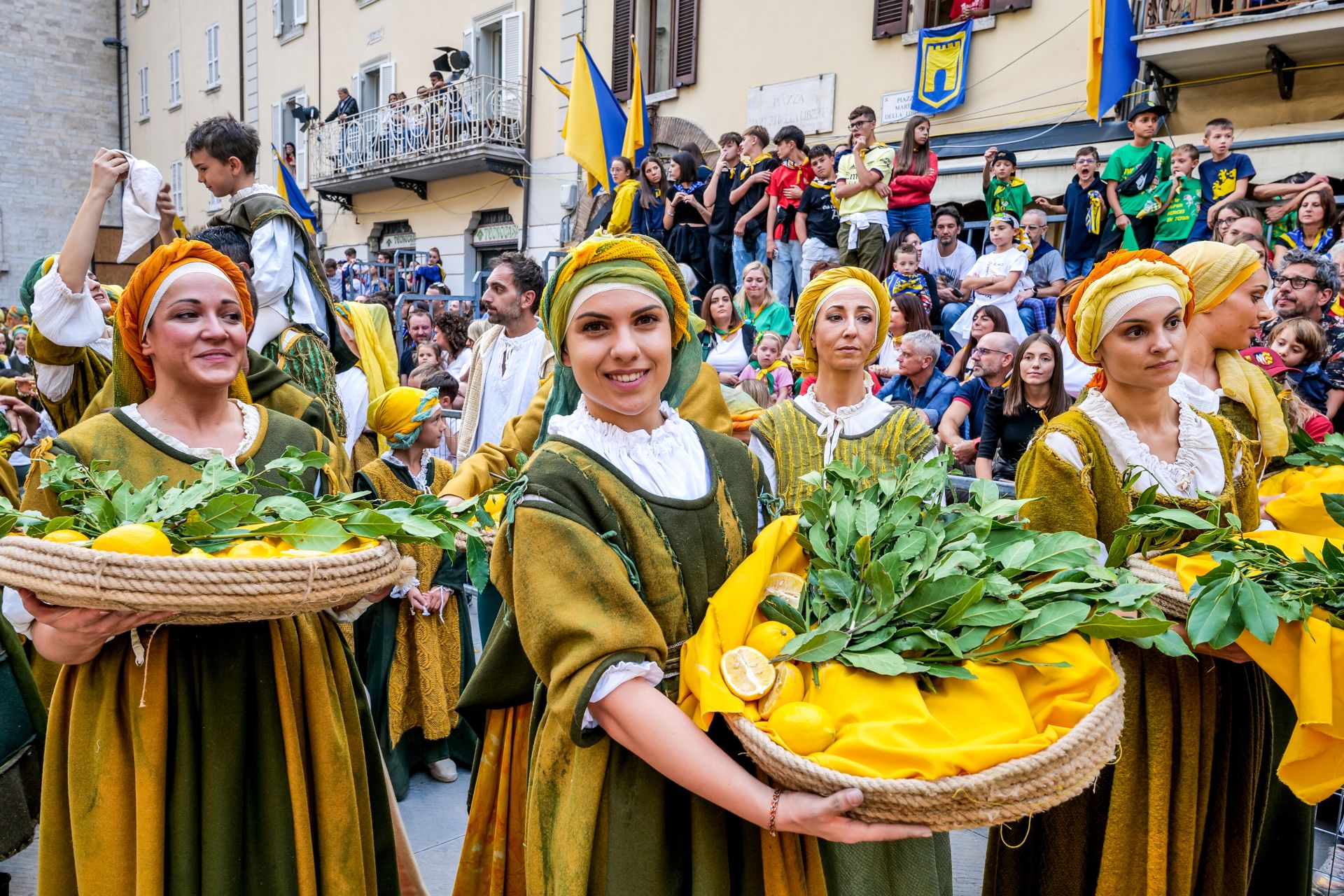
On a brisk November day in Terni, a former industrial city in southern Umbria, white-tented booths line either side of the central thoroughfare as families and couples stroll by, stopping to taste the various pastries and chocolates on offer. The combination of sugared air and bundled-up visitors gives the feeling of an Italianized Christmas market. Irina Rachieru, who lives in the city, is staffing a booth offering mulled wine and warm apple cider. According to her, there’s an obvious reason for the diffusion of food-themed events in Italy.
“They are very widespread in Italy, because you eat well here, wherever you go, north to south, right to left, on the islands,” she says. “You eat very well.”
Ask any Italian today for some of the hallmarks of modern “Italianita” (Italianness), and they’ll likely point to these festivals — known as “sagre,” the singular is “sagra” — as an uncontested item on the list. At its root, the sagra is a village festival centered around a local food item, like radicchio, prosciutto di Parma or gorgonzola. But the term is often used to conjure a sense of intimate rural celebration, where the emphasis isn’t so much on luxury or high standards as it is on community and local traditions that often hinge on food.
There are now an astonishing 20,000 or so in Italy, a number that has increased by around 30% just since the pandemic. These festivals attract roughly 50 million visitors each year, according to Antonino La Spina, president of the National Union of Pro Locos in Italy, which are the regional and municipal organizations that generally manage these events. And the economic impact for all 20,000 festivals comes in at around 2.1 billion euros annually.
Intrinsic to the Italian concept of a sagra is that it is, in some ways, ancient. In fact, many Italians will say the practice harks back to ancient Rome, when harvest festivals were held in honor of various deities and timed to the agricultural calendar. They often point to the etymology of the word sagra, from the Latin for sacred, thus theoretically proving that the festival was originally religious in purpose.
But the reality, plumbed by historians, is more complicated and has less to do with ancient roots than with Italy’s more modern history. From fascists to communists, politicians have long sought to use these celebrations of food and locality to construct political identities.
Despite their widespread impact, the real history behind the festivals that dominate Italy’s village landscape is known to few. One exception is Alberto Grandi, an associate professor in food history at the University of Parma.
Grandi is known, and one can almost say somewhat hated, in Italy for his academic stance on the country’s culinary traditions — that many of them are invented. He caused a stir among Italians when he announced, in a 2023 Financial Times interview, that one of the four classic Roman pastas, carbonara, was actually created using American army provisions during World War II.
In recent years, he has published two books that question Italy’s culinary ideas about itself: “Denominazione di Origine Inventata” (“Invented Designation of Origin”) came out in 2018, and an even more polarizing title, “La Cucina Italiana Non Esiste” (“Italian Cuisine Doesn’t Exist”), co-authored with Daniele Soffiati, came out in 2024. Grandi also has a podcast with Soffiati, and one episode examines the role the sagra has played in Italian life.
Sagre with religious origins were often linked to a local patron saint. Grandi names, for example, Neapolitan zeppole, the cream-filled fried pastries that take their name from Saint Joseph, and are now commonly used for Father’s Day. But even these roots, Grandi says, have been “revised,” with cultural traditions added to the celebration of these holidays over time, making them more elaborate.
“In the end, the real feast of the patron saint was a mass said on Sunday — it wasn’t like it was something extraordinary,” he says. “In some specific cases, but very rarely, there might have been a specific dish for that festival, but it’s difficult — maybe they reused a dish that was already typical for Christmas.”
The oldest sagra in Italy — and, according to organizers, the oldest bird-themed festival in Europe — is actually not focused on food. This is the Sagra dei Osei, a 752-year-old festival born from the medieval bird market in Sacile, in the northern region of Friuli-Venezia Giulia. The sagra was so important to the area that local towns competed to host it. This, of course, is not the standard for a sagra, which almost always includes some food component at its center, but the Sagra dei Osei’s long lineage predates the precise definition of the food- and village-themed sagra as a concept.
“Unlike other festivals, where the driving force is a product, our driving force is the whole field of ornithology,” says Pro Sacile President Lorena Bin. That is to say, the festival is all about birdsong. At 12 p.m. on the Sunday of the festival, a jury of experts still declares one bird the best singer of all.
Over the last century, regulations have changed so that the birds are no longer allowed to be captured but must instead be bred in captivity. This has given shape to a different kind of festival, but it has not touched the central contest: that of the best birdsong.
It’s a very popular event, attracting more than 60,000 visitors each year. “It clearly generates significant economic activity,” Bin says, “not just in our city, but also in neighboring towns, because all the hotels and other accommodations are fully booked months in advance of our festival.”
Yet Bin worries for the future of this sagra and, really, any sagra, claiming that it is a sector both “expanding greatly and in great danger.” And when it comes to the Sagra dei Osei, specifically, there is the small matter of bird-breeding to think about.
“Our breeders are between 80 and 90 years old, and there is no replacement, in the sense that young people today are doing other things,” she says. “So we are concerned that, in a few years’ time, we will no longer have the raw material to keep it going, which are the birds.”
The Sagra dei Osei represents the earliest iteration of these village festivals. But more than 600 years later, they received a huge boost. In the 1920s and 1930s, as part of an initiative to embrace local products and traditions, fascist leaders moved to promote local products in the service of a national identity, like porchetta from Ariccia, just outside of Rome, or wine from Frascati.
Soon, these state-instituted sagre became a type of official event that was codified and broadcast to people from other areas in an effort to promote a so-called Italian way of life to other Italians. In 1930, the regime officially instituted the Festa dell’Uva, which was celebrated in various cities throughout Italy.
“In order to build a unified national identity, the regime deployed folklores and regional customs to validate the cultural experience of the Grape Festival. The organizers seamlessly engineered popular traditions into the event, making them highly visible on ornate floats, temporary kiosks and exhibitions on the salutary properties of the fruit and of viticulture,” writes Ruth Lo, an assistant professor of architectural history at the University of Houston, in a 2016 essay on the Festa dell’Ulva. She continues: “Fascism’s gentle indoctrination worked steadily, thus rendering the Grape Festival a powerful tool in selling not only the fruit but also the authentic experiences of Italian culture.” This move, she argues, was driven by political ideology. “Deliberately stripping grapes of their associations to Christianity, the regime made the Grape Festival entirely fascist.”
In Rome, despite the fact that the city center was not exactly known for its wine production, Italian fascist leader Benito Mussolini held a Festa dell’Uva that harkened back to imagined ancient roots. Vendors got into the theme by wearing tunics and stoles at one of the city’s most commerce-associated ancient sites, Trajan’s Market, in images that Lo says were likely circulated throughout Italy. In another photograph from 1936, a float decorated with the head of Bacchus, the Roman god of wine, is paraded through Villa Borghese, one of Rome’s most prominent parks.
“These events were to be photographed and filmed so people throughout Italy could see them,” Lo tells me. “That’s why they were incredibly elaborate. It’s not even really about the food — it’s about the representation of the food.”
Because much of the media was state-controlled under fascism, even moviegoers were forced to watch state-sponsored newsreels before their movie began, she says. So these photographs were disseminated far beyond their immediate impact. “The reach was very, very wide,” she says. “Even if they couldn’t get the people to actually go, even by train, to these places, they brought it to them.”
But while the institutionalized sagra had a public purpose, it also had a tension instinctively built into it — it embraced a regional identity while also promoting a national identity. In May 1938, after Italy had already been sanctioned in 1935 by the League of Nations for its invasion of Ethiopia, the fascist regime organized what they called a “villaggio rustico” (rustic town) in Rome’s Circus Maximus, bringing together restaurants from Turin to Naples. Each booth not only offered regional favorites, like vermicelli with clams and mozzarella in carrozza from Naples or bistecca alla fiorentina from Florence, but also featured singing chefs and a mural of Vesuvius. At a time when Italy’s food security was at risk, this was a way for Mussolini to show Italians and the world that the country was just fine. And it was also a way to create a version of a unified Italian identity that still adhered to its regional distinctions.
“This is another negotiation the regime was trying to do, which is, how do you actually use regionalism for nationalism?” Lo says. “It’s also about highlighting the specialties of these different places and using that to create a unified national identity.”
Perhaps inadvertently, Italy’s leftist political parties managed to harness this same strategy after the war. Just months after Victory in Europe Day and the end of World War II on the continent in May 1945, the Italian Communist Party organized the first Festa dell’Unita, or Unity Festival, in a small town in the province of Como in September of that year. More than 200,000 people attended the gathering, according to La Repubblica, eating “bread and salami, because there wasn’t anything else.”
Where exactly the idea came from is hard to pinpoint, Grandi says, although we know that representatives of the Italian Communist Party participated in a similar festival in France and brought the idea to Italy, hoping to both finance the party and create a sense of belonging.
Their goal was to make use of the “gastronomic dimension, attracting people that way, and at the same time, hold debates, discussions, presentations, book presentations, essentially cultural and political events,” Grandi says.
These lively festivals became a powerful tool for organizing, and other political parties quickly caught on. In 1953, the Socialist Party hosted the first Festa dell’Avanti in Naples, the Onward Festival, while Christian Democrats threw the Festa dell’Amicizia, the Friendship Festival, in the province of Udine in 1977. But, as noted by Corriere della Sera’s Cesare Zapperi, these events “never managed to reach the levels of their rivals, the Communists, at least based on how widespread the celebration was throughout the country.”
Perhaps that is because the Festa dell’Unita managed to immediately capture a postwar spirit of almost desperate celebration and hope that political parties could not possibly recreate in the decades that followed. Or perhaps, as Grandi hypothesizes, it is because the Communist Party had a more “organized and militarized” approach compared to the Socialists and the Christian Democrats. Unlike other political parties, a very high percentage of Communist Party voters were actually card-carrying party members. And in a way, this phenomenon was echoed in the widespread diffusion of the Festa dell’Unita, which went on to be held in many of the country’s various municipalities.
Just as political parties and a post-World War II Italy were embracing the country’s apparently agricultural roots, workers themselves were turning away from the practice of farming. In his podcast with Soffiati, Grandi cites data points that show the stark shift the country has undergone: In 1950, 40% of the Italian working population worked in agriculture; now, that number is under 5%.
By the time Italians were just beginning to really elevate their agricultural history, their so-called present was quickly becoming the past.
The system of Pro Locos, the organizations that largely run the sagre, predates both World War II and fascism. They were established in 1881, La Spina tells me, originally as a kind of beautification society for towns. In fact, the first Pro Loco was created in Pieve Tesino, a town in Trentino, at that time still part of the Austro-Hungarian Empire, with the goal of remodeling the town’s central feature, the hill of Saint Sebastian, into a major attraction, inspired by other great European cities.
By the early 20th century, the national government had taken these spreading agencies in hand, and their proliferation eventually led to the establishment, in 1962, of the National Union of Pro Locos in Italy. This became the way to manage the now 6,500 organizations that exist across Italy’s 20 regions, responsible for roughly 110,000 to 120,000 events a year.
At a time when Italy’s tiny towns are emptying out, when some houses are still being sold for a euro and about 6,000 Italian towns are considered abandoned, the sagra often brings money and people to remote villages. In some cases, La Spina says, towns will sell out of their entire harvest of a product during the sagra weekend. Other times, villages with a population of under 5,000 will welcome numbers more than triple or quadruple their inhabitants.
That’s in large part, according to La Spina, because the sagra creates a tourism dynamic between the product and what Italians call “the territory.” This means that visitors are coming to an area not just to taste prosciutto di Parma or parmigiano reggiano but to really see the place where these items are produced and the people who produce them.
“Maybe you come back the following week because you want to taste that product, and so you go to the restaurants, you come back to buy those typical products,” he says, “and you create this direct link with your own territory, with your own producers.”
In other cases, the sagra itself may be the attraction that reanimates a town, like in Poggio Umbricchio, a hamlet in Abruzzo that La Spina says has only seven full-time residents. Every year, they hold a white truffle festival, attracting between 12,000 and 13,000 visitors over three days.
“During the festival, there are more than 100 volunteers working, because all those who have left over time, the children, the grandchildren, those who have houses there, come back for the festival,” La Spina says. “And that festival revives the village and helps to keep it alive and creates a moment of togetherness.”
While the sagra in Italy may not be as ancient as it claims to be, the modern demand is anything but fading. In the few years since the end of the COVID-19 pandemic, there has been what La Spina calls almost “an invasion” of new sagre.
“The concepts are long-standing, but gradually, we manage to make them increasingly new — there is always innovation in tradition,” he says. “You go there because you want to taste the product that is made there, because, in many cases, the dishes are made by grandmothers, by 70- and 80-year-olds who are there cooking and preparing everything in a genuine way with their old recipes and methods.”
In the last two years, one such festival has emerged in Terni, in honor of pampepato, a sweet with a chocolate base often filled with nuts and raisins. In Terni, the tradition holds that each family makes their own pampepato and gifts it to their neighbors and friends for the holiday season. When asked who has the best pampepato, goes the saying, you must always say it is your own.
“We all remember the pampepato that was made at home with our grandmothers and with our mothers,” says Mauro Franceschini, president of Confartigianato Imprese Terni, the local artisan and small business association. “And for this reason, it is something that is very much heard and understood in the city.”
Seemingly as proof of this, more than 100,000 people attended last year’s festival, the first of its kind. After all, the sweet is one of only six desserts in Italy to have a protected geographic certification, according to Franceschini, certifying that it can only be made in certain ways and in certain areas to be considered pampepato.
Here, we can return to an idea that is central to Grandi’s work: When we talk about food, at least in Italy, we’re not just talking about food. We’re talking about identity.
“When a festival is attributed to a very long history, in some way, a strong identity is attributed to a specific place,” he says. “But there is also a very deep sociological problem in Italy, which at the moment holds on to lasagna and tortellini to prove its existence.”
Recently, Grandi was in Modica, in Sicily, for the area’s now-famous chocolate festival. The scene was almost “horrific,” he says, streets so crowded you couldn’t walk down them. “It was completely congested, and they told me there were 150,000 people there,” he says. “It felt like being at a stadium during a game.”
And while Modica is the kind of city that in Italy requires an almost immediate rejoinder (“that’s the city of chocolate”), so strong is the association with its product, Grandi notes that its proliferation only dates back to the 1880s, when the Bonajuto family started its chocolate operation in the baroque Sicilian city.
But these are the kinds of comments that have gotten Grandi into trouble. He always has a standard disclaimer.
“I never question the quality of our products and the quality of our dishes and our cuisine,” he says. “But if you say that the story is a little different from how it is told, it obviously becomes an attack on Italianness.”
That these sagre are more than the sum of their parts is exactly how La Spina sees them in his work at the National Union of Pro Locos. This is not about merely sharing a sausage sandwich or a plate of pasta. “That’s what it appears to be,” he says, “but behind it, there is a fantastic world that truly tells many stories, very interesting stories.”
Grandi also sees the power in the sagra as cultural rather than merely economic. These events may often be well attended, as La Spina’s own data suggests, but they also hold an importance that goes beyond the revenue numbers. “This aspect of sharing has a value in itself, regardless of whether the festival is successful or not,” Grandi says. “There are many festivals that don’t do well but are kept alive only because they have symbolic value.”
It is perhaps this more than anything else that a sagra can offer, holding up a mirror to Italian society not exactly as it is, but as it would like to see itself. The only problem is that as Italians choose how they want to see themselves, they also selectively leave out what they do not want to see.
“It’s about who has a claim to these things and what becomes categorized as Italian and what is not. Culinary heritage is often mythologized, and this has side effects — it can feed gastronomic nationalism and exclusionary identity politics,” Lo says.
There’s perhaps a reason why Italy’s far right has weaponized the country’s culinary heritage as a tool. In one interview segment that Grandi mentions in his podcast, far-right Lega party leader Matteo Salvini quotes a political opponent as telling him he should be the president of the Pro Locos of Italy since he knows every sagra in the country.
“To me, it’s a compliment,” he tells the audience, on stage with La Spina. “I wasn’t upset.” And while he goes on to say that the Pro Locos are open to everyone and create a political class “of any color and orientation,” he ends with this: “What is the best part about them? They are connected to the territory.”
In this way, Salvini’s proud association with the Pro Locos and his link back to the land shows clearly how Italy’s sagre have completed the turn from right to left and back again. The fascists and the communists, on different ends of the spectrum, understood the political importance of bringing people together around a shared identity. In a country that is, in part, always searching for what it means to be Italian, both of these political parties, however ideologically opposed they might have been, realized that whoever could offer the most compelling definition of Italianita might have the key to influencing the public.
Become a member today to receive access to all our paywalled essays and the best of New Lines delivered to your inbox through our newsletters.