


In 2018, Saudi Crown Prince Mohammed bin Salman described the Islamic Republic of Iran, the Muslim Brotherhood and jihadist organizations (such as al Qaeda and the Islamic State group) as an axis of evil. At the time, Saudi Arabia was fighting a proxy war against Iran in Yemen, had no diplomatic ties with Qatar and was unofficially engaged in an economic boycott of Turkey on the grounds that it supported Islamist groups.
Five years later, Saudi Arabia announced a unilateral withdrawal from Yemen, normalized relations with Iran and helped broker a ceasefire in Sudan by supporting the country’s Muslim Brotherhood-allied military. A year after that, Riyadh threw its support behind the new leadership of Ahmad al-Sharaa in Syria, despite his background as the leader of Hayat Tahrir al-Sham, a jihadist group that broke away from al Qaeda.
Meanwhile, the gap between Riyadh and a bloc led by the United Arab Emirates and Israel continues to widen. This goes beyond Israel’s war on Gaza; it can be seen in recent escalations in Yemen, where the UAE supported the separatist Southern Transitional Council (STC) as it moved into the region of Hadramawt, as well as in Israel’s recognition of Somaliland as a state independent from Somalia, a Saudi ally.
Yet these events are not best explained as part of a Saudi turn to Islamism, as some observers argue. They should be seen as evidence of a change in the strategic environment — both regionally and in Riyadh. Since 2019, when an Iranian attack on oil processing facilities in eastern Saudi Arabia destroyed half of the country’s oil production, the kingdom has followed a “zero-conflict” policy built around neutrality and conciliation. It is this policy that has, perhaps paradoxically, led the kingdom into clashes with the Emirati-Israeli bloc.
Since the 1960s, Saudi regional policy has moved through three major phases. In the late 1960s and early 1970s, it evolved to fill the power vacuum that the British left when they withdrew from their protectorates east of Suez in 1968, and was based primarily on threat management. Security arrangements that had once been dealt with by the U.K. now had to be overseen locally. Before 1968, Saudi Arabia’s main concerns were Gamal Abdel Nasser’s Egypt, Israel and the civil war in North Yemen between royalists and republicans. Almost as soon as the British left, new threats emerged. Iran and Iraq were competing to dominate the Gulf. The south of the peninsula became a source of instability, from South Yemen’s Marxist turn to the Dhofar insurgency against British influence in Oman. Riyadh feared that the political order on its borders could collapse with little warning.
To meet these challenges, Saudi Arabia developed a regional policy that remained in place until the U.S. invasion of Iraq in 2003, when a second phase began. This policy emerged not as a deliberate, long-term strategy, but as an ad hoc response to a series of critical events during the pivotal late 1960s and early 1970s.
The policy of this earlier period had four dimensions. The first concerned Arab politics, including the volatile situation with Israel. At the 1967 Arab summit in Khartoum, famous (or notorious) for the “three noes” regarding Israel — “no reconciliation, no recognition and no negotiation” — King Faisal of Saudi Arabia and Nasser reached a settlement that ended their indirect conflict in Yemen. They also agreed on annual Saudi, Kuwaiti and Libyan financial assistance that would allow Egypt to rebuild its military capabilities after the 1967 war with Israel.
The situation changed after Nasser’s death and the rise of Anwar Sadat in Egypt and Hafez al-Assad in Syria, as a Saudi-Egyptian-Syrian triangle emerged. This “conservative” triangle, loosely speaking, stood in opposition to a group of “radical” Arab states, including Moammar Gadhafi’s Libya, Baathist Iraq, Houari Boumédiène’s Algeria and South Yemen, which adopted antagonistic policies regarding monarchy, Arab unity and relations with the Western bloc and with Israel. During the 1970s, this triangle set the Arab agenda on issues ranging from the 1973 war to oil policies and coordination over the Lebanese Civil War.
After Egypt signed the Camp David Accords with Israel in 1978 and the 1979 revolution in Iran that toppled the shah, the relationships underpinning this conservative dominance were weakened. Saddam Hussein’s Iraq organized an Arab boycott of Egypt for signing the accords, which Saudi Arabia joined. During the Iran-Iraq War, Syria aligned with Iran, whereas Saudi Arabia backed Iraq. Yet in the 1990s, Iraq’s invasion of Kuwait, coupled with the collapse of its superpower backer in the Soviet Union, enabled the triangle to regain its strength. Egypt was reintegrated, and Syria asserted its dominance over Lebanon. Other radical Arab states were also weakened: Libya was sanctioned and Algeria was consumed by civil war.
The second dimension of Saudi Arabia’s regional policy involved its relationship with the United States. From immediately after World War II through the early 1970s, this was based on oil. Aramco, the U.S. oil conglomerate, wielded significant influence in Washington. Meanwhile, the U.S. relied on Saudi oil for the Marshall Plan, its program to revitalize postwar Europe. To safeguard its vital investment in oil from Saudi Arabia — then a newly established state with little infrastructure — the U.S. provided economic, technical, military and educational assistance.
Until the 1973 Arab-Israeli War and the embargo imposed by the Arab state members of OPEC on countries that had supplied the Israeli military, the U.S. relied on other non-Arab states to coordinate its policies and safeguard its interests in the Middle East. This included the U.K. in the Gulf, Iran under the shah and, to a lesser extent, Israel. For Saudi Arabia, regional policy disagreements over the Palestinian issue, which gave rise to three regional wars during this period, were a persistent source of tension.
The 1973 Saudi oil embargo, occurring in the context of the Arab-Israeli war, forced both sides to confront the fact that oil and regional politics could not be separated. Prices rose sharply, and the U.S. suffered an enormous economic blow that made it impossible to continue treating the relationship with Saudi Arabia as a quiet technocratic arrangement. After the 1970s, the Saudi-U.S. relationship was less a purely transactional one of money for oil and slowly evolved into something more strategic, based on protecting shared interests.
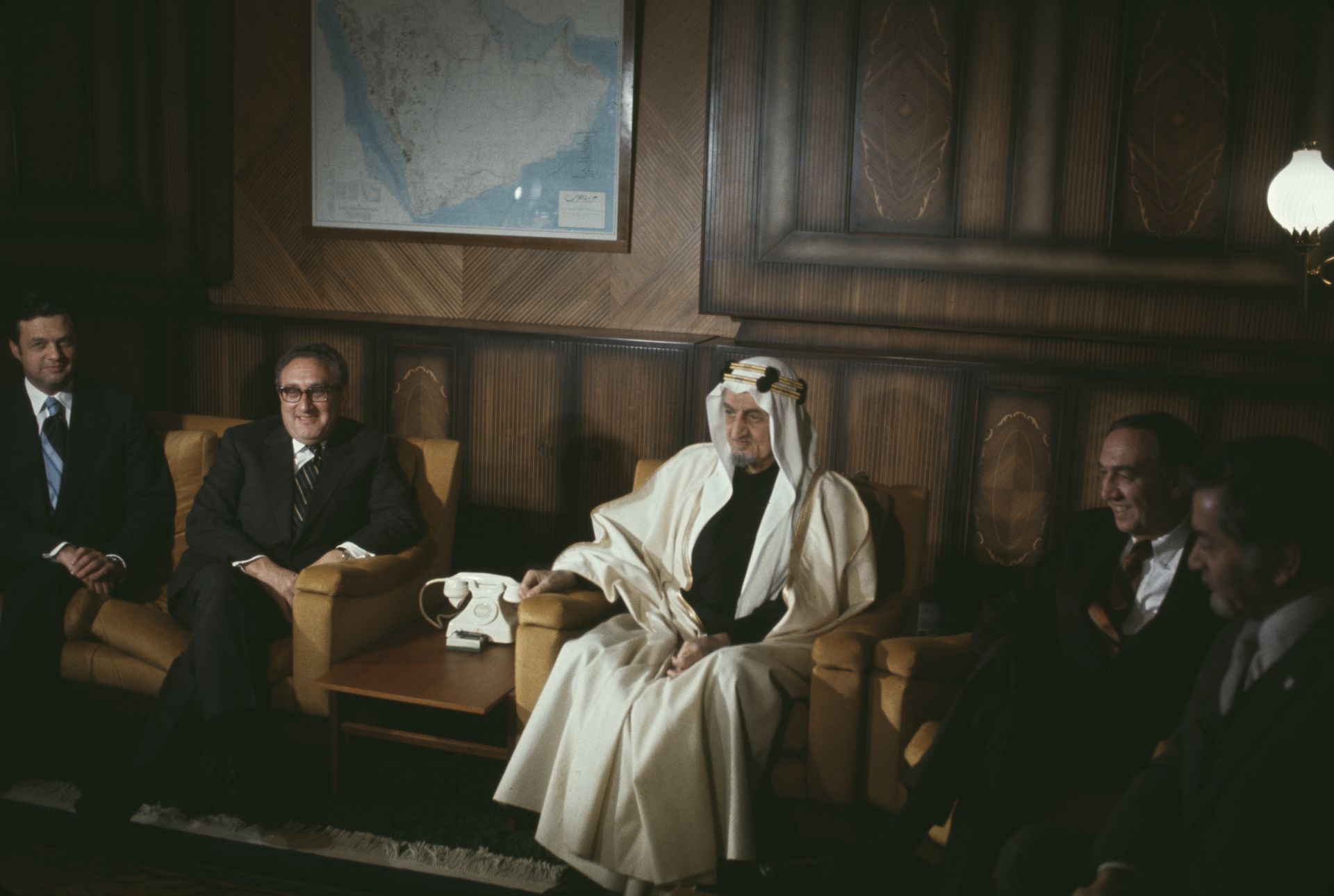
One aspect of this was the strengthening of economic ties and interdependence. Saudi Arabia was encouraged to import American goods and services and to invest its vast oil surpluses in the U.S. This was the purpose of the initial talks held in March 1974 between Henry Kissinger and Prince Fahd, then deputy prime minister, which paved the way for Richard Nixon’s visit to Saudi Arabia in July 1974 — the first by a sitting U.S. president. As a result of this arrangement, hundreds of American experts were brought to Saudi Arabia to assist ministers and decision-makers in managing development and modernization and to facilitate cooperation between the U.S. private sector and the Saudi government. Other outcomes included the recycling of Saudi petrodollars into American bonds and markets, which contributed to stabilizing the dollar and financing U.S. deficits, in addition to increased arms deals.
Another side of the relationship concerned the coordination of regional policies. When Nixon became president in 1969, he continued an existing policy of not replacing U.K. dominance in the Gulf, but he reframed it as part of a new Cold War strategy. Instead of direct and costly engagements in multiple regions, the U.S. would support allied regional powers. Nixon tasked Kissinger, then his national security adviser (and later his secretary of state as well), to translate this vision into policy in the region. In 1970, the “Twin Pillars” policy was born. This envisioned Iran as the primary stabilizing force, while providing support for Saudi-Iranian cooperation and establishing diplomatic relations with newly independent states in the Gulf following British withdrawal, coupled with educational and technical assistance.
This policy persisted until the eruption of the 1979 revolution in Iran, which prompted President Jimmy Carter to promote a policy of direct intervention in the Gulf. This led to increased Saudi-U.S. regional coordination during Ronald Reagan’s presidency. During this period, the two countries supported Iraq in its war against Iran and coordinated funding and arms for Afghan fighters against the Soviets.
After Iraq’s invasion of Kuwait in 1990, that security dimension became more direct and institutionalized, as U.S. forces and facilities became a lasting feature in the Gulf.
A third dimension of Saudi Arabia’s regional policy was the balancing of both Iran and Iraq in a manner that prevented either from achieving dominance over the Gulf. As it became clear that the U.S. would not fill the vacuum left by British withdrawal, a multipolar order emerged in the Gulf in which Iran and Iraq were the principal competitors. Saudi Arabia, which was militarily the weakest and demographically the smallest of the three, played a more limited role. Aware of these constraints, which precluded any Saudi bid for regional hegemony, Riyadh confined its policy to the more modest objective of preventing either Iraq or Iran from monopolizing the region. Until the fall of the shah in 1979, the kingdom aligned more closely with Iran, Washington’s principal ally in the Gulf. It then leaned toward Iraq in the 1980s to check Iran, and then recalibrated again when the balance shifted after 1990.
The final dimension of Saudi Arabia’s regional policy prior to the U.S. invasion of Iraq was its sustained effort to establish hegemony over the Arabian Peninsula. This meant both preventing any external rival from gaining a foothold and ensuring that no other peninsular state could threaten Saudi dominance.
In the eastern Arabian Peninsula, this was expressed through Saudi support for the independence of the states that became the UAE, Bahrain, Qatar and Oman. In that vein, Saudi Arabia opposed the shah of Iran’s attempt to extend Iranian influence over Bahrain. The kingdom also pushed for a federal union encompassing the nine emirates, including Qatar and Bahrain, within a single federal state. On the one hand, King Faisal feared a repetition of the failed federation of the South Arabian sultanates, which had culminated in the emergence of a communist state. On the other hand, he was keen for Qatar and Bahrain to be included in the federation to limit Abu Dhabi’s influence, given a longstanding border dispute between Saudi Arabia and Abu Dhabi over the Buraimi Oasis.
Events, however, unfolded differently. In the second half of 1971, Bahrain and Qatar declared independence, while six emirates, led jointly by Dubai and Abu Dhabi, formed the UAE, which was joined later by Ras al-Khaimah. Saudi Arabia did not recognize the UAE until its border dispute with Abu Dhabi was resolved in 1974. But in 1981, following the fall of the shah in Iran and the subsequent Iran-Iraq War, Saudi Arabia and the UAE drew closer alongside Bahrain, Qatar, Oman and Kuwait when they jointly established the Gulf Cooperation Council.
The Iraqi invasion of Kuwait, however, weakened both the council and Saudi Arabia’s influence over its members. Although the council had largely succeeded in insulating its members from the effects of the Iran-Iraq War, its failure to prevent or reverse Iraq’s occupation of Kuwait pushed member states to enter into unilateral security and military arrangements with the U.S.
These arrangements created space for other Gulf states to pursue foreign policies that were increasingly independent of, and at times in tension with, Saudi Arabia. Following the “White Palace Coup” in Qatar in 1995, Emir Hamad bin Khalifa charted a course for Qatar based on soft power — through Al Jazeera on the one hand, and the development of an extensive network of relations that enabled it to take on a mediating role in regional and international conflicts on the other.
The UAE, by contrast, developed its independent trajectory more gradually, due to its federal structure. The appointment of Mohammed bin Zayed as chief of staff of the armed forces in 1993 initiated a gradual shift toward investment in hard power and military capacity to advance an autonomous foreign policy. Meanwhile, Dubai’s limited oil wealth drove it to position itself as a hub for capital, tourism and trade.
In Yemen, Saudi influence was built less through formal alliances than through economic leverage and patronage. The number of Yemeni laborers in Saudi Arabia grew dramatically, and remittances became a pillar of Yemen’s economy — so much so that Saudi decisions could translate into immediate economic shocks across the border. Riyadh also cultivated ties inside Yemen through stipends and relationships with tribal and political figures, creating a structure of dependence that existed alongside the formal state.
When Yemen’s politics diverged from Saudi preferences in 1990, the diplomatic and economic impact was significant. When the president of the recently unified Yemen, Ali Abdullah Saleh, declined to condemn Iraq’s invasion of Kuwait, Saudi Arabia responded by revoking the visa-free entry that Yemeni nationals had enjoyed since 1934 and deporting approximately 800,000 Yemenis in a single move. This development made oil, which had been discovered in Yemen’s southern regions in the mid-1980s and was controlled by Saleh and his allies, the primary source of revenue for the new government.
Combined with the poor management of the merger of the two former state bureaucracies, this led to rising tensions between northern and southern Yemeni elites, prompting southerners to push for elections. The elections failed to heal the rift, and the country gradually slid into civil war following the Socialist Party leadership’s declaration of secession in 1994. Although the war lasted only 70 days and ended in victory for Saleh, it accelerated Yemen’s decline in ways that later fueled new armed actors on Saudi Arabia’s border.
This Saudi regional policy collapsed after the U.S. invaded Iraq in 2003.
The Iraq war meant that America’s role in the region had ceased to be about preserving the status quo, of which Saudi Arabia was among the biggest beneficiaries. The language of “freedom” and “democracy” signaled major differences over how to ensure a sustainable regional order. “Sixty years of Western nations excusing and accommodating the lack of freedom in the Middle East did nothing to make us safe, because in the long run, stability cannot be purchased at the expense of liberty,” President George W. Bush said in a November 2003 speech.
This was the beginning of a slow but pronounced parting of ways between the decision-makers in Saudi Arabia and the U.S. over how best to preserve their common interests. It was exacerbated by the American mishandling of post-Saddam Iraq. The war also increased public hostility toward American troops stationed in Saudi Arabia, leading the U.S. to move a military base from Riyadh to Al Udeid in Qatar.
In addition to complicating the Saudi-U.S. partnership, the war transformed Iraq from a regional balancing power to a sphere of reignited competition between Saudi Arabia and Iran. Initially, Iran was scared that America had now become its new neighbor in Afghanistan and Iraq. There was a brief but ultimately fruitless attempt to reach a deal with the U.S.
It didn’t take long, however, for Iran to adopt an offensive posture in multiple areas. After 2005, it succeeded in asserting its dominance in Iraq and supported the insurgents against the U.S. there. In Syria, Iran’s relationship with the country became less of a partnership and more like domination, especially in the years after power passed from Hafez al-Assad to his son Bashar in 2000. In Lebanon, the strengthening of Iranian influence followed the decline of Saudi Arabia’s and Syria’s, and was hastened by the 2005 assassination of the country’s former prime minister, Rafiq al-Hariri, and the resulting expulsion of Syria from Lebanon. When Saudi Arabia could not find a viable alternative to Hariri, the power vacuum was slowly filled by Iran’s ally Hezbollah.
Finally, the war in Iraq indirectly contributed to reducing Saudi hegemony in the Arabian Peninsula. It propelled Qatar’s transformation into an important regional player with independent priorities: Qatar replaced Saudi Arabia as host of the U.S. Combined Air Operations Center; Al Jazeera’s coverage of the Iraq war and the Second Intifada allowed it to dominate the pan-Arab media scene; and it played a key role in brokering agreements, such as the one between Lebanese factions in 2008 that successfully ended an 18-month sit-in by the Hezbollah-led opposition.
The continued decline of Yemen’s state capacity gave rise to different challenges that further eroded Saudi Arabia’s delicate arrangement to contain its southern neighbor. One of them was the Zaidi Islamist Houthi movement, which dominated Saada in the northern part of the country and engaged in six wars against Saleh’s regime between 2004 and 2010. The other was the separatist southern Hirak movement. Finally, when al Qaeda’s branch in the Arabian Peninsula was defeated in Saudi Arabia, many of its remaining members transferred to Yemen, taking advantage of its institutional weakness. The rise of these threats coincided with the disintegration of Saudi patronage networks within Yemen following the death of the powerful tribal leader Abdullah al-Ahmar in 2007 and the declining health of Crown Prince Sultan, who was responsible for the network.
Faced with these developments, the Saudi government began to slowly adopt a more assertive and interventionist regional policy. The first indication of this new policy occurred at the Arab Summit of 2007 in Riyadh, when King Abdullah declared the American military presence in Iraq an “illegitimate occupation” and called for an Arab “new beginning.” This policy intensified between 2007 and 2019 as the spheres of regional competition widened, driven by unfolding revolutions and civil wars, the expansion of Iranian influence, the rise of the Turkey-Qatar axis, the proliferation of jihadist groups and the increasing centralization of internal decision-making.
The intensification of Saudi interventionism unfolded in three stages. In the first stage (2007-2011), competition was still confined to a handful of theaters, and Riyadh invested heavily in anti-Iranian factions. In Iraq and Lebanon, Saudi Arabia supported the anti-Hezbollah March 14 Alliance in the 2009 Lebanese election, and former Iraqi Prime Minister Ayad Allawi’s “Iraqiyya coalition” in the 2010 Iraqi election. Both coalitions won these elections, but their adversaries succeeded in undermining their victories. In Iraq, the Supreme Court reinterpreted the constitution to allow the second- and third-largest coalitions to merge after the elections and become the winner. In Lebanon, resignations in January 2011 forced the collapse of Saad Hariri’s national unity government and paved the way for the emergence of a Hezbollah-dominated government.
In the second phase (2011-2015), Saudi policy grew more assertive and interventionist as a result of the Arab uprisings. These transformed regional actors including Syria, Egypt, Libya and Bahrain into spheres of regional competition. They also gave rise to a new Turkish-Qatari-Muslim Brotherhood axis that quickly challenged both Saudi Arabia and Iran for regional influence. Finally, President Barack Obama’s handling of the uprisings, coupled with his pursuit of the Iran nuclear deal, deepened the rift with Saudi Arabia over regional priorities. Although Obama rejected the neoconservative interventionism of the Bush administration, he appeared less committed to protecting America’s regional allies and their core interests. This was most evident in his support for Egyptian President Hosni Mubarak’s resignation in the face of protests and his insistence on securing a diplomatic deal regarding Iran’s nuclear program.
Faced with these threats, Riyadh partnered with an increasingly interventionist and anti-Islamist UAE to counter regional rivals. After Sheikh Zayed Al Nahyan’s death in 2004, one of his sons, Khalifa, became emir of Abu Dhabi and the president of the UAE, and another, Mohammed, became the crown prince of Abu Dhabi. Mohammed continued the centralization of the military and other aspects of power. When the global financial crisis of 2008-2009 severely impacted Dubai, Abu Dhabi provided a $10 billion bailout, a move that effectively cemented its dominance over the federal government of the UAE. When the Arab uprisings empowered Islamist movements allied with Qatar and Turkey, the UAE made it its mission to lead a regional campaign against Islamism.
The Saudi response to the Arab Spring was less ideological than the Emirati approach. It intervened militarily on the side of the Bahraini government, and in Yemen it brokered an agreement for a peaceful transition in return for complete immunity for the old regime. Outside the Arabian Peninsula, Saudi policy was less interventionist but still assertive. In 2013, it supported a military coup against Egypt’s democratically elected President Mohammed Morsi, backed various Syrian rebel factions against the Assad regime and endorsed U.N. Resolution 1973, which formed the basis for NATO’s intervention in Libya.
The years 2015-2019 witnessed the most extreme form of Saudi interventionism, involving direct confrontation with both the Iranian axis and the Turkey-Qatar axis. This coincided with the death of King Abdullah and the rise of Crown Prince Mohammed, who centralized power. During this period, the Saudi-Emirati axis expanded to include Abdel Fatteh el-Sisi’s Egypt. In March 2015, the Saudis led an Arab military coalition in reaction to the Houthi coup in Yemen. Starting from 2014, the UAE and Egypt (Saudi allies) supported Khalifa Haftar in the second Libyan civil war against the Government of National Accord, which was supported by the Turkey-Qatar axis. In January 2016, Saudi Arabia cut all diplomatic relations with Iran over an incident of mob violence at the Saudi Embassy in Tehran. In June 2017, joined by the UAE, Egypt and Bahrain, it announced it was cutting all diplomatic ties with Qatar. In 2018, and especially after the killing of Saudi journalist Jamal Khashoggi in the Saudi Consulate in Istanbul, a government-sponsored “popular” economic boycott was launched against Turkey.
When Donald Trump was elected, the Saudis initially perceived his policy toward the region as more aligned with their interests than Obama’s. Trump pulled out of the nuclear deal that his predecessor had concluded with Iran. While the Obama administration had returned $400 million of frozen funds to Iran and paid $1.3 billion in interest, Trump launched his “maximum pressure” campaign of increased economic sanctions.
Saudi interventionism seemed to be at its peak when its oil fields were attacked in September 2019. These attacks were a game changer because they were sophisticated, accurate and yet very cheap to carry out. Around 3:30 a.m. on Sept. 14, 2019 — just nine days before Saudi National Day and five days after Ashura — around 18 drones and several cruise missiles were launched against the Abqaiq oil processing facility, the largest in the world, and the Khurais oil field and processing plant. The attacks briefly disrupted more than half of Saudi oil production and 5% of global oil output. They caused a 14% increase in oil prices — the highest single-day increase since at least 2010.
The September attacks exposed Saudi Arabia’s vulnerability and a U.S. lack of interest in retaliation, leading to a shift in Saudi regional policy. It is estimated that the drones used in the attack cost between $10,000 and $15,000 each. More than 90% of the drones and cruise missiles launched were neither detected nor intercepted by the expensive defense systems in place. The kingdom suddenly appeared to lack the means to defend itself.
There were expectations and calls for a U.S. military response. For instance, Frederick W. Kagan, a senior fellow and the director of the Critical Threats Project at the American Enterprise Institute, made the case that inaction would alienate an ally and encourage Iran. But Trump chose that course. “The easiest thing for me to do,” Trump told the press six days after the attacks, “is to say, ‘Go ahead, fellas. Go do it.’ And that would be a very bad day for Iran.” He then defended not striking Iran on the grounds that the “thing that does show strength would be showing a little bit of restraint.”
Trump opted instead for bolstering Saudi Arabia’s defenses. On Sept. 28, the Pentagon announced that the U.S. would send 200 troops, a Patriot missile battery and four ground-based radar systems to the kingdom. Two weeks later, the Pentagon said it would send 3,000 troops, in addition to “two fighter squadrons, an air expeditionary wing, two Patriot missile batteries, and a Terminal High Altitude Area Defense, or THAAD, system.” But when Saudi Arabia started an oil price war in March 2020 aimed at pressuring both Russia and American shale producers, causing the price to fall below $30, the pressure in Washington intensified. In May 2020, the U.S. called back 300 troops from Saudi Arabia and pulled two batteries that were guarding oil facilities there.
After these attacks, the Saudi government adopted a more neutral and conciliatory regional policy. On Jan. 5, 2021, during a Gulf Cooperation Council summit in Al-Ula city in northwestern Saudi Arabia, the Saudis and the Qataris announced the end of their three-year dispute and the restoration of relations. Then the Saudi-led coalition in Yemen announced a unilateral ceasefire. In June 2022, the Saudi crown prince visited Turkey and the unofficial economic embargo was lifted.
The same approach was used with Iran. In an interview in April 2021, Crown Prince Mohammed adopted a new stance toward the Islamic Republic, saying, “At the end of the day, Iran is a neighboring country and all that we hope for is to have good relations.” This sentiment was reflected in several rounds of negotiations and was repeated in a March 2022 interview with The Atlantic, in which the crown prince said that the Iranians “are neighbors. Neighbors forever. We cannot get rid of them, and they can’t get rid of us. So it’s better for both of us to work it out and to look for ways in which we can coexist.” A year later, in March 2023, the two countries announced the resumption of their relationship.
This “zero-conflict” approach reduced the attacks on Saudi Arabia from Iran and its allies, and it allowed Riyadh to present itself as a mediator rather than a party to every regional confrontation. This is why it has survived the test of multiple conflicts in the past few years. Instead of taking sides in the Russia-Ukraine war, Saudi Arabia decided to adopt a neutral, mediatory role. The same approach was adopted in the case of Sudan when the civil war erupted in April 2023. When Israel launched its war on Gaza after Hamas’ surprise attack of Oct. 7, 2023, the Saudis led a diplomatic initiative for a ceasefire, expressed concerns about Israeli attacks in Yemen and even condemned Israel’s war against Iran.
But the Saudi “zero-conflict” approach also comes with a price. The posture that protects Saudi Arabia most effectively creates friction with allies that still operate through interventionism and proxy leverage. More particularly, it puts the kingdom at odds with its Emirati allies, who remain committed to their interventionist and anti-Islamist regional policy. In 2020, the Emiratis normalized their relations with Israel. Their increased support for the southern separatists in Yemen led to clashes that were only resolved in the Riyadh Agreement, which introduced a power-sharing and security-coordination mechanism between the Yemeni government and the STC. The UAE continued to send arms to the forces of Haftar in eastern Libya. When the Sudanese civil war broke out in 2023, the UAE supported the Rapid Support Forces in their war against the Sudanese military.
This Saudi-Emirati divide became more apparent with the collapse of the Iranian regional axis and increased Israeli interventionism after the Oct. 7 attack. Israel launched its first strike in the Arabian Peninsula against Houthi targets in July 2024. In September 2024, Israel launched a sophisticated pager attack on Hezbollah and then assassinated its leader, Hassan Nasrallah. The following month, Israel invaded southern Lebanon, and by the end of November, a ceasefire brokered between Israel and Hezbollah included the requirement that the latter redeploy north of the Litani River. A day after the conclusion of the ceasefire agreement, Syrian rebel forces in Idlib launched an attack on the Assad regime to capture Aleppo. Although the initial aims of the operation were limited to Aleppo, the rebels were surprised by the speed of the Assad regime’s collapse, which allowed them to enter Damascus on Dec. 8. Six months after the fall of the Assad regime, Israel launched an attack against Iran that lasted 12 days and ended with Trump attacking Iranian nuclear facilities.
These developments pushed the UAE closer to Israel in an anti-Islamist axis and away from the Saudis. The question, then, is not whether Riyadh’s language has changed. It has. The question is whether this UAE-Israel axis will allow Saudi Arabia to keep insulating itself from wars of choice. Last December, the Emirati-Israeli axis made two moves that pushed Saudi Arabia to adopt a more forceful posture. Starting in December, the UAE-backed STC in Yemen captured large swaths of territory in the country’s south. On Dec. 26, Israel became the first country to recognize Somaliland as an independent state. The two incidents both involved support for separatism in a region closer to Saudi borders.
The Saudi reaction was measured but swift. The kingdom struck an Emirati weapons shipment, and then gave the UAE 24 hours’ notice to leave Yemen. When the UAE announced its departure from the country, the Saudis convened a conference for the Southern Yemenis, at which the STC delegation announced the organization’s self-dissolution. With support from Saudi Arabia, Yemeni government forces were able to recapture most of the territories the STC controlled. As for Somalia, the Saudi reaction was mostly symbolic. It included assembling all major Muslim countries in condemning the Israeli move.
Because the Middle East has no single hegemon, regional alliances are shifting and changing. If the UAE-Israel axis continues its interventionist campaign, it will likely be extremely difficult for Saudi Arabia to maintain its new “zero-conflict” approach.
Become a member today to receive access to all our paywalled essays and the best of New Lines delivered to your inbox through our newsletters.