


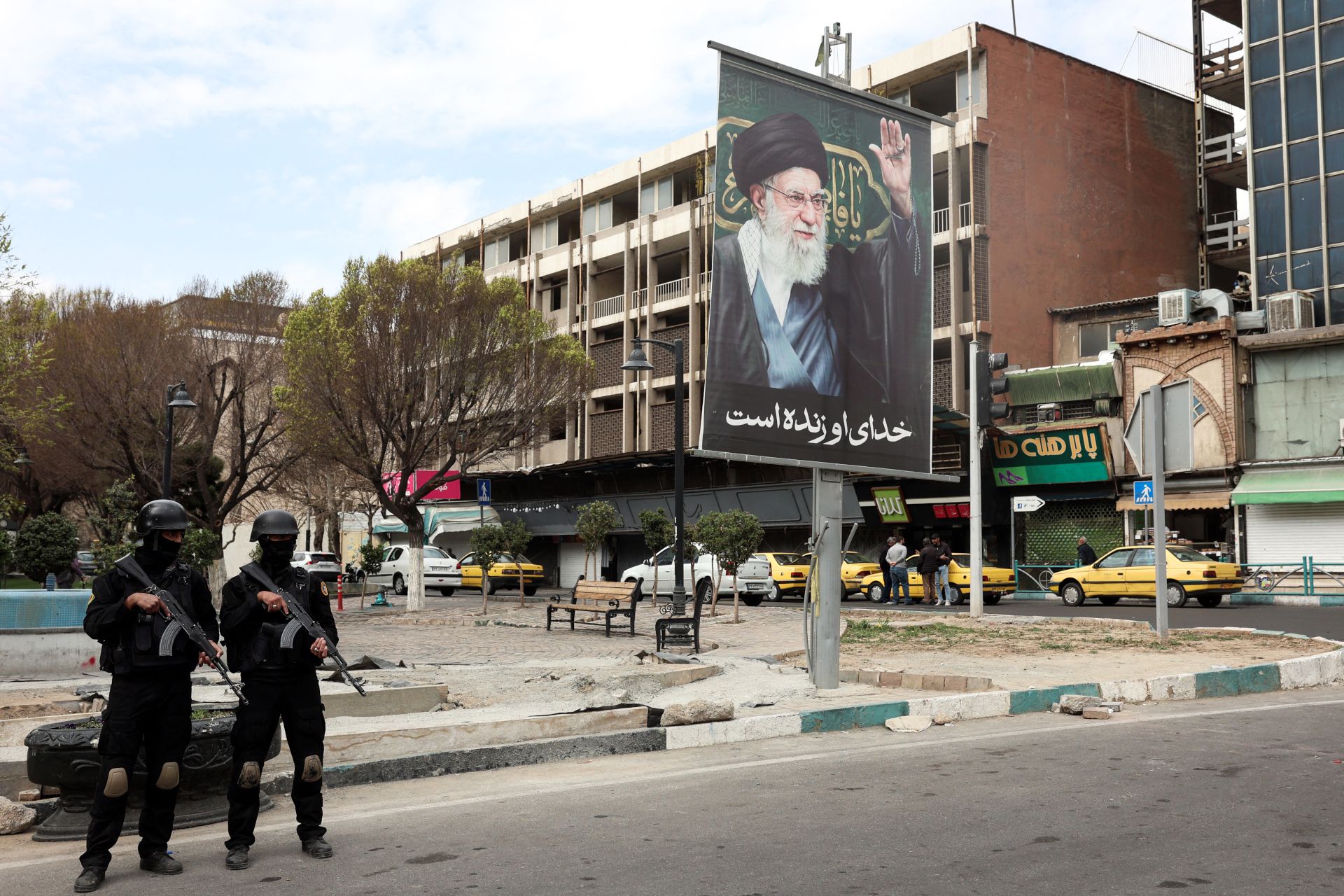
The 13th-century Persian poet Saadi once offered a prescient warning: “He who would not practice statecraft with his foe will not be able to maintain his rule.” It is a maxim Ayatollah Ali Khamenei chose not to heed. “The enemy” was among the most frequently invoked terms in the lexicon of Iran’s late supreme leader — most often directed at the United States and, at times, Israel. In the end, those very adversaries brought his 37-year rule to a close.
Many Iranians, both inside the country and across the diaspora, have celebrated his death. The passing of the Middle East’s longest-serving autocrat has generated a wave of euphoria and renewed speculation about regime change. In a political culture where hope springs eternal, some now interpret his demise as the down payment on a democratic transition.
But this optimism is premature. The end of a ruler does not automatically signify the end of a regime. It marks the beginning of uncertainty — and uncertainty, in Iran’s case, may prove more destabilizing than either triumph or defeat.
The Islamic Republic of Iran has demonstrated remarkable institutional resilience. Born of a mass revolution, it fused ideological commitment with organizational depth. The theocratic-authoritarian hybrid regime has shown considerable elasticity over 47 years. Although Khamenei functioned as its spinal cord — mediating factional rivalries, arbitrating elite disputes and preventing the rise of serious challengers — the Islamic republic was never a “one-bullet state.” Its stability did not depend solely on one man.
To understand Khamenei’s role, and what the Islamic republic loses with his death, one must understand what it took for him to become Khamenei.
In his adolescence, Khamenei — who would retain a lifelong interest in poetry and literature — developed an affinity for the works of Kahlil Gibran, whose popularity in Iran reached its zenith in the 1940s and 1950s, particularly in modernist and romantic literary circles. The period between the abdication of Reza Shah Pahlavi in 1941 and the 1953 coup that deposed Prime Minister Mohammad Mossadegh and returned Mohammad Reza Shah Pahlavi to power was a period of relative political openness, ideological contestation and an expansion of print culture. By the 1950s, literary modernism had become the dominant idiom among urban intellectuals in Iran. Khamenei translated “A Tear and a Smile,” a collection of poems, parables and stories by the Lebanese-American author, first published in Arabic in 1914.
A decade later, Khamenei had moved on to rendering the writings of Sayyid Qutb, the principal theorist of the Muslim Brotherhood, translating the Egyptian thinker’s “In the Shade of the Quran” and “Islam: The Religion of the Future” into Persian. This intellectual shift — from literary modernism to Islamist revolutionary thought — mirrored broader currents within Iran’s intellectual milieu, where nativist, Islamist and Third Worldist discourses were gaining traction and reshaping the contours of political imagination. (I examine these dynamics in my book “Iranian Intellectuals and the West: The Tormented Triumph of Nativism.”)
Coming from this background, Khamenei was not, at the outset, an unequivocal champion of the doctrine of absolute “velayat-e faqih” or “guardianship of the jurist,” a Twelver Shiite political-legal doctrine first systematically articulated by Khomeini in around 1970 that vests governing authority in a qualified Islamic jurist (faqih) during the occultation of the Twelfth Imam — and which became the constitutional foundation of the Islamic Republic of Iran. In January 1988, while serving as president, Khamenei delivered a Friday sermon in which he advanced a narrower reading of Islamic governance, arguing that the state’s authority to impose binding conditions must operate within the framework of established Islamic rulings. This interpretation of velayat-e faqih triggered a public rupture between him and Khomeini.
Khomeini responded with an unusually sharp rebuke, insisting that the Iranian state — grounded in absolute guardianship — possessed authority that could override even primary religious obligations, including the pilgrimage, when required by state interests. The exchange clarified the hierarchy: absolute guardianship was not merely supervisory but could supersede subsidiary rulings. Within days, Khamenei acceded to Khomeini’s interpretation.
Thirteen months later, in February 1989, he was publicly upbraided again. After Khamenei suggested in a Friday sermon that Salman Rushdie’s repentance might create grounds for clemency, Khomeini issued an immediate and categorical denial, declaring that repentance would not void the death sentence.
The irony is striking. Twice reprimanded for circumscribing the scope of supreme authority, Khamenei would, after ascending to the leadership in June 1989, preside over — and further consolidate — the very doctrine whose expansive logic he had once appeared to question. In August 2000, when a reformist-dominated parliament was attempting to amend the press law, Ayatollah Ali Khamenei exercised his authority as supreme leader to block the bill from being debated, effectively stopping the proposed media reforms. By intervening directly and overriding the legislature’s agenda, he demonstrated his commitment to the expansive powers of the absolute supreme leader, powers that had taken him decades to make his own.
The succession to Iran’s supreme leadership has always unfolded through an opaque and highly managed decision-making process. If the Islamic republic survives the present crisis, its second leadership transition will occur under exceptionally adverse conditions: sustained aerial attacks by the United States and Israel, institutional attrition at the top of the regime and a restive citizenry increasingly prone to renewed and potentially more radical rounds of mass protest as state authority weakens.
How choreographed can such a transfer of power realistically be?
Formally, the Assembly of Experts is constitutionally entrusted with selecting the next supreme leader — the fulcrum of Iranian politics. In practice, however, it has never exercised unconstrained authority. The selection process has historically been shaped by a complex interplay of formal rules and informal mechanisms: elite bargaining, factional maneuvering, coercion, preemptive consensus-building and strategic cooptation. The Assembly ratifies outcomes that are typically forged elsewhere.
This transition differs from the first in one crucial respect. Key members of the supreme leader’s inner circle have been removed from the scene in the current airstrikes. Hence, they can’t deploy personal networks, arbitrate factional rivalries and broker compromises behind closed doors.
Three structural realities make the impending succession particularly consequential. First, there is no officially groomed or broadly acknowledged successor. Second, no senior cleric today commands independent religious gravitas or a nationwide social base distinct from the state apparatus. Third, there is no plausible candidate whose political record is sufficiently uncontroversial to generate elite consensus or public acquiescence.
These conditions open a series of unsettling questions. Will the assembly select an elderly conservative cleric — further widening the generational gap between ruler and ruled in a society that is young, urban, educated and digitally connected? Could factional divisions within the political and military elite harden into open splits during the selection process? Might such fractures trigger renewed unrest? And in the name of national emergency, could the Islamic Revolutionary Guard Corps (IRGC) intervene decisively — either by shaping or effectively overruling an “unfavorable” choice?
Whoever emerges as the next supreme leader will almost certainly begin his tenure weaker than Khamenei was at the end of his life. Popular disaffection has deepened, economic and institutional strains have multiplied and much of the first generation of revolutionary elites has been eliminated — whether through age, attrition or external targeting. The cumulative effect is a regime that retains coercive capacity but lacks the cohesion and charismatic authority that once underwrote its durability.
The current war has thus accelerated the succession crisis, but without any planning for what comes after. American and Israeli policymakers are yet to articulate a credible postconflict strategy, a coherent blueprint for what follows the air raids. President Trump’s exhortation to the Iranian public — “the hour of your freedom is at hand … once we are finished, take over your government” — is rhetorically powerful but strategically hollow. It is hardly obvious how an unarmed population, lacking an organized domestic opposition capable of functioning as a government-in-waiting, is to confront a regime that only recently demonstrated its willingness to slaughter protesters en masse.
Still, the removal of a “supreme” leader who monopolized ultimate authority inevitably creates a vacuum, and politics abhors such vacuums. The pressing question is not whether someone will attempt to fill it, but who — and with what legitimacy. Will Iran witness the elevation of a thinly credentialed but loyal apparatchik ayatollah? The consolidation of power by a Revolutionary Guards commander-turned-politician? Or the symbolic reemergence of an exiled royal claimant seeking to translate nostalgia into authority?
Much depends on how the current conflict concludes. A swift regime collapse followed by the orderly emergence of a peaceful democratic Iran is conceivable — but optimistic. The opposition remains fragmented, its factions divided by ideology, strategy and personality. Iran’s social fabric is marked by cross-cutting cleavages — economic, political, religious, ethnic — that do not neatly align. Such discordance rarely produces smooth transitions.
Conversely, a battered yet surviving Islamic republic would confront a different but equally daunting landscape: deteriorating infrastructure, severe fiscal strain, military vulnerabilities, legal ambiguities, intensified elite infighting and mounting demands for retribution and accountability. Internal purges could follow, as factions seek to distinguish “true believers” from revolutionary chameleons.
A newly appointed supreme leader — particularly one lacking religious gravitas — would face immediate structural disadvantages. In this scenario, the Revolutionary Guards are likely to emerge as decisive power brokers. Under the pretext of safeguarding national security during a period of heightened instability, they may attempt to concentrate agenda-setting authority in their own hands, reducing the new leader to a legitimizing figurehead.
Iran is thus entering uncharted territory. The succession will not merely determine who occupies the apex of power; it will test whether the institutional architecture of the Islamic Republic of Iran can reproduce authority without the stabilizing presence of a long-entrenched leader.
Albert Camus once observed that every revolutionary ultimately becomes either an oppressor or a heretic. Khamenei chose the former path. With his passing, 90 million Iranians are left to reckon with the political order he shaped, the institutions he fortified and the unresolved contradictions he leaves behind.
Become a member today to receive access to all our paywalled essays and the best of New Lines delivered to your inbox through our newsletters.