


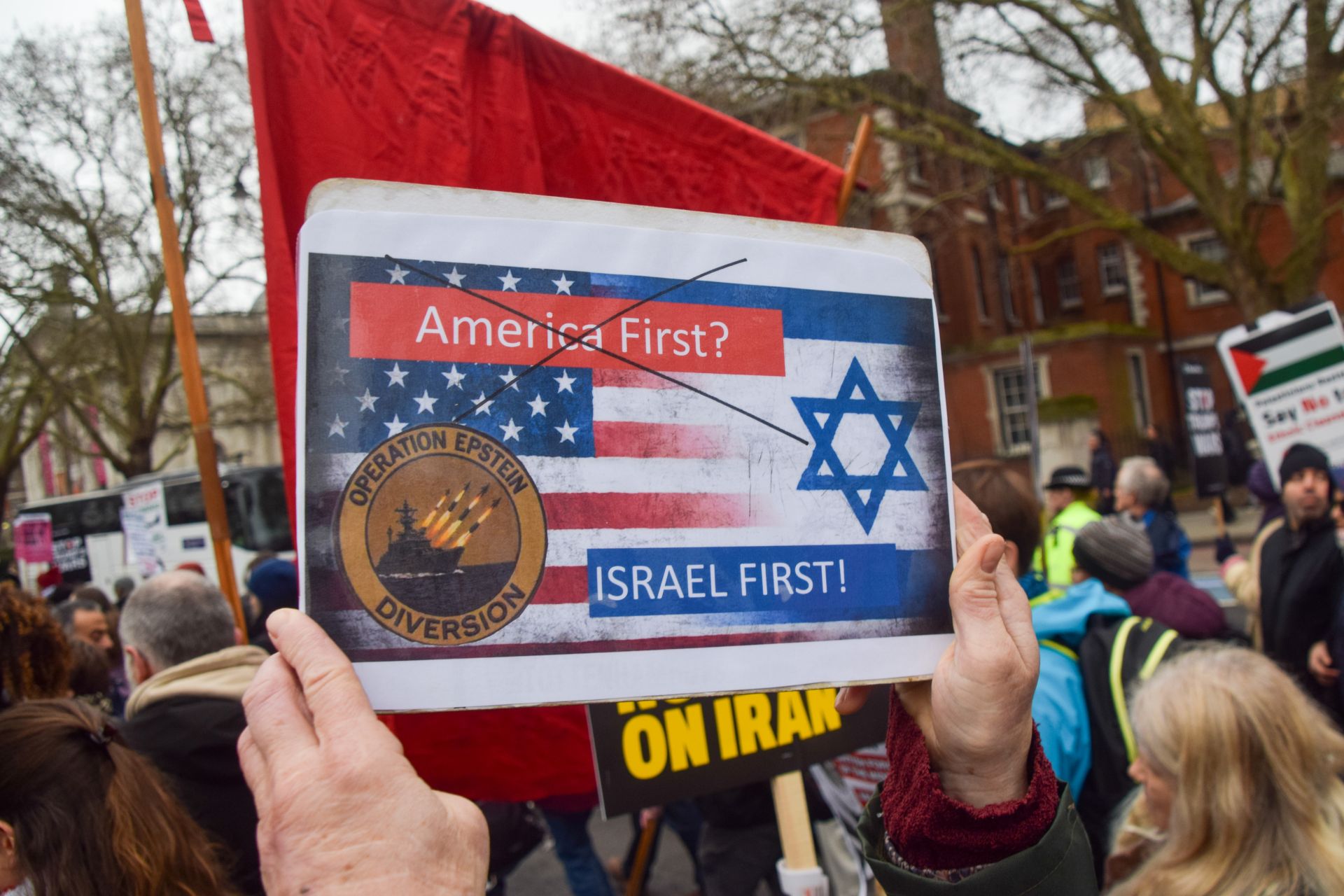
Much of the MAGA base, the Western left, Global South solidarity networks and the Iranian regime itself have converged, improbably, on the same talking point: The Iran war is not “America First.”
A Bloomberg headline declared it “America Second, Israel First.” Former Republican representative Marjorie Taylor Greene told journalist Megyn Kelly that American soldiers were “dead and murdered for foreign interests.” Matt Walsh stated, “As Americans, the freedom of Iranians is not our responsibility. If a single American life is lost in the service of that goal, it will be a travesty.”
“The U.S. military is now attacking Iran not because our nation faces an imminent threat but because the Israeli government has long sought confrontation with Tehran and has finally found a willing partner in Washington,” wrote Hussam Ayloush, the CEO of the California chapter of the Council on American-Islamic Relations (CAIR-CA). This sentiment is echoed in the Progressive International, the South African Federation of Trade Unions and the Brazilian leftist Socialism and Liberty Party (PSOL), which denounced “U.S. imperialism and Israeli Zionism” on the “path of war and barbarism.”
Iran’s temporary leadership council labeled the intervention a betrayal of “America First” and the adoption of “Israel First” foreign policy. The late secretary of Iran’s Supreme National Security Council, Ali Larijani, Iranian Foreign Minister Abbas Araghchi and regime-adjacent analysts worldwide have been quick to frame the strikes as Israel’s war, fought with American bodies and money.
Here is why they are all wrong. The Iran war is actually the purest expression of America First, its direct consequence. America First literally means American interests first.
America First has conventionally been read as isolationist — withdraw U.S. troops, focus on domestic energy reserves, stop fighting other people’s wars — but that confuses the slogan with the structure. In practice, America First can equally mean American interests first, pursued by whatever means are deemed expedient. Donald Trump was elected president for the second time against the backdrop of an increasingly persuasive narrative of Western decline: loss of hegemony as China advances, and growing challenges from BRICS and a Global South coalition that has gained purchase with non-Western audiences across the political spectrum and also with the intelligentsia and progressive commentariat in the West. Shoring up American interests against this backdrop means doubling down on hard power, securing reliable access to key resources (especially oil) and working transactionally with tried-and-tested allies to get quick, demonstrable results unencumbered by norms, consensus-building or the democratic drag of constructing legitimacy under international law.
This intervention also mirrors Trump 2.0 domestic policy. The turmoil in American politics since Trump’s return has been marked by comprehensive, multidimensional, rapid change: seeming chaos with an underlying agenda, prioritization of loyalty above all else, and the use of force where it is deemed necessary, riding roughshod over long-standing constitutional interpretations and societal norms. Fascist trajectories are revolutionary and are distinct from conservatism. While the parallel between domestic and foreign policy is not exact, Trump 2.0 applies the pattern of “you are either with us or against us” internationally to established NATO allies as much as to adversaries, in a way that is transactional and interest-based rather than grounded in shared values. The Iran war is a logical foreign policy outcome of Trump’s revolutionary project.
The Iran war confronts us with a set of paradoxes that need further reckoning. There is an inverse relationship between the scale of the legitimacy apparatus a state seeks for its interventions and its operational agility. Put simply, the more legitimacy a state seeks, the less agile it becomes. The 2003 Iraq invasion required U.N. debates, weapons inspectors, a “coalition of the willing” and a maximalist theory of democratic transformation — all of it slow, visible and committed to objectives it could never achieve. The ideological objectives created mission creep by generating new obligations. The ongoing Iran war has required none of that. The distinction here is not ideology versus no ideology, but transformative ideology (we will rebuild Iraq as a democracy) versus transactional ideology (we will achieve specific aims and leave). A transformative ideology generates obligations outlasting the operation, while a transactional ideology defines success narrowly enough to declare victory and move on.
Freed from the legitimacy apparatus that doomed earlier interventions, the attack on Iran advanced its initial objectives with a speed and precision that interventions committed to democratic ideology cannot match. Iraq and Afghanistan demonstrated a pattern of escalating commitment. The same indifference to democratic process that makes Trump’s domestic agenda destructive is precisely what made the Iran war effective in eliminating key regime figures. Legitimacy processes don’t prevent targeted killings, but they generate obligations such as reconstruction, democratization, coalition maintenance, etc., that outlast the operation itself and define its failure in terms that the operation never needed to accept.
This is an analytical starting point that both critics and supporters refuse to accept. Critics refuse to acknowledge that the Iran war is more operationally agile than any legitimacy-burdened intervention could be, and that this effectiveness is connected to the abandonment of democratic process, thus viewing it in identical terms to previous U.S. wars. On the other hand, supporters of the present war refuse to acknowledge that it has the same qualities that make Trump’s domestic agenda dangerous.
Furthermore, the stated U.S. objectives have been presented in inconsistent and contradictory terms — “no nation building” one moment, flirting with “boots on the ground” another, “this is your moment” to Iranians, “the war is very complete, pretty much” followed hours later by “we haven’t won enough” — looking like confusion. Whether this reflects deliberate strategic ambiguity or improvisation dressed as strategy, the functional effect is the same: Like the tariff reversals, where abrupt shifts in position serve those who benefit from uncertainty, the moving target of aims keeps adversaries guessing and allows multiple outcomes to be claimed as wins.
And then there is the most uncomfortable paradox of all. The commentary class has been quick to file this under imperialism. In doing so, they deny Iranians the agency to interpret their own moment. Iran has had a brutal, deeply misogynist and tyrannical regime that has slaughtered protesters, been a globally leading executioner state, and helped the Assad regime commit crimes against humanity and industrial-scale torture. It has repressed its people across decades of protest and revolt: the Green Movement in 2009, the economic uprisings of 2017-2018, the fuel price protests of 2019, the Woman, Life, Freedom movement of 2022 that was ignited by Mahsa Amini’s death in morality police custody. And, most recently, the massive December 2025-January 2026 uprising, the largest in Iran since 1979, which the regime quelled with methods modeled on Tiananmen, killing thousands. Each time the Iranians rose, they were crushed, with the regime offering no opening.
Trump’s policies are widely resisted by Americans, and there has been media, institutional and judicial pushback (from federal court injunctions to congressional resistance to sustained press scrutiny), because the democratic setup allows it. Iranians do not have that luxury. Iranians are simultaneously the potential beneficiaries of regime disruption and the victims of the war itself, a duality that cannot be resolved from the outside on their behalf. This war may not end with greater freedoms for them, but it could — and that possibility, arriving through an intervention led by Trump, is what many globally find impossible to acknowledge.
When Iranian Americans celebrate in Times Square, and Iranians take to the streets in Karaj and Isfahan, to dismiss their celebrations as misguided and treat them as dupes who don’t understand their own interests is to erase the agency of those Iranians. Iranians who express relief and are celebrating the attack on the regime are fully aware of the civilian toll. They have friends and family members who have been in prison and killed in many previous uprisings. When they celebrate, it isn’t because they are clueless about the cost, but because they weigh it against 47 years of living under a brutal, suffocating regime and have formed their own conclusions. External commentators who override that calculus on their behalf reproduce the very imperial logic these commentators claim to oppose.
What does a transactional intervention look like in practice? Iran’s response to the strikes has confirmed its strained trajectory. The appointment of Mojtaba Khamenei, the son of the late supreme leader, as his successor indicates regime reconsolidation in dynastic form: Ironically, a theocracy formed after toppling a monarchy in 1979 has now become a monarchy itself in all but name. The Islamic Revolutionary Guard Corps (IRGC) has declared that Iran, not the United States, will determine when the war ends. Yet Iran’s multifront retaliation (striking nine countries within 36 hours, attacking mediators and neighbors alike, closing the Strait of Hormuz not via sustained naval blockade but by selective strikes on tankers for insurers to cancel coverage, using threats to commercial viability rather than military control) signals not strength but disintegration. With its ballistic missile launch rate down over 90% from the opening day of the war, its missile production facilities under systematic bombardment, its navy effectively destroyed and its state broadcaster targeted, the regime is burning through every asset without strategic sequencing. The strike on a girls’ school in Minab, located near an IRGC naval compound, produced the war’s most devastating civilian toll, and raised as yet unanswered questions about whether the compound was the intended target or whether outdated intelligence failed to account for the school’s presence.
The regional dynamics reveal an unprecedented exhaustion with the politics of Iran and its proxies, even as regional actors remain loath to welcome an American-Israeli operation. The UAE has withdrawn its ambassador from Tehran and closed schools nationwide. Qatar is trapped between hosting Al Udeid, the largest U.S. air base in the region, and absorbing Iranian strikes. Bahrain’s state oil company has declared force majeure, legally suspending contractual obligations due to extraordinary circumstances. Saudi Arabia, under the Strategic Mutual Defence Agreement with Pakistan, faces pressures it has never before confronted. Iran has even targeted Azerbaijan and Turkey. In a strategic gift of desperation, Iran is making Gulf Cooperation Council consolidation easier by attacking everyone indiscriminately.
Meanwhile, Hezbollah’s decision to enter the war was arguably more about organizational survival than ideology, since it stands to lose its patron and supply line from Iran. Its actions have provoked a backlash and division in Lebanese politics and also led to numerous Israeli strikes across Lebanon, displacing hundreds of thousands. The Houthis, notably, have remained restrained, issuing subdued political statements rather than military action, influenced by their 2025 ceasefire with the United States. The architecture of Iranian proxies that sustained the regime’s regional reach is fracturing under the weight of a war it cannot win but refuses to lose.
The underrecognized second-order threat is European paralysis. European allies are caught between anti-Trump sentiment (considerably strengthened after the Greenland affair) and the need to perceive and address the challenge to a broader Western alliance from hostile adversaries like Russia and rivals like China. Macron has visited Cyprus and declared that an attack on the island is an attack on all of Europe, after drones struck the British military base at Akrotiri. NATO forces have shot down Iranian missiles entering Turkish airspace. The E3 statement from German Chancellor Friedrich Merz, French President Emmanuel Macron and U.K. Prime Minister Keir Starmer threatened proportionate military measures to suppress Iranian missile capability at source. Yet Europe was informed minutes before the strikes began, and Starmer has said he does “not believe in regime change from the skies.” European engagement is essential for supporting any potential transition, should one occur, and managing the destabilization now rippling across the region. But Europe cannot formulate a coherent position because it is being asked to simultaneously condemn the method, welcome aspects of the outcome and plan for an aftermath it had no hand in shaping. European paralysis is itself a product of the America First approach: An intervention designed without allies cannot expect allies to manage its aftermath.
If “America First” can pivot from Iran toward the real strategic competitor, China — whose influence expands in precisely the regions this war disrupts — then the intervention resets the board. But China is positioned to gain regardless of outcome: leverage if Iran stabilizes under Mojtaba Khamenei, influence if it fragments, strategic advantage if the United States gets bogged down. There is no significant downside for Beijing, barring temporary energy supply disruption.
This may be the Achilles’ heel of “America First” foreign policy pursued in this manner: It can kill a supreme leader and destroy much of a regime’s military capacity with stunning efficiency and yet may not be able to prevent the strategic competitor from harvesting the aftermath. The capacities that made this intervention effective (speed, transactional indifference, minimal institutional constraint) are the opposite of what the aftermath requires. Shaping a stable postwar order in Iran and the region demands patience, institutional design and orchestration that transactional interveners are constitutionally incapable of providing alone. For Iranians, whose agency matters most and is discussed least, the question is no longer whether this was right or wrong. It is who fills the space now, and whether anyone planned the aftermath with the same precision as the intervention.
Become a member today to receive access to all our paywalled essays and the best of New Lines delivered to your inbox through our newsletters.