


Since March 12, Israel has bombed and destroyed at least eight of the bridges that traverse Lebanon’s Litani River, which is the unofficial boundary that divides the southernmost region from the rest of the country. Satellite imagery shows gashes and even gaps of thin air between sections of the bridges. The Israeli government claims that the purpose of the destruction is to sever a central transit artery used by Hezbollah, the Iranian-backed militia, to transport weapons, including rocket launchers that are used against civilian targets in Israel.
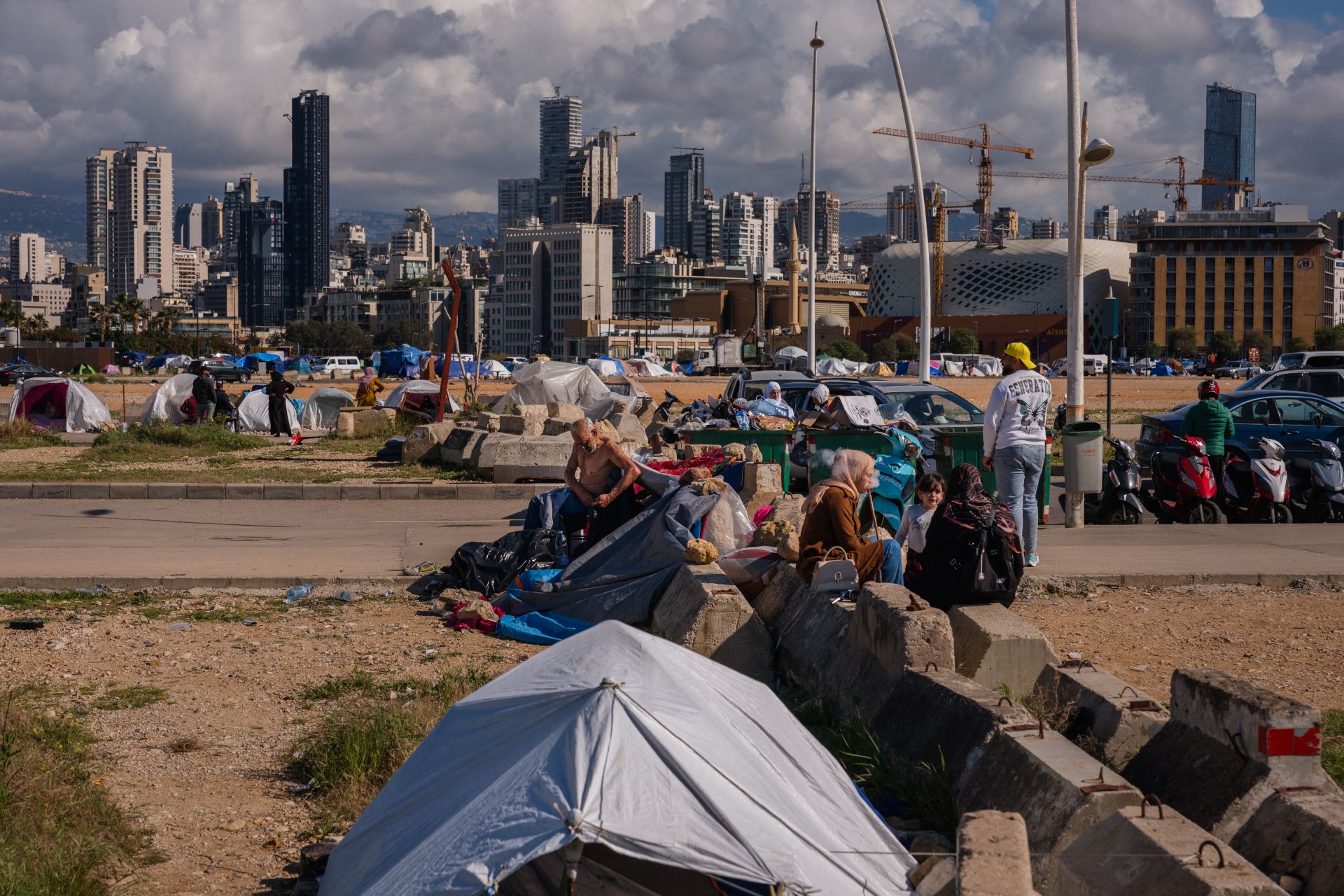
In Lebanon, the Israeli airstrikes are causing chaos, with mass destruction and displacement. Even before Israel’s punishing airstrikes on April 8, hours after a ceasefire was declared with Iran, over 600,000 civilians had fled from the south following the Israeli army’s demands to evacuate. The war has displaced more than 1 million, out of a total population of roughly 5.8 million. Many were already displaced by earlier fighting in 2023 and 2024, and now fear that, with the bridges destroyed, they might never be able to return to their homes.
President Joseph Aoun has called Israel’s actions a “war on Lebanon,” pointing out that, while Israel says its fight is only with Hezbollah, the destruction and chaos affect the entire country. Earlier in March, in a post to his official account on X, Aoun called the bombing of the bridges on the Litani a “blatant violation of Lebanon’s sovereignty.”
Why does Israel so often seem to be pursuing tactics aimed at weakening states in the Middle East, particularly in Lebanon, Syria and now, at least according to Prime Minister Benjamin Netanyahu, Iran? Does Israel have a weak-state doctrine? If so, it may be ignoring the dangers weak states pose — to the people who live in them, to Israelis, to the region, and even to Israel’s own tactical goals.
Lebanon is a weak state. In 2024, the last available year, the Fragile States Index ranked it 23rd out of 179, with Syria ranking fourth and Yemen sixth. The nonstate actors that make up Iran’s “axis of resistance” thrived in these weak states. Hamas, which flourished in Gaza largely thanks to funding from Iran, led the Oct. 7, 2023, attack on southern Israel that sparked the ongoing Middle East wars. In 2023, Palestine was in the “high warning” category of the index, although neither Gaza nor the West Bank is defined as sovereign territory, since the authorities that govern them do not control the borders, currency, security, freedom of movement or resources.
Sanam Vakil, director of the Middle East and North Africa program at Chatham House, said in an interview conducted on Oct. 24, 2025, that the Iranian-allied militias Israel dreads flourish in such states. These nonstate militias “are taking advantage of the weakness of states,” she said, to embed themselves in host countries and amass power. Academics debate the exact relationship between weak or failed states and the existence of nonstate militarized actors, but there is broad agreement that, in weak states, they find the space to survive and thrive.
In its quest to disarm and destroy Hezbollah, Israel received an unprecedented overture from Aoun, who has offered to negotiate to coordinate the disarmament of Hezbollah. Instead of accepting the offer and entering negotiations, Israel’s defense and finance ministers for weeks said openly that they want to impose an indefinite military occupation on southern Lebanon, recalling Israel’s ill-fated 18-year occupation from 1982 to 2000. Hezbollah grew out of that occupation, positioning itself as the head of the resistance and establishing a de facto statelet in southern Lebanon. On Thursday, for the first time, Netanyahu said that he had instructed his cabinet to open the negotiations — only after carrying out far-reaching attacks that undermined the state throughout the war.
Orna Mizrahi was Israel’s deputy national security adviser for foreign policy until 2018 and is now a senior researcher at Israel’s Institute for National Security Studies (INSS), an independent think tank affiliated with Tel Aviv University. She told New Lines that the Israeli establishment has been wrestling for many years over whether weak states or strong states are better for Israel’s security. “There’s always some tension between those who prefer for neighboring states to be dealing with internal chaos and conflict, so they can’t free up to focus on you,” she said, “and those who argue we need states around us that are thriving, who care about their economy, who are interested in peace and security.” She added that, in her official roles, she generally preferred the latter.
But to illustrate the arguments favoring weak states from Israel’s perspective, Mizrahi pointed to Syria during her time at the National Security Council. During Syria’s civil war, from 2013 to 2024, Israel carried out hundreds of airstrikes to prevent Hezbollah from transferring weapons overland from Iran to Lebanon via Syria; these airstrikes surely undermined the Syrian state. When the opposition led by Syria’s current President Ahmad al-Sharaa finally ousted Bashar al-Assad and his Baathist regime in 2024, Netanyahu openly claimed some of the credit.
Another common theme among Israeli analysts is that a state busy with its own internal chaos has reduced capacity to act against Israel. In the current war with Iran, Israel clearly hoped for regime collapse, said Raz Zimmt, head of the Iran program at the INSS. Neither he nor Vakil from Chatham House would predict that the current war could bring about that goal, and as of the ceasefire Wednesday morning, this has not happened. But, Zimmt said, “it’s completely clear that Israel prefers a weak state with a reduced capacity for rehabilitation.” Mid-way through the five-and-a-half weeks of fighting, he posited that Israel might even look to ethnic groups that threaten Iran’s territorial integrity as a means of causing strife that drains the regime’s resources. Given the current Iranian regime’s enduring hostility to Israel, there is a logic to weakening such a state. The irony is that the regime may have actually gained advantages due to the war, in the form of leverage and simple survival, despite Netanyahu’s insistence that Iran has “never been weaker.”
Zimmt does not believe that Israel prefers weak states as a rule, pointing out that the country benefits from strong states in Egypt and Jordan, which have long-standing peace treaties with Israel. Israel’s interests can be characterized as states that are “strong, but not strong enough to challenge Israel, and on the condition that their outlook is consistent with Israel’s.” That sounds logical but probably can’t be engineered.
Israel might not have a consistent weak-state doctrine, but its actions give the appearance that it does. And the government appears to underestimate the far-reaching negative consequences of these actions.
“Wherever there’s chaos, it’s grounds for the growth of negative elements,” Mizrahi said. There are plenty of recent examples. Elizabeth Tsurkov, a fellow at the New Lines Institute and a doctoral student at Princeton University, noted in a March 26 post on X that “Israel tried destroying Lebanese state infrastructure in the disastrous 2006 war and this did not help weaken Hezbollah.” She described Israel’s attacks on the Litani bridges as “wrong and counterproductive.”
Bader Mousa al-Saif, an associate fellow at Chatham House who specializes in the Gulf, echoed Tsurkov’s analysis. He told New Lines that Israel’s fresh incursion into Lebanon “is empowering these [Iranian] proxies, they are now seen once again as the resistance.” He added: “By occupying more Lebanese territory, you’re throwing yourself into the arms of those actors.”
Dania Koleilat Khatib, a Middle East expert and columnist at Arab News, explained why: “More and more people believe that … [Israel] wants to isolate the south from the rest of the country and wants to annex it.” Khatib confirmed that some Lebanese were becoming more anti-Hezbollah, since the group started this war by initiating rocket and drone attacks on Israel as an expression of support for Iran. But, she added, a greater number of people saw the Lebanese central government as impotent, meaning “the only choice was the resistance” — i.e., supporting Hezbollah.
In addition to improving Hezbollah’s image, Israel’s current actions in Lebanon will cast a long shadow over opinions of Israel in the region. In response to questions sent by a messaging app, Khatib wrote that “there is a belief that [Israel] does not want a strong state that stands up to Hezbollah. They want a weak state where they have freedom of operation.” That fuels suspicions in the Middle East about Israel’s aims: “Everyone in the region believes Israel is executing its greater Israel project,” Khatib said.
Numerous examples in recent history demonstrate the dangers of weak-state chaos in the Middle East.
Immediately after the fall of Saddam Hussein, Iraq was too weak and chaotic to threaten Israel. But that chaos created the space for it to become a staging ground for Iran-backed militias. One of them, an Iraqi Shiite group called Kataib Hezbollah, took Tsurkov, who is an Israeli citizen, hostage in March 2023 and held her until September 2025, subjecting her to months of brutal torture. On March 31 this year, the group abducted Shelly Kittleson, a freelance journalist from the U.S. and a New Lines contributor, who was reporting in Baghdad. She has since been released.
Israel does not trust al-Sharaa, the new leader of Syria, largely because he once led an Islamist rebel group affiliated with al Qaeda. Senior figures in Netanyahu’s government have referred to him as a “terrorist in a suit.” But Ksenia Svetlova, director of the Regional Organization for Peace, Economics and Security (ROPES) and a former Israeli parliamentarian and journalist, warned in a 2025 article that Israel’s interventions could make Syria’s internal strife worse, “by keeping the state from being able to exercise that authority.” She recommended “supporting Syrian state-building efforts that serve regional stability.” She told New Lines that, if the U.S. weren’t holding it back, “Israel would have blown up the presidential palace a long time ago.”
Weak or failed states can remain chaotic long after foreign occupation ends, Tsurkov told New Lines. Reluctant to give up the power they have accrued, nonstate actors often continue to erode the state and prevent it from reconstituting. This has been the case in Lebanon, where Hezbollah refused to disarm or give up its state-within-a-state for decades after Israel withdrew its forces in 2000. A Lebanese academic in Beirut who preferred not to be named sees this dynamic in the current crisis. Responding to questions sent to him via a messaging app, he wrote that Israel hopes the mass displacements will lead to internal clashes against Hezbollah, “transforming the problem into a domestic intra-Lebanese one.”
Another dangerous example for Israel is far closer to home.
Even before the Oslo Accords created the skeletal structures of a hypothetical Palestinian state, Israel’s policy was to weaken any powerful Palestinian political actor. To that end, it tolerated or even enabled Hamas in its earliest years, to counter Yasser Arafat’s Fatah movement. By the mid-1990s, Hamas posed the greatest threat of militant attacks against Israel.
Over the years, Netanyahu has systematically stripped both power and legitimacy away from the Palestinian Authority (PA), which Hamas kicked out of Gaza in 2007, by playing Hamas and Fatah against one another. To this end, prior to Oct. 7, 2023, Netanyahu famously encouraged Qatar to support Hamas with monthly cash injections of approximately $30 million. Netanyahu avoided engaging in any diplomacy that would have created an actual, centralized Palestinian state — a process that would have strengthened the PA’s legitimacy as well. Accordingly, Hamas flourished in the stateless, jobless, hopeless land of Gaza. And on Oct. 7, Israelis paid the price.
Despite Netanyahu’s glowing promises of further regional normalizations, which he repeated again in a March 30 press conference, the Palestinian issue will continue to be an obstacle. “Palestine is key for everyone,” said Chatham House’s al-Saif, referring to the Gulf states. “Our issue is occupation, and the Arab states have been framing that as an issue. We want the occupation to end and to have a dignified life for everyone.”
And yet, when Mizrahi, the Israeli security analyst, spoke of her broad preference for flourishing states rather than weak ones prone to chaos, her examples included improving the economy and quality of life in Gaza by allowing laborers into Israel, as the government did from 2022 to 2023, prior to Hamas’ attacks (alongside a tough security approach, she said). But that approach involves only small tweaks to the existing unsustainable situation of military closure and occupation, rather than a conceptual shift toward viewing Palestine as a future state, which could benefit Israel’s foreign relations — and probably its security as well.
Israel isn’t the only country to sabotage states in the region. The U.S. war took down Saddam Hussein in Iraq, but led to what Tsurkov describes today as a “failed state.” She also observed that the main power undermining the Lebanese state over recent years was not Israel but Iran, by supporting Hezbollah.
Ironically, Iran could be Israel’s greatest cautionary tale. Its axis of allies was intended to create strategic depth and keep conflicts off Iranian soil. Instead, Vakil said, “the axis of resistance ultimately led to a sort of rebound or boomerang effect.” Over the past three years, Hamas, Hezbollah and the Houthis spurred the region’s most cataclysmic war, resulting in Iran’s nightmare of multilateral waves of assaults and the decapitation of its regime, right at home.
Israel’s government nevertheless now touts a doctrine of holding security zones in Gaza, Lebanon and possibly in Syria, while openly annexing the West Bank. These actions are a sure way to undermine and weaken these states or entities. Israel does not seem to have an alternative long-term approach — one that advocates strong centralized states, open to diplomacy and cooperation with Israel, as the leaders of both Syria and Lebanon have offered. And there’s no evidence that any Israeli leader is calculating the risks of engineering chaos.
Become a member today to receive access to all our paywalled essays and the best of New Lines delivered to your inbox through our newsletters.