


“I’m just getting back from work,” whispered Soumaya Said, as she took her place on the couch in the Caesar Families Association’s Damascus office. She was slightly out of breath and excused herself for being late.
Her large, round, brown eyes were compassionate, yet her countenance conveyed a blend of sadness, anger and elation. “Three generations were born here. Three generations under injustice,” she started, referring to the Assad regime. “An injustice that can’t be described. When we saw Sednaya, when we saw the prisons, when we saw the babies not knowing who their fathers were — that’s all injustice — violation of the freedom of women, children and us, as the victims’ families. During the whole time we had lost them, we didn’t know whether they were coming back, nor could we even ask. Me? I lost my husband [who was taken] from his own ministry.”
Majd Al-Boukai, a journalist assisting with the translation, respectfully interjected, acknowledging her story, her children and her late husband. He politely asked her to state her name and occupation first. She adopted a relaxed posture and smiled.
“My name is Soumaya Said. How old am I? I am 100 years old,” she said, laughing and pushing her sunglasses back on her white veil. The mother of four is 50 but feels double her age, particularly since her husband was taken from her.
It was on a cold day, Feb. 20, 2013. “Asinat [one of their two daughters] was 10 months old when we lost her father,” recalled Soumaya, the sadness spreading across her face. On that day, Mohammad, an engineer working for various organizations and at the Ministry of Agriculture, went to the ministry in Damascus for a meeting. He was never seen after that, according to his wife.
The couple used to take care of their children in the morning: Two would go with Soumaya, and the other two with Mohammad. But that day went differently. “My husband never went to pick up our children. My daughter asked, ‘Where is Baba?’” Soumaya broke into tears. On that day, their suffering began.
“First comes denial,” she added. “I always say: Any employee who enters the ministry and signs in should be given this as a security guarantee. When you sign in, the institution is supposed to protect you. But for 13 years, they lied to us. In Syria, every ministry is basically a branch of the security services. Every office has a security officer — not to protect you, no, but to watch you.” Then came the silence, the absence of answers, the chaotic pathways taken to look for him.
Twelve years later, she still recalls the name of the security officer to whom she repeatedly inquired about Mohammad’s location, acknowledging the potential risks involved. The war resulted in the demolition of her house. Following the displacement, she lived with limited family support and hoped that Mohammad, who would now be 55, would return. Yet he did not.
“I became the spouse of a terrorist. At work, I faced ongoing harassment and mistreatment. There was the Ministry of National Reconciliation, the Ministry of Justice. I subsequently visited the state TV station, where families of missing individuals were present and were required to complete relevant paperwork. They claimed they were looking for them. However, it was Syria’s state itself that had killed the missing,” she said. Her research led to extortion attempts in exchange for incorrect or misleading information.
“Let me tell you something: You never lose hope,” Soumaya said, her eyes fixed on us. A few weeks after the regime change, the Caesar Family Association published a link for the families of the missing. Soumaya entered Mohammad’s name into the system, and his details were immediately visible. Mohammad died after 26 days of detention, under torture.
“After we saw the photo, a volcano erupted in the house. I only wanted him back. I wanted to breathe. I would say: ‘When your father returns, I will tell him, “Take the kids; let me sleep.”’ Sleep is a blessing,” she said. Soumaya and her four children entered a new period of denial: Mohammad was not dead. He promised he would come back. Why wouldn’t he?
Estimates based on a variety of data indicate that between 100,000 and 300,000 people are still missing in Syria. The crime of enforced disappearance constitutes a human rights violation that contravenes international law. Consequently, the new Syrian government is legally bound to search for the missing individuals.
Enforced disappearances may constitute a war crime when committed in the context of an armed conflict. When such attacks are carried out as part of a widespread or systematic attack against the civilian population, they can be classified as a crime against humanity. On May 17, 2025, the Syrian authorities established two commissions to deal with past violence. The first was the National Commission for Transitional Justice. The second was the National Commission for the Missing and Forcibly Disappeared (NCM).
In the Old City of Damascus, Zeina Shahla, the latter commission’s media liaison, met us at a terrace cafe. She understood that the process can feel overly slow for families. “Many families ask us when we will have answers for them. It’s tough to tell them that it might only be in 10 years,” she said.
The NCM is working on several priorities: In addition to building solid infrastructure and expertise for the search for the missing, it also aims to support families in their pursuit of the truth. “We want to offer them legal and psychological support. We are building a national database of missing persons with the help of civil society organizations,” Shahla explained.
Transitional justice expert Mustafa Haid’s research emphasizes the risk of marginalization in the work of such commissions. In an article for Justice Info, he noted that the process has been top-down, with key actors excluded. Haid summarized the situation by quoting a family member of a victim: “Everyone talks about us, but no one talks with us.”
The ongoing challenge for families seeking their loved ones persists, even in the aftermath of the collapse of the Assad regime on Dec. 8, 2024. A few hours before Soumaya Said arrived at the office, we met with an elderly couple, united in their grief.
The father, Mohammad Ziad Sabbagh, proceeded toward the shelf where portraits of the missing are displayed. He retrieved his phone and showed a photograph of a man lying on the ground: “Do you see what they did to him?” The 70-year-old’s face bore deep lines of anger. His jaw tightened. In 2013, his son went missing on his way to work. His name was Mohammad Ehab Sabbagh. He was 25 years old.
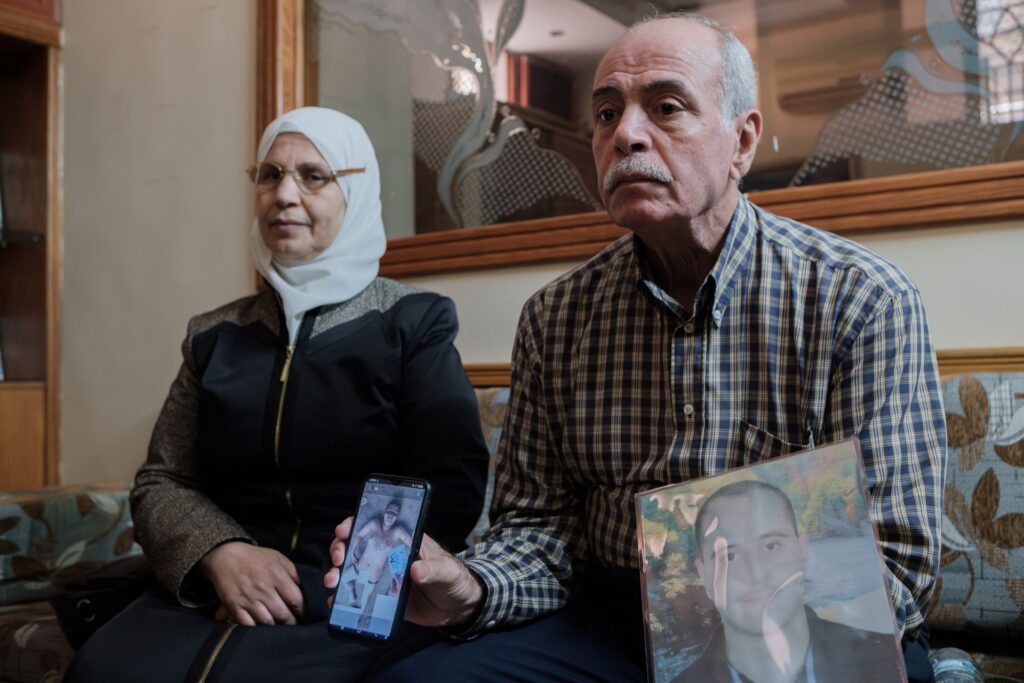
For over a decade, his parents navigated the complex bureaucratic processes and systemic corruption that prevailed under the Assad regime — years of extortion in exchange for false information. Then came the fall of the regime and, with it, the truth — shattering their hope of finding their son alive.
Ehab had passed away several years ago. “If you zoom in on the photo, you can clearly see the burn marks from cigarettes on his skin: on his forehead, between his eyes … everywhere,” the father said, struggling to find the words to express his emotion. Since then, they have been working tirelessly to locate his body and finally pay their respects. Um Ehab, the mother, who had been standing in her husband’s shadow and nodding as he spoke, finally lifted her head and broke her silence: “We want justice. We want to know where our son is — he vanished. … We want to find his remains and bury him.”
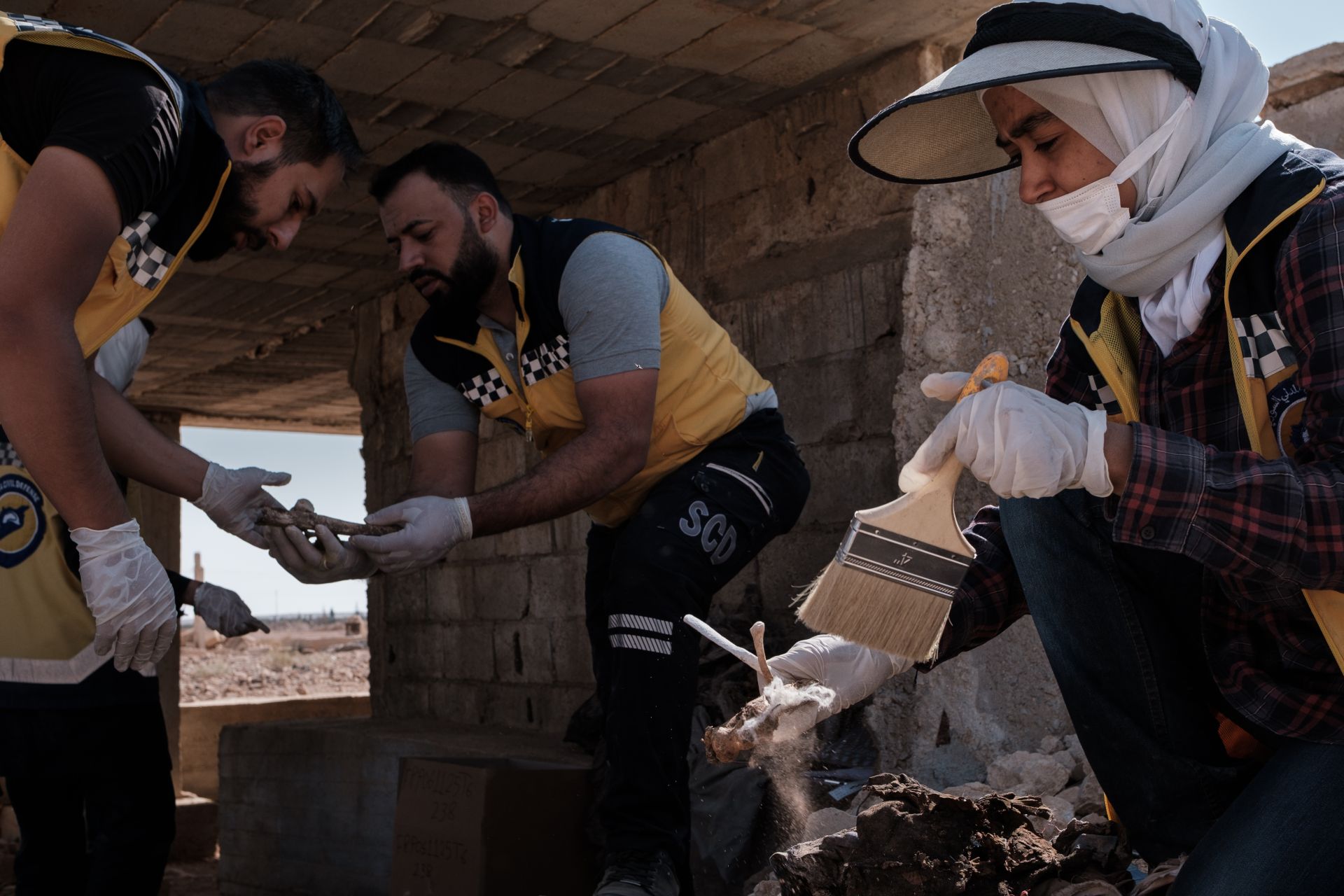
Under the bright sun of a November morning, trucks belonging to the Syria Civil Defence, more commonly known as the White Helmets, raced down a dusty road with blaring sirens.
Amid a landscape largely devoid of vegetation, substantial military structures dating back to the Assad regime are now used by the transitional government. One of the drivers navigated using a GPS point on his smartphone. When he reached the designated point and stopped, two men in casual clothing approached the White Helmets and entered the White Helmets’ vehicles. The trucks headed to a perpendicular dirt track leading to the remains of a house. In the distance, there was a view of a few ocher hills, a mosque and a power plant. Two weeks earlier, residents had discovered human remains in the countryside, approximately 20 miles from Damascus and close to the airport.
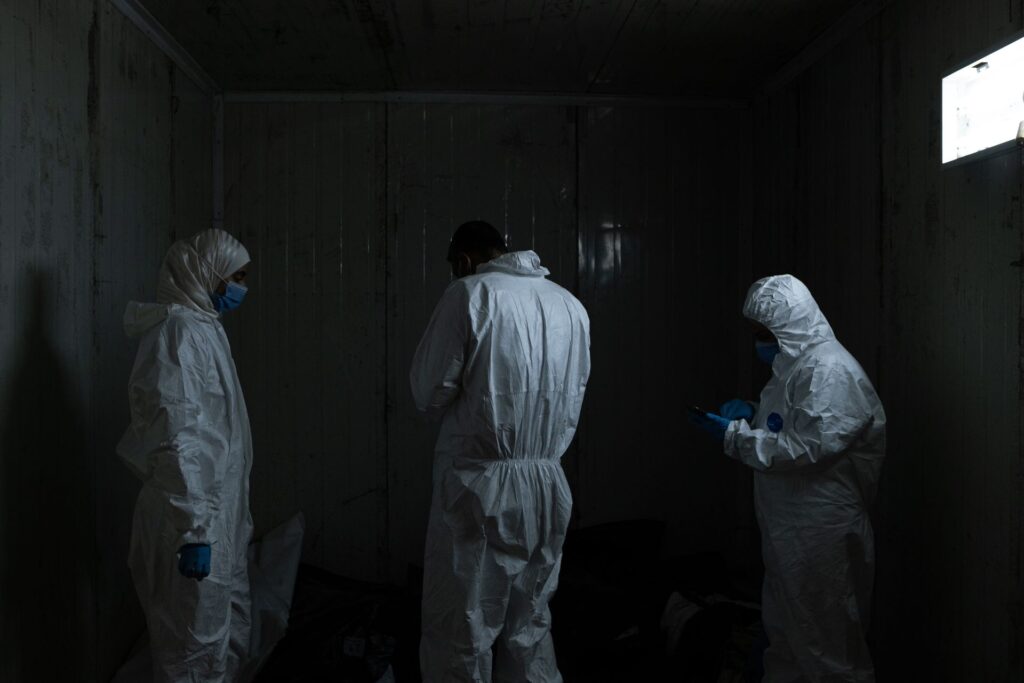
Upon discovery, the bodies were found to be buried beneath the earth and debris. “I believe they have been here since 2013, when executions were being carried out,” said Muhammad Hamadeh, 30, from the village of Bitariyah. He directed the rescuers to the location, where various bones were found, including femurs, a skull and a jawbone, covered in dirt and rags. The area was secured. The bones were inspected on-site, dusted off, then sorted by type and placed into bags and cardboard boxes. They were then sent to the missing persons identification center in Damascus.
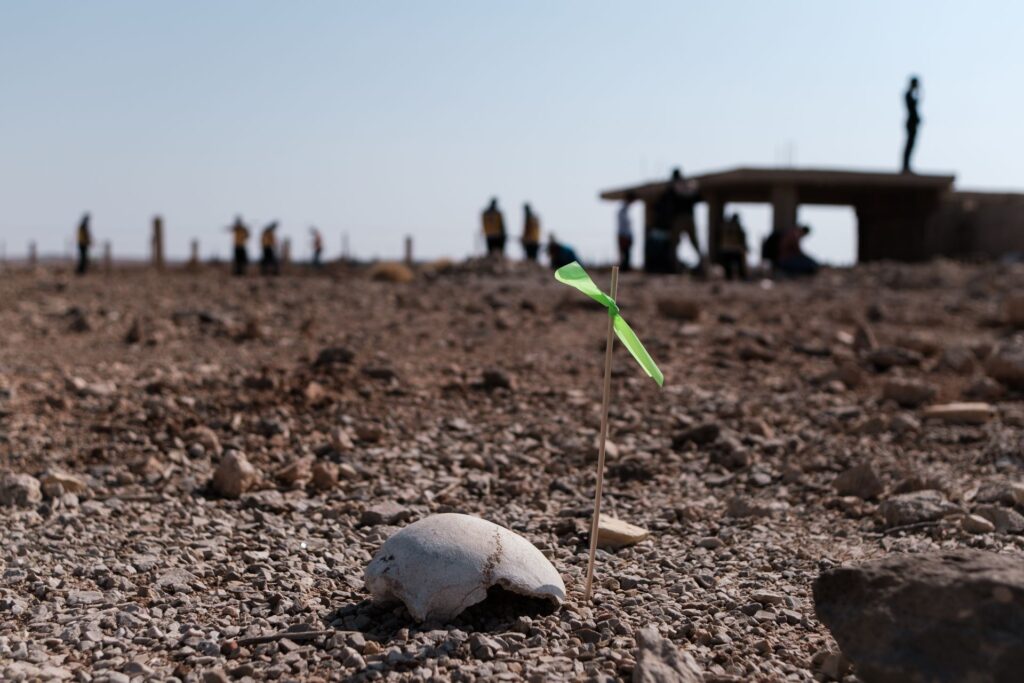
“At least once a month, one or two sites like this are discovered,” explained Sarah Melhem, a fourth-year student of forensic medicine at the University of Damascus and member of the White Helmets’ missing persons research team. “We are only talking about surface sites at this time, not mass graves.”
Syria lags significantly in the field of forensic medicine, and urgently needs resources, technical support and expertise. The commission collaborates with several international organizations to meet its needs. Before starting the digging of mass graves, the government is taking measures to locate them.
“This process demands patience, robust technical expertise, and comprehensive training,” said Mohamad Aswad, a member of the National Commission for the Search for Missing Persons. “It is also essential to raise awareness among families, journalists and all relevant stakeholders. We must exercise caution and respect at these sites. They are crime scenes. No individual or entity should be permitted to violate these principles or undertake unauthorized excavations.” So far, more than 60 mass graves have been located by the government, according to various media reports.
The commission has entered into a protocol with the Independent Institution on Missing Persons in the Syrian Arab Republic (IIMP) and the International Committee of the Red Cross (ICRC) to establish a framework and clear pathways for research into the disappeared. Those two organizations are meant to help them with the training on the forensic aspect, and will also support the families of the missing and forcibly disappeared.

“For example, in Bosnia, where I am from, we have 75% of the missing who have been identified in about 10 years. We are 30 years after the conflict, and bodies are still being both exhumed and identified, and there are still families waiting for answers. Some will never get any,” said Admir Jugo, forensic coordinator for the ICRC in Syria. He said that the organization has received over 30,000 requests from Syrian families, but that the ICRC’s role is to support the authorities, not to replace them.
The National Commission for the Search for Missing Persons is responsible for coordinating these operations. “Work is also starting to put in place specialized laboratories and morgues. The remains that are discovered will be received, sorted and the identification process will be handled. All of this takes time,” Aswad added. Therefore, while awaiting the commission’s full operationalization, the White Helmets persist in their fieldwork in open-air locations.
In the Damascus countryside, the sun was at its highest point in the sky. The White Helmets team discovered numerous bones, which were meticulously packed into black bags. “I am committed to doing everything I can to help with the search for missing persons,” Melhem said. For her, this work is not just professional or scientific; it’s an act of justice for her own people.
She then proceeded to adjust her mask and added: “Many Syrians were hopeful to be reunited with their loved ones after the fall of the regime. For many, that hope is now lost. This is why we search for remains: to allow families to remember the ones they loved.”
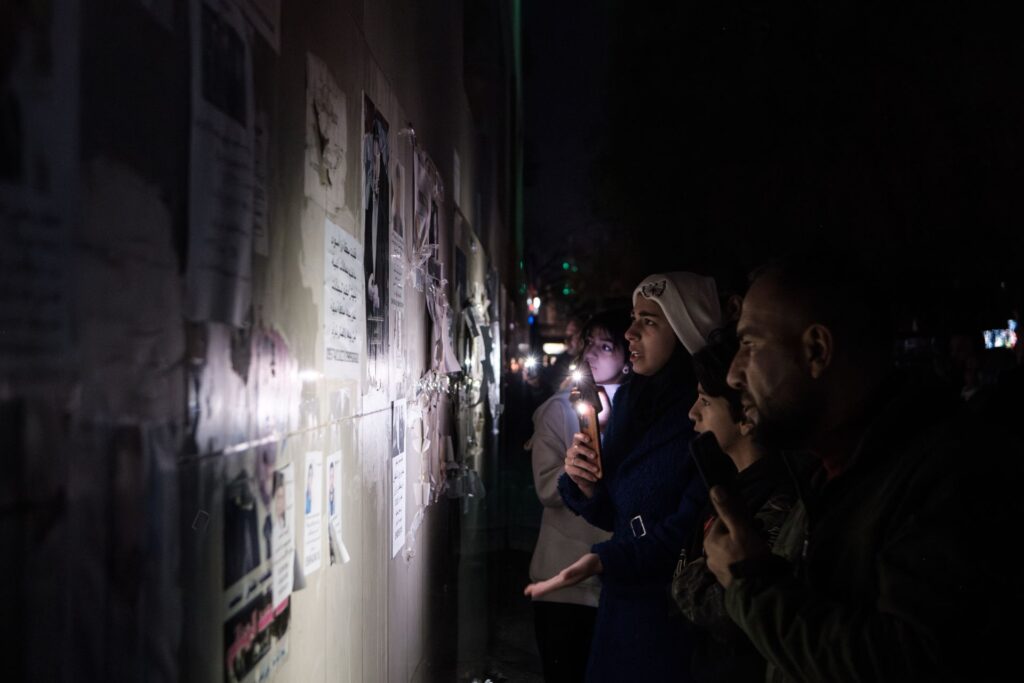
In the capital, the faces of the disappeared vanished from the hospital’s walls and from various locations around the city. They were present everywhere in the days after the fall of the regime. Soumaya Said wiped her eyes in the office of Caesar’s association. “When someone is missing, you live on hope. You imagine that one day the door will open and they will walk in. Now that hope is gone, you are not allowed to even think they will come back. You must continue living. But do we have the strength to continue? I don’t know.”
She stood up and thanked us again for listening. Outside, the call to prayer echoed through the streets, and traffic gradually increased. Another day had passed — another day seeking those who are missing and forcibly disappeared.
“Spotlight” is a newsletter about underreported cultural trends and news from around the world, emailed to subscribers twice a week. Sign up here.