


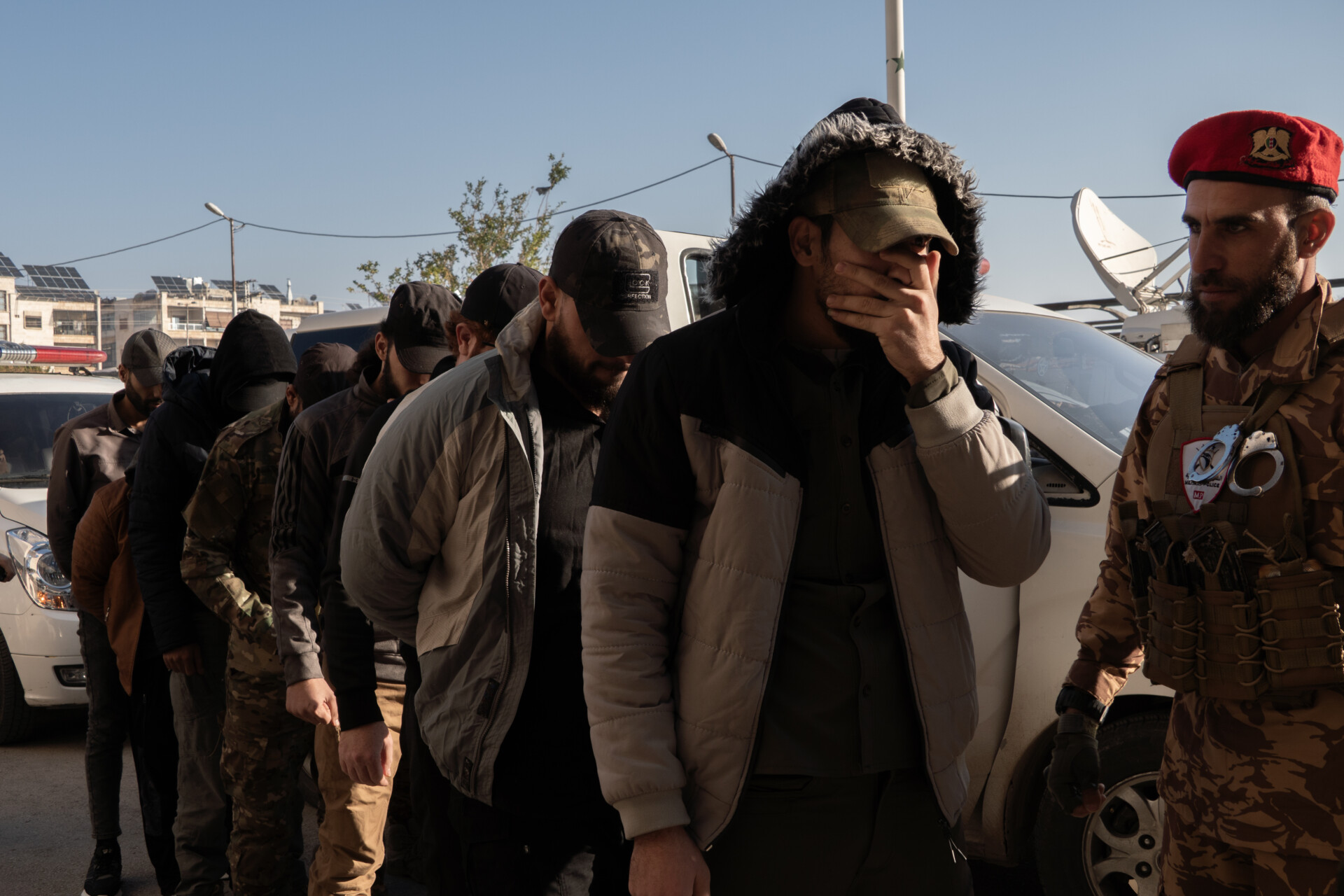
As the sun rose on Nov. 18, 2025, the Palace of Justice in Aleppo was the site of unusual activity. It was ringed by cars labeled “A1 forces,” filled with men in military garb and sunglasses. A flurry of journalists flocked in — camera in one hand and coffee in the other. Lawyers and others walked up the entrance stairs in search of the room for a long-awaited trial, which once seemed inconceivable in Syria.
In early March 2025, individuals affiliated with Bashar al-Assad’s fallen regime carried out an armed uprising against the new Syrian state, established after the toppling of the Baathists in December 2024. The insurgents killed forces affiliated with Syria’s Ministry of Defence as well as the General Security Directorate. The government quickly crushed the rebellion by issuing a general mobilization order, but what ensued was a bloodbath. Over 1,400 individuals, including women and children, were killed.
Today was the first day of a trial for accused individuals from both sides — those who were allegedly part of the uprising as well as members of Syria’s security apparatus. The government has long maintained that the violent acts carried out by its affiliates along the country’s coast were individual actions, and that many of the perpetrators were “remnants” from the Assad regime attempting to sow discord and create chaos.
Activists and families of victims of Assad’s rule, as well as those affected by the violence on the coast, have long called for transparent investigations into the events and public accountability. Recently, when I asked the parent of a missing person about what “justice” meant to her, she spread her hands out to mimic an imaginary screen as she replied, “Public trials, for us all to see.”
The trial, limited to alleged perpetrators of violence on the coast, was broadcast live after news of it began making the rounds less than 48 hours prior.
An eerie silence filled the court building, as photographers and videographers ran down a flight of stairs. A man stepped out of a van, staring determinedly at his shoes. He stole a glance at us before looking back down. As he walked into the court building, another group of the accused lined up behind him and followed in his footsteps.
The courtroom was small, fitting about 100 people. Most of them were journalists, lawyers from Aleppo and family members of the accused. Some of them pulled their jacket hoods over their heads. A toddler sat on the bench, occasionally leaning into the shoulder of the woman next to her.
A group of five men, members of the judging panel, entered wearing black robes with red and golden sashes draped over their shoulders.
“Hassan Halabi,” the judge, Zacaria Baccour, bellowed.
“Present.”
“Do you have a lawyer?”
Halabi stood up to face Baccour. The lawyer, Rami Hanjeel, is representing him and four others who are alleged to have been part of militias loyal to Assad. He is also representing two others from the government, who are accused of having been on the other side of the violence.
Halabi, born in 1984, is from Latakia, an Alawite-majority governorate on Syria’s coast. Latakia and its neighboring province of Tartus were both strongholds of the now-deposed president.
The judge then went on to list a slew of charges — inciting discord and civil war, murder and looting, secession. He gave Halabi a chance to rescind or change testimony he had given in investigations by the military court and in administrative hearings.
“Did you not participate in any of the fighting? Did you request funding for any armed group?”
In the middle of the questioning, the baby in the court babbled. Anxious family members watched on.
Halabi denied all the charges, his own voice barely audible through the holding cell. The judge repeated his testimony for the colleague to his right, who was noting all of it with a pen. On occasion, he knocked on the wooden table with his knuckles, ordering a temporary silence and quieter whispers among the crowd.
During the March violence, social media was flooded with videos of violations, including field executions and sectarian speech. Those videos today were evidence that the judge referred to in each, if not all, of his lines of questioning.
The other men who followed Halabi were charged almost identically. For one of the accused, Tahani Ahmed Shafik, the interrogation largely centered around the alleged stealing of cars belonging to the army. He admitted being guilty of that, but strongly denied joining an alleged gathering of armed members in early March. Others were questioned similarly, with some admitting to joining the gathering but remaining unarmed, while others denied it entirely. A few of them were asked whether they had colluded with Israel or Russia. On occasion, the judge raised the question of a video that the men had filmed, in which they were seen holding “Russian rifles.” They said the video had been sent to people inside Syria to raise personal funds.
Significantly, a number of those accused of participating in the uprising changed their testimony from previous trials, saying they were forced into admitting guilt by the “conditions of the interrogation.”
The second session of the court was focused on the members of the government accused of crimes. Belal Hassan is from Saraqib in Idlib. Many of the accused in the second session are from Idlib governorate.
The judge cited a video in which a person appearing to be Hassan could be seen using sectarian slurs and killing someone.
“It wasn’t me, it was AI,” Hassan protested. “It’s all fabricated.”
“I mean, you’re clearly seen in the video,” the judge responded.
Many in the second session seemed to have been in incriminating videos next to piles of corpses. Many said that the corpses had already been present when they were taking the videos, adding that, though they appeared to be in civilian clothes, military IDs had been found on the ground next to them.
Toward the end, the judge called out the name of Mahmoud Shahin from Idlib. Shahin insisted he didn’t participate in the violence.
The journalist next to me whispered, “That’s his mother and father.” I looked to my right and saw a woman in a niqab, or full-face covering, her eyes bloodshot. She was crying silently, clasping her hands and laying her head on the table. Beside her, a man in a camouflage-print summer hat looked on anxiously. He dabbed at his eyes with a tissue.
At this stage in the trial, it was hard to guess why she was crying, but I struggled at the sight of yet another mother, heartbroken by the evil that years of war had fostered.
“I didn’t go to the coast to kill people, I went to protect them,” Shahin insisted. “No one who has lived through 14 years of oppression would repeat that.”
Sitting in the courtroom, I tried to pick up on clues about what direction the verdict would take. Over the session of nearly two and a half hours, Baccour maintained the same stern demeanor regardless of whom he was dealing with.
“I’m not asking you about before. We’re dealing now with what happened on the coast,” he told one of the accused from the first group.
“Don’t speak until I ask you a question,” he said to one of the Ministry of Defense members.
When another one of them used the word “fulool,” which means “remnants” but is used colloquially as a term for regime loyalists, often loosely, he retorted. “We don’t have fulool here, we only have the accused and the rebels,” adding later, “We only have Syrian citizens.”

Baccour was warm when I visited him in his office. He invited me inside and gave me a candy, but firmly refused to comment because he was the judge for the case. Despite the professionalism inside the courtroom, I couldn’t help but notice the difference in how the two groups were treated in the short walk from the car entrance to the holding cell. As the men stepped out from the first van, which housed the accused government forces, one of the security officers helped adjust his cap to help cover his face. All of them were wearing hoodies and were able to cover their faces with their hands. They were free to jog up the stairs at the entrance.
The men who disembarked from the second van, which included the alleged regime loyalists, were in tracksuits without hoodies or caps to cover their faces. Their hands were in zip ties, and they glanced around, shoulders hunched, as though curling into themselves. A security officer held each one of them by the back of the collar and led them up the stairs.
We’re yet to see the verdicts delivered. For now, the defense is scheduled to submit “proof of innocence” for the accused a month from today, according to Hanjeel, the defense lawyer.
Regardless, Nov. 18, 2025, was a significant day in Syria’s recent history. Hanjeel said it brought him pride that the country was witnessing “a public, live trial,” covered by local and international media. He expressed confidence in the neutrality of the court and the fairness of the trial.
A year ago, it would have been inconceivable to imagine where this country is today. In terms of judicial proceedings, it is significant that government officials are being tried alongside those alleged to have ties with the previous regime. Hanjeel says it’s a statement by the judges at the Ministry of Justice. “It’s a message that the law is above all, and that it will be applied to everyone, with no exceptions or discrimination.”
Sign up to our mailing list to receive our stories in your inbox.