


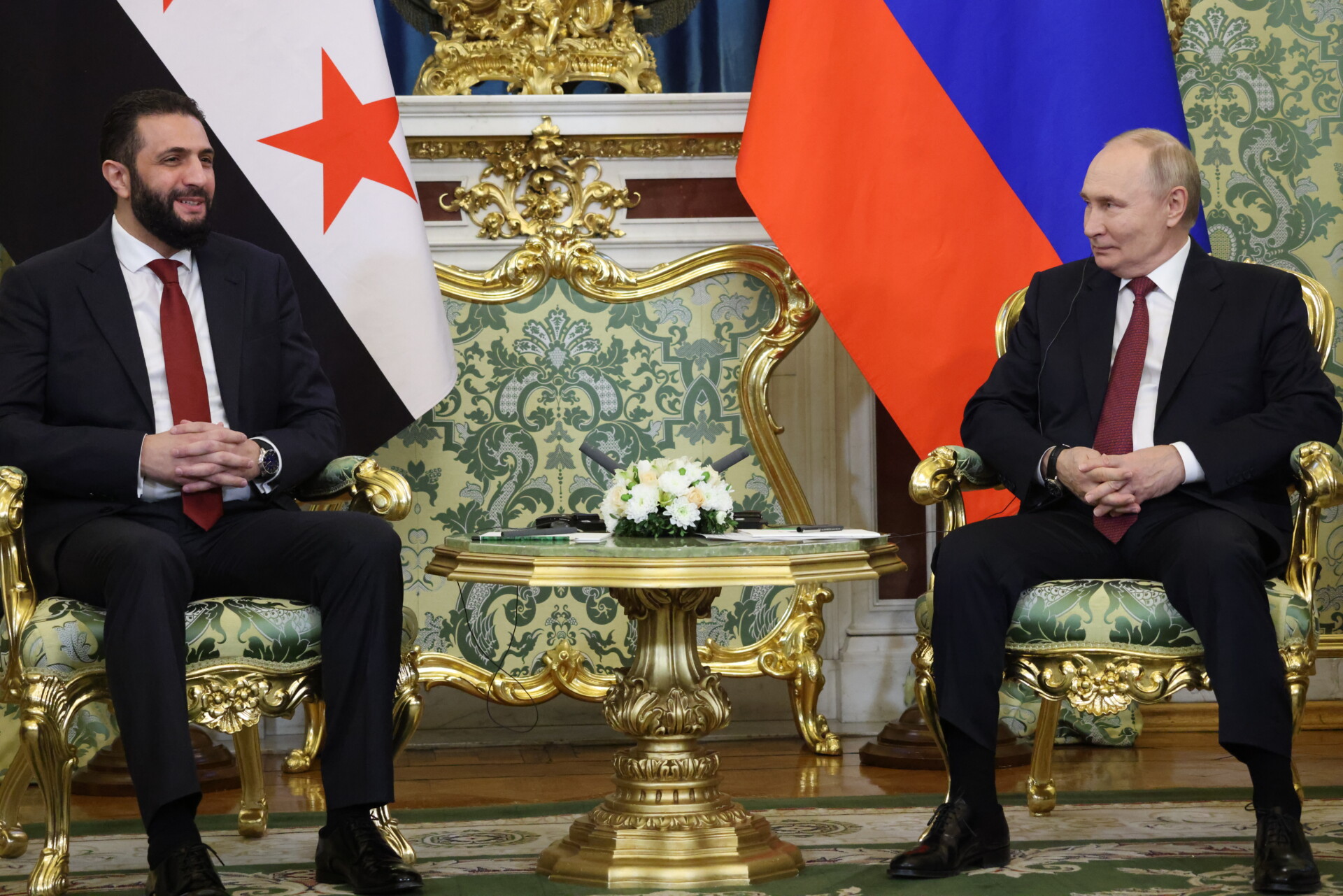
The day was rainy and overcast. The motorcade of cars with black-tinted windows sped down Moscow’s main arteries, taking the new leader of Syria to the gilded halls of the Kremlin.
Inside, President Vladimir Putin greeted Ahmad al-Sharaa with open arms and a broad smile. The two men chatted and posed for photos. Al-Sharaa made a joke about the considerable length of the Kremlin’s staircase, which he and his team had managed to scale without tiring. In other words, getting to Moscow took a while, but al-Sharaa was tough enough to persevere.
Their enmity from being on opposing sides of Syria’s civil war was nowhere to be seen. “Over the past decades, our countries have built a special relationship,” Putin told al-Sharaa. The former jihadist turned savvy politician replied that he wanted Syria to reestablish relations with all countries after years of isolation, but “chiefly with Russia.”
Almost one year ago, in December, I wrote a piece in this magazine about the arrival of another Syrian leader to Moscow, Bashar al-Assad, albeit an ousted one. When al-Sharaa met Putin last week, I experienced a flash of deja vu as the same talking points resurfaced: Moscow and Damascus have long-established and friendly ties. Russia wants to keep its military bases in the country — Hmeimim in Latakia province, a smaller one in northeastern Qamishli and the naval facility in Tartus. Syria offers major investment potential for Russia’s economic interests. Russia is a reliable provider of arms. Reinforcing the sense of history repeating itself, al-Sharaa told Putin he would respect previous bilateral agreements, without specifically mentioning the bases.
But Russia is a different place than it was at the end of last year, when a plane quietly brought Assad into the country under the cover of darkness. (“Russia never abandons its own” was the official Kremlin line.) Preoccupied and weakened by its full-scale invasion of Ukraine, the Kremlin was unable to save its longtime ally Assad when his regime suddenly collapsed.
It was a far cry from when Russia first intervened in Syria a decade earlier, turning the tide in Assad’s favor in the civil war and allowing him to continue his brutal decades-long rule. Russian troops entered the conflict head-on, raining deadly bombs down on Syrian towns and villages.
Propping up Assad’s rule also ensured a lasting military presence on the Mediterranean and reestablished Moscow’s status as a force capable of operating well beyond its immediate sphere. The bases provided Russia with its only stopover points for planes and ships traveling to and from Africa, where it has many strategic interests.
Inside Syria, activists and government critics condemned al-Sharaa’s visit, saying it rewarded the government that backed Assad and helped bomb their country. Al-Sharaa’s vague reference to previous agreements with Moscow prompted questions over whether post-Assad Syria would pay debts to Russia incurred during the regime’s crackdown after 2011. The backlash pushed the government to issue clarifications, including a rare interview by Foreign Minister Asaad al-Shaibani on local media, who said the agreements would be renegotiated to redefine relations on the basis of sovereignty and territorial integrity.
Since providing refuge to Assad, things have only gotten worse. Soon to enter its fourth harrowing year, the war in Ukraine drags on, leaving Russia increasingly isolated on the world stage and stripped of cash and men to send to the battlefield. U.S. President Donald Trump, after meeting Putin in Alaska in August, has grown increasingly frustrated with his Russian counterpart and his seeming indifference to stopping the war. In Ukraine, Russia has yet to fully control the regions it has formally claimed in its constitution. Influence in its own backyard — in Armenia, Azerbaijan and parts of Central Asia — is waning.
The very existence of Syria’s new leader serves as a stark reminder to Moscow of what it has lost. Al-Sharaa once headed the Syrian branch of al Qaeda. In 2017, when he formed Hayat Tahrir al-Sham (HTS), an alliance of several factions united against Assad, the Russian government said they wanted to “eliminate” both the man and his group.
For Russia’s influential, pro-war military bloggers, often a barometer of nationalist sentiment, al-Sharaa’s welcome was a slap in the face.
“The terrorist Jolani … is in Moscow as an official guest, as the imposter president of Syria,” wrote Anastasia Kashevarova on the Telegram social network, intentionally using al-Sharaa’s former nom de guerre. “He’s shaking our president’s hand. This is causing extreme indignity for our fighters who fought these terrorists,” wrote Kashevarova, who is the co-host of a pro-Kremlin propaganda show.
Since Russia’s invasion of Ukraine, the country’s far-right landscape has evolved. Pro-war channels on Telegram have mushroomed, forming a peculiar media subculture in Russia. While their opinions and popularity vary, they are generally loyal to the Kremlin and serve Russia’s interests, even while often leaning into radical nationalism.
The Fighterbomber Telegram account, widely believed to have connections to the Russian air force, made the offence personal on its channel: “My friends and I fought Jolani and his friends to the death. Turns out we didn’t finish them off, we didn’t fight very well.”
Rybar, the wildly popular pro-war Telegram channel with 1.4 million followers, was more restrained in its coverage of the leader it also calls Jolani, yet still critical. “The Damascus regime is once again demonstrating ‘Syrian-style democracy,’” it wrote after the visit, calling al-Sharaa’s government a band of “militants” who only serve themselves.
As for Russia’s offer to help rebuild Syria, “Such plans are unlikely to be feasible — the new authorities have still not taken control of Syria, and this could ruin any investment.”
Fighterbomber, which has over half a million subscribers, proclaimed in half-jest that it was only a matter of time before al-Sharaa was toppled and forced to live in Russia, too. “Jolani and his comrades will move into the apartments next to Assad. Or he will be replaced by another new-but-old acquaintance, and we’ll have to negotiate with him the same way. Only time will tell. The main thing is not to make the same mistakes.”
Some days after the visit, in a series of posts, Rybar accused al-Sharaa’s government of not protecting minority groups like Christians and Alawites, the minority to which Assad belongs. It also said a deadly attack last week on a government-owned bus in the oil heartland of Deir ez-Zor — believed to have been carried out by the Islamic State group — could have been prevented.
Several of the pro-war channels expressed outrage at the prospect of Assad’s extradition to Syria, which al-Sharaa requested in Moscow behind closed doors, according to senior Foreign Affairs official Ashhad Salibi, who spoke to Syrian state television on Saturday.
Assad is wanted for war crimes and crimes against humanity committed during the war. Over the years, Assad has been the subject of multiple international arrest warrants, including from France. In September, the Syrian Network for Human Rights — a leading rights watchdog — renewed calls for his extradition and demanded a formal apology from Moscow for its support of Assad’s regime and its involvement in the war. Since the fall of the regime last year, around 1,200 former Syrian officers now live in Russia, according to the German newspaper Die Zeit. These include Assad’s chief of staff, Ali Ayoub, who shelled cities and used banned chemical weapons, and the last head of military intelligence, Kamal al-Hassan, who oversaw the Sednaya prison where torture was omnipresent.
During his television appearance, Salibi described Moscow as “understanding” of the new Syrian government’s aim of achieving “transitional justice.” Kremlin spokesperson Dmitry Peskov declined to go into any details on the extradition request, saying, “We have nothing to report on Assad here.” Unless there is a dramatic change in Russian law and politics, it is highly unlikely that Assad would be extradited. The country does not allow this for its own citizens or others under its protection except in extremely rare cases, like the recent extradition agreement with Thailand. For years, the U.S. has unsuccessfully sought the extradition of whistleblower Edward Snowden, who resides in Russia under official protection alongside his partner.
Al-Sharaa’s visit coincided with a decline in Russian geopolitical clout in the Middle East, where it has long defended deep-rooted interests, though critics say such diplomacy is chiefly driven by its rivalry with the West. Shortly before the new Syrian leader came to Moscow, the Kremlin was forced to postpone a summit with Arab leaders that had been in the works for half a year. The Russia-Arab World Summit was framed as a display of influence, highlighting Moscow’s lasting ties with the Middle East and its defiance of Western sanctions. But only a handful of leaders, including al-Sharaa and the head of the Arab League, Ahmed Aboul Gheit, confirmed their attendance. Instead, world leaders including Turkish President Recep Tayyip Erdoğan and British Prime Minister Keir Starmer gathered in Egypt for a Gaza “peace summit.” There, the U.S., Egypt, Qatar and Turkey signed a declaration for peace including a phased ceasefire, which Israel has since broken.
Russia was notably absent from the summit in the Egyptian beach resort of Sharm el-Sheikh. Posters of its hosts, a smiling Trump and Egyptian President Abdel Fattah el-Sisi, highlighted the regional shift away from Moscow and toward Washington. Analysts said the summit must have been particularly embarrassing for Russia due to its strong ties with Egypt and Qatar.
At least Russia was not alone. China, with which it maintains a close relationship, also didn’t come. “We cannot ignore big countries such as Russia and China,” Egyptian Foreign Minister Badr Abdelatty later told a news briefing.
“You know, there was an invitation. But it was too late.”
“Spotlight” is a newsletter about underreported cultural trends and news from around the world, emailed to subscribers twice a week. Sign up here.