


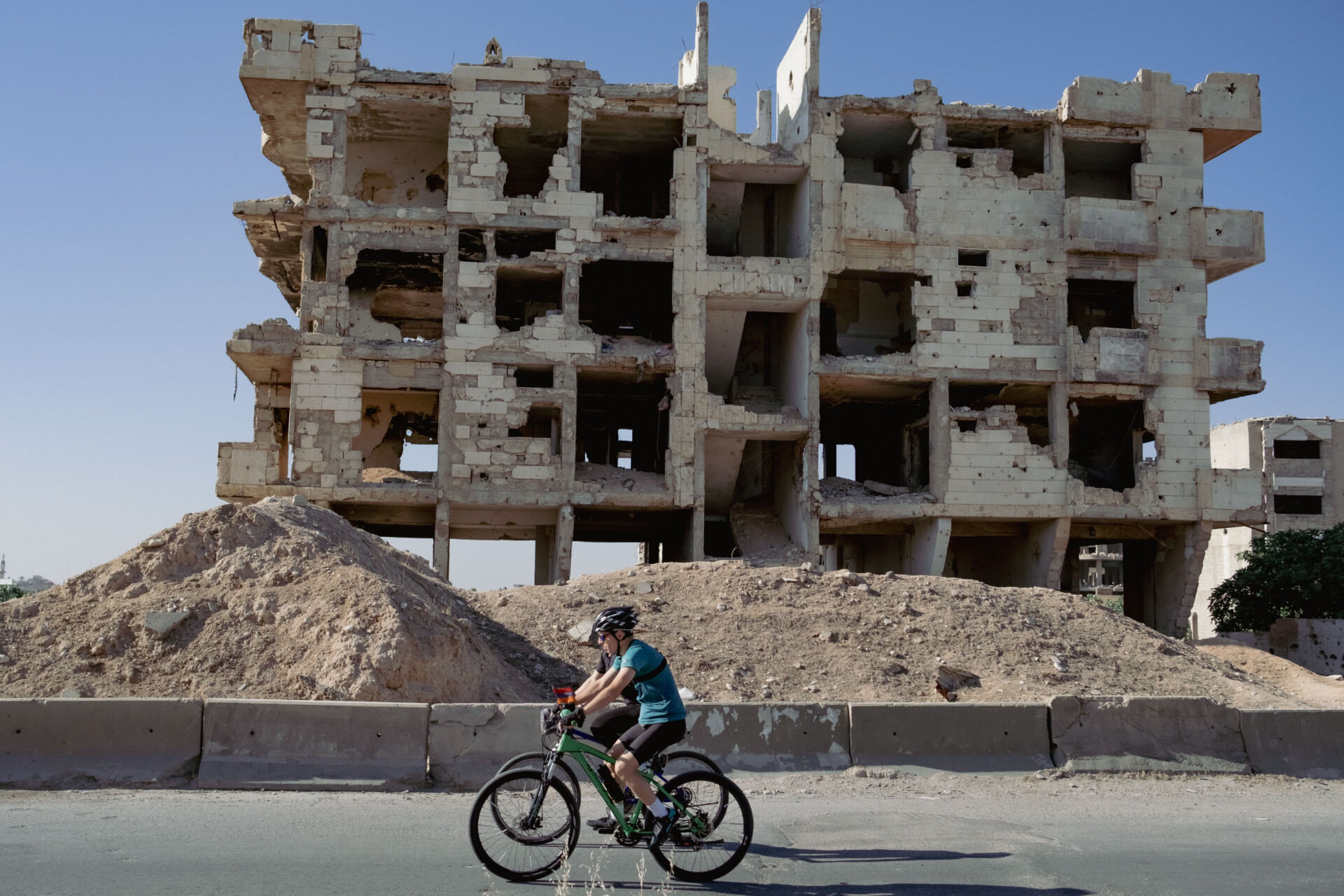

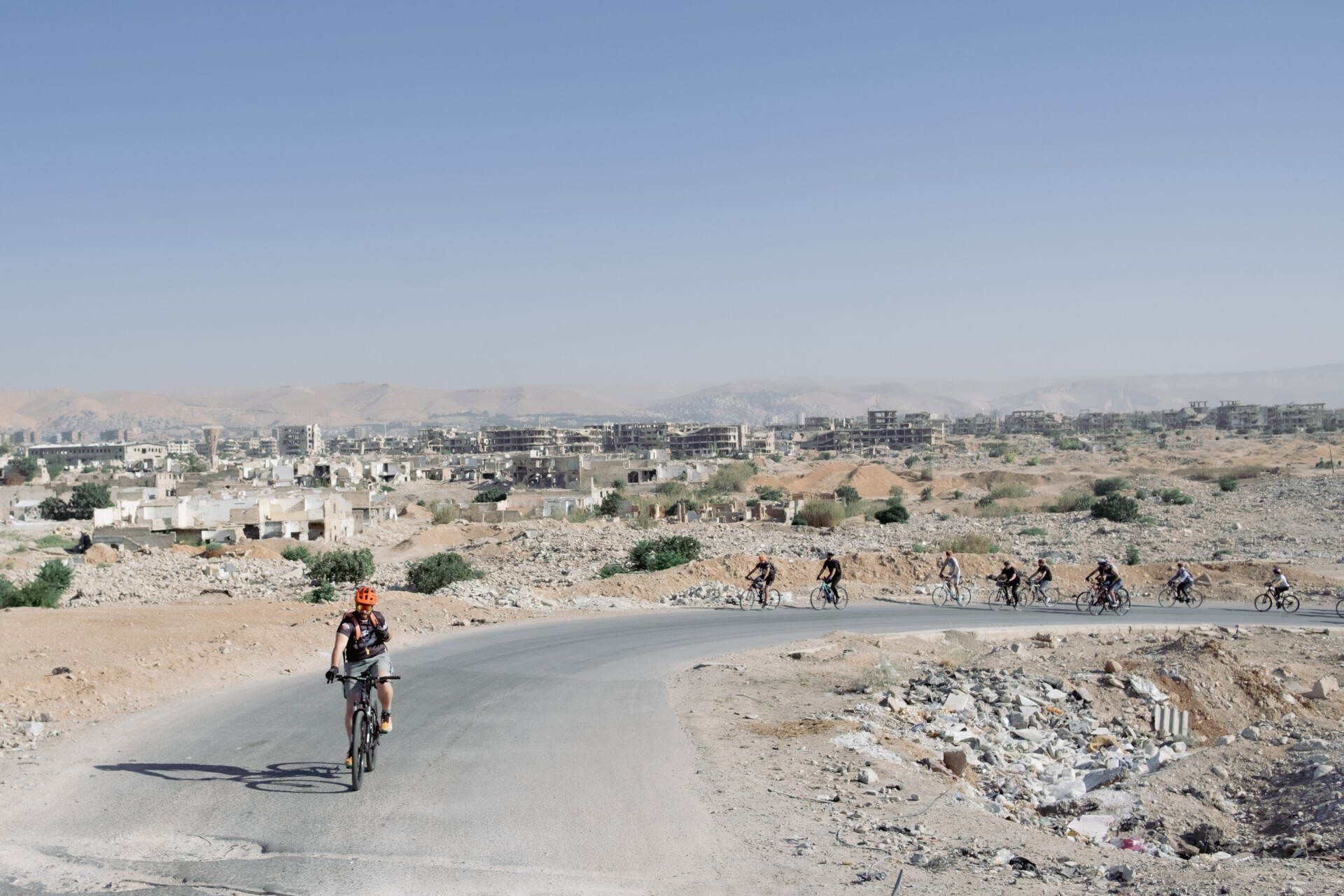

Every Friday, at dawn, some 30 cyclists navigate the streets of Damascus. A man from Idlib, long trapped in the country’s last rebel enclave; a German woman who arrived after Bashar al-Assad’s fall; Sunnis, Alawites and Christians, riding side by side through a city scarred by 14 years of war. They ride through ruins — but what they’re really navigating are the fault lines of conflict, fear and isolation.
Yahya, 34, rides near the front, smiling uphill and down. For seven years, he was stuck in Idlib, Syria’s last rebel-held enclave — bombed, besieged, isolated. He briefly crossed into Turkey, but the front line still cut him off from the rest of Syria. He was one of the 32,000 followers of Road Ride — a group of urban cyclists in the capital — on Instagram. He zoomed in on their posts, imagining the routes. Joining the group was a dream, “almost too good to believe,” he says.
Back then, he and a friend rode endless 60-mile loops between Idlib and Jisr al-Shughour, mimicking the group’s rides. “Just two crazy kids,” locals said. He didn’t care. On his German-made Cube bike, smuggled in from Turkey, he felt free — from war, from his phone, from everything.
In December 2024, Assad’s regime fell. Yahya made the journey to the capital. He crossed into a Syria he barely recognized. His first wish: to join Road Ride. Two weeks later, he was pedaling the streets of Damascus with the very group he had once only watched on a screen.
He and his friend are the first members of the club from Idlib. He says he has found a new family here. “I just didn’t know if they’d accept me. But they’d stayed neutral during the war. That’s why I trusted them.”
As the rides went on, Yahya began to talk. He told his new friends about the regime’s airstrikes on Idlib, the disregard for civilians, about the targeted hospitals, the sleepless nights and the silence they felt from the rest of the country. From his testimony, some Damascenes discovered realities they’d never known. During the war, Syrians lived much of their lives in parallel worlds, in which they were fed propaganda and mass misinformation. “They were shocked. They’d ask, ‘Was it really like that where you’re from?’ As if they’d lived in another world,” he recalls. The first conversations were rough. He was asked blunt questions: “Is it true that you behead babies in Idlib?”
He didn’t lose his temper. He understood. He knew what Assad’s propaganda had sown over the years: fear, suspicion, caricature. He simply wanted to challenge those images. At first, people were surprised. Yahya had a nice bike. He looked like anyone else. He didn’t come from another world. “I want them to know we’re not enemies anymore, that we’re not terrorists. That we love life, health and sport. That we are the same.”
By riding together, walls fall. Yahya says that, today, some of his closest friends are Alawites — the same sect as Assad — and he’s almost surprised himself. He even went on a camp with them in Latakia, which used to be the regime’s stronghold, despite his fears.
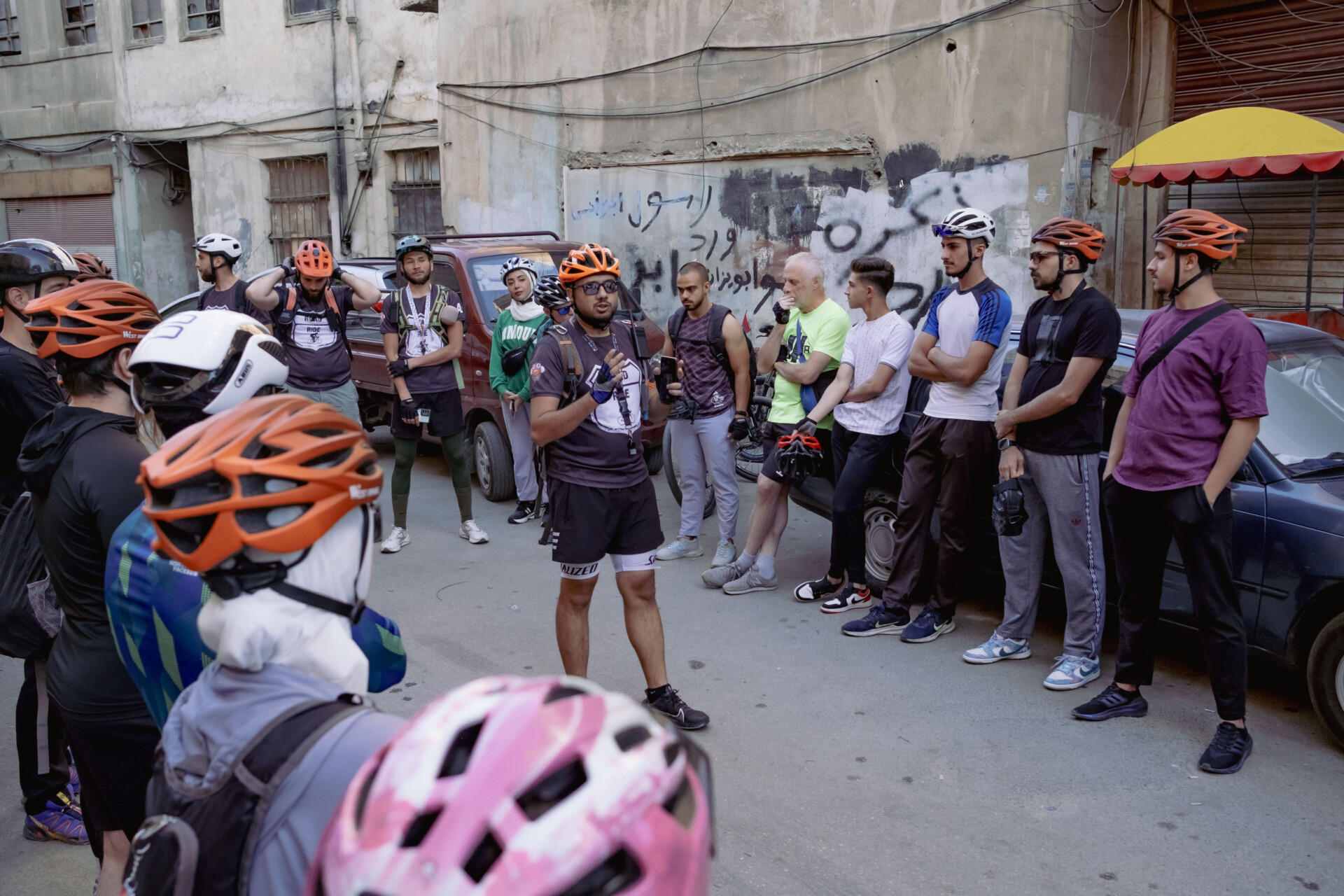
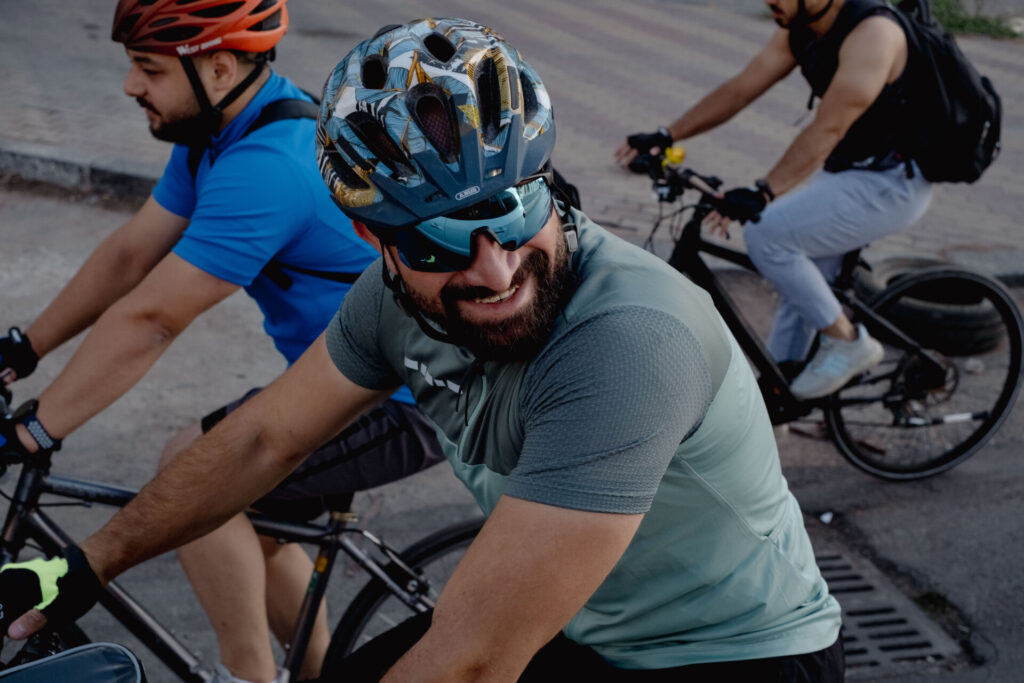
“Look at this — that’s peacebuilding,” says Bassam, one of the founders, turning to the cyclists chatting in Damascus streets during a ride briefing. The peloton includes a bit of everything: veiled women and others without headscarves, young and older riders, men and women side by side. “Hijab or no hijab — it doesn’t matter here. What counts is that we feel connected.”
In a country shattered by 14 years of war, where Assad long positioned himself as the protector of minorities — Christians, Druze, Alawites and others — against an opposition he framed as Sunni terrorists, the bicycle becomes a tool for social reconstruction: a pretext to break the ice, to tear down invisible Syrian walls.
Road Ride began in 2019, when Damascus was still tightly patrolled by Assad’s regime. Checkpoints were everywhere, each route had to be preapproved and permits were required. Some areas were military zones and completely off-limits. It was founded by Bassam al-Hawari, a Sunni, and his brother Mohammad. His wife, Reem Barakat, an Alawite, has been involved from the start. Their vision: to use sport to create neutral ground, a common space for all Syrians.
At first, that ideal was out of reach. The country was fragmented. Rides were limited to the capital. Public gatherings were discouraged and outings were capped at 30 participants. Between 2019 and 2024, their rides were repetitive. “Maaloula, Sednaya. … We were going in circles. We dreamed of new routes,” Bassam admits. Occasionally, foreigners or nongovernmental organization workers joined, seeing it as a new way to discover the city. “Abroad, Syrians are often seen only as refugees. Here, we’re just regular people,” says Reem.
Since the regime’s fall, a new wind has swept through Syria. Route permissions are no longer necessary and there is room to grow. Plans are underway to expand the network’s routes beyond Damascus to Homs, Hama and even Idlib, the northern city that was mostly disconnected from the rest of Syria for a decade. For years, Syrians living there couldn’t move freely or cross into government-controlled areas. Connecting it now, even symbolically through cycling, would have been unthinkable just months ago.
For this group of cycling enthusiasts, this means more freedom, greater visibility, renewed hope — and new recruits, both inside Syria and from abroad, now that the country is reopening after years of isolation.
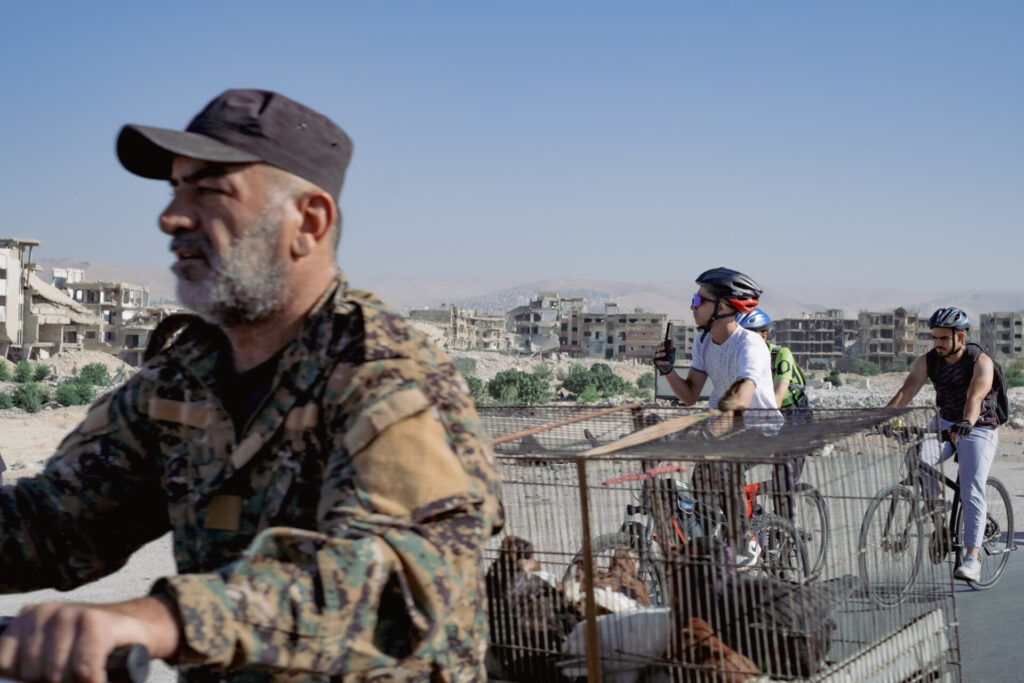
Yet cycling in Syria is no easy feat. The country remains a minefield, both literally and metaphorically. Scars from the war fill the landscape. Whole neighborhoods are still mined, making Syria one of the most heavily contaminated zones in the world.
The regime’s collapse did not bring instant peace, nor heal old wounds. Every Friday, the Road Riders are confronted with an uncertain future, and with both the hopes and the fears of this new chapter in Syrian history. Behind every curve there is rubble; beneath every silence, wounds. In this landscape, Road Ride has carved a route and, through it, an opportunity to heal the scars of war and the mistrust of 14 years of civil enmity.
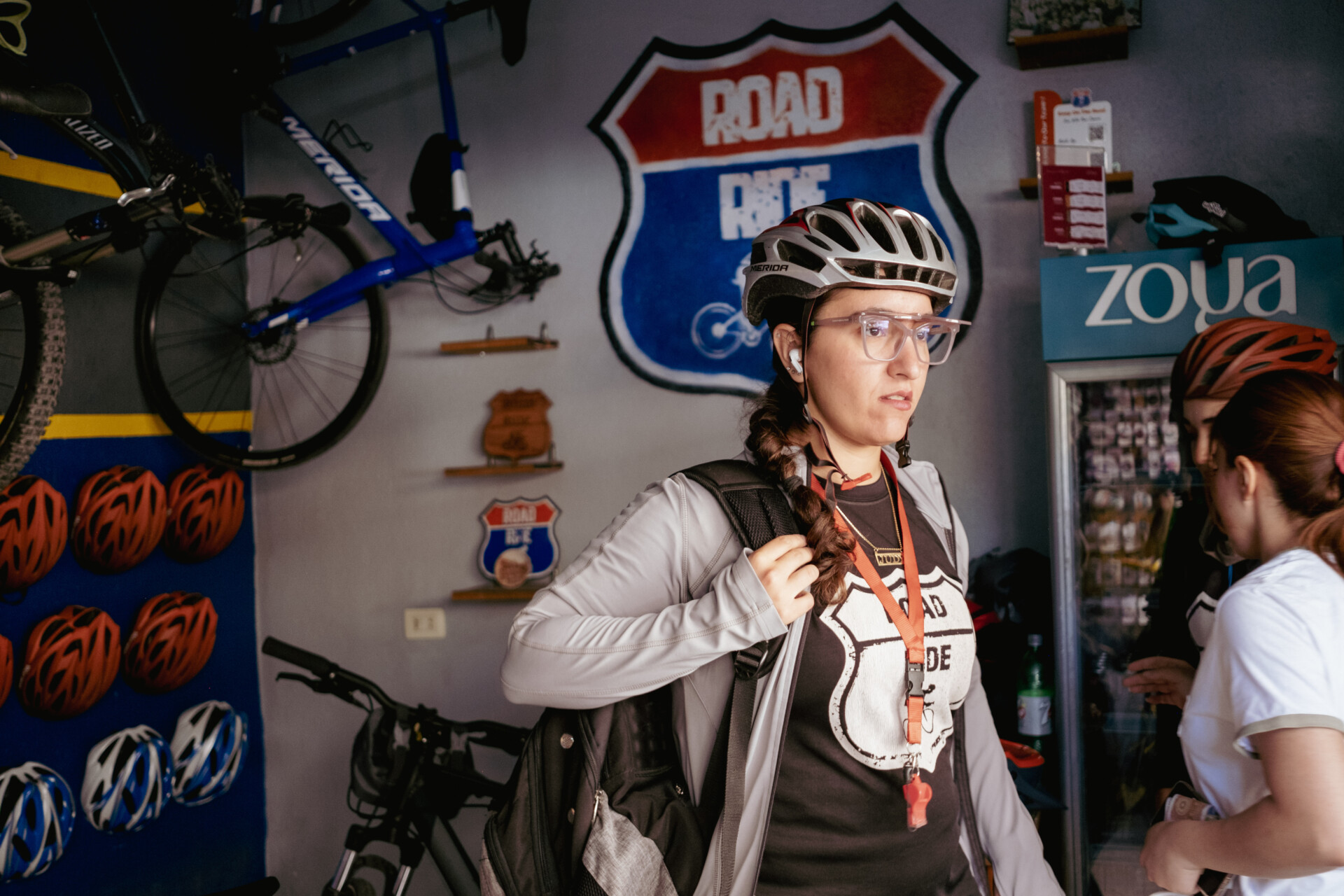
Cyclists meet outside a gleaming new bike shop emblazoned with the Road Ride logo. They get ready with thoroughness. Once their helmets are clicked, their gloves fitted and their water bottles filled, they are ready to go. The atmosphere is relaxed yet efficient. On the pavement, their lined-up bikes form a quiet force.
From the first pedal rotation, the pace is set: fast, precise, fluid. This is serious riding. With walkie-talkies in hand, one cyclist leads, while another sweeps the rear. The wheels crunch on cobblestones, pass bread carts, brush empty market stalls. Mount Qasioun marks the horizon. Damascus filters past with its alleys, bridges and suburbs — all charming.
Vahan, 19, is the group’s youngest member. An Armenian Orthodox Christian, he speaks of an “ideal society on two wheels.” “Cycling is more than a sport — it’s a way of life,” he says, adding, “This group of cyclists — warm, open, who love and respect each other, regardless of religion or ethnicity … I hope Syria will someday be like this.”
Adel, the eldest at 58, is a retired civil engineer who first picked up a bike to relieve back pain. Now, he often brings up the rear — calm, measured, attentive. “I’m still surprised by how young they are. But it gives me hope. This community, full of dreams … My dream would be for a Syrian society to be like this,” he admits, worried about the future. He knows such a mix of identities is frowned upon by some. He knows that balance is fragile.
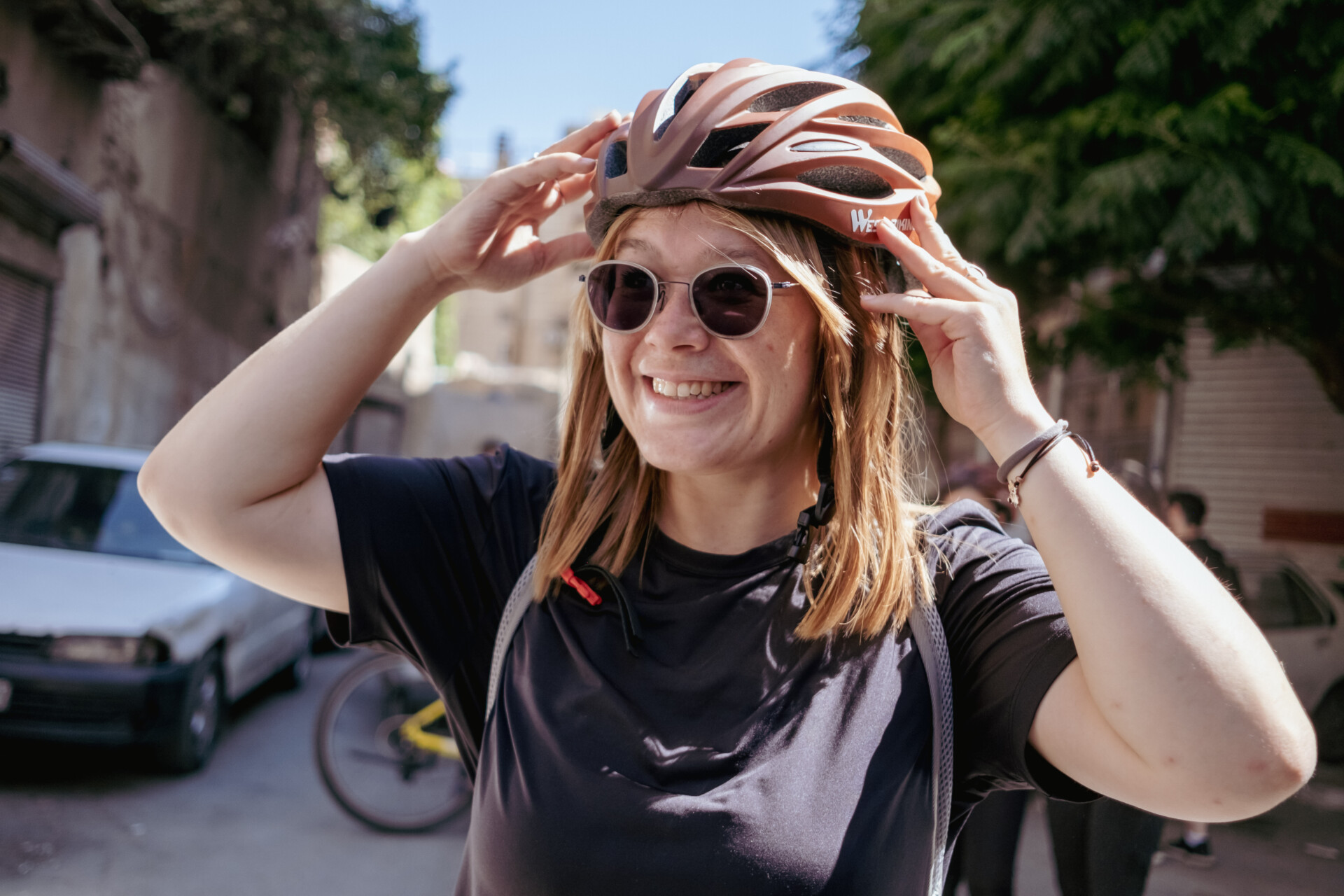
It’s 5:30 a.m. and Tabea, 33, with dyed blond hair and green eyes, is about to do what she once believed was impossible: ride freely through Damascus on a bicycle.
She came to know Syria through those who fled it — from the teens she supported as a social worker in Germany to the refugees who became her friends in Berlin. For years, she absorbed their stories. Then, in December, the regime collapsed. A few months later, she arrived, determined to see their country with her own eyes.
She leaves the old quarter of Damascus at dawn. It is sleepy — shops are still closed, the buzzing cars are nowhere to be seen and the vendors’ calls have faded into the silence of stones. In a graffiti-covered alley in Hayy al-Diwaniyah, a working-class district in the west, she joins Yahya. They are part of the more experienced team (as opposed to the beginner group of Road Ride) — about 30 Syrians, men and women, who have been sharing miles for years or months. Tabea is the newbie and the only foreigner.
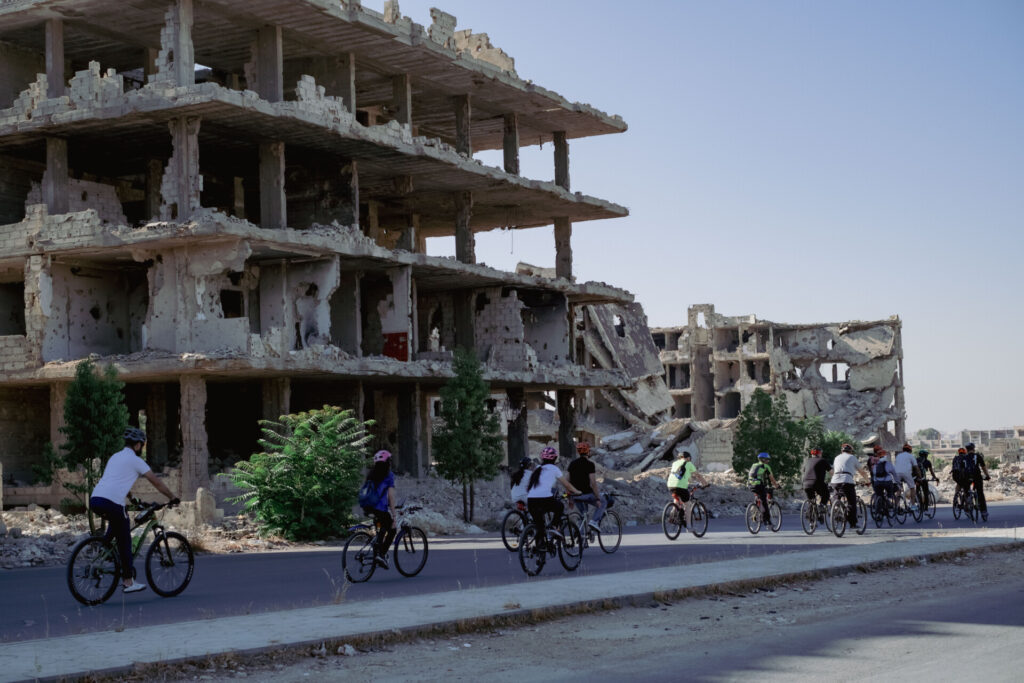
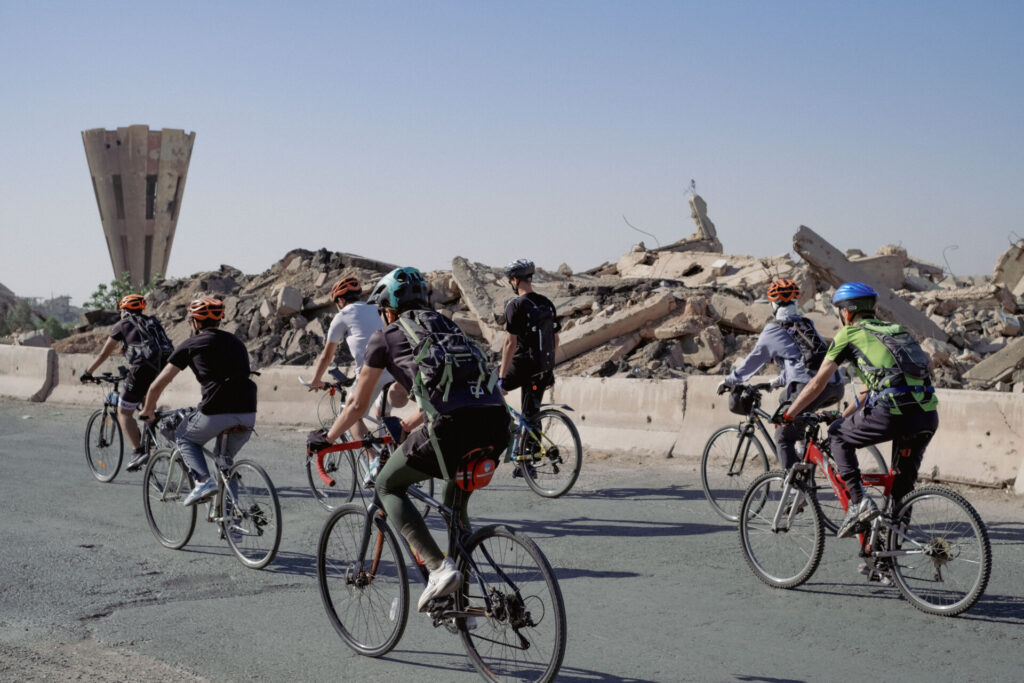
Crumbling buildings, empty streets, pockmarked walls: Riding east, the group enters Jobar, only about 4 miles from the center. Under Assad, Jobar was one of Eastern Ghouta’s main rebel strongholds, besieged for four years. After years of fighting, it was violently retaken by the army in 2018 and turned into a military zone — off-limits to civilians. No one lived there. Today, it lies in ruins.
Tabea pauses and takes in the scene with a look of shock on her face. “You can’t stop thinking about everyone who lived here, what happened to them. I’m not used to seeing this level of destruction,” she says. “In a car, you look through glass. You pass by. On a bike, you feel every bump and hole. You move more slowly. You see more. And you can’t look away — you connect with what happened here.” The social worker’s voice trembles. “It’s different hearing stories … than seeing them.”
Even for born-and-raised Damascenes, the impact is profound. Salah, a 25-year-old from the capital, rides here for the first time. “It’s awful to see this level of destruction.” He thought he knew about the war’s consequences but he hadn’t seen them like this, not up close.
For Bassma, 28, an English teacher, it’s essential to go everywhere. “Why distance ourselves from reality?” she asks.
The following Friday, the group gathers again as usual. But the mood has shifted: fewer laughs, more silence, increased caution.
Five days earlier, on June 22, a suicide bomber struck the Mar Elias Greek Orthodox Church in the humble neighborhood of Dweila, Damascus — the first attack of its kind since the fall of the regime. Claimed by an Islamist group, Saraya Ansar al-Sunna, the blast killed 25 and wounded 63. One rider was close to the church that day. He refuses to talk about it. Ten people in his neighborhood died.
Since then, the sense of fragility has only deepened. In the southern province of Sweida, more than 1,000 people were killed in fierce sectarian clashes that broke out in July between Bedouins, government forces and Druze militants — one of the deadliest bouts of intercommunal violence since the regime’s collapse.
Vahan, the 19-year-old, feels the shock deeply. Even before the Dweila bombing, he never felt safe. “When the explosion happened, I thought: We can’t live here anymore, peace is impossible.” He confesses: “My heart is broken. What hurt the most was knowing that some people celebrated it.”
“After 14 bloody years of civil war, I hope we can learn to live together,” he adds. They were meant to ride around Ghouta that week but, given the situation, they decided to stick to central Damascus.
Another risk comes from the ground. Reem Barakat, one of the organizers, understands it well. “We know how to work in tough terrain. We scout routes ahead of time. We also go to checkpoints before every ride to prepare the ground for our group.” Under Assad’s rule, official permits were mandatory. “Now, they don’t ask for permits anymore. Everything’s more open,” she claims. But openness doesn’t eliminate risk.
Bassma, a young woman rider, says plainly: “The attack painfully reminded us Syria still has major security challenges — even after Assad fell. The country is trying to rebuild itself, but things are going slowly.”
As a cyclist, she admits to practical fears. “There are old bomb fragments. … And those now in control might not like people riding freely — especially not alone.” She jokes: “This isn’t exactly a ‘chill bike trip’ spot! Clearly, there are safer routes elsewhere.”
Yet danger is not limited to the ground. Since the rise to power of interim President Ahmad al‑Sharaa, a former Islamist warlord, fears of conservative rollback have surfaced in a country already steeped in tradition. The group feels it each time they ride outside the capital.
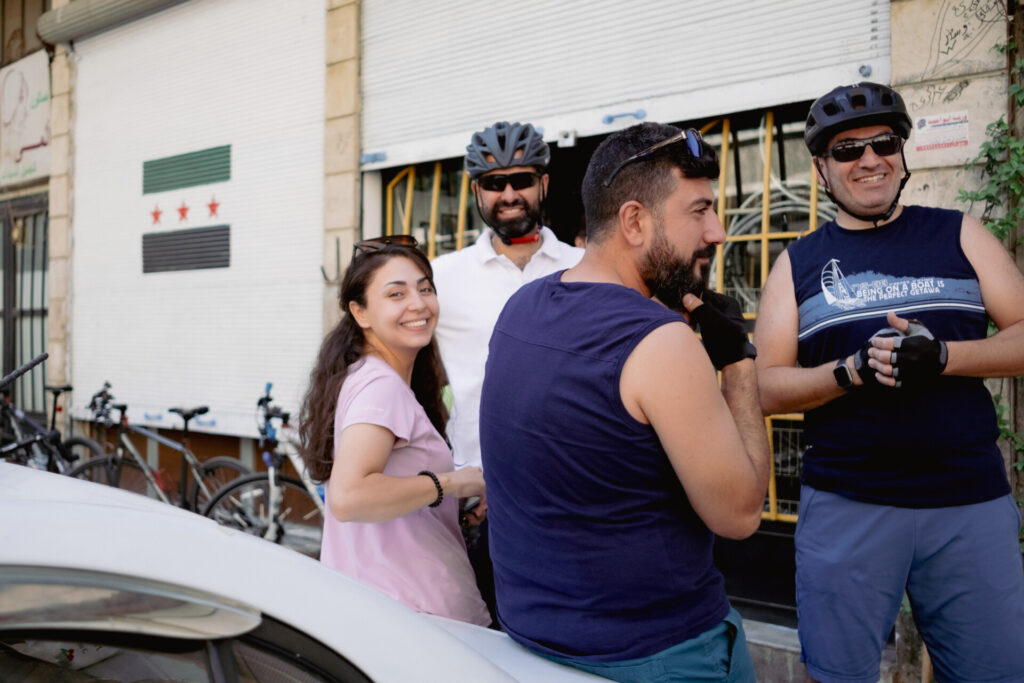
“They call us ‘ajanib’ — foreigners — even though we’re Syrians,” laughs Reem. One time in Ghouta, locals threw tomatoes at them. “Just because it’s mixed — men and women riding together.” In Damascus, it’s normal but, elsewhere, they’re often seen as anomalies.
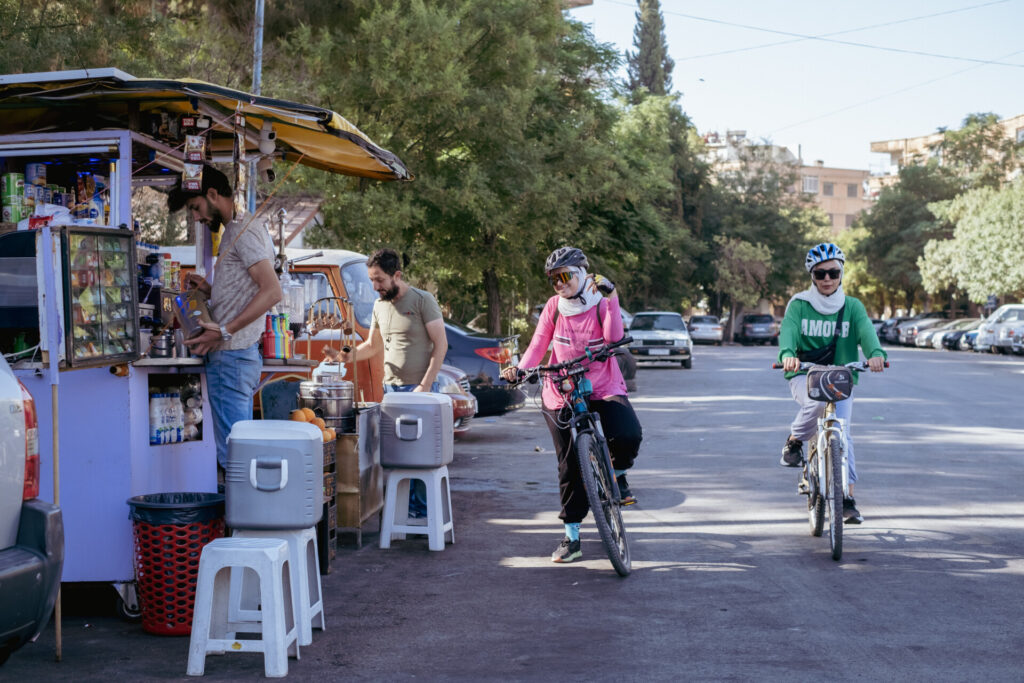
Bassma often leads the pack, with her veil and snug helmet, her gaze confident. She took up cycling five years ago. At first, her family didn’t understand. “To them, a woman on a bike — especially with men — wasn’t normal. It was culturally disapproved of.” But she persisted. “People began to change how they saw us,” she says.
Now an English teacher and avid cyclist with three bikes, she rides every day except Sundays. She posts her routes on Instagram and explores the city from new angles. “In a car, you miss everything. On a bike, you discover. You breathe. You live.” Last month, she even crossed into Lebanon with the group.
Since the fall of the regime, a few social media influencers have entered Syria — among them Seb, known online as Sebbie Bikes, whose “Amsterdam to India — Against Borders” trip brought him through the country. “Welcome to Syria,” he wrote in week 41, posting reels of the capital. His reason: Many of his cycling friends in Amsterdam were Syrian.
Inspired by one of them, Hamude — a 20-year-old German Syrian — decided to cycle over 1,800 miles to return home, with one message: “We can come back. We don’t have to be afraid.” From Croatia, pedaling toward Syria, he was hoping to be the first Syrian to return this way — “out of love: for my grandmother, my aunt, my city,” he said. After 42 days of pedaling, on Aug. 9, 2025, he rolled into Damascus with a smile, the new Syrian flag tied around his neck beneath the “Welcome to Syria” sign, and shared a post that drew over 53,000 likes.
Like Yahya, for Hamude each ride is a form of reconnection — with his country, a memory and the part of himself war once severed.
Back from a ride, Tabea collapses into bed, exhausted. She thought she’d stay only a few weeks in Syria, but the group’s intensity and what it stands for are among the things that pulled her in.
Yahya still spends most of his time in Idlib, but he tries to make it to Damascus for his Friday rendezvous. “I found myself biking by their side,” he says. Since the fall of the regime, he’s become a central figure in the group. His three children — aged 3, 7 and 9 — already ride.
As he talks, he pedals tirelessly, as if this group knows only how to move forward, even through a country holding its breath.
“Spotlight” is a newsletter about underreported cultural trends and news from around the world, emailed to subscribers twice a week. Sign up here.