


The sound arrives before sleep does. For millions of Ukrainians, the wail of an air raid siren has become one of the most familiar noises of the past four years, a signal that seeps into the body long before it reaches the ears. “It is very long. It goes on and on,” said Oksana Ruzhenkova, a 55-year-old Kyiv resident.
As Russia’s invasion of its southern neighbor grinds on, with no clear end in sight, the noise of war has become an inescapable backdrop to daily life, a soundscape of sirens, drones and explosions. For some, these no longer trigger immediate action, but something quieter and more dangerous: numbness. It is a survival response, a way to endure life in a war zone while clinging to fragments of normal routine.
“When the air alarms begin, I have only one desire: for the siren to stop. … I want to cover my ears,” Ruzhenkova said. “But drones, they are a whole other story.”
She has not slept in her bedroom for almost two years. “The attacks are so frequent now that we don’t have the strength to go to the bomb shelter every time the alarm sounds,” she explained.
Instead, she dragged her mattress into the hallway of her Soviet-built apartment, following the “two wall” practice, a widely used safety measure meant to protect against blasts. In that narrow space, she built a makeshift bed in what she believes is the safest corner of her home, often closing the windows to block out any sounds.
But silence rarely lasts.
On some nights, increasingly over the past year, explosions jolt her awake. “It’s hard to go back to sleep after the house shakes, and car alarms go off from the explosions,” she said.
On those nights, sleep becomes impossible. Ruzhenkova lies still, listening. The faint buzzing of a drone cuts through the darkness, growing louder, then softer. “If the sound gets louder, then it’s closer, but then starts to fade, and you feel a sense of relief: Bingo! I’m lucky this time,” Ruzhenkova said.
The sound, even as it fades, is a fresh wave of dread. For Ruzhenkova, a drone that has passed is not a relief but a terrible redirection. “It means that it is still flying,” she said, her thoughts tracking its unseen trajectory toward her three granddaughters, all aged under 7, who live in a different part of the city, about 18 miles away. “These thoughts can drive you mad.”
In four years of relentless war, the psychological toll of these sounds is the latest, most insidious weapon. It is a kind of sonic warfare. Russia’s drone strategy has created a nation on permanent, exhausting alert. Every Ukrainian is now an involuntary sound engineer, acutely sensitive to the ambient noise, trying to mentally calculate a threat’s distance from a high-pitched buzz or a faint whistle.
The drone, a relatively cheap and evolving piece of technology, has become a staple of Russia’s arsenal. Over 91,000 such aircraft have been used since February 2022, according to the Ukrainian Ministry of Defense. The volume of attacks has soared in the past year, with single nights now seeing as many drones, or more, than the entire month of June last year, according to local media reports — a surge that has contributed to making Ukraine the deadliest conflict of 2025. Independent global monitor ACLED (Armed Conflict Location and Event Data) also documented nearly 30,000 drone attacks and airstrikes on Ukraine in 2025.
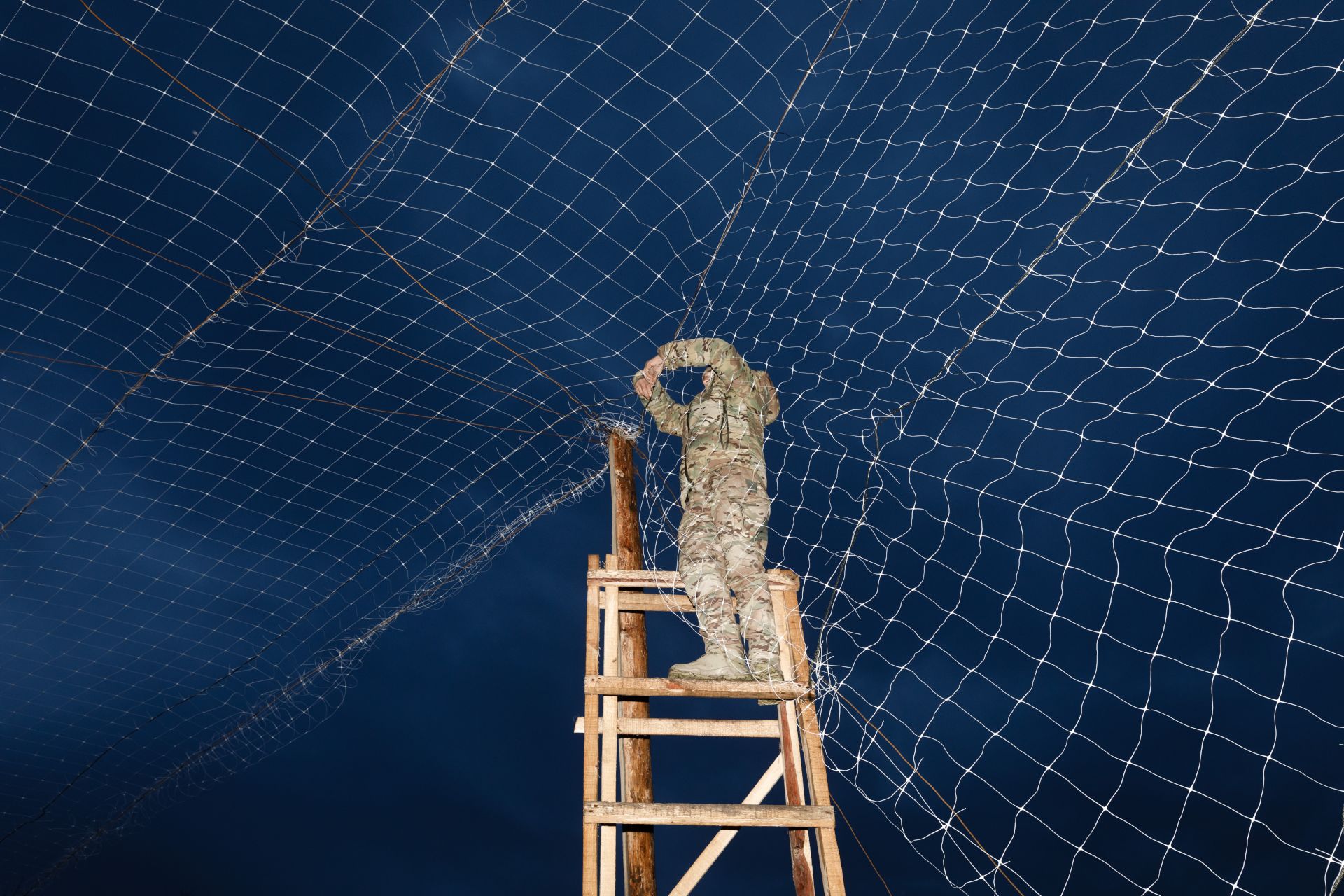
By design, these vehicles erase the front line, bringing the war’s sharpest edge directly to civilian homes. The result is a nation of civilians enduring not only the physical threat of a blast but the omnipresent, traumatic soundtrack of their own fight-or-flight response. In towns closer to the front lines, infrastructure has been adapted in expectation of the daily drone attacks. Antidrone nets made of polyester are draped over long stretches of road in the cities of Kherson and Kharkiv to prevent drones from hitting commuters. The mesh corridors create surreal tunnels through the urban sprawl, like enormous spider webs trying to keep out harm.
Olga Viktorivna Topchilo, 39, recounted a night when an explosion from a Shahed drone rained debris over their apartment block. The family huddled in the hallway. It was her daughter’s 7th birthday, which was spent in a state of shock. While physically unharmed, the trauma lingers, rooted in the dreadful sound of a Shahed “picking up speed and going in for the strike.”
The Shahed drones, originally designed and manufactured by Iran, are now being mass-produced in Russia as the Geran drones. With a wingspan of 8.2 feet and 11.5 feet in height, the smallest version of these drones is still the size of a small car, and can carry up to 198 pounds of explosives.
Being relatively low-cost, in the $20,000 to $50,000 range, they can travel from 250 to more than 500 miles, depending on the payload. This has allowed Russians to overwhelm Ukraine’s skies with a larger number of explosives. While the Ukrainian forces have been quickly adapting to drone warfare, the budget-friendly, unmanned explosives have given the Russians an advantage in terms of the damage they can inflict.
New Lines spoke to over 40 Ukrainian civilians about such trauma, which is now being dubbed “drone-induced anxiety,” a term finding its place in medical vocabulary globally, from researchers at Harvard Medical School to military journals such as the Scandinavian Journal of Military Studies.
Air Alarms Ukraine, which since 2022 has been calculating how often air alarms are sounded every day in Ukraine, said that in 2025, sirens went off 19,219 times. Most blared for an average of two minutes; the longest played for an overwhelming 49 minutes.
Kharkiv was the loudest region in 2025, with alarms going off 2,000 times, while Kyiv experienced over 500 alarm sounds.
In Afghanistan, the U.S.-made drones, sometimes locally referred to as “bizbizak” after the buzzing sound they made, were notorious for targeting alleged insurgent positions as well as exploratory surveillance flights. But their legacy includes creating an environment of fear and anxiety among locals, in Afghanistan as well as Pakistan, where drones were used liberally.
In the Palestinian territories, too, Israel has used drones, particularly quadcopters, locally known as “zanana” after the buzzing sound they make, which have been proven to cause psychological and physiological stress from long-term exposure. According to reports from local human rights organizations, the sounds of the zanana drones, which have been used since the early 2000s, create a constant sense of imminent threat among Palestinians.
Another report by the Geneva-based Euro-Med Human Rights Monitor observed that Israeli quadcopters deliberately hover outside windows, in corridors of shelters and above displaced persons’ tents. “The drones would circle slowly before broadcasting disturbing sounds specifically designed to terrify and psychologically exhaust civilians,” it noted.
Now, Ukrainians exhibit similar scars.
Olena Valentynivna Kozina, a 39-year-old economist, described the sound of a Shahed drone, “the terrible buzzing of their engines,” a sound that brings “the greatest fear and panic … this feeling of impending mortal danger.”
Kozina observed that her children “struggle to cope with their emotions every time the sirens go off — it causes trembling and nausea in them.” Adults, too, report a profound, chronic exhaustion. Maksymchuk, a 48-year-old from Kryvyi Rih, a city in Dnipro Oblast, who shared only her last name to protest her identity, said the greatest stress comes not from the sound but from the “uncertainty — whether it would strike or fly past.” In those endless moments, internal tension grows, and any calm is only a brittle facade.
One of those investigating the psychological impact of sound is Olena Yelizarova, lead researcher at the Marzeev Institute of Public Health of Ukraine. Each attack is “layered trauma — psychological, physical, and existential — the impact of noise on the psyche along with the direct threat to life.” The near-daily attacks have deliberately disrupted the biological rhythms of millions, impacting mental and physical health. Her team conducted a study between 2022 and 2025, involving over 10,000 parents of school-aged children, to study the effects of sounds from war on mental health. They found that the children showed symptoms consistent with post-traumatic stress disorder (PTSD): disturbed sleep, nightmares, dizziness, intrusive memories. Nearly half of the children lost their appetite.
Trauma like this leaves a biological legacy, Yelizarova warned. Epigenetic marks from constant fear may be passed on, meaning children who never hear a siren could inherit increased vulnerability to stress. “This,” she concluded, “is a form of terrorism, and wholly intentional.”
It has been widely reported that Russian drones are increasingly and intentionally flying into civilian areas and residential buildings, making these noises an existential threat. However, those watching the Ukrainian conflict closely will point out how many of these attacks are deliberately designed to trigger anxiety.
“If you trace these drones, the routes they take … you can see that they fly through civilian areas on purpose,” said Yuriy Boyechko, founder of Hope for Ukraine, a humanitarian nonprofit organization. “They circle some of the residential areas repeatedly before they hit a location. It’s all psychological warfare, to instill terror in the people. It’s a form of torture, and the Russians are doing it on purpose to break the spirit of the people.”
His organization’s response is to offer a brief, fragile alternative: “no-siren camps.” These retreats take children outside the country to places like Italy, designed to help participants cope with the trauma of the war by simply letting them experience normal life. It is an attempt to alter the emotional wiring of a generation.
“Because you have to understand, there are some kids now who were born just before or during the war — all they have known is this state of mind,” Boyechko said. He recalled one moment at a camp in Italy: A plane passed overhead, and the children instantly dove for cover under their beds, convinced the sound was a drone. “It took them two days to understand and adjust to the sounds of the plane.”
The stakes, he insisted, are existential for the country’s future. “We want to make sure that they don’t forget what normal is. Because these are the next leaders of our country, but if they lose that innocence or forget how to smile, or how to play, or if they are completely consumed and defined by this terror, then that is the society that Ukraine will inherit.”
Maksymchuk, raising her son while her husband serves on the front lines, echoed this profound burden. “Over time, you learn to live with anxiety: to remain calm, and not let fear control your life. But at the same time, you understand that this reality should not be the norm for anyone.”
“Spotlight” is a newsletter about underreported cultural trends and news from around the world, emailed to subscribers twice a week. Sign up here.