


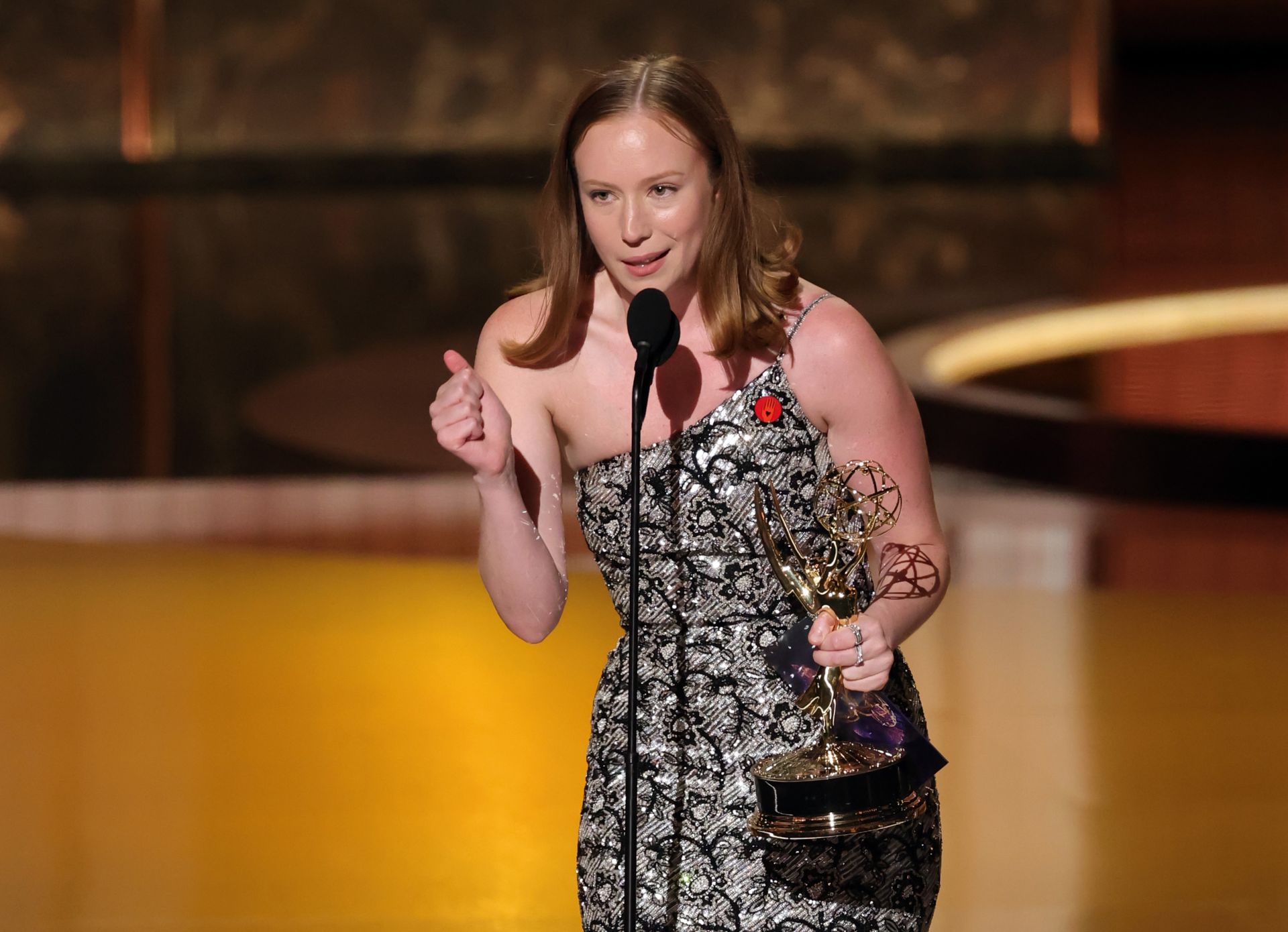
One word can curdle a room. At this year’s Emmys, that word was Palestine.
Hannah Einbinder slipped it into a speech that was light, quick and alive. It was the kind of moment that makes these nights worth watching, when an actor’s timing pulls you in. The room laughed and cheered until her parting call for a “Free Palestine” pressed against a boundary Hollywood works hard to seal.
In the press room, she was asked to explain why she said it. The question itself revealed the limits as much as her answer did. She replied that as a Jewish woman, she felt an obligation to separate Judaism from the state of Israel, echoing other Jewish actors like Natalie Portman who had also refused that conflation. That she had to spell this out, on a night meant for celebration, showed how little space Hollywood gives to Palestine.
For decades, the industry has paraded its conscience when the tide was safe: Vietnam in the 1970s, climate change in the 2000s, #MeToo in the 2010s. Palestine has never been granted that ease. To invoke it is never casual. To thank it, to wear it on a pin, to say the word aloud is to guarantee a reaction out of proportion to the act itself.
The pattern began in 1978. Vanessa Redgrave, already known for her politics, had produced “The Palestinian,” a documentary sympathetic to the cause. The backlash was immediate. Advocacy groups denounced her, while the Jewish Defense League burned her in effigy outside the Academy Awards. Months later, when a Los Angeles theater prepared to screen the film, a bomb exploded at its doors. A JDL member was later convicted, though the screening went ahead the next day.
That same night, Redgrave collected her Oscar for “Julia,” playing a woman who gave her life resisting fascism, even as she herself was vilified for siding with Palestinians.
On stage, she turned the moment back on her critics, rebuking the “Zionist hoodlums” who had tried to silence her. Hollywood insiders accused her of spoiling the evening with politics. The press called her reckless. Within days, Saturday Night Live aired a parody mocking her outburst. One of the performers in that sketch was original SNL cast member Laraine Newman, who is Einbinder’s mother. What played as scandal and satire in 1978 set the template for how Palestine would be treated whenever it surfaced on Hollywood’s stage.
The link is not just genealogical. It reveals the frame: Moral outrage is quickly converted into ridicule, the seriousness drained away through satire. Redgrave’s career survived, but she had crossed an unspoken line.
In 2005, “Paradise Now” was nominated for Best Foreign Language Film. Even its label, Palestinian or not, became contested terrain, as Israeli officials pushed to rename it. The debate turned from art to recognition under the Oscars’ glare.
Palestine returned in 2024, inside the Spirit Awards tent in Santa Monica. Four months into Israel’s assault on Gaza, activists interrupted the ceremony with chants for a ceasefire. Their voices clashed with speeches about artistic freedom. At an event that frames itself as a space for that freedom, Palestine’s presence was treated as an intrusion, not as solidarity.
That same season, “No Other Land” won the Oscar for Best Documentary Feature. Co-directors Basel Adra and Hamdan Ballal spoke of bombardment and dispossession in their speech. The Israeli government responded within hours, condemning the academy for allowing what it called a “politicized” message. Newspapers debated whether the filmmakers had crossed a line. The line was never defined. That is the point.
Weeks later, Ballal was beaten by settlers, and a central figure in the film was killed. The academy at first issued a vague statement condemning violence against artists, only naming Ballal after a backlash. The gap between Hollywood’s symbolic recognition and the violence unfolding in the film’s villages could not have been starker.
The act of mentioning Palestine, even in a moment of triumph, is almost always treated as a breach. That breach matters most on the awards stage, where sequins and champagne are meant to keep politics at bay.
The Oscars, Emmys and Golden Globes don’t just mirror culture, they manage it. Causes are only absorbed once they reinforce Hollywood’s image of virtue. The Darfur Crisis became a rallying point in the mid-2000s, with bracelets and awareness campaigns that cost nothing — gestures that proved loyalty to the industry’s self-image without ever threatening its order.
Why, then, does awareness turn into provocation when the word is Palestine?
Because the two are not the same. Darfur could be mourned without unsettling the order of things. Palestine cannot. To name it is to brush against the machinery that decides whose lives are acknowledged and whose are ignored.
Palestine shows that Hollywood’s escape depends on denial. To acknowledge it collapses the fantasy of neutrality, the illusion that art floats above empire. When actors in couture name a siege, the bubble bursts. Viewers are forced to see that the gowns and billion-dollar industry exist alongside bombed hospitals and blockaded cities. Those who speak face the harshest response.
Redgrave was mocked. Einbinder has the shield of comedy and family legacy. Javier Bardem and Penélope Cruz faced criticism for signing a letter denouncing Israel’s assault on Gaza, but their star power spared them lasting harm. Rachel Zegler, Golden Globe winner and star of Disney’s “Snow White,” faced harassment and threats after expressing support for Palestine. If it is precarious for someone with her profile, the risk is even starker for others without protection, where jobs have vanished over a tweet.
The asymmetry is glaring. In May 2024, Gal Gadot was awarded a star on the Hollywood Walk of Fame. As thousands were being killed in Gaza, Hollywood celebrated a former Israeli soldier without hesitation. If politics must be separated from art, why only here, and why now?
This is what is being guarded: not simply decorum, but narrative power. The disproportionate reaction is itself the evidence. Critics of Israel have long been dismissed as conspiratorial for pointing out how discourse is managed, yet the pattern is in plain view, replayed every awards season. Palestine makes the fault lines visible: whose voices are ridiculed, whose careers are threatened and whose standing is preserved.
Einbinder’s moment at the Emmys belongs to a chain stretching back nearly half a century: Redgrave’s defiance, the contested identity of “Paradise Now,” the speech under fire of the filmmakers behind “No Other Land,” the chants at Santa Monica. Each shows how Palestine unsettles Hollywood’s most guarded spaces by dragging siege and dispossession into a room designed to deny them. Even brief appearances reveal its force.
Award shows are built to contain performance, but every so often a word slips through the script. Palestine has done that again and again, and each time the reaction confirms the stakes. It should not take courage to say the name of a people.
That it does is the clearest sign of the double standard. Einbinder’s call for a free Palestine lasted only seconds, but it forced everyone to hear what the industry works to shut out. The moment may fade. The risk will not. That risk is the measure of control.
“Spotlight” is a newsletter about underreported cultural trends and news from around the world, emailed to subscribers twice a week. Sign up here.