


The wreckage of the plane lay scattered across the ocher sand of Niger’s Tenere desert — twisted aluminum, scorched luggage, a lone shoe. There were no survivors.
French investigators combed the debris of UTA Flight 772 for weeks after the airliner fell from the sky on its journey from N’Djamena to Paris on Sept. 19, 1989. Analysis of the wreckage revealed the presence of a bomb, hidden in a suitcase in the cargo hold, which had caused the plane to split in half and crash in the Sahara.
Fragments of a timer, traced back to Libyan intelligence, led to the 1999 conviction in absentia of six Libyan nationals, including Abdullah al-Senussi — the Libyan dictator Moammar Gadhafi’s brother-in-law and intelligence chief — as the mastermind behind the attack. For the families of the 54 French victims, it was a grim sort of justice.
They never imagined they would see Senussi’s name resurface decades later — not as a fugitive finally brought to trial, but as a bargaining chip in the political rise of a French presidential hopeful.
On Sept. 25, 12 years after Nicolas Sarkozy’s ties to the Libyan regime were first revealed, a Paris criminal court sentenced the former French president to five years in prison. The charge? Conspiring with Gadhafi, via Senussi, to secure funding for his successful 2007 presidential campaign, in exchange for incentives both diplomatic and economic — and for a promise to have the arrest warrant against Senussi lifted.
The court ruled that because of the “exceptional gravity” of his actions — “liable to undermine citizens’ trust in the republic’s institutions” — Sarkozy can only appeal from inside prison. The verdict made the 70-year-old the first French head of state since Vichy leader Philippe Pétain to face real jail time.
On the day of the verdict, television crews swarmed the courthouse. Sarkozy’s defiant declaration — “I am innocent. This injustice is a scandal” — ran on a loop. Allies on the right decried the “politicization of justice.” Editorials wondered what this might mean for the future of the Fifth Republic.
Much of the reaction focused on the political drama: Why imprison Sarkozy when the corruption charges — the perceived core of the so-called “Libyan affair” — had been dropped by the court? Why leverage a charge like “criminal conspiracy,” usually reserved for terrorism and organized crime, against a former president?
On the far-right channel CNews, interviewees debated whether or not Sarkozy might be a “victim of the republic of judges” determined to humiliate him.
But in all this political theater, almost no one paused to notice a quieter, unexpected detail: The court had named actual victims in the Libyan affair — the families of UTA Flight 772 — and ordered Sarkozy and two of his closest allies to pay them symbolic damages.
The judges ruled that by entering clandestine talks with the Libyan regime and hinting at judicial concessions for Senussi, Sarkozy’s camp had inflicted a fresh moral wound on those families. They were not abstract political casualties, but people who had lost loved ones and who discovered, decades later, that their grief had been treated as a negotiating point in the pursuit of political power.
That recognition reframes the entire story. To truly understand why the Libyan affair will have Sarkozy sleeping in jail for criminal conspiracy, we must go back to the 1989 attack, and to the families who have carried its weight ever since.
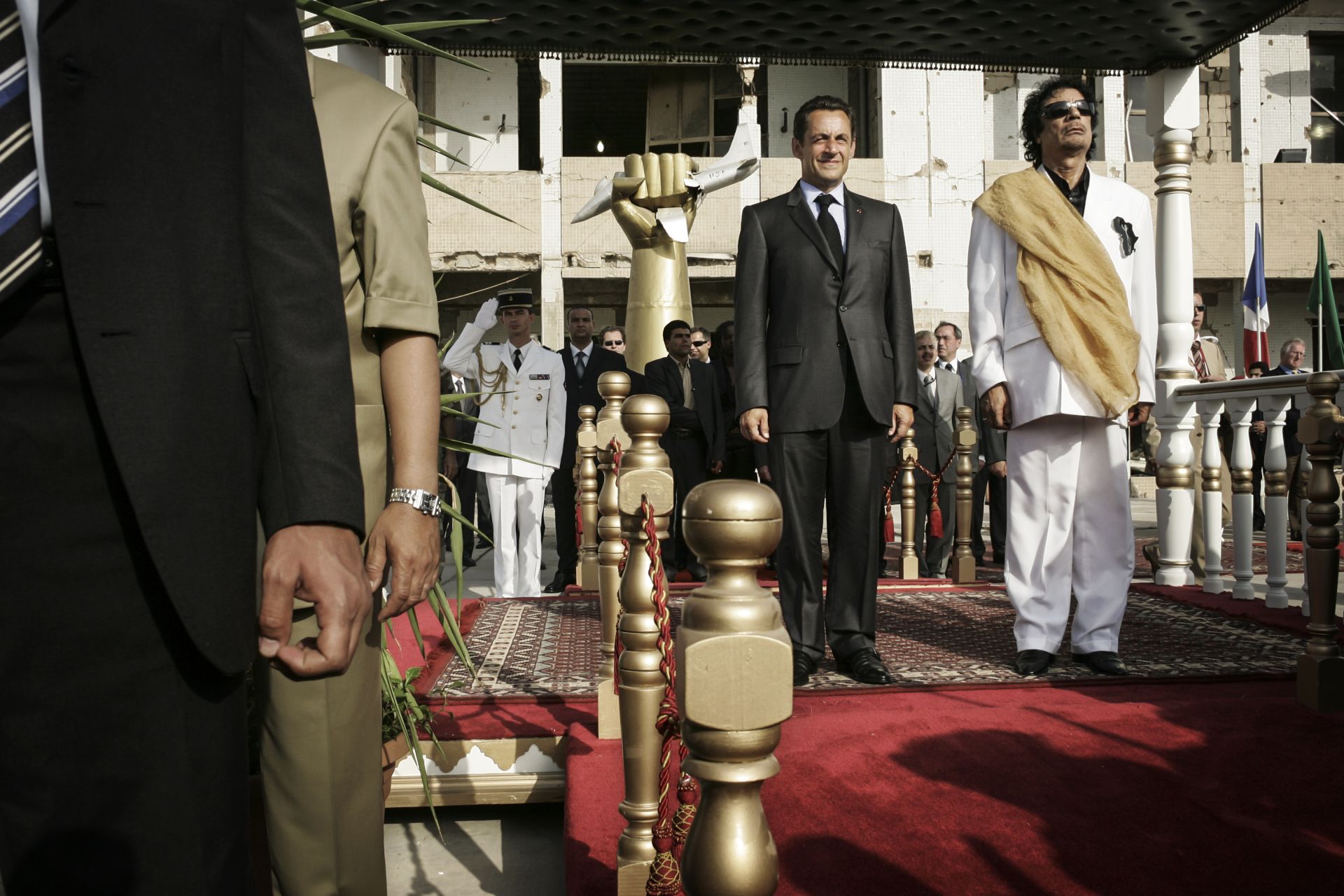
In December 2007, Parisians awoke to an extraordinary sight: Moammar Gadhafi’s Bedouin tent, a massive marquee he traveled around the world with, pitched in the gardens of the Hotel Marigny, steps from the Elysee Palace.
The scene stunned much of the country. For decades, the Libyan leader — later deposed and executed — had been shunned as a sponsor of terrorism and a serial abuser of human rights. Then, seven months into his presidency, Sarkozy gave him a red carpet welcome and feted him as a partner.
The Libyan leader did not keep a low profile: His entourage, including some 200 or so of his female, elite “Amazonian guard,” filled 100 limousines, clogging traffic as they swept through the Louvre and visited Versailles and the former royal forest of Rambouillet, where, according to gossip, domesticated pheasants were set loose for Gadhafi to hunt. Contracts were signed for arms and infrastructure.
Though the visit was only meant to last 72 hours, it went on for five days. “Five days! Five endless days! It hurt so much,” Danièle Klein exclaimed when she took the stand on Jan. 23 as a plaintiff in Sarkozy’s trial.
Her brother, Jean-Pierre Klein, had been on UTA Flight 772. A young actor, noticed by François Truffaut and given a small role in “The Last Metro” (1980), Jean-Pierre had spent two months in the Republic of Congo staging a play about a mad dictator devouring his own people. On Sept. 19, 1989, on his way back to Paris, Gadhafi’s regime took down his plane.
Klein told the court that Gadhafi’s visit to the French capital, 18 years after her brother’s death, had felt like “an indignity.” In her testimony, she recalled the giant motorcade that took over the Parisian streets and having to pull her scooter to the side of the road to let the dictator pass.
“It was difficult to admit that the [French] Republic went about doing so much for that man,” Klein said in an interview. She remembers Sarkozy inviting her and some other bereaved family members to meet him in the Elysee Palace during Gadhafi’s visit. Klein recalls him commiserating with their pain but explaining the motives behind the visit, and telling them that such was the game of diplomacy.
Klein’s niece, Melanie, was only 4 when her father died. She told the court that Sarkozy’s invitation to Gadhafi had left her feeling “surprised” and “anxious.” Growing up, Melanie used to tell people that her dad had died in a plane crash. But she was 22 by the time Gadhafi came to Paris; she knew that that plane crash had been the result of a bomb attack and that “men had met in Libya to plan this terror attack.”
Later, when it was revealed that Sarkozy’s allies had allegedly met with Senussi to negotiate campaign funding, her understanding evolved yet again. In January, Melanie joined the trial as a plaintiff. She said she wanted to understand “if other men had met, this time in France, to see whether the justice given my father was negotiable.”
The first public allegation of criminal conspiracy against Sarkozy came in March 2011, during the Arab Spring.
As French jets joined NATO’s strikes against Gadhafi’s regime, Saif al-Islam Gadhafi, the colonel’s son, claimed that Libya had financed Sarkozy’s 2007 presidential campaign “to the tune of €50 million” — more than twice France’s legal campaign limit. Before he was ultimately toppled by the rebellion, Gadhafi himself told a reporter from French daily Le Figaro: “We were the ones” who provided Sarkozy “with the funds that allowed him to win the elections. He asked me for financial support. And we supported him.”
At the time, many dismissed those statements as propaganda from a desperate regime. But in April 2012, in the midst of yet another presidential election, the French outlet Mediapart published what it said was an internal Libyan memorandum that recorded an alleged commitment of funds to Sarkozy’s team by the Libyan regime.
Though the document’s authenticity would later be contested in court, the revelations spurred French magistrates to open a formal inquiry in 2013.
The story, as the Paris criminal court pieced it together, began in 2005. Sarkozy was the interior minister and already preparing his presidential bid. His lieutenants, Claude Guéant and Brice Hortefeux, slipped into Tripoli, outside official channels — no interpreter, no embassy note — to meet Gadhafi’s number two: Senussi, the mastermind behind the UTA Flight 772 bombing.
Among other crimes, Senussi was also credited with the 1986 bombing of La Belle (a West Berlin nightclub frequented by American soldiers), the 1988 Lockerbie bombing (the deadliest terror attack in the history of the United Kingdom) and the 1996 massacre of 1,270 prisoners at Libya’s Abu Salim prison. (He is currently jailed in Tripoli for his role in the brutal repression of the 2011 rebellion that finally toppled the Libyan dictator.)
When they met him in 2005, Guéant and Hortefeux allegedly signaled that, if Sarkozy won, France could be “understanding” about Senussi’s legal troubles, help ease his international arrest warrant and rehabilitate Gadhafi’s image on the world stage. In return, the Libyan regime would discreetly support Sarkozy’s campaign.
The sprawling investigation has captured the public imagination for more than 12 years now. It is, no doubt, a fascinating story, replete with cash-filled suitcases, greedy intermediaries, secret flights, giant bank vaults and improbable offshore accounts.
But in the swirl of cloak-and-dagger intrigue, something more elemental was at stake for the families of the 170 passengers and crew of UTA Flight 772. They needed to know whether or not the lives lost in 1989 had been reduced to bargaining chips in the rise of their former president.
Yohanna Brette was only 18 months old when her mother, Martine, a flight attendant, died in the attack. Brette was appalled when she found out her mother’s death was at the heart of the investigation against Sarkozy. “Honestly,” she said in an interview, “it was terrible. There was a great sense of betrayal, and of contempt.”
Christophe Raveneau, whose father, the flight’s captain, was also killed in the bombing, described the pain of the burial for the court. “We had to identify the remains, to bury the remains, without having the certainty that they were his.” Turning toward the former president on the stand, he added: “Imagine standing before an almost empty coffin and being told, ‘This is dad, darling.’ Monsieur Sarkozy, that day I was the age your daughter is today.”
On Sept. 25, the Paris court of justice found the former president, alongside Guéant and Hortefeux, guilty of criminal conspiracy. According to the report, investigations found that Sarkozy “let his close collaborators approach the Libyan authorities in order to obtain, or attempt to obtain, financial support” for his 2007 campaign.
The court did acquit Sarkozy of the narrower counts of corruption and embezzlement. Though financial investigators did find material proof that some 6.5 million euros ($7.6 million) was transferred, and that illegal cash was indeed withdrawn and circulated within Sarkozy’s 2007 campaign headquarters, as well as within his party’s office, they were not able to prove the Libyan origin of the money.
But even without proof that the promised Libyan millions ever reached Sarkozy’s campaign, the judges ruled that the mere act of seeking such a deal, which included hints at easing the case of a convicted terrorist, constituted a betrayal of the republic.
The court also recognized the families of the 1989 bombing as victims of that betrayal. They ordered Sarkozy and his two closest allies, Guéant and Hortefeux, to pay symbolic damages — just a few thousand euros each — to those who had lost fathers, mothers, brothers and sisters on UTA Flight 772.
The sum was modest, just 3,000 euros. The meaning was monumental. By recognizing that victims had been treated as a bargaining chip in Sarkozy’s ascent to power, the court restored, however belatedly, a measure of their memory.
The thread running from the Tenere desert in 1989 to the Paris courtroom in 2025, if we take the time to untangle it, helps us to look past the spectacle of Sarkozy’s fall — past the convoys of limousines, the tents in Parisian gardens, the cash-filled suitcases, the defiant president denouncing injustice in the hall of a court of justice — to the grief of families who have carried the weight of the bombing of UTA Flight 772 for 36 years.
“Spotlight” is a newsletter about underreported cultural trends and news from around the world, emailed to subscribers twice a week. Sign up here.