

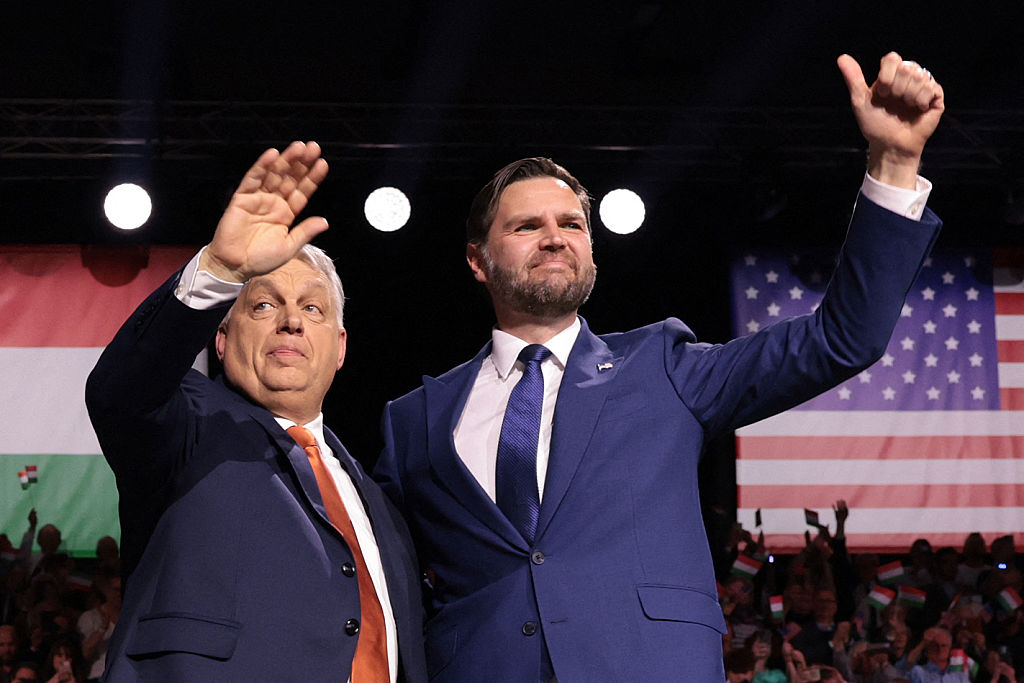
Viktor Orbán’s defeat in Hungary’s election on Sunday to Péter Magyar of the center-right Tisza Party is widely seen as a repudiation not only of the prime minister’s 16 years in power, but of U.S. Vice President JD Vance, who went to Budapest to stump for the right-wing Hungarian incumbent in the final stretch of the campaign.
“Vance Bitterly Humiliated as Voters Turn Out in Droves to Reject His Pleas,” a Daily Beast headline read. “JD Vance mocked over failures in Iran and Hungary,” read another. Journalist Brian Beutler referred to Vance’s “crowning failure to help Viktor Orbán.”
But to declare Vance’s efforts a failure is to presume that he could have swayed the election for Orbán had he somehow done things differently. This is a faulty premise, and it turns a fundamentally Hungarian story into one about America. The election wasn’t about the U.S. — it was about Hungary, and Orbán would have lost with or without Vance’s intervention on his behalf.
Orbán and his Fidesz Party are deeply admired on the American right, especially among the MAGA intelligentsia. Under his leadership, Hungary — a country of just 10 million people — has become a “Christian conservative Disneyland,” in the words of Hungarian journalist Balázs Gulyás.
In 2022, the Conservative Political Action Conference (CPAC), based in the U.S., began holding a version of its influential annual gathering in Budapest. Five years in, CPAC Hungary has become a major happening, attracting American conservatives to the Hungarian capital for several days of networking and political discussions.
Some notable American conservatives have even relocated to Hungary. Gladden Pappin, a conservative political theorist and co-founder of the journal American Affairs, moved to Budapest to become president of the Hungarian Institute of International Affairs, a state-run think tank close to Orbán.
Rod Dreher, a longtime senior editor of The American Conservative magazine, is perhaps best known for his books “The Benedict Option: A Strategy for Christians in a Post-Christian Nation” (2017) and “Live Not by Lies: A Manual for Christian Dissidents” (2020). He moved to Hungary some years ago to work for the Danube Institute, a conservative think tank in Budapest.
Dreher’s most consequential feat was arranging for Tucker Carlson to visit Hungary and broadcast his Fox News show from Budapest for a full week in August 2021. Carlson praised Orbán’s rollback of LGBTQ+ and transgender rights, his promotion of “Christendom” and the traditional family, and his defense of Hungary’s sovereignty against “globalists.”
Among the many arguments against meddling in the domestic affairs of other countries is that, if your candidate loses, their opponents are likely to resent your interference when they assume office. The Trump administration will now have to deal with Magyar, after attempting to prevent his victory.
Backing one candidate over another in a foreign election is unwise in general, but it’s particularly odd for an administration that claims to promote an “America First” foreign policy, a supposedly realist approach that places U.S. strategic interests front and center, with the internal affairs of other countries not Americans’ concern. Why pick sides in the internal politics of other countries and put a finger on the scale of their elections?
As I argued in these pages last year, this is one of the contradictions at the heart of the “America First” doctrine, whose proponents want to have it both ways. This contradiction was perfectly distilled by Carlson, when he asked a few years ago: “Why do I care what’s going on in the conflict between Ukraine and Russia? And I’m serious. Why do I care? And why shouldn’t I root for Russia? Which I am.”
Either you don’t have a dog in other people’s fights, or you do. Vance and Dreher and the “postliberal” right have had a dog in the Hungarian fight since Orbán came to power 16 years ago. Indeed, the outgoing Hungarian prime minister has played an outsized role in right-wing ideological battles and inspired American conservatives like few other living political figures.
He will soon exit the stage of Hungarian politics, but the flame of Orbánism as an ideological project will likely continue to burn on the American right.