

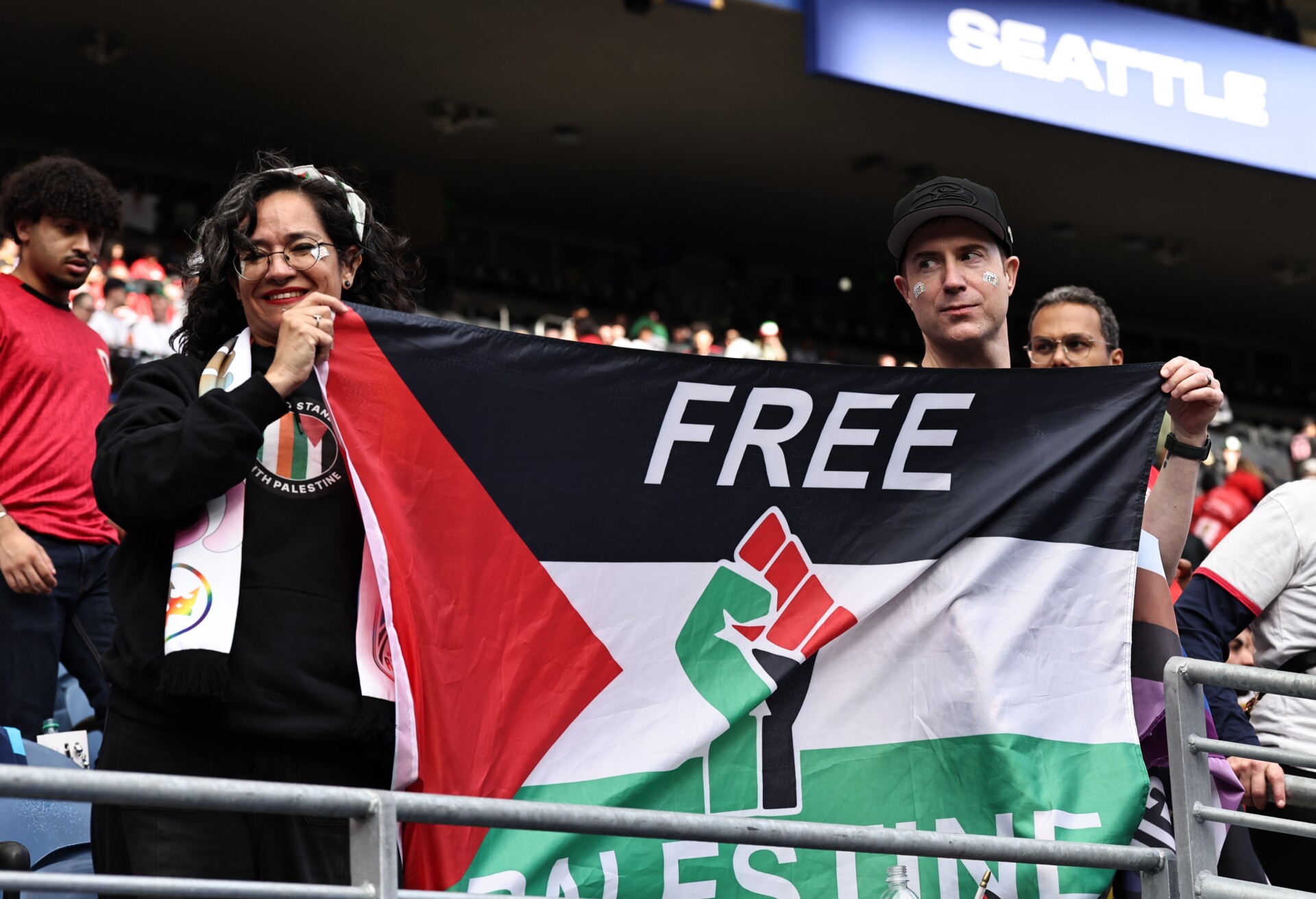
Palestine may not have played at the 2026 World Cup, but in many ways it has been one of the tournament’s most visible political presences.
Earlier this month, Academy Award-winning actor Javier Bardem was photographed raising a Palestinian flag during Spain’s match against Austria at SoFi Stadium in Los Angeles. In another widely shared moment, a Palestinian fan approached him in the stands, thanking him for speaking out and inviting him to visit his home “when Palestine is free.” Meanwhile in Toronto, thousands of Bosnia-Herzegovina supporters marched through the downtown streets carrying Palestinian flags and chanting in solidarity ahead of the team’s opening match against Canada on June 12. Weeks earlier in Barcelona, teenage superstar Lamine Yamal had found himself at the center of an international controversy when he waved a Palestinian flag from an open-top bus during the club’s celebrations after winning Spain’s top professional soccer league title, La Liga. As Israeli officials accused Yamal of inciting “hatred” against Israel, Spanish Prime Minister Pedro Sánchez posted on X that he was “proud” of Lamine, who “has merely expressed the solidarity with Palestine that millions of Spaniards feel.”
Norway, too, was part of this broader display of solidarity. Last year, when they defeated Israel 5-0 in a World Cup qualifier, the match unfolded against a backdrop of pro-Palestinian demonstrations outside Oslo’s Ullevaal Stadium. Inside, Palestinian flags filled sections of the crowd, as well as a huge “Let children live” banner, as chants of “Free Palestine” echoed during the game. The Norwegian Football Association even pledged to donate the proceeds to humanitarian relief efforts in Gaza.
But Palestine’s significance in soccer did not begin with this tournament. For decades, some of the sport’s most iconic figures have spoken openly about the cause. Diego Maradona, revered across the Arab world as much as in Argentina, once described himself as “the number one fan of the Palestinian people” and, in 2018, embraced Palestinian President Mahmoud Abbas while declaring: “In my heart, I am Palestinian.”
This time around, perhaps no soccer figure has embodied that outward solidarity more than Egypt’s head coach, Hossam Hassan.
After Egypt’s victory over Australia, the former striker walked around the pitch carrying a Palestinian flag as supporters chanted “Free Palestine.” The gesture quickly went viral, along with an image of Hassan wrapped in a Palestinian flag along with an Egyptian one. Following the match, he told the press he was dedicating the win to the “good and noble” Egyptian and Palestinian people. Some Israeli commentators called his moves a provocation and demanded sanctions, even arguing that Egypt should be disqualified. In Egypt, media figures like right-wing populist TV presenter Tawfik Okasha accused Hassan, who is Egypt’s all-time leading scorer, of being unpatriotic. FIFA responded by reiterating that Palestinian flags are permitted at its tournaments.
Such a vigorous response didn’t seem to deter Hassan. Ahead of Egypt’s round-of-16 match against Argentina, perhaps the biggest match in Egyptian soccer history, he delivered an impassioned press conference in which he drew attention to the humanitarian crisis that continues to unfold in Gaza.
“If there is anyone in the world who does not feel for the Palestinian people, then they are not human,” he said. “Just as FIFA’s slogan calls for respect among us, I hope there will be respect for people’s right to live. Everyone who holds authority or influence needs to imagine themselves or their children spending just one day in the conditions endured by the people of Gaza and Palestine, sitting out in the open under the scorching sun or in the rain and cold, without shelter or security.”
Last Friday, as supporters welcomed Egypt’s team home after the most successful World Cup campaign in the nation’s history, team members draped a Palestinian flag from their open-top bus as they waved to fans below. When Egypt’s tournament ended in a controversial defeat to Argentina, a reporter asked whether Hassan believed his support for Palestine had affected how his team was treated. Rather than dwelling on the refereeing decisions, which stirred controversy amid accusations of inconsistent refereeing favoring Argentina, the head coach returned to the subject of Gaza.
“Those people you see, they love soccer,” he said. “They wear Argentina jerseys. They wear Barcelona’s and Manchester City’s and Real Madrid’s. But they’re still being killed, and you’re staying quiet [about them] … Collectively, soccer and the media, sports, players should support humanitarian causes.”
His comments reverberated across Gaza. Despite ongoing widespread destruction and displacement, men and women, the elderly and children in Gaza gathered to watch matches, sometimes sitting amid the ruins of their damaged homes. Several videos have circulated online showing crowds cheering on Egypt’s improbable run, waving Egyptian and Palestinian flags. Beneath shattered concrete and twisted steel, they even unfurled a large image of Hassan draped in the two flags. Many of the comments from Palestinians based in Gaza reflected that for a few hours at a time, soccer offered something increasingly rare there: distraction, and in some moments, a sense of joyous victory.
One of the people responsible for creating those moments was Mohammad al-Waheidi, who organized public World Cup screenings across Gaza. According to reports, al-Waheidi was killed along with three others, including two siblings aged 10 and 8, in an Israeli strike shortly before Egypt faced Argentina. Hundreds attended his funeral, where his body was wrapped in both Palestinian and Egyptian flags. The tragedy echoed the very point Hassan made, that behind the solidarity and any controversy it garnered, the lives of real people remained in danger.
The lethal cost has been felt within Palestinian sport, too. Earlier this month, 32-year-old Saleem Khader Al-Ashqar, a goalkeeper from Gaza, was reportedly killed by Israeli forces while traveling on a motorcycle to secure a cooking gas cylinder for his pregnant wife. The death added to what many Palestinian sports officials and advocates increasingly describe as the systematic destruction of Palestinian sporting life. Since October 2023, dozens of soccer players, coaches and sports administrators have been killed, while stadiums, training facilities and sporting clubs across Gaza have been damaged or destroyed, as I previously reported in a story about Mustafa Tafesh. Last August, the 21-year-old player for Gaza’s Palestine National Baseball Team was killed in an Israeli airstrike. His death came just three days after an Israeli quadcopter killed Gaza-based soccer star Suleiman Obeid, the “Pelé of Palestine,” as he was known.
Soccer cannot stop a war, it cannot rebuild homes and it cannot bring back the dead. And even though the tournament and the games leading up to it repeatedly produced moments of highly visible solidarity with Palestinians, these moments also highlighted the limits of such symbolism at a time when many governments and sporting bodies remain reluctant to confront the realities of Israel’s actions in Gaza and the West Bank.
Perhaps this is one of the most salient lessons of the 23rd World Cup: that even one of the most popular global spectacles could not fully insulate itself, or us, from the moral questions raised by Israel’s genocidal campaign in Gaza.