

Syria Quietly Reconnects to the Global Financial System
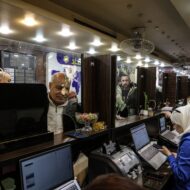
A few weeks ago, I was having dinner with a U.S. banker advising the Syrian government on integrating it into the world economy. I asked him why, if President Donald Trump had announced the lifting of sanctions, we had not yet seen normal banking transactions return to the country, which has been suffering from the crippling economic restrictions. He explained that for sanctions relief to translate into real financial activity, the Syrian Central Bank had to open an account with the U.S. Federal Reserve in New York. For that to happen, the bank first had to comply with stringent U.S. financial regulations dealing with terror financing and money laundering. He told me the process could take more than two years. That meant I would still have to travel to Beirut in Lebanon, or be fortunate enough to have an account with QNB, Qatar National Bank in Damascus, to access normal banking services.
Now, for the first time since 2011, Syrian Finance Minister Mohammed Yisr Barnieh and Central Bank Governor Abdulkader Husrieh, with the help of Tom Barrack, the U.S. envoy for Syria and Turkey, have managed to overcome the compliance issues with the Federal Reserve and open an account there. This is a small but important step toward Syria being incorporated back into the global financial system and, in the context of the ongoing wars in the region, this immensely significant development has largely gone unnoticed.
Though only the first step, it could prove hugely important for the Syrian economy. For years, Syrian businesspeople have relied on various work-arounds to conduct financial transactions. One method has been cryptocurrency, for the more tech-savvy. Older, more traditional businesspeople who do not quite trust or understand digital currencies often rely instead on the hawala system, a traditional financial network used in the Muslim world for centuries. Another method, as one businessperson told me, involves paying for an all-expenses trip for a Syrian with a foreign passport to travel to a country like Kuwait or Oman, obtain residency, open a bank account and then hand over management of that account to the businessperson.
In practical terms, the new account with the Federal Reserve means Syrian commercial banks may eventually be able to conduct transactions many of us take for granted, from SWIFT transfers to handling foreign currency. Syria will no longer have to rely as heavily on neighbors like Lebanon, whose banking system long served as an indirect financial channel.
There are still many hurdles ahead. Syria’s commercial banks must comply with stringent financial rules and transparency requirements. But already you can see signs of cautious optimism. Interim President Ahmad al-Sharaa recently opened Syria’s mobile network, MTN, once controlled by the Assad family, to foreign tender.
But there is another element to this as well. Washington recently removed Hayat Tahrir al-Sham, the group al-Sharaa once led, from the sanctions list and delisted it as a terrorist organization, giving other countries greater confidence in engaging with Syria. Turkey has now followed suit. By linking Syria’s financial system to the U.S. financial infrastructure, Washington draws the country ever closer into its orbit of influence. Alongside the Gulf and European countries, it still retains the ability to shape how quickly that reintegration proceeds. Whether that closeness to Washington proves beneficial or problematic for Damascus remains to be seen.