

Iran Strikes Back at the Gulf as the US Pursues a Regime Change It Cannot Force
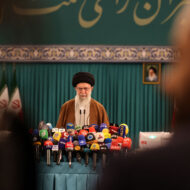
The new round of attacks on Iran by the United States embodies a paradox. It is the highest-stakes campaign at least since Israel’s targeting of high-level Iranian and Hezbollah officials in early 2024. The current operation, involving B-2 bombers and naval strikes, dwarfs the June 2025 strikes on Fordow and Natanz, which already set Iran’s nuclear program back by months. But it also comes with limited options for both sides, despite the maximalist rhetoric.
The statement by President Donald Trump framed the attacks as an effort at regime change. The hope is to prompt a rebellion by encouraging Iranians to rise up, or to trigger an internal regime fracture by leaving the door open for defections. He offered immunity for those who do not fight.
It seems clear from the chatter in the U.S. and Israel that this is envisioned as a sustained campaign to create new strategic realities and scenarios, or to force the regime to accept surrender terms. The strikes came hours after Iran rejected maximalist U.S. demands in Geneva, including full destruction of its nuclear sites, surrender of all enriched uranium and a permanent deal with no expiry. Oman’s foreign minister had said peace was “within reach” that same morning.
The problem, though, is that regime change does not currently appear feasible. No such change has taken place in recent years without either American boots on the ground, like in Iraq and Afghanistan, or a preexisting mass rebellion against a dictatorship, like in Libya and Syria. In Iran, neither of these scenarios is currently likely. An internal coup by pragmatists or otherwise against Ayatollah Ali Khamenei is also extremely unlikely. The regime functions more like multiple pillars than a pyramid, with varying degrees of autonomy. Even when Khamenei was reportedly sheltering in a bunker during the June strikes, dubbed the 12-day war, the regime made rapid military decisions without him. The regime has divergent factions, but they all tend to be Islamist, with loyalty to the intertwined religious and political authority.
If regime change isn’t possible due to a lack of counterforce or an internal turn against Khamenei, the best-case scenario could be that pragmatist elements within the existing regime find themselves vindicated after the current escalation proves destructive. After the June 2025 war, former reformist President Hassan Rouhani called for institutional change. Such elements show a degree of flexibility over Iran’s nuclear and military ambitions, instead of the current maximalist position, although pragmatist elements will appear foolish for having believed that negotiations with Washington were possible at all.
Even in Israel and the U.S., analysts have become convinced that no change to the Iranian position was possible under Khamenei. This position gained traction in policy circles close to both Trump and Israel in recent months. The argument cites the dramatic change in Hezbollah after the killing of its long-standing leader, Hassan Nasrallah, in September 2024. Post-Nasrallah Hezbollah, the argument goes, accepted a surrender agreement with Israel that its former leader would not have agreed to, because of his ideological commitment and legacy considerations. The same is being said about Khamenei. At his age, he prefers a high-stakes game that leaves little room for compromise.
So it is a waiting game. Washington has the resources in place to keep up the heat on the Iranian regime, to drain its resources and cause it lasting damage. Observers, viewing the current situation through this prism, will conclude that the regime in Tehran faces an existential crisis. But a better way to view the current situation is to consider the lack of a counterforce that could take over in Iran. The Iranian opposition abroad remains fatally fragmented. The Mujahedin-e-Khalq (MEK) is widely despised, even by Iranians who oppose the regime, and the Pahlavi monarchists seem to resonate at street level but have no organizational infrastructure. From this perspective, the U.S. and Israel can bleed the regime but cannot bring about its downfall yet.
On the other hand, the Iranian regime also has limited but potentially consequential options. It feels compelled to retaliate by attacking U.S. assets on the other side of the Gulf, and might escalate further by attacking critical energy infrastructure there, to punish American allies and cause a global economic crisis.
The June 2025 retaliation was notably restrained. Iran reportedly gave the U.S. a heads-up before firing missiles at Al Udeid Air Base in Qatar, causing minimal damage. This time, Iranian officials have warned that they will retaliate with much less restraint. If Iran does target many such facilities, the consequences for global markets would be far more severe than the 2019 Abqaiq attack on Saudi Arabia’s largest oil processing facility. Qatar, the United Arab Emirates and Oman together supply nearly a sixth of global liquid natural gas.