


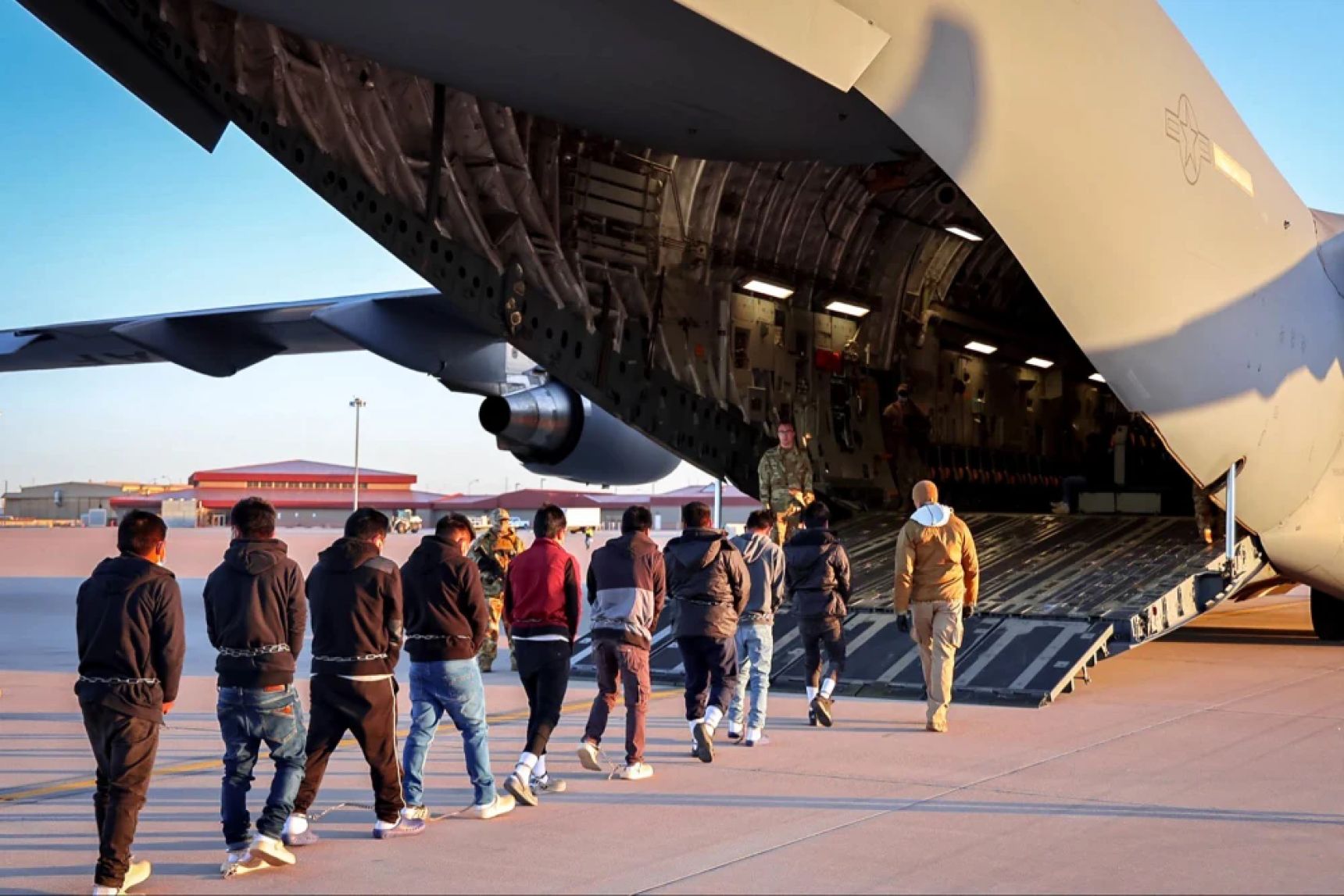
Without explanation, 62-year-old Orville Etoria and four other men were cuffed, taken from the Immigration and Customs Enforcement (ICE) detention center in El Paso and put on a long flight. No one told them where they were being taken. As the plane flew over the Atlantic on July 15, Etoria realized he wasn’t being repatriated to Jamaica. Even after the chartered flight landed in Djibouti and they were transferred onto a U.S. military transport aircraft, they still weren’t told where they were going.
Etoria, who had lived in the United States for almost 50 years, had a Jamaican passport and expected a straightforward deportation, but he had no idea what the Trump administration had planned for him instead. Finally, after about 24 hours of travel, as the flight descended for landing, they were told they were going to a place he had never even heard of, the Kingdom of Eswatini, a small landlocked country in southern Africa and the continent’s last absolute monarchy. “He didn’t know he was going to Eswatini until he was like 30 minutes from landing,” his Legal Aid Society attorney, Mia Unger, told New Lines. “Mr. Etoria’s deportation to Eswatini and his imprisonment in a maximum security prison with no charges was a grotesque abuse of government power.”
What happened to Etoria and the others wasn’t a mistake. It stemmed from a quiet deal between the U.S. and Eswatini, signed in May. At the time, U.S. officials put out a distorted story to sell the program, portraying the men as violent criminals whose countries refused to take them back. The narrative obscured the complicated truth behind the real difficulties standing in the way of repatriation, including America’s history of conflict with many of the countries of origin — such as Cuba, Laos and Vietnam — and the fact that most had fled as refugees decades ago. In Eswatini, officials said only that the men were “in transit” and would be held in an isolated unit until they were repatriated. None of the men had any connection to Eswatini. Yet under this secretive pact, one that bypassed Eswatini’s Parliament and stunned local lawyers, the men have been deprived of basic due process and fundamental rights like habeas corpus, which requires that a person in custody be brought before a court. Their stories reveal how U.S. immigration policy is quietly outsourcing deportations to African governments, and the real human cost of the practice.
On arrival, the men were taken to Matsapha, Eswatini’s maximum-security complex outside the capital Mbabane, and placed in an isolated unit. They were imprisoned without charge or sentence for any crime. They had already completed sentences in the U.S. years ago and had been living in their respective communities under ICE supervision: working, checking in, waiting in the same legal limbo that traps thousands of noncitizens with previous convictions and long-standing removal orders. But in its drive to ramp up deportations, the Department of Homeland Security (DHS) is testing a seldom-used and legally untested third-country provision to remove people who can’t otherwise be returned to their countries of origin. And Etoria’s deportation, together with the four other men, was the first under the secretive U.S.-Eswatini deal.
The DHS program sidesteps due process by sending deportees to a third country willing to hold them in indefinite detention, their lawyers say. The agreement, a nonbinding memorandum of understanding, which became public months after it was signed, allows the U.S. to send up to 160 deportees within a “one-year transit framework,” and provides $5.1 million in “capacity-building,” yet disclaims any legal obligations. What’s billed in the agreement as a “transit” detention looks, in practice, like open-ended imprisonment, an outsourced custody system that critics call human trafficking. The one-year agreement can be renewed and, notably, includes a clause denying any legal rights or obligations under Eswatini law, U.S. law or international law, effectively placing the deportees beyond the reach of any court. Meanwhile, it’s not clear how, when or where the men may see freedom.
The first five men moved in July were Cuban, Jamaican, Laotian, Vietnamese and Yemeni. U.S. officials have framed all of them as dangerous offenders. Their families and attorneys describe a process built on speed and silence that denies people the chance to know, or contest, where they’re being sent.
Under U.S. law, deportees may be sent to a third country only if returning to their home country is “impracticable, inadvisable, or impossible,” according to a seldom-used, catch-all statute — 8 U.S.C. 1231(b). It is currently being contested in a 1st U.S. Circuit Court of Appeals case known as D.V.D. v. DHS. On paper, the rule sounds reasonable, a safeguard for rare situations where deportation isn’t possible. In practice, though, it’s become something else entirely.
For countries like Cuba, Laos and Vietnam, which have a history of conflict with the U.S. that makes repatriation difficult, this clause has rarely been invoked when home-country return isn’t possible. People in these circumstances are generally placed under ICE supervision, allowing them to live in the community and work, if granted authorization. This can last for years, as long as they check in with ICE for review and extension on an annual basis and follow the other conditions, like requesting permission to travel out of state. In 2025, Laos and Vietnam increased cooperation in some cases, on a limited basis, but removal remains legally and politically complex, especially for people who fled decades ago. Attorneys argue that the Eswatini transfers reflect a novel and problematic use of the statute, which — combined with the nonbinding memorandum of understanding — strips people of a meaningful chance to contest a third-country destination.
After the U.S. lawyers hired by the families were unable to contact their clients, they retained a Swati lawyer, Sibusiso Nhlabatsi. When he tried to visit the men, prison officials repeatedly refused him access and offered a cascade of excuses. On his first visit, they said the deportees were still “adjusting to Eswatini,” and on the second, that he needed permission from the U.S. Embassy, which he found insulting. “Why should I ask permission from the American Embassy to practice law in my own country?” he told New Lines. On his third attempt, Nhlabatsi said, the prison officials told him the deportees didn’t want to see him.
It was only after Nhlabatsi asked a court to grant him access, two weeks after the detainees had arrived in Eswatini, that they were finally allowed to contact their families in the U.S., through WhatsApp calls monitored by their guards, their lawyers say. A judge then ordered the prison to grant Nhlabatsi access, but that order was stayed when the commissioner of prisons appealed to Eswatini’s Supreme Court, “saying the judge made an error by ignoring the fact that the men don’t want to see me,” according to Nhlabatsi. Given the timeline of the legal process, Nhlabatsi told New Lines he expects the deportees to spend a year in prison before they are able to have their first meeting with a lawyer in Eswatini — if the kingdom’s Supreme Court does eventually grant access.
North Carolina-based immigration attorney Tin Thanh Nguyen, who is representing several of the deportees from Laos and Vietnam, described these third-country deportations to Eswatini as “a legal black hole,” essentially “human trafficking in a digital age.” It has become a way to move people beyond the reach of U.S. courts and then claim there is nothing a judge can do once they are outside the jurisdiction of the American legal system, he told New Lines. “Everybody’s making money off of human bodies right now, and the only way to please the Trump administration so that you don’t get tariffs or any kind of visa sanctions is by accepting more deportees.”
The second group of 10 men was deported to Eswatini under the same agreement on Oct. 6 and were originally from Cambodia, Chad, Congo, Cuba, Ethiopia and the Philippines. An investigation of flight data by Zeteo found that the Gulfstream IV plane used to fly those 10 men is owned by the Israeli-American billionaires Michael and Gil Dezer, who have close ties to the Trump administration. The 10 are also now imprisoned in Eswatini, said Nhlabatsi, with no legal justification. They aren’t accused of any crimes in Eswatini; they’re not awaiting trial or serving a sentence. “They are in perpetual detention with uncertainty,” he said. “Even the strongest men can break down under such circumstances.”
The first two cohorts are only the beginning. The Trump administration is ready to expand the program significantly, including with high-profile cases. In September, Kilmar Abrego Garcia, who is originally from El Salvador, was notified by ICE that he will be sent to Eswatini, after his lawyers challenged plans to send him to Uganda. Eswatini government spokesperson Thabile Mdluli told Reuters at the time that the “government of Eswatini has not received any communication regarding this person.” For now, Abrego Garcia remains in ICE custody, and his fate is uncertain.
Eswatini is not the only African country that’s agreed to take “third-country deportees.” The Trump administration has made similar deals with other African states, including South Sudan, Uganda, Ghana and Rwanda. In Ghana, 14 men arrived on Sept. 4, 2025, under a similar arrangement. Government officials there confirmed the transfers and said more were expected in the coming weeks, though Ghana insists it has taken no payment for accepting them. The BBC reported the case of a Nigerian deportee who said Ghanaian officials bypassed the border and “dumped” him in neighboring Togo. In Rwanda, officials have acknowledged receiving seven deportees since August, part of a broader plan to take in as many as 250 people. The first cohort to arrive included an Iraqi refugee.
The East African nations South Sudan and Uganda have also agreed to receive deportees, but details are murky. Officials have not disclosed how many have arrived or from where. Meanwhile, several African governments, among them Burkina Faso, Libya and Nigeria, have refused to sign such deals altogether.
Together, these quiet transfers reveal a widening network of deals stretching across Africa, where countries with no connection to the deportees are being drawn into Washington’s expanding system of offshoring migration control. What looks like cooperation on paper raises deeper legal and moral questions, ones that go to the heart of international refugee protection.
Temple University law professor Jaya Ramji-Nogales argues that, from a U.S. legal perspective, the transfers violate the bedrock principle of non-refoulement, which forbids sending anyone to a place where they risk harm, or to a third country that might pass them on to such danger. “You can’t send people to a country that you’ve never designated with no warning, it’s totally illegitimate,” Ramji-Nogales told New Lines.
The U.S. law regulating third-country deportations in cases where it is “impracticable, inadvisable, or impossible” to send them to their country of origin uses what Ramji-Nogales called a “catch-all provision” that’s rarely been used before. The 1st Circuit ruling in D.V.D. v. DHS will spell out “what’s required as process before people can be deported to a random country,” she said. This will establish the specific requirements for allowing deportees access to legal counsel so they have a chance to contest removal orders, and how much notice DHS must give deportees to launch challenges and raise concerns about possible torture or ill-treatment under the provisions of the 1967 Protocol to the Refugee Convention and the 1984 Convention Against Torture.
For Nguyen, the immigration lawyer, these practicalities are key. The barriers are already extremely high, with legal fees for a challenge costing up to $25,000. The time factor is also vital. Until recently, DHS practice had been to notify deportees 72 hours before removal. Nguyen explained that this was already an extremely tight window for prisoners to hire a lawyer who needs to prepare all the necessary details, affidavits and documentation for a plausible challenge. Then, in July, DHS announced it will give as little as six hours’ notice, which Nguyen described as ludicrous. “What can you do in six hours to prevent deportation to a third country?” he asked.
For Ramji-Nogales, the bottom line as regards due process is simple: notice and a chance to be heard about the specific third country before any transfer. “None of these people elected Eswatini, there’s been no opportunity for them to contest and they don’t know where they are going,” she said.
In a kingdom where political parties are banned and criticism of the monarchy can be perilous, Eswatini’s civil society is mounting a rare challenge. The deal has been challenged in a lawsuit brought by the Southern African Litigation Centre (SALC) and local partners. The case argues that the deal violates the constitution because the government didn’t consult Parliament, as required for all international agreements. They also warn that the arrangement weaponizes an already overstretched prison system and denies prisoners basic legal access. Eswatini’s attorney general, Sifiso Khumalo, described the case to Reuters as “a frivolous legal application” with no legal basis. The government didn’t show up for the first High Court date, and the judge failed to appear for the second, according to SALC. The challenge was listed for a three-judge constitutional bench on Nov. 3.
In recent years, Eswatini has seen successive waves of popular discontent about the lack of democracy. Melusi Simelane, the SALC civic rights program manager, said that in this context the deportation arrangement further undermines the country’s already weak constitutional limits on absolute executive power. He believes the U.S. is particularly targeting “weaker democracies” for this immigration policy. Countries like Eswatini, Rwanda, South Sudan and Uganda “are countries with little to no actual democratic practices,” he said. “We need open government and accountability, not deals made in the cloak of the night.” He’s motivated to bring the case, he said, because “we’re not going to allow it to happen, not 20 years into our constitution.”
Inside Matsapha, cut off from the world and imprisoned indefinitely without charge, the men have become desperate. Roberto Mosquera, who came to the U.S. with his family when he was 13, began a hunger strike in protest on Oct. 15, according to his attorney Alma David. “The fact that my client has been driven to such drastic action highlights that he and the other 13 men must be released from prison. The governments of the United States and Eswatini must take responsibility for the real human consequences of their deal.” she said. In a statement addressing Mosquera’s “alleged hunger strike,” Mdluli, the Eswatini government spokesperson, said he was “in good health and spirits” and “that he did mention that he was currently fasting and praying because he was missing his family.”
A close family friend of Mosquera in Miami, who asked to be called “Ada” for fear of reprisals, told New Lines that she’d spoken to him after he began his hunger strike and called Mdluli’s statement “a shameless falsehood and a blatant lie.” Mosquera had “found Christ,” she said, and turned his life around after completing his sentences for prior criminal convictions in Florida 13 years ago, but he is “absolutely not fasting.” In Miami, Mosquera has left behind his American children as well as the two brothers and a sister he came to America with as a child on the Mariel boatlift — during which more than 100,000 Cubans fled to the U.S. in 1980. Now in an isolated unit, far away from everything he knows, Ada said he was “very adamant that he’s doing the hunger strike because he’s in fear of his life, he’s in a continent far away from his family in a place that he has not committed a crime, so he doesn’t understand how a man that was free is indefinitely incarcerated.” Mosquera was driven by “desperation for the uncertainty of what’s gonna happen to him,” she said, and would continue “as far as his body allows him.”
Mosquera ended the strike after 30 days, but his legal position is unchanged. He’s still in prison without any criminal charge in Eswatini and he has no court date or approved private legal access. Ada told New Lines he experienced health complications during the protest. The episode underlines what lawyers describe as the powerlessness built into Eswatini’s “transit” regime: Even a drastic act yields no path to review. “What his hunger strike exposed more than anything else is that there is no accountability in this situation,” said his lawyer, Alma David. Everyone she reached out to for updates on her client’s health directed her elsewhere. “The correctional services, the U.S. government, and the Eswatini government all avoid being held accountable for anything, including Roberto’s well-being.”
The agreement signed between the U.S. and Eswatini in May is valid for one year while Eswatini and the International Organization for Migration (IOM) try to arrange onward movement. “We don’t know what happens after that year,” said David, who represents men from the first and second cohorts. For some, nationality is disputed or undetermined; others simply cannot safely return. “There are going to be those who can’t or won’t [be returned to their home countries]. Are they stuck? Do they go somewhere else? Why are they in prison?” David asked.
The IOM, for its part, has distanced itself from removals while acknowledging its limited role following arrival: “IOM does not support or facilitate deportations,” it said in a statement sent to New Lines. The IOM acknowledged meeting with some of the deportees in Eswatini “to assess needs and provide post-arrival humanitarian support,” and said it would assist should any of the men choose to “voluntarily return to their countries of origin.”
But “voluntary” is a complicated word when they fled those countries decades ago and the alternative is open-ended detention in a maximum-security facility thousands of miles from home. “It’s scary not knowing what the future holds,” Nguyen said of his clients and their families.
Human rights organizations are also sounding an alarm about how this agreement violates the deportees’ rights. “Arbitrary detention, ill-treatment and the principle of non-refoulement” are the core concerns, Human Rights Watch researcher Noma Masiko-Mpaka told New Lines, noting reports that the deportees have been held in isolation with no access to legal representation. She called the arrangement “a transaction in which people’s rights are thrown out the window.”
In Eswatini, human rights supporters are also speaking out against the agreement. For Bheki Makhubu, editor of The Nation magazine, “Eswatini has involved itself in a human trafficking ring run by Donald Trump.” Since there hasn’t been an open parliamentary process with accountability about the details of the deal, it’s not clear who will receive the money or how it is being spent, he said.
Nhlabatsi is more blunt. “The Americans did their research,” he alleged. “And they know that our king can never say no to money, so if there was going to be a financial benefit, he was not going to say no.” Makhubu also fears the lasting impact on executive accountability in Eswatini. For those who look to the U.S. as a model of the constitutional rights they hope to establish in their countries, Makhubu told New Lines, ”America is betraying everything that gives hope to mankind.”
After spending more than two months in prison in Eswatini, Etoria was repatriated to Jamaica on Sept. 22 — the only deportee to make it out of Eswatini so far. Unger, his lawyer, points to the domestic law that should have led to a different outcome for her client. He “could have only been sent to a country other than Jamaica if deportation to Jamaica was impracticable, inadvisable or impossible,” she said, noting he had a valid Jamaican passport and that Jamaica had never refused his return. Instead, “he was being held in prison without any charges and in a country that he’s never been to, where he doesn’t have any ties,” she said.
Human Rights Watch lays out the broader context in Eswatini, pointing to banned political parties and a track record of judicial pressure, conditions that make opaque arrangements easier to conclude and enforce. “There couldn’t be a worse place for this, or perhaps [it’s] the best place, because it’s an environment that’s conducive for these violations to take place,” said Masiko-Mpaka.
Ramji-Nogales offered the bluntest summation of the law. On the merits, she said, “this should not be happening”; it’s “not legitimate under U.S.” law. She worries about a transactional model that undermines the rule of law, rewarding governments with weak checks while exporting U.S. obligations to protect people from harm.
The program has created fear in the immigration system, said the attorney Nguyen. “Everybody’s scared as hell to be deported to Africa right now,” he told New Lines, “a continent to which they have never been and to which they have no ties.” The effect has been a form of “psychological warfare on the impacted people and their families.” His immigration practice has seen a huge uptick in Vietnamese people seeking passports so they can self-repatriate rather than risk third-country deportation. “People are like, forget it,” he said, “I’m gonna go on my own terms.”
Nguyen also fears the Trump administration is using these cases to test the bounds of constitutional rights. By “picking on immigrants with no rights” and sending them beyond the jurisdiction of U.S. courts, it is establishing norms that could be expanded to other categories of people in the U.S. And to get the public to buy into the practice, or at least shrug and look the other way, the administration is portraying the deportees as “barbaric people with crazy convictions,” he said, rather than free men who have long ago completed sentences for their offenses, now indefinitely incarcerated without charges. The danger, he warned, is “more and more erosion of our rights.”
The eventual scope of this program, if it continues unchanged, remains undefined.
“These human bodies are just being moved across borders like game pieces,” David told New Lines. Her Yemeni client, 70-year-old Kassim Saleh, who had been in the U.S. since he was a teenager, finished a 20-year sentence and was released in 2019. “We’re trying to figure out where he can be safe,” she told New Lines, but it’s not clear how, when or whether he may be set free.
The next cohorts are coming. Some people will be repatriated. Others won’t. Some are stateless or disputed; others have credible fears that no one has yet heard. For the men inside Matsapha, the “one-year transit framework” isn’t any guarantee of movement, just days passing without hearings, without answers, without home. In Eswatini, a constitutional challenge argues Parliament should have had a say. In the U.S., attorneys fight for the most basic thing: notice, and a chance to be heard before a one-way flight.
Meanwhile, the deeper questions remain unanswered: Where does this end, and who will be next?
Become a member today to receive access to all our paywalled essays and the best of New Lines delivered to your inbox through our newsletters.