



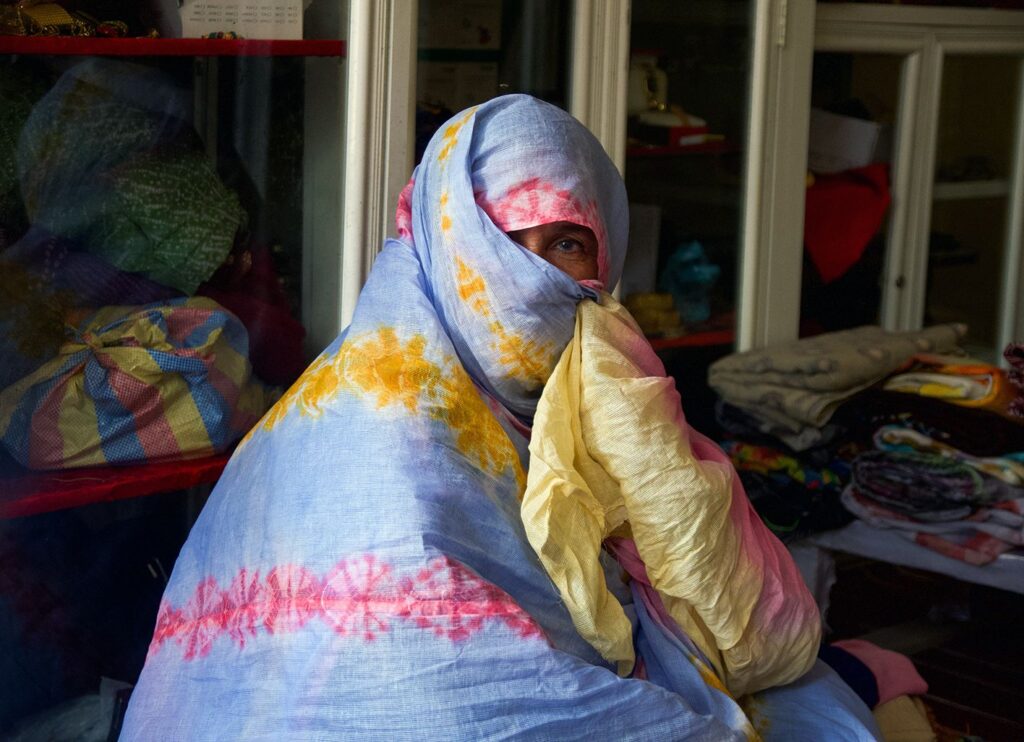
In a small textile shop set back from a sandy road near an overpass in the Mauritanian capital Nouakchott, three women in their 30s and 40s are chatting animatedly, passing the afternoon sipping sweet green tea on the carpeted floor, which is stacked high with piles of veils. One of the women, Nevissa, 45, has recently finalized her ninth divorce, and her friends Tuti and Khana are celebrating with her. (Like all those we interview for this piece, they prefer only to share their first names.) Her manner suggests she is in high spirits, though she may just be trying to play it cool. “I was so happy when he left,” she says. “Soon, I will have another husband and a lot of money. Everybody loves money.”
While already entertaining offers from many men eager to court her, tradition requires her to wait until the end of her third menstrual cycle before she can court suitors. When that time comes, she will choose carefully — she is keen to find someone who can provide a generous bride price, the customary payment a man makes to a woman or her family when securing the right to marry her.
Nevissa’s marital life started early. Over a glass of tea, she recalls how, at the age of 12, she stabbed her first husband after she caught him flirting with other women, wounding him. Now a mother of three, she shrugs off criticism of her penchant for serial divorce. “There are men who judge, but I don’t care,” she says. “I’m not doing anything that’s haram, anything un-Islamic.”
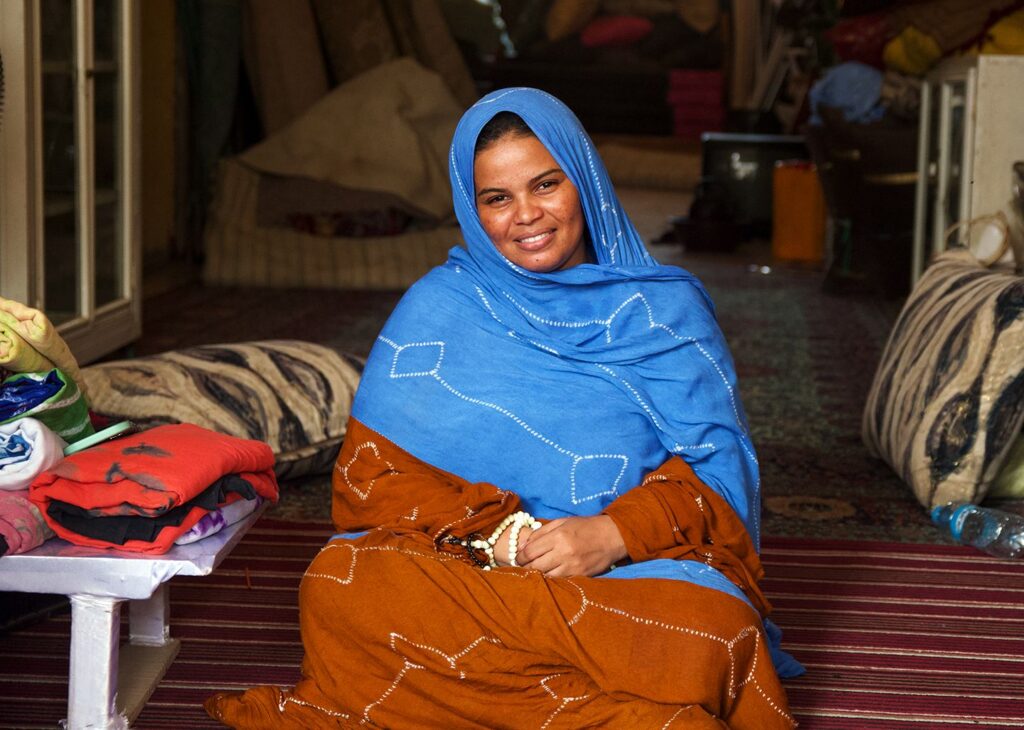
In a few weeks, the three-month waiting period will draw to a close. She will mark the occasion with a party. Her female friends will congregate, and together, donning henna and their finest clothes, they will sing and dance to celebrate Nevissa’s newfound freedom — announcing her availability to the men of Nouakchott.
Amid the discussion, punctuated by the preparation of another pot of tea, Tuti’s phone buzzes. A message with a very specific request arrives. “A Moroccan man is asking me if I want to have a secret marriage with him,” she laughs. “He’s leaving Nouakchott in two months, and wants to have a wife until he leaves.” He’d found her number on Facebook, and seeing that her shop was in the so-called “Divorced Women’s Market” — a bazaar in northeastern Nouakchott where many divorced women sell their household possessions after separating from their husbands — he messaged her in hopes of securing an arrangement reserved primarily for local Mauritanians, used by many as a way of navigating a taboo against polygamy: a “sirriya,” or secret, marriage. Even though Islam generally allows polygamy, it is frowned upon by many in Mauritania. As a result, such secret marriages have become a workaround for the stigma that comes with taking — or being — a second wife.
Serial divorce and secret marriages are part of the rapidly evolving social landscape in a nation that has had one of the world’s most profound transformations over the last half-century. Before 1960 — the year Mauritania gained its independence from France and established the current Islamic republic — there was not a single town larger than 10,000 inhabitants in the vast West African nation; almost all of its inhabitants were pastoralists who lived a largely nomadic life. The country’s rapid urbanization and economic growth have triggered far-reaching social and cultural changes, with the realm of gender politics increasingly contested. This is particularly evident in the romantic and marital lives of Mauritanians, where serial marriage, secret unions and transactional relationships have become part of everyday experience, reflecting both continuity with a fast-vanishing past and adaptation to the pressures of modern urban life.
Over several months of reporting, New Lines attends boys’ nights out, drinks tea at women’s markets and speaks with imams at prominent mosques and madrasas in Nouakchott and Nouadhibou, Mauritania’s two biggest cities. Based on dozens of interviews, we delve into the romantic lives of those living in a society that is charting a new course in the 21st century.
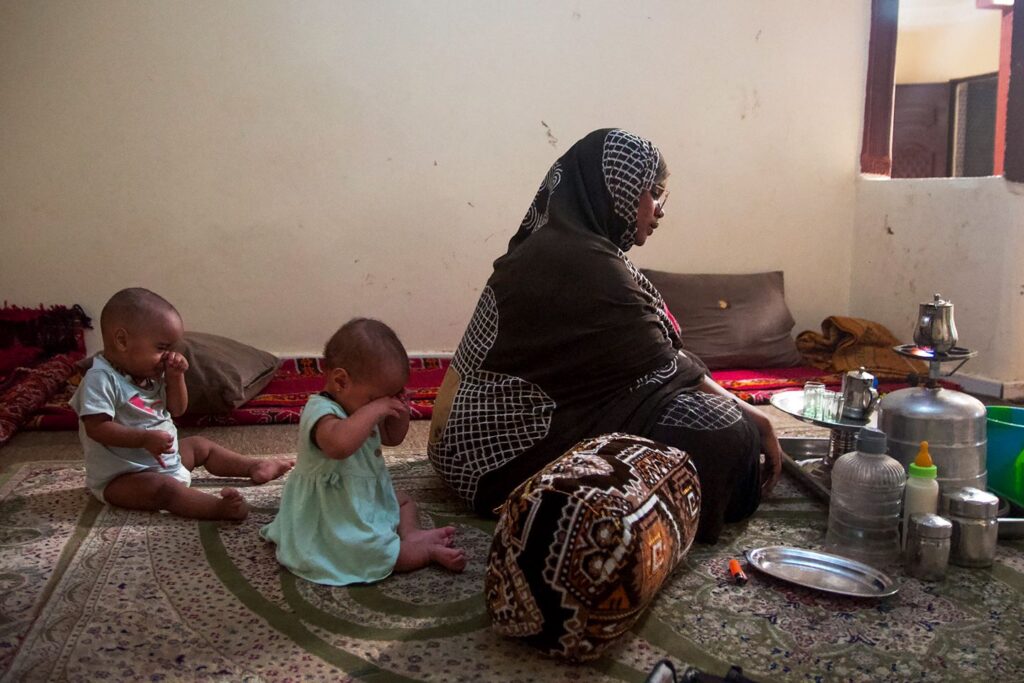
If one wanders down the market streets of Nouakchott and Nouadhibou and speaks with the middle-aged women operating and visiting boutiques, one detail in particular stands out: One seldom comes across a woman with no experience of divorce. Our conversations suggest that many will have more than five husbands in their lives.
Nejwa El-Kettab, a sociologist at the University of Nouakchott and an expert in gender relations, views the ease with which Mauritanian women can divorce as an inheritance of the Sanhaja confederations that inhabited the territory prior to the arrival of Arabic-speaking tribes. From the 11th century onward, these newcomers gradually obtained political and social influence, consolidating their status by the 17th century. “This particular way of conceiving divorce is a strong heritage from the matriarchal Sanhaja society, which is an integral part of Mauritanian culture. It has always been there,” she says. “We have similarities regarding the role of women, their visibility and the way they manage their relationships, despite the dominant Arab influence.”
One way that Mauritanian women express that visibility and control in their relationships is through their insistence on being a man’s one and only wife. Many women will insist on a clause in their marriage contract of “no prior, no post” — meaning that the man assures her that he currently has no other wives and that he will not take any more after their marriage. If he marries a second wife, the contract is considered void, and the woman can walk away without stigma.
Fatima, a Nouadhibou boutique owner in her late 60s, describes it thus: “A Mauritanian woman is strong, she is a character, she is free. This is our tradition. She’s not like a European woman. If there is something she doesn’t like, she will divorce and leave.”
According to El-Kettab, “The issue of easy remarriage and divorce has always existed in Mauritania. There are very ancient expressions in Hassaniya” — the local dialect of Arabic — “suggesting that it’s not a problem to divorce and that a divorce does not diminish a woman’s value in any way.” In fact, she says, it can be a way for women to “renegotiate their social and economic position, choose better alliances and exercise agency within marriage.”
Despite that assurance, passed down through history, divorce practices have seen a dramatic shift in the last half-century. A series of destructive droughts in the 1970s triggered a widespread exodus from the desert into cities, drawing the region’s millennia-long tradition of nomadism largely to a close, and setting in motion a social transformation that altered the population’s conception of marital unions. While stressing that statistics are nonexistent and thus any meaningful quantification is impossible, El-Kettab says that there are indications that this may have come with an increased incidence of divorce. “A lot of people settled in Nouakchott and Nouadhibou, which had a strong impact on gender relations,” she explains. “Urbanization brought a lot of factors, especially economic and financial ones, which made marital life unstable. Men face unemployment, financial difficulties, so women don’t find stability with them and divorce in order to look for something better elsewhere.”
This coincided with the rapid formation of a wealthy bourgeoisie, says El-Kettab, “creating an entire chic culture, the nightlife people, people with money, so, inevitably, this has contributed greatly to the phenomenon of remarriage.”
Mariam, a middle-aged woman who manages a boutique in Nouakchott alongside her mother, guesses that she has been divorced six times — although she struggles to recall if the number is accurate. Her mother adds that her daughter has “a child or two” with each husband. She first married at the age of 15 to her first cousin, aged 33. It was an arranged marriage; she was unhappy from the beginning. “I never liked him,” she insists. She had hoped that he would divorce her, and recalls feeling happy when he ended the marriage after two years.
During the three-month waiting period, Mariam took it upon herself to prepare for a new husband. “I ate a lot to get fat,” she says. By the time the waiting period ended, many men were interested in her, and she remarried almost immediately. Her subsequent marriages were short-lived. When asked why this was the case, she shrugs and says that they cheated or fell out of love. Her mother takes a different view. “She was young. She saw her friends, who had a good life — she wanted money,” she says. “She didn’t do enough research about her husband. After a period of time, she’ll discover that her husband isn’t rich and ask him to divorce her.”
On a dusty evening in the upscale neighborhood of Tevragh Zeina, Moctar, a French-educated Mauritanian businessperson in his mid-20s, eases his car onto a windswept stretch of Nouadhibou Road for an evening drive, a common diversion in a city where social life unfolds mostly behind closed doors rather than in public.
Lonely and nostalgic for Europe’s bars and nightclubs, which he felt made for a more straightforward dating scene, Moctar has given up on finding love in Nouakchott. “Mauritanian women are diabolical,” he says, driving along the dimly lit road, dotted with occasional fast-food restaurants and half-empty shisha (water pipe) lounges. “They’ll make you go bankrupt before you can even hold their hand, and then they’ll block your number because a man with more money came into the picture,” he says, adding that there should be a hashtag on X: #StopTheSufferingOfMauritanianMen.
Although finding true love seems a stretch for Moctar, many Mauritanian men are keen to get involved with divorcees, who are seen as more sexually experienced. Corinne Fortier, an anthropologist at the French National Centre for Scientific Research specializing in gender, says that this is reflected in a Mauritanian proverb: “A divorced woman is a shadow of a tree where a man can take a rest.”
“You can go to her house, she will open the door and bring you some tea. If she likes you and if you are generous with her, maybe you can get close to her. It’s not a problem because she is no longer married, so she is free,” Fortier explains. “A divorced woman is a ‘shabiba,’ a star. In other societies, maybe it looks like she’s a bad woman. But here, it means she’s very respectable.”
(This nuanced, and often strikingly frank, relationship to sexuality stood out across our reporting. People frequently spoke with ease about the intimacies of their lives, often in great detail. While many subjects are taboo in Mauritania, sex is not one of them.)
For her part, Mariam found that her desirability increased with the number of husbands she’d had. “In my experience, men that I know, they like to have an experienced woman. I have already been married, so I know things,” she says, declining to elaborate.
According to Zeina, a civil servant in her early 20s who is yet to marry, this is linked to the relative ease with which divorced women can engage in romance. No longer virgins, divorced women can go out as they please, and the family’s expectations have less of a bearing on their choices. A first divorce can be liberating for those in an environment where cousin marriages, arranged by the parents of the bride and groom, are the norm.
In addition, the separation often comes with generous compensation for the woman, especially in well-off circles. “It’s a question of masculine prestige. If a man treats his wife badly after the divorce and doesn’t compensate her, he will be seen as stingy, someone who is not a gentleman, with no social value,” El-Kettab says.
“Women talk much more than men, which disadvantages men,” Moctar says. “If the same thing is pointed out” — that he is stingy, or poor, or behaves badly — “by different women, it can decrease the man’s competitiveness. But if he compensates generously all the women he divorced, his competitiveness is unaffected. More and more women will be interested in a man who divorces often. We give Mauritanian women too much value,” he adds.
Such compensation can be liberating for women. “Before she gets married, she doesn’t have a lot of freedom, but after the divorce, she will be freer because she’ll have resources, and she won’t be restricted by her father or mother,” says Zeina, who is now trying to accommodate her family’s expectations about her future husband. “If I want to marry someone, I need to get my family’s approval of him and his financial situation.”
Yet while some women in Mauritania can use divorce to leverage better social standing, a significant percentage of women receive no compensation or child support when they divorce — leaving women and their children vulnerable. “If the man is poor, he won’t give anything — nothing,” says Nedwa Moctar Nech, the director of Mauritanie 2000, a Mauritanian nongovernmental organization advocating for women’s economic empowerment. While providing generous divorce compensation is a matter of social prestige for Mauritanian men, many choose not to. Compensation is mandated by Mauritanian law, but according to Nech, enforcement is lacking.
Left with children to take care of and no financial support from their ex-husbands, many women are compelled to remarry for economic reasons. Mnaye, a woman in her 40s, has five children from her first and second marriages, but has divorced a total of five times. To her, remarrying was always an attempt to secure financial stability, a task at which her husbands would repeatedly fail. “They just left without saying anything,” she says.
The seeming ease with which Mauritanian women can divorce, and their tradition of marking separation from their husbands with a party, has become a source of media fascination in a country that seldom receives international coverage. Multiple articles and short documentaries have shown women jubilantly celebrating their independence. This narrative implies that Mauritania, despite being a conservative Muslim country, offers an unexpected model of women’s empowerment.
But Mauritanian women are skeptical of this depiction. “Most of the people who come to the country and talk about it, they exaggerate. No one really likes to be divorced,” says Amal, a communications executive in her early 30s, and a divorcee herself. Nech offers a similar view. “I think this idea is a bit of a caricature,” she says, pointing out that it is taboo for a Mauritanian woman to show her feelings. Instead, she has to display strength. “It’s just for show. People gather around to boost her morale,” she says. “You have to understand that it can bring a kind of relief for the woman. It’s a way of making her feel better in her life — a sign of compassion from neighbors and friends — but it’s not that she’s celebrating the divorce.”
With continued urbanization and elite enrichment, secret sirriya marriages have gained more traction in the culture.
Unlike a conventional marriage, sirriya, from the outside, can appear more transactional. There’s often a financial agreement before the relationship begins. The couple is wedded discreetly, in the company of an imam and the two legally mandated witnesses. In turn, the man can end the marriage at his convenience, saying “I divorce you” three times — a formulation from classical Islamic jurisprudence.
Sirriya’s practice is evolving, but it is not about temporary relationships at its core. Unlike some other short-term marriage structures that exist in different Islamic traditions — notably Shiite “mutah” marriages — sirriya was largely adapted to enable a man to take a second wife in a country where polygamy is taboo. If a man’s original marriage contract has the “no prior, no post” clause, taking a second wife could trigger a crisis in his relationship; having a secret second marriage enables him to keep his first marriage intact and in the open, while also maintaining a second wife in the shadows.
Many women are complicit in their husbands’ sirriya marriages, aware that the second wife exists but willing to tolerate it as long as their own social standing and dignity remain untouched. Many hope these are temporary arrangements — a sort of sharia-compliant fling — that will end after a while. But if the second wife is discovered by the community, it can force a crisis in the marriage, and the first wife can invoke her rights and walk away. For many women who enter sirriya marriages, the aim is not a temporary arrangement, but to secure something more long-term, perhaps even displacing a first wife.
But some younger people have begun using sirriya as a means of creating halal casual relationships that include sex, marrying in secret for a few weeks or months and then splitting up when the relationship turns rocky or the novelty wanes.
According to Nech, the director of Mauritanie 2000, such marriages are now ubiquitous in Mauritania. “It is a banality. An everyday thing,” she says. The nonchalance with which Tuti received a sirriya proposition was a case in point.
In Mauritania itself, the legal foundations of sirriya remain murky. Over several days at mosques and a major madrassa, we attempt to unpack the legal underpinnings of the practice. While many decline to comment on the matter, those willing to speak emphasize that sirriya is not haram and makes sense as a marital practice, particularly for those for whom polygamy is not taboo. “Arabs in Mauritania do sirriya to avoid spoiling the first official marriage, so the wife doesn’t get angry,” says an elderly imam at the Saudi Mosque in central Nouakchott, who declines to give his name. “It’s to avoid doing what’s wrong — better to get married to another woman in secret than not to get married and have sex,” he adds, as a growing crowd of young men filtering out of the mosque after Friday prayers listens in.
For Abdulqadir, a village imam visiting the Ibn Abbas Mosque in Nouakchott, one’s intent is the deciding factor. A man can legitimately enter into a marriage irrespective of his intentions, but the marriage would become haram if the woman were to know that he intended to break off relations within a specific time period, he argues.
According to Rumee Ahmed, professor of Islamic Law at the University of British Columbia, Abdulqadir’s account is sound from a legal perspective. “He nailed it,” he says. “If you were to stipulate in the contract that this is for a finite period of time, it becomes void amongst Sunnis,” although he adds that many Shiite jurists would allow for it. What matters, Ahmed explains, is not unspoken intention but explicit stipulation. So long as no time limit is written into the contract or otherwise made clear to the other party, the marriage is legally valid under Sunni law, even if others might question the motivations behind it.
“Islamic law is very fluid. It responds to social, political, economic interests and pressures and looks slightly different in different places,” he says. “If the formal requirements of a marriage are met, then from a legal perspective the marriage stands, even if people are uneasy about why it was entered into.”
But for Usaama al-Azami, assistant professor of Islamic Studies at Hamad Bin Khalifa University, the potential formal permissibility of sirriya marriages is less convincing. “A secret marriage can be a technically valid marriage, but it completely goes against the spirit of what a marriage is,” he says. “If both parties intend the marriage to be temporary, then it is not a marriage at all. You’re engaged in an illicit sexual relationship, which is an extremely grave matter in Islam.”
Al-Azami emphasizes that sexual desire itself is not the problem. “In Islamically literate societies, this is not a taboo subject. Not only is there nothing wrong with sex, the Prophet explicitly stated that the sexual act in a legitimate relationship is an act of charity.” But secrecy itself, he argues, goes against the spirit of marriage in the Islamic tradition. “Besides being a place for healthy sexual expression, it’s also about creating a family and enjoying the benefits of participating in society as a family. That is basically denied in the context of a so-called secret marriage,” he says.
El-Kettab, the sociologist, attributes sirriya becoming commonplace to the continuing urbanization of the 1990s. “As the city became bigger, peripheral and more distant neighborhoods sprang up. So, for example, a man in Tevragh Zeina, in central Nouakchott, was suddenly able to have a second wife in the suburbs without anyone knowing,” El-Kettab explains, arguing that this has been fed by recent trends in the application of Islamic law. “They brought a desire to legislate, legalize adultery and to avoid ‘zina’ as it is understood, zina meaning sexual relations outside marriage,” she adds.
Mohamed, a local politician in his late 30s, endorses this view of secret marriages. “Islam forbids sex outside marriage, that’s why people do sirriya. We want to have sex, that’s natural,” he says.
For Ahmedou, the 24-year-old son of a local construction tycoon, the newer uses of sirriya defined some of his first romantic experiences. He describes meeting a young woman out in the city: “We were both driving and then I stopped at a convenience store and she was there. We exchanged numbers and she told me she liked me, and she wanted to spend some time with me. But she wanted it to be approved by an imam,” he says. The two entered into a sirriya marriage. “Then, we just rented an apartment for a month.”
Khadija, a twice-divorced mother of two in her mid-20s, unlucky in love and struggling to find a viable partner, also felt the pull of sirriya. Through a friend, she was put in touch with a married man purportedly looking for a romantic adventure, but Khadija hoped it could grow into something more. After Khadija was transferred the equivalent of $1,250 — a sum amounting to over half a year’s salary for an unqualified laborer in Mauritania — an imam sanctioned the arrangement. They were both tested for sexually transmitted diseases at Khadija’s request, and her new husband took her to a rented apartment, where they spent the night together. For the next month, Khadija had no communication with her husband, until she received a WhatsApp voice note one night. The man said he was divorcing her, and subsequently sent her around $370 through Bankily, a local mobile transfer service. Though she was somewhat melancholic after the abrupt separation, she expresses an interest in undertaking further sirriya arrangements.
While many women enter sirriya hoping for the relationship to last and grow, for others, such arrangements are driven by exclusively economic concerns. Salma, a divorcee in her early 30s from the northern port city of Nouadhibou, manages a small boutique. She sees marriage — whether secret or public — in strictly transactional terms. “A sum of money, a car with a driver and house — that’s the minimum,” she says. “Here in Mauritania, we only know money. Give me money, and I’ll fall in love with you. You will see.”
Samia, a mother of three in her late 20s, is four times divorced, with the latter two being sirriya marriages. The secret arrangements, each lasting just one or two months, were financially lucrative — gold bracelets, cash payments totalling $12,500 and her rent covered for a year. Now a free woman, she is on the hunt for a competitive husband. “I want someone who is a bossman,” she says. “Someone who has a big cock, someone who is a Muslim. I can do all the sexual positions.” When asked if she would consider a more casual arrangement — one not sanctioned by an imam — her answer is a decisive no. “That would be haram,” she says. The suggestion that a marriage could be sustained by love is met with similar derision. “I can’t eat your heart. It won’t buy me clothes,” she says.
Views on sirriya differ wildly. Nech, for example, sees little difference between sirriya and prostitution. “I’ve seen a picture of a pig with halal stamped on it. It’s the same thing. It doesn’t make it halal,” she says. But many defend the arrangement staunchly. Mohamed, the local politician, says the imam’s approval is a game changer. “Casual sex and sirriya, they are totally different.”
Sitting at a table housed under a plastic neoclassical dome at Cineparc, an outdoor cinema and entertainment complex on the outskirts of Nouakchott, the halal–haram dichotomy feels very distant for the younger generation. Chatting with a group of friends — the sons of Mauritania’s rentier elite — Ahmedou, the tycoon’s son, signals a more relaxed approach. “It depends on the woman,” he says, as the Weeknd’s “Save Your Tears” plays in the background. “If the woman is a bit religious, she only wants sirriya. But if she’s not, she can go and do whatever.” His friend, Ahmed, agrees. “There are many girls who want to have fun without sirriya,” he says.
Yaqub, a Tunisian-educated government employee in his late 20s, seconds this, explaining that Mauritania’s sexual mores are continuing to change. “When I see a woman on TikTok I like, I text her. If she’s up for it, we agree to meet,” he explains, adding that among many younger women, the approval of an imam is increasingly not a necessity. “You can pick her up from outside a wedding, and if you have money, you should go to a hotel or an apartment. If you don’t have money, just take your car to a dune,” he says, underlining that among younger generations, romantic attitudes are changing.
“Why would I do a sirriya?” Yaqub says. “If you want to be bound to a woman before Allah, but not in front of creatures of Allah — it makes no sense. Call me old-fashioned, call me conventional, but I think the marriage bond is sacred.” He says he plans to stick to casual dating for now. As for a future wife? “I prefer to wait for the right one and do it properly, rather than marry someone for 24 hours because of a sexual urge.”
Become a member today to receive access to all our paywalled essays and the best of New Lines delivered to your inbox through our newsletters.