



On Dec. 3 last year, media outlets around the world shared “teasers” of their upcoming investigation into what they called the “Damascus Dossier,” a trove of leaked data from the former regime of Bashar al-Assad that included 33,000 photographs of killed detainees and countless death certificates.
“Revealed for the first time … tomorrow!” read a poster shared by the Lebanese outlet Daraj on X. “Documents the Assad regime tried to hide for years.” The poster depicted a torn-up portrait of Assad, behind which emerged someone’s death certificate. The same image was shared by reporters of the International Consortium of Investigative Journalists (ICIJ) and the German broadcaster NDR, which co-led the investigation. “Stay tuned!” an NDR reporter posted.
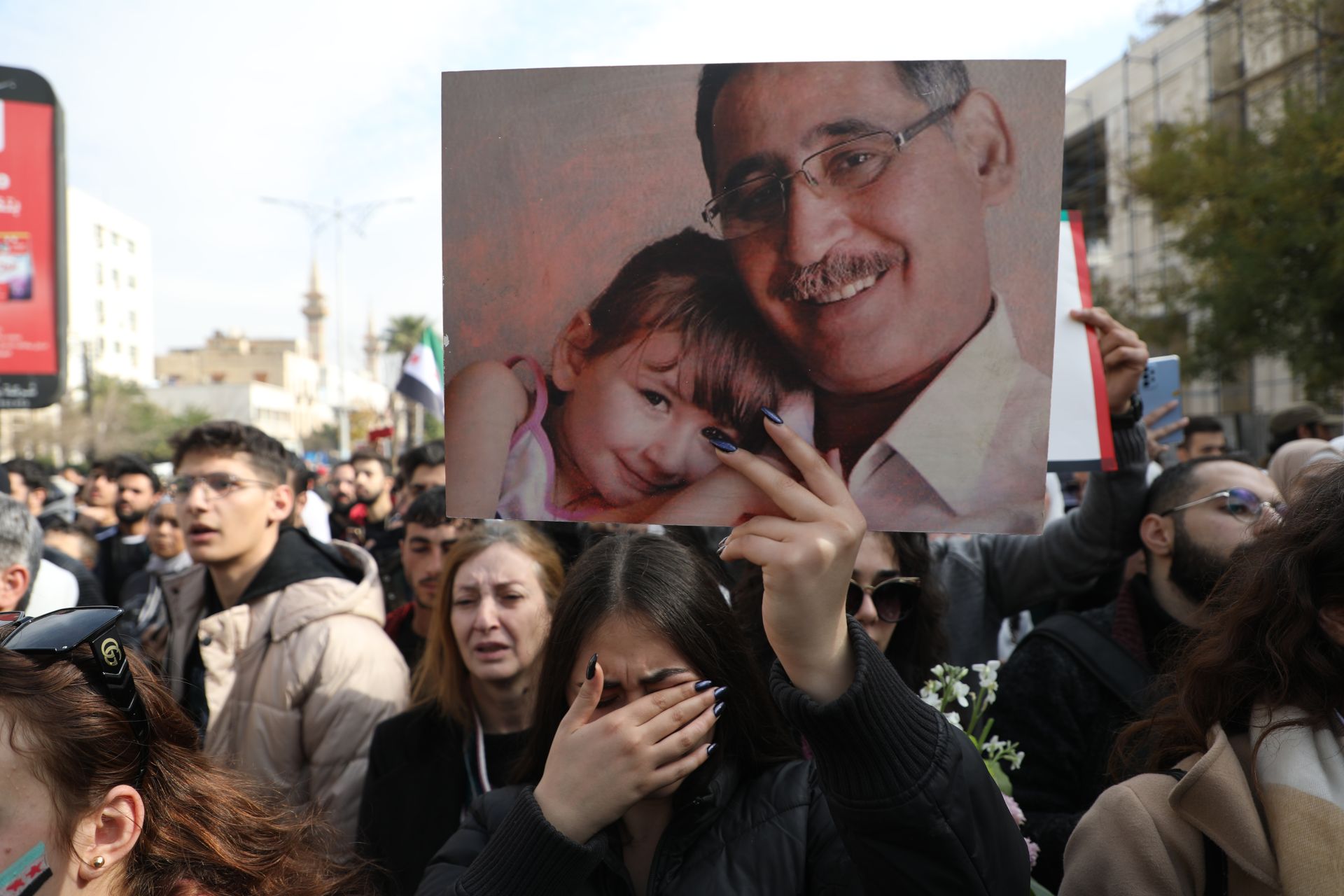
Almost immediately, Syrians whose loved ones were forcibly disappeared by the Assad regime responded with anger and anguish. “What does this mean?!” said Wafa Moustafa, a prominent Syrian activist whose father was taken by regime forces in 2013, in a video she posted on her Instagram the same evening. “Does this mean you will publish death certificates? You are saying that tomorrow we will publish something, but you are not being clear. I know that there are families here that will not sleep until tomorrow. It’s unacceptable.”
The next day, over 20 media outlets participating in the Damascus Dossier project broke their stories. In most cases, their articles and television reports focused on the trove of pictures and included interviews with one or more families whose loved ones were in the files or photographs. Thankfully for the families’ privacy, the journalists did not publish the tens of thousands of death certificates and pictures they held.
More troubling to the families, however, was the fact that the journalists had decided not to share the photographs with third parties that could have attempted to identify victims. Moreover, many publications did not clearly explain what will now be done with the material or mention whether it is in the possession of the new Syrian government. The resulting confusion left families of the forcibly disappeared — whose pain is precisely about the lack of certainty — to face even more uncertainty as they wondered whether and how they would ever be able to find out if their loved ones are in the photographs.
“I wish these journalists had thought of me as a mother before they thought of their scoop,” said Maryam Hassan, a 58-year-old Palestinian woman whose husband Younes al-Muqbil and son Mohammed were arrested by regime forces in September 2013. From her home in a suburb of Damascus, she told us about the impact the publication had on her and her family. “I cannot describe to you what it feels like to scroll through blurred images of mutilated corpses, looking for your son and husband,” she said. “I felt deep pain, shock, and fear for my children. We try so hard to live a normal life and escape our pain. Then something like this happens, and we have to start all over again.”
Hassan said she barely slept in the days following the publication. By the time it was Dec. 8, she was exhausted and could not bring herself to join any of the celebrations for the anniversary of the Assad regime’s fall. Like many families of the forcibly disappeared, she and her children spent their liberation day indoors.
The Damascus Dossier investigation is the latest example of a profound disconnect between survivors of Assad’s atrocities and journalists who report on their suffering. While the project was described as “one of the most consequential investigations of 2025” by the Global Investigative Journalism Network and has already been nominated for the Grimme Award (described as the Oscars of German TV), its reception inside Syria, and particularly among the families of the forcibly disappeared whose fate the investigation purports to illuminate, has been far less positive.
Two days after publication, nine different associations representing the families of the forcibly disappeared issued a damning statement branding the investigation “a media stunt which disregards the dignity and rights of the victims and their families, and even exploits their pain.” Syria’s National Commission for Missing Persons, too, released a statement in which it said the publication not only “causes further harm to families” but also “obstructs the path to justice,” as journalistic use of the data can affect the chain of custody and undermine the material’s credibility in future legal proceedings.
While Daraj published a video message apologizing for any pain it caused to families, others were less introspective. “Doesn’t this investigation deserve praise rather than criticism?” NDR reporter Amir Musawy retorted when a DW Arabic journalist asked him about the backlash. The crimes of the Assad regime are the problem here, he insisted, “not some investigative journalists trying to reveal accurate information.”
According to Musawy, he and his colleagues only did their job, and made a great contribution to exposing “the inner workings of the Assad regime.” Whereas the infamous “Caesar photographs” showed 11,000 people killed by the regime’s security services between 2011 and 2013, the Damascus Dossier images were primarily taken between 2015 and 2024, thereby providing irrefutable evidence that systemic torture and killing continued all the way up to Assad’s fall. After the Caesar photos’ release in 2014, Musawy said, many expected that the regime would change its ways. “But we were shocked to find out that the killing machine continued.”
To Syrians, of course, this is nothing new. The regime’s systematic torture of civilians up until Assad’s fall has been widely documented by human rights organisations and journalists alike. The same goes for the use of Harasta Military Hospital within this torture machine, the topic that NDR and several other outlets focused their stories on. Apart from some important exceptions — including an ICIJ piece that revealed how the United Nations paid $11 million to a regime-owned security firm and several Arabic-language articles on leaked intelligence documents — many Damascus Dossier publications added little to our understanding of the “inner workings” of the Assad regime.
They did increase awareness about Assad’s atrocities and fulfilled a fundamental journalistic task: to expose wrongdoing. Yet, especially when covering a topic as sensitive as this, journalists are usually expected to balance the public’s need for information against another key journalistic principle: the minimization of harm.
It is mainly on this point that the Damascus Dossier investigation can be found lacking, as conversations with over 20 sources, including seven journalists who participated in this project, demonstrate. Although the reporters were certainly aware of the sensitivities and thought carefully about ethical dilemmas, the decisions they ultimately took did end up causing unnecessary harm, in particular to the families of the forcibly disappeared around whom their investigation revolved.
In the way they dealt with our questions, the ICIJ and NDR also demonstrated little commitment to two other key journalistic principles: transparency and accountability. Despite the wave of criticism their reporting unleashed in Syria, neither the ICIJ nor NDR agreed to an on-the-record interview for this piece. Both organizations only agreed to respond to written questions.
The ICIJ, however, deferred most of our questions to NDR. “It is proper that NDR answer most of your questions,” a spokesperson said, because the German broadcaster obtained the data, and the ICIJ does not control the editorial decisions of its partners. Some of our questions that directly concerned the ICIJ were also left unanswered, however. In general, the spokesperson said, “we do not agree with your characterization of the way the investigation was handled.”
Two individual NDR reporters who took a leading role in the project refused to comment and referred us to a spokesperson. One of them subsequently tried to prevent individual journalists from speaking to us by circulating a group message among partners, in which he advised them to refer questions to NDR or the ICIJ, “simply so that we speak with one voice and do not inadvertently produce contradictions.”
The NDR spokesperson initially provided replies to the numerous questions we sent, but in many cases provided general responses that danced around specific queries, and eventually stopped engaging altogether. “NDR has at all times adhered to journalistic standards and acted transparently and in a manner aligned with the needs of the affected families,” the spokesperson said, in a final email that ignored questions specifically related to the treatment of these families.
How did a German broadcaster obtain tens of thousands of files from Assad’s security services? As NDR writes in an explainer page on its website, the source of the photographs served as the chief of the Evidence Preservation Unit of the military police in Damascus from 2020 to 2024. On the night of the regime’s collapse, he smuggled out the hard drive from a military facility, supposedly because he wanted to make Assad’s crimes public and help relatives find their loved ones. The hard drive was first taken to the coastal province of Latakia, then back to Damascus, and “eventually made its way” to NDR reporters.
The explainer adds that the reporters learned during the investigation that Anwar al-Bunni, a Syrian human rights lawyer living in Berlin, and the federal public prosecutor general in Karlsruhe (the seat of much of the German judiciary) also had access to the data.
Al-Bunni himself puts the order of events quite differently. “It started with me,” the Syrian lawyer told us. He said he received the files in January last year, first shared them with the German judiciary, and then with the journalists. “We gave it to them. I didn’t really decide, it was a coincidence. We were at the office and were chatting about the files. My friend Amir Musawy [the NDR reporter] said he could make a story out of it.” Asked for a reaction, an NDR spokesperson replied: “We do not comment on speculation regarding our sources.”
According to al-Bunni, the Syrian government has also had the files from the start. He said the source who gave him the material also provided it to Sheikh Anas Ayrout, a prominent figure in the new government, who was appointed governor of Tartus in the wake of the regime’s fall and sits on the so-called “Committee for Civil Peace,” which negotiates with ex-regime figures. NDR did not say whether it contacted Ayrout to verify this account. We did, but received no response.
NDR said it has “sufficient evidence [that] the Syrian government is in possession of at least part of the material (files and images).” Though the spokesperson refused to comment further “for reasons of source protection,” its reporter Musawy told DW Arabic that, during a visit to the military court in Damascus, reporters “discovered by accident” that employees of the Ministry of Justice “have all the photos and lists of names.”
The Minister of Justice said in a television interview last month that his ministry is working on archiving just under 100,000 files from regime courts. It is very likely that at least part of the Damascus Dossier is contained in this material.
Last December, however, the head of the National Commission for Missing Persons, Mohammad Reda Jalkhi, told us he had not received material related to the Damascus Dossier publications. He said Ayrout did not contact him about the matter and al-Bunni only got in touch about sharing the material after the journalists published their investigation. Yet al-Bunni himself says that he gave up on this because he could not be bothered to follow the commission’s protocols. “They emailed us like 10 pages on how to transfer the documents,” he said. “I said I might just drop it at your door.”
According to al-Bunni, the main cause of all the confusion around who has the material is the commission’s poor coordination with other parts of the government. But asked why he had not just contacted the head of the commission at an early stage to guide him so that families of the forcibly disappeared might be helped more quickly, the lawyer reacted disparagingly. “I don’t have to speak to him,” he said. “If he thinks too big of himself and has an attitude of ‘come to me, come to me’ then who will come to you?”
The journalists, for their part, do not seem to have been too preoccupied with the question of whether the commission tasked with helping the families of the forcibly disappeared had the material or not. That is a matter for the Syrian government to deal with, some said, and it is not a journalist’s task to get involved in the work of governments.
It is unclear when exactly NDR contacted the ICIJ to start an international investigation on the dataset. The ICIJ did not answer our question about this, nor did it clarify whether it could rule out that any of the files were physically removed from Syria by any of the reporters working on the project.
On its website, the consortium states that the “ICIJ, NDR and 24 media partners in 20 countries spent over eight months organizing and analyzing the documents.” This turns out to be a mischaracterization, however, as several partners we spoke with only joined the collaboration last fall. The ICIJ also listed Le Monde as a partner, though the French newspaper never ended up publishing on the Damascus Dossier.
The fact that many media outlets had only two or three months to deal with a huge dataset seems to have led in some cases to hasty reporting, said Annsar Shahhoud, an academic specializing in Assad’s intelligence services who was invited to help one of the partners make sense of the material. “By that time, it was already October,” Shahhoud said. “I told them they need more time, but they said they had a deadline. It seemed they did not know much about Syria and were more focused on finding story lines related to victims with relatives in Europe than on actually understanding the material. That’s unfortunate, because the documents contained valuable information about the regime’s chain of command.”
Still, the reporters did think carefully about the best way to examine the data, particularly in the case of the photographs. Though they did not analyze all 33,000 of them with the human eye, they created a representative sample of 540 images with a 98% confidence level, which was then manually analyzed by journalists who filled in questionnaires developed by a forensic expert. This process took a heavy toll on the journalists’ mental health, the ICIJ states on its website, but it allowed them to conclude, among other things, that around 45% of the bodies were naked, 75% were malnourished and 55.75% showed neck or face injuries.
Identification of the victims, however, proved very difficult. While the digitally inserted index cards on nearly all images did indicate who delivered the bodies (in most cases, the military police in Qaboun and various security branches), NDR writes that the body numbers on them do not correspond to individual prisoner numbers and that, in only around 320 cases (mostly dead soldier prisoners or recruits), do the cards contain full names. The journalists extracted these and around 1,200 other names that appeared in the data and shared them with several organizations — a point we will return to later.
Ethical dilemmas, the ICIJ, NDR and individual reporters all said, were taken very seriously throughout the investigation. “The reporting raised complex ethical considerations,” the ICIJ said, “which were discussed carefully and at length among the partners, balancing accountability with compassion.” According to NDR, the channel even hired an external trainer to offer “two training sessions: one focused on handling traumatising photos, the other on dealing with bereaved families.”
Such courses, however, apparently did not guarantee all reporters would treat families with what many would consider to be basic levels of empathy and decency.
In one scene shot by NDR, we see the relatives of a Syrian activist at a graveyard just outside Damascus. As they stand by the grave of their loved one, NDR reporter Musawy (the journalist who told DW Arabic the investigation deserved praise, not criticism) pulls out a picture of the activist’s mutilated corpse, shows it to the family, and tells them that what they believed to be true about his death is incorrect — with the camera rolling.
According to the relatives, who asked to remain anonymous for privacy reasons, they were not informed that this would happen when they were asked to come to the cemetery. “They only told me they wanted to visit the grave to recite prayers,” said the activist’s older brother. A nephew of the activist said the reporter did tell the family about the photographs, but only after they had already arrived at the graveyard. He said he felt tricked. “Visiting a grave is one thing, to interview and film us while we are in shock, something very different.”
In another scene, Musawy is sitting on a couch in the living room of another family, who have been searching for their relative for 12 years. “We have this photo with us, but we don’t know if it’s [him],” he says, as he takes out the picture from his backpack. The older man sitting opposite him looks nervously at the camera, then at the photograph. He shakes his head in disbelief: “It’s not him,” he stammers.
“They don’t want to believe it at first,” a voice-over is heard saying, “until inkling turns into certainty.” Suspenseful music swells as the man collapses into tears. The camera quickly zooms in on the man before being placed on the floor, but it keeps running. The reporter first looks at the camera, then turns to the man, and puts a hand on his knee. “My condolences.”
NDR said that, “in the interviews referred to, the reporters’ primary aim was to prevent any potential retraumatisation of the relatives.” For that reason, the families were informed in advance about the content of the conversations and free to stop the interviews at any time, the channel stated. It later added that the camera was switched off during the interview and filming only continued with the families’ agreement. NDR did not say, however, whether the camera was turned off before or after the images were shown, nor did it respond to the first family’s claim that they were not properly informed.
“I doubt these journalists would do this to a German family,” said Jalal Nofal, a Syrian psychiatrist who leads the psychosocial support division of Syria’s National Commission for Missing Persons, upon being presented with the footage. “In Germany, there are of course many regulations on the rights of families in such a situation, just to be on the safe side. But I guess in Syria journalists just get away with this.”
Without “informed and well-designed consent,” Nofal said, putting a family in a situation like this is “very harmful and unethical.” The psychiatrist also noted that when the commission informs families, it makes sure a psychosocial worker is present. “You need a professional with you who understands the techniques of psychological first aid,” he said. “A hand on the knee is not enough.”
Of course, not all journalists dealt with families in the same way. Nofal, for instance, said an ICIJ reporter who sought his advice on the best way to approach families was “knowledgeable and respectful.” Multiple reporters we spoke with, moreover, disapproved of the way in which the above scenes were shot.
Some journalists on the project spoke out about the conduct of their colleagues. “I know that there have been people upset with how this was revealed in the media and about how some journalists were acting, and honestly I agree with those criticisms,” said Sally Hayden, a correspondent for The Irish Times, in a podcast for the newspaper. “Journalists sometimes can act quite disconnected from the reality of people and treat things like this as what they would call a scoop, instead of horrific new information for people who have suffered so much. It’s horrible to think that this may have added to their pain.”
Hayden pointed out that partners had to sign a nondisclosure agreement with the ICIJ and NDR before they found out what material they would work on (this is common in investigative collaborations). When she got access to the material in October, she added, she immediately said family associations should be consulted and asked whether the photographs had been made available to the new Syrian authorities. “I said a lot of Syrians would want that,” Hayden said in the podcast.
She was not the only one to raise the issue, and multiple reporters told us they thought it would have been better to share the material. While doing so with a government body like the National Commission for Missing Persons could be considered problematic in journalistic terms, they said the photographs should at least have been shared with family associations. NDR is said to have taken their suggestions seriously, but ultimately opposed them.
“Our journalistic mandate is to uncover wrongdoing and to enable public debate about it. It is not the task of journalists to share data with third parties or to enter into cooperation with governments or authorities,” the channel said when we asked about its position on the matter. NDR is also said to have put a lot of emphasis on “source protection” as a reason not to share any data. In its own television report, however, the channel not only shows the building where the officer who leaked the photographs worked, but even his individual office and the safe in which he kept the hard disk.
After much internal discussion, the journalists found an alternative way to ensure that at least some of their findings could reach affected families. They decided to share around 1,500 names they extracted from the data — 454 names of people who died in detention and 1,099 names of people who were arrested — with four organizations: the U.N. Independent Institution on Missing Persons in the Syrian Arab Republic, a Syrian-led support network for survivors of torture named Ta’afi, the Syrian Network for Human Rights, and al-Bunni’s Syrian Center for Legal Studies and Research. According to NDR, all of these organizations were informed about the type of information they would receive, and all stated it would be helpful to their work.
That turned out not to be the case, however, according to three sources inside these organizations. The spreadsheets they received contained just lists of names, they said, including many duplicates, which often lacked additional identifying information or detailed explanations on how the names featured in the data. This put the organizations in a difficult position vis-a-vis the anguished family members, who began contacting them after the journalists published their stories, so much so that both Ta’afi and the Syrian Network for Human Rights felt compelled to put out statements and give interviews on Syrian national television to clarify they did not possess the actual data.
“The information [we received] is not even sufficient to begin communicating with families of the people whose names are on the list,” Ta’afi’s director, Ahmad Helmi, said in a video posted to his Instagram account. He noted that the journalists only contacted him “less than a month ago,” and said he told them outright the material had to be shared with the relevant authorities. “Informing families must be done with hard evidence … and only through official channels. … Any unclear talk about this file reopens our wounds and makes us go back searching everywhere for any information about our loved ones.”
That’s exactly what happened. Though likely well-intentioned, the decision to share lists of names in the end only caused more anguish and confusion for families. This was compounded by the fact that many media partners did not clarify the limitations of the information they shared, and some did not even say exactly with whom the names were shared or how these organizations could be contacted, leaving families with heightened expectations and unsure where to look. We asked the ICIJ whether it set any common guidelines on the matter, but despite being the coordinator between the partners, it left that question unanswered.
While countless families were left wondering if their loved ones may be in the pictures, even those who did get answers did not always find closure. In the case of the family of the Syrian activist filmed at the graveyard, for instance, some relatives thought the picture they had been shown was fabricated, while others believed the journalists.
This caused a lot of pain and conflict inside the family, relatives told us during an interview in the family home. “These journalists left us in a paradox,” the nephew said. “They took us to the graveyard, gave us information different from what we believed for the past year, and then left after they were done filming us.”
The relatives were also divided about the investigation more generally. While the activist’s older brother said he appreciated the journalists’ effort to raise awareness about a topic he said was being neglected by the new government, the nephew clearly disagreed. “They did nothing for us, they just created a media buzz,” he said. “And there are many ways to put pressure on the authorities without retraumatizing thousands of families.”
According to the nephew, the journalists used the specific feelings that enforced disappearance imposes on families to their advantage. When your loved one is taken by the regime, he explained, you always feel guilty that you could not do anything for him, so when a journalist asks you for an interview “to make sure the world knows,” you agree, if only to forgive yourself. “They are taking advantage of our kindness, our hospitality, and the fact that we have been silenced for 14 years.”
Despite their differences, one thing all three relatives we spoke with agreed on is that they did not want the picture of the mutilated corpse of their loved one to be published. That’s precisely what happened, however, and in several cases, media outlets published the shocking image unblurred.
According to NDR, the family gave explicit permission for this. Asked to substantiate this claim with evidence, the channel did not reply. Its reporter Musawy did, however, call up the relatives after we sent our questions, the nephew said. “He said, ‘Don’t you remember, we asked you when we were at the grave.’ I was clear with him and said we do not want the picture published and that such things require informed consent. Of course a German journalist knows that.”
To this day, the image has not been taken down.
NDR did not comment on the above. Asked if there’s anything it would do differently if it were to publish this investigation again, the spokesperson just replied: “We, the NDR Investigation team, are always striving to optimize processes and workflows. We are therefore grateful for critical questions.”
Become a member today to receive access to all our paywalled essays and the best of New Lines delivered to your inbox through our newsletters.