


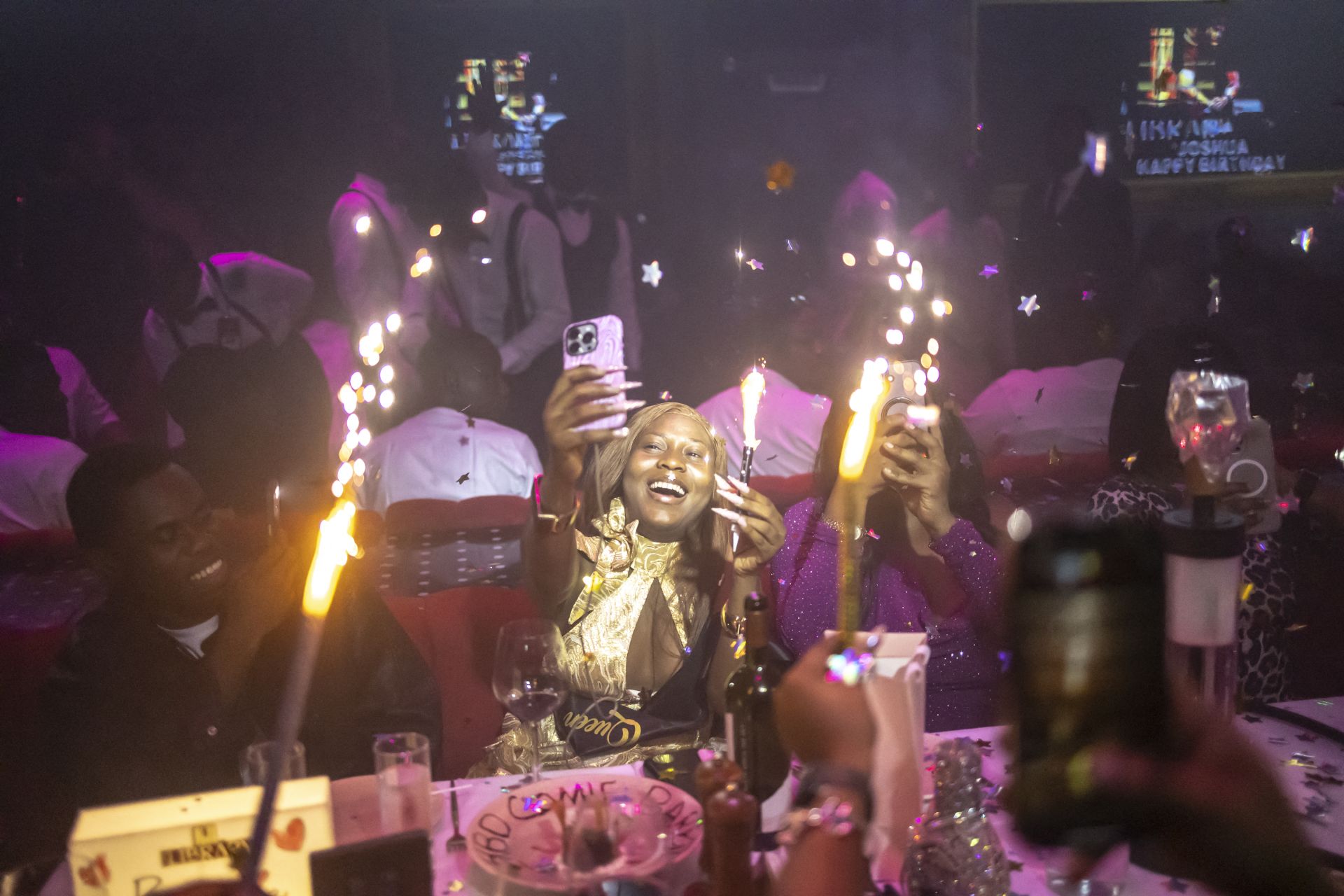
Masked women in sleek black gowns lifted a 4-foot casket, flames flickering from within, alongside bottles of premium liquor. Leading the procession, one held up a glowing VIP alert board displaying the buyer’s name for the entire club to see. As they moved through the crowd with measured, choreographed steps, like pallbearers at a solemn funeral, an unsettling hush fell over what had moments before been a pulsing dance floor. The air grew thick with anticipation and the sweet scent of expensive champagne, mingling with the perspiration of hundreds of bodies packed into the dimly lit space. Neon blue lights cast an ethereal glow over the scene, while phones emerged from every corner, their screens creating a constellation of light as people captured the spectacle. The DJ played Era’s haunting “Ameno” as the masked women carried the casket drinks forward — the track’s ghostly refrain now serving as an unofficial soundtrack to Nigeria’s wildest nights, its Latin-inspired chant adding an almost religious solemnity to the commercial theater unfolding before us.
Then the hype man seized his moment with practiced timing, his wireless microphone crackling as his voice cut through the ambience: “If you dey use savings account, go home! This one no be your kind setting.” (“If you’re using a savings account, go home! This place isn’t for people like you.”) Around me, I watched faces light up with excitement, some pushing toward the front to get closer to the action. He screamed again with more energy: “If you no get money, commot make better person enter!” (“If you’re broke, step aside and let someone richer take your place!”) The response was immediate: Pockets of the crowd answered by spraying bundles of cash into the air, creating a brief shower of naira notes that floated down like confetti. At the same time, a few men rushed forward to shower the hype man with more money.
What I witnessed that December night in Lagos wasn’t a typical club experience of dancing and communal joy; it was a spectacle of wealth, status and performance that revealed how Nigerian nightclubs have transformed into elaborate theaters of ostentatious spending. But how did venues once meant for escape and fun become arenas where social worth is measured almost exclusively by extravagant bottle service? What does it mean when even our supposed spaces of freedom become stages for displaying financial status?
Like countless other Nigerians trying to shake off another challenging year’s accumulated stress, economic uncertainty and political frustrations, I had found myself drawn to the city for “Detty December” — that sprawling season when locals and diaspora visitors pour into streets, clubs and concert grounds, aiming to lose themselves in music and celebration. Although I had long heard stories about Lagos nightclub excesses and the infamous “Dorime” processions — the elaborate bottle parades with astronomical prices led by women in costume and set to Era’s “Ameno” — nothing prepared me for witnessing it firsthand. For months afterward, I struggled to put the experience into words, replaying that surreal night in my head, trying to understand how I felt deeply disturbed by what I had witnessed.
Looking closer, I realized the music and drinks were only there to amplify the real display: social currency, status and the performance of wealth itself. The business model was brutally efficient at exploiting social insecurities, turning what should have been a good time into individual competition for recognition and status.
When I glanced at my friend’s receipt that night, the figures left me stunned — over 590,000 naira (almost $400) for what might have cost a third of that outside the club. He didn’t seem fazed by the markup; if anything, he seemed energized by it. For context, a single bottle of Clase Azul Reposado tequila, which retails for between 200,000 and 300,000 naira ($130-$200) outside, was selling for between 800,000 and 1 million naira inside the club. In the course of putting this essay together, I reached out to several club promoters and insiders who have worked in Lagos’ club scene for years to get a sense of how pricing works. One of them, James (not his real name), a promoter with over a decade of experience, told me that this was just the “standard rate” for basic bottle service.
According to him, there’s a separate, more ostentatious tier where higher prices come with full spectacle. The markup here can reach 500% of retail prices, James explained, and includes LED sparklers that flood entire sections with light, custom display cases crafted to look like miniature stages, coffin-style presentations complete with dry ice effects and choreographed processions featuring costumed performers, while the DJ halts music to play the funeral-march soundtrack of “Ameno.” “We call it ‘Dorime,’ and the customers ordering Dorime aren’t just buying drinks,” James told me. “They’re buying a performance when the entire club stops and acknowledges their financial power. Some guys will spend between 3 million and 5 million naira in a single night just for that feeling.” What made it murkier was learning that some of these luxury drinks have been flagged by the Nigerian agency responsible for regulating food and drugs and Lagos authorities as potentially counterfeit, adding a darker layer of deception to the opulence patrons eagerly bought into.
“The economics are brutally simple,” James explained during our conversation. “One VIP table spending 2 million naira in a single night makes far more money than 50 regular customers buying drinks all evening that cost 5,000 naira. So we build everything around big spenders. Club owners even ask me to reach out to guys who consistently spend heavily, offering them special deals, reserved tables and even transportation to ensure they keep coming back. I know the regular customers complain about feeling excluded, but honestly, they’re not paying our rent or staff salaries. Any club in this Lagos that doesn’t adapt to this high-spender model will close within six months.”
The economic disparity hit me like a physical blow. Nearly half of Nigerians earn less than 50,000 naira per month, meaning that a single bottle service can cost what a typical family might earn in five years of honest work. With Nigeria grappling with extreme poverty rates, such manufactured exclusivity felt, to me, like a deliberate mockery of the economic realities most citizens face daily.
This business model has reshaped Lagos nightlife into an ecosystem where every detail revolves around exclusion and hierarchy. While this mirrors bottle service culture in Miami’s South Beach clubs, Vegas luxury suites or Dubai’s extravagant sky lounges, Nigerian venues escalate the concept into a full-blown performance that turns financial competition into public entertainment.
DJ Diamond, a veteran spinner who has worked the scene for over five years, explained the constant commercial pressure that shapes every night’s energy: “The club owners want to see big spenders getting their money’s worth in terms of attention and recognition,” he explained. “So sometimes, even when the crowd is genuinely hyped and the musical vibe is absolutely perfect, you’re told to abruptly switch up the music, maybe because someone particularly important just walked in and needs acknowledgement, or because a VIP table just ordered an expensive bottle that requires immediate musical celebration. The natural flow of the night gets completely interrupted, but to the management, it’s a necessary trade-off for maintaining the business model. It’s all just part of how the business operates now.”
He described how DJs are given lists of “VIP arrival songs” and “bottle service tracks” that must be played, regardless of the crowd’s energy. “Sometimes when I’m taking the crowd through different emotions and energy levels, I have to stop mid-song to play that ‘Ameno’ song because someone ordered a 2 million naira bottle. It kills the artistic integrity of what we’re trying to do, but the financial pressure is too strong to resist.” These musical interruptions have become so routine and expected that even public figures, social media influencers and regular clubgoers voice frustration with how the practice destroys nightlife’s communal experience. In November 2023, Nigerian comedian KlintonCod posted a viral video explaining why he barely clubs anymore, describing how music abruptly stopped during a song he was enjoying so a hype man could acknowledge a bottle purchase. In Nigeria’s nightlife scene, a hype man is the person who energizes the crowd, keeps the party lively and builds momentum for the DJ or performing artist. They are usually on the microphone, shouting catchy phrases, hyping up specific guests (like big spenders popping bottles) and making sure no one loses energy on the dance floor.
The music that dominated that night felt deliberately curated for the spectacle unfolding around me. Songs like “Yahooze” by Olu Maintain, and “Cash App” by Bella Shmurda, Lincoln and Zlatan, were carefully curated accompaniments to the spectacle unfolding around me. In “Cash App,” for instance, the chorus — “Sho ni CC? / Load am cash app / Cashout / O ni maga bill am / Small money ball out” — leaves little to interpretation, as it bluntly lays the script for cyberfraud. In Nigerian parlance, “CC” means “stolen credit cards,” while “maga” refers to the victim of the scam. The lines translate loosely to: “Do you have a credit card? / Load it into a cash app / Withdraw it / Do you have someone to scam? / Bill the person / Even if it’s small money, lavish it.” Every line about showing off wealth or “getting rich fast” validated the club’s theater of status, signaling that audacious spending, regardless of its source, was not just normal but actively desirable and worthy of celebration. For a moment, it was easy to forget the economic realities outside the club walls, where the majority of Nigerians could never dream of affording a single bottle, let alone the elaborate displays being paraded around us.
Dirego, a popular Lagos hype man known for his energetic performances, was refreshingly candid when I approached him after one of his sets: “Look, we just have to hype like that because that’s genuinely how we make our money. The clubs also earn way more when we create this kind of energy and pressure around spending. It’s a performance, but it’s also a business strategy.” He explained how successful hype men study the crowd, identifying potential big spenders and creating social pressure around them to order expensive bottles. “We know who has money just by looking at how they dress and the kind of drinks they order. Then we make them the center of attention until they feel obligated to spend more.”
Hype men have become unofficial enforcers of club hierarchy, using their microphones and crowd influence to nudge guests toward conspicuous spending while simultaneously creating public entertainment through the humiliation of those who cannot or will not participate in the financial theater. Lines like “If you no dey use three cameras, abeg stay for back seat” (“If you’re not taking pictures with three phones, stay at the back”), “This is not for 9-5, this is for the ballers” (“This isn’t for salary earners, it’s for big spenders”), or “If you no fit ball, are you sure you’re a living thing?” (“If you can’t spend lavishly, are you even alive?”) exemplify how honest work is mocked and fraudulent wealth glorified.
The gender dynamics I observed added another calculated layer of exclusion, revealing how assumptions about spending power and social value determine access and treatment in these spaces. Amusan Feyikemi, a 27-year-old accountant and marketing executive, shared two different encounters that illustrate this systematic discrimination in Lagos. In one instance, she and a female friend were denied entry to a popular club despite having tickets. “The bouncer kept making excuses and said we weren’t dressed right, then said we weren’t on the guest list,” she recalled. “We stood outside for 30 minutes watching men walk straight in. It wasn’t until our male friend showed up that suddenly everything was fine.”
Recounting another experience, she recalled the subtle ways clubs enforce a visual hierarchy. “If you’re not wearing expensive jewellery, people look at you like you don’t belong,” she explained. “The bouncers treat you differently, and even other clubgoers act like you’re invisible. I remember wearing a nice, but nondesigner, dress to a club in VI [Victoria Island], and a guy asked me if I was someone’s plus-one. Like I couldn’t possibly afford to be there on my own.”
Such gatekeeping isn’t arbitrary or accidental; it reflects calculated business decisions rooted in deeply held beliefs that women attending alone won’t spend as lavishly as the male “ballers” who drive profits through bottle service and VIP tables. Club owners actively cultivate environments that discourage independent female patronage, viewing women primarily as decorative accessories to enhance the atmosphere for male spenders rather than as customers in their own right.
This shift feels especially disappointing when contrasted with what Nigerian nightlife offered just two decades ago. Mr. Ayobami, a federal government worker in his mid-40s who spent his 20s immersed in Lagos club culture, remembers the early 2000s with reverence. “You went to the club to dance,” he said heartily. “The DJ could take you to spiritual heights. If you didn’t lose your voice shouting your favourite songs or wake up sore the next day, you didn’t party. Back then, places like Bacchus, 11:45, Club Papas and Swe Bar in Lagos were where everyone went to feel free. It wasn’t about money or bottles, it was just the music, the people and the vibe.”
His description painted clubs as spaces of raw, unpredictable human connection — unfiltered, authentically alive and genuinely democratic in their accessibility. That world feels almost mythical when measured against the calculated exclusivity I witnessed that December night.
Yet even as traditional nightclubs become consumed by spectacle and increasingly elaborate status games, a powerful countermovement has emerged across Nigeria that offers genuine hope for what nightlife could become when freed from commercial theater. Across Lagos, Abuja, Port Harcourt and other major cities, underground raves have begun flourishing in abandoned warehouses, converted apartment lofts, open fields and repurposed rooftop spaces, organized by young collectives, independent DJs and cultural activists committed to building environments explicitly rooted in authentic connection rather than economic competition.
“At raves, no one cares about your shoes, outfit, phone or who you came with,” said Oyin, a rave enthusiast and culture writer. “Raves strip everything down. It’s just bodies, lights and sound. Nobody’s trying to outshine the next person or show off the price of bottles like there is in the club. You just come as you are and vibe till morning.”
These raves — with names like Sweat It Out, Element House, Ward99, Real Househeads, Ile Ijo, Group Therapy and Monochroma Live — deliberately reject the exclusivity and financial gatekeeping that define mainstream club culture. Entry is intentionally affordable, drinks are reasonably priced and the focus remains firmly on musical experience rather than social status display. They operate as intentionally inclusive spaces, welcoming people of all genders, backgrounds and economic situations, including LGBTQ+ Nigerians who often face discrimination in traditional venues, creating genuine refuge from the classism and misogyny that characterize mainstream nightlife.
The music programming reflects this inclusive philosophy: carefully curated blends of Afrobeats, house music, EDM, Amapiano, Alte and techno that prioritize rhythm and immersive experience. There are no VIP sections creating physical separation, no bottle parades interrupting the flow, no hype men disturbing the music, just bodies moving together under strobing lights.
What makes this movement particularly significant is how it mirrors successful underground rave scenes in cities like Berlin, where warehouse parties became spaces of radical inclusivity that helped heal social divisions after reunification, or Johannesburg, where postapartheid rave culture deliberately dismantled racial and economic hierarchies through music and collective experience. Like these international counterparts, Nigerian raves signal a conscious rejection of exclusionary practices and a return to nightlife’s original promise of escape.
As I left the Victoria Island club in the early hours of that December morning, the casket procession, the show of wealth, the hype man’s taunts and the crowd’s frenzied responses to financial display all replayed in my mind. Reflecting on the rise of underground raves, I wondered if we were witnessing more than just a trend. Would Nigeria’s mainstream clubs continue as theaters of class performance, or would the inclusive spirit of today’s rave culture eventually reshape what it means to belong on a dance floor?
Become a member today to receive access to all our paywalled essays and the best of New Lines delivered to your inbox through our newsletters.