


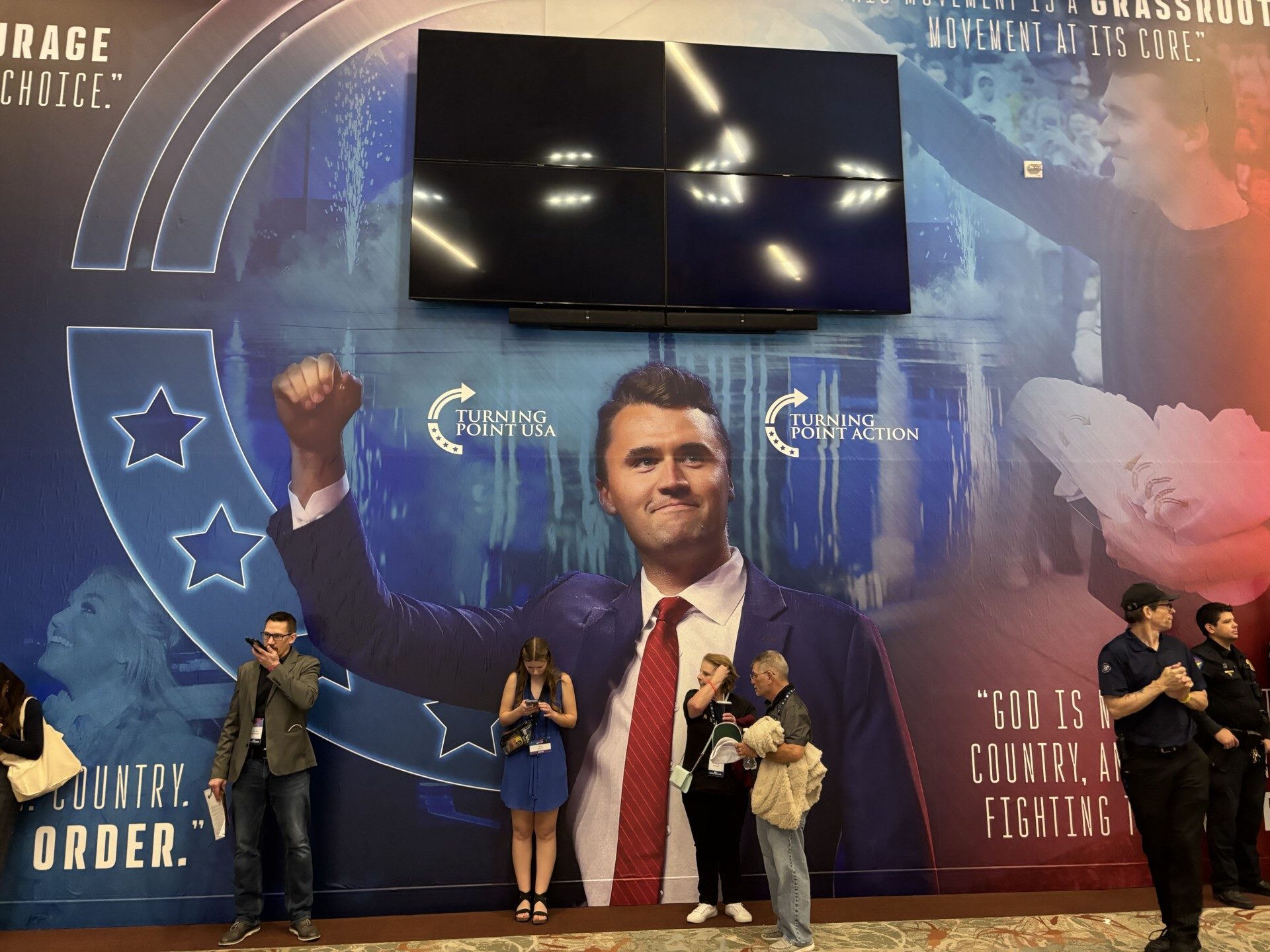
This year’s edition of Turning Point USA’s annual AmericaFest conference, held last weekend in Phoenix, was, first and foremost, a tribute to the memory of Charlie Kirk. That isn’t surprising: The assassination of the conservative organization’s founder just three months ago has left it reeling. TPUSA’s leaders and members are traumatized by his death, and the organization has come under severe internal strain. The only point of agreement seems to be how much they miss their founder.
Tribute is an understatement, really. Wherever attendees walked inside the exhibit hall of the Phoenix Convention Center, they were met with 50-foot images of Kirk’s face, or a 50-yard timeline of his life depicting all its major events, or a giant image of George Washington in military garb astride a horse, next to the words: “Choose courage. Reject comfort. Continue the work. For Charlie.” Even the side of an escalator depicted Kirk’s face and hand gesturing upward toward the word “Freedom.”
It would be a mistake to imagine that AmericaFest attendees found any of this unnerving. Among the more than 30,000 people who gathered for this year’s event were thousands wearing versions of the T-shirt that Kirk was wearing when he was shot. And if you needed one, you were never more than 100 feet from a vendor who had them in all sizes and colors, short-sleeved and long — next to baskets of wristbands emblazoned with “We Are All Charlie Kirk,” mugs, hats, carved wood depictions, oil paintings and countless other renderings of the slain leader.
Perhaps the oddest commemoration, nestled between a militarized Immigration and Customs Enforcement (ICE) vehicle and a semitruck bed bearing a mural of Donald Trump and Kirk shaking hands, was a replica of the “Prove Me Wrong” tent where Kirk was killed, complete with a ring light for selfies. A continual stream of attendees wanted their photos taken inside. Once they were in, though, many were unsure what to do. Should they smile like tourists, or look somber like mourners? The very microphone he was holding when he was killed was encased in a clear plastic reliquary, completing both the kitsch and sacred aspects of the pop-up martyry.
But Kirk’s ghost was perhaps felt most of all on the main stage of AmericaFest, where his life and legacy were less a site of reverence than of conflict. How could it be otherwise? He was the one thing everyone could agree on, yet major figures in the movement all wanted to claim him for different ends, as deep fissures in the organization and in the broader American right came to the surface. For the first time in its history, AmericaFest was less a feel-good gathering of the faithful than a donnybrook that left the future of the organization in question.
The first time I came across TPUSA was at the 2016 Republican National Convention in Cleveland, where I met a pair of bespectacled college students wearing matching light blue T-shirts that read “Socialism Sucks.” When I asked them about the shirts, the Turning Point representatives told me that their main concern was limited government and the free market. They did not have many allies in what was, at that time, a right-wing populist revolt in the party, and they were circumspect about that year’s presidential candidate. TPUSA was still a libertarian college organization across a smattering of campuses. But that was to change radically in the coming years.
By the time Kirk was slain last September, Turning Point had become the most powerful organization on the American right. Its organizing model, which had proved effective for taking over chapters of the College Republicans group, became a durable base on which to build a highly coordinated national effort that trained legions of student organizers, connected grassroots groups with conservative celebrities and Republican Party elected officials, and tapped the resources of wealthy donors.
TPUSA played an important role in getting out the GOP vote in the 2020 election, but its biggest influence was yet to come. In 2021, much of the MAGA movement’s organized militant right had gone into retreat. Proud Boys, Oath Keepers, Three Percenters, Bikers for Trump and other groups that attacked Black Lives Matter protesters in the summer of 2020 and laid siege to the U.S. Capitol on Jan. 6, 2021, were discredited on the right and faced prosecution. Trump’s own political fortunes were hardly secure. From the top, a coalition of conservative think tanks led by the Heritage Foundation patiently strategized for a possible Trump victory in 2024, including by developing Project 2025, a blueprint for his second term.
That victory and many others depended on TPUSA, which used its growing organizing acumen to build a broad organization that would continue to stoke the fires of right-wing rage. Turning Point organizers would aid or lead campaigns of MAGA Republican candidates in cities, counties and states across the country through its lobbying arm, Turning Point Action. The GOP has depended on TPUSA’s formidable skills to win local and statewide elections in both solidly Republican and tightly contested, or “swing,” states. GOP leaders and elected officials flocked to Kirk and to Turning Point for credibility among conservative voters and activists. Meanwhile, Turning Point chapters on campuses across the country produced organizers, content creators, speechwriters, electoral strategists and candidates.
Pushing past the confines of libertarianism, the organization became increasingly rooted in evangelical Christianity, particularly the Seven Mountains Mandate, a belief popular among Christian nationalists that followers should seek influence in seven key areas of society — such as government, education, media and business — to shape culture according to biblical values. This evangelical turn helped give Turning Point’s mission a spiritual intensity, created meaningful community among its members and gave it access to churches, Bible colleges and growing Christian nationalist networks across the country.
At the heart of all this was Kirk, a uniquely talented and contradictory figure. He was, at once, a disrupter and institution-builder, entrepreneur and hustler, bridge-builder and polarizer, and — most famously — a person who issued dark warnings about children being lured away by leftist professors and trans groomers, only to prove himself the most gifted pied piper of all. In those roles, Kirk held together big donors and the activist base, party leaders and far-right insurgents, Black and Latino conservatives, Islamophobes, antisemites and white nationalists. If there was any figure on the American right who could both cement its past victories and promise it a glorious future, it was Kirk.
In the immediate aftermath of Kirk’s death, the GOP establishment was united in its desire to make him a national martyr. At the White House, Trump, Vice President JD Vance and deputy chief of staff Stephen Miller all called for retribution against anyone who expressed anything but grief — preferably of the performative variety — over his killing. Congress established an official Charlie Kirk Day of Remembrance on his birthday, Oct. 16. His massive, seven-hour memorial at State Farm Stadium in Glendale, Arizona, brought together the entire leadership of the Trump administration with the major figures of the MAGA right to call for spiritual revival among the faithful and holy war against the left. The right reveled in this moment of renewed unity and purpose — but it was not to last.
The months since the assassination have made clear just how costly Kirk’s assassination has been. The Republican Party has a leader who is in apparent mental and physical decline, is rapidly losing support in his base over numerous issues — chief among them the Epstein files — whose polling numbers continue to plummet and who is approaching lame-duck status with a restive Congress, a year before we even get to the midterm elections.
This isn’t merely an issue of presidential power, but of Trump’s role as the unifying symbol of the party and the movement. With this in mind, the GOP is desperately holding onto Kirk’s legacy with all its might, making the slain leader not simply synonymous with itself, but with the fundamental principles of American democracy. The party’s push has included state-sponsored directives to install Turning Point clubs at high schools across Texas, Tennessee and Florida; a proposal by Rep. Nancy Mace to turn Black Lives Matter Plaza in Washington into Charlie Kirk Freedom of Speech Plaza; and a plan to erect a statue of Kirk in the House of Representatives.
Meanwhile, the various elements that Kirk held together have begun to split apart. The pressures come from without — in particular, from neo-Nazi Nick Fuentes, whose Groyper followers consistently showed up at Kirk’s campus debate events to challenge him on his support of Israel — and from within, by his close ally Candace Owens, who has used her enormously popular podcast to peddle a fantastical conspiracy theory about his murder that includes the Mossad, French President Emmanuel Macron, Egyptian planes and members of the TPUSA leadership itself. Meanwhile, Fuentes — always kept at bay by Kirk — was recently invited onto conservative commentator Tucker Carlson’s show to air his white supremacist and antisemitic views, a decision that deepened rifts already occurring in the MAGA movement.
Tensions around these issues continued to mount going into AmericaFest last week. Much has been reported already about harsh criticisms lobbed by conservative commentator Ben Shapiro at Carlson, Owens, conservative journalist Megyn Kelly and Steve Bannon for allegedly promoting or tolerating antisemitism — and of hostile comments lobbed back at Shapiro in return. The charge of antisemitism was at the heart of the conflict, refracted through Israel and Palestine, “America First” ideology, Jeffrey Epstein and conspiracy theorizing more generally.
Over the following days, headline speakers on the main stage of AmericaFest continued to return to this rift, although not quite clear how to handle it. Veteran white nationalist Jack Posobiec, who has been more oddly gentle and congenial in his tone these days, interviewed Kelly about the conflict. Kelly was careful not to endorse Owens’ conspiracy theories but went after Shapiro and Bari Weiss (founder of the conservative publication The Free Press, now editor-in-chief of CBS News), for wanting to control debate about Israel. YouTuber Benny Johnson first embraced the conflict, claiming that the right welcomes debate (unlike those cancelers on the left), before ragefully denouncing it moments later as the work of outsiders who were dividing the movement.
Where AmericaFest speakers could lean into shared hatreds, they did so. The demonization of the left — described as violent, treasonous, anti-family, pro-trans and a danger to children — was a common theme. “The real enemy? It’s not Steve Bannon or Tucker Carlson or Ben Shapiro, it’s the radical left that murdered Charlie and celebrated it on a daily basis,” Donald Trump Jr. shouted. Pious and vengeful Christian nationalism was another comfortable lane for many speakers. And celebration of ICE brutality toward “illegal criminal aliens” was guaranteed to bring cheers from the floor.
But there is no denying the growing white nationalism and antisemitism that is clearly gaining ground. There were many fewer Black and Latino speakers this year, and this absence was visible among attendees as well.
When the front-running Republican candidate for Ohio governor, Vivek Ramaswamy, spoke at AmericaFest two years ago, he bantered with Turning Point bros about his “max bench” and did pushups on the stage. This year, easy masculine bonding was replaced by anxiety over the direction of the American right. “The idea that a ‘heritage American’ is more American than another American is un-American at its core,” he said, echoing an argument he made in a New York Times op-ed earlier in the week. Invoking a conversation he had with Kirk about the power of faith, Ramaswamy implored young attendees to have faith not in racial lineage, but in a colorblind American dream.
Indeed, speaker after speaker told stories of their close connections or last moments with Kirk — often meant to gesture to what TPUSA’s founder truly believed or where he was headed politically and spiritually before his death. Posobiec, for instance, told a story about the moment he joined TPUSA. The evangelical Kirk apparently drove him to a Catholic church in Phoenix and sat in silent prayer with him for an hour before the blood-stained relics of St. Padre Pio, a 20th-century Italian Capuchin friar known for having borne the stigmata. This use of Kirk’s memory raised yet another divide, this one over whether and how TPUSA would navigate the growing rivalry between evangelicals and hard-right Catholics in its ranks.
By Sunday morning, AmericaFest had to turn toward its future. Trump border tsar Tom Homan urged attendees to celebrate their victories in securing the southern border and achieving record deportations. House Speaker Mike Johnson exhorted attendees to honor Kirk by warning of a political apocalypse on the horizon where “radical left Marxist Democrats … want to dismantle the very foundations of our republic and everything that we all stand for and that Charlie Kirk evangelized. Everything that’s been said here, everything is on the line in the midterms of 2026. And we have much more to do.”
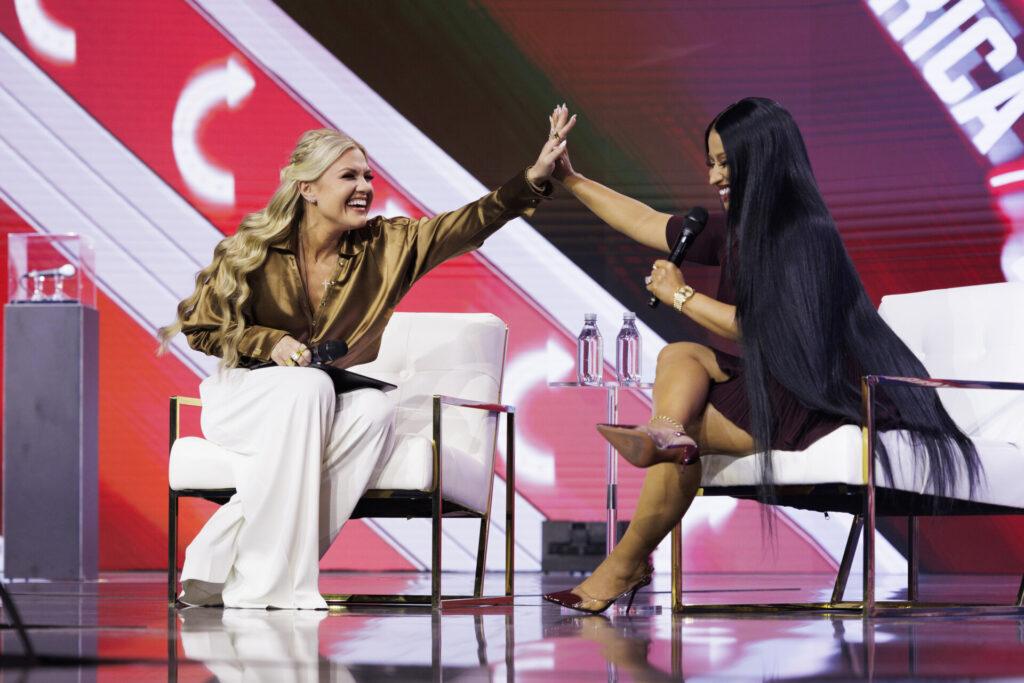
When Kirk’s widow, Erika Kirk, decided to bring out surprise guest Nicki Minaj (whom Charlie Kirk once called “not a good role model for 18-year-old girls”) to speak about the persecution of Nigerian Christians, it might have been a symbolic gesture to thwart growing white nationalism on the right or at the very least to stem the growing tide of America First opinion in the organization. The comment string below the Rumble live feed during Minaj’s appearance was rife with racist anger.
As the final speaker, Vance (recently endorsed by Erika Kirk for president in 2028) tried one last time to move past the conflicts bedeviling the movement by giving a pass to anyone guilty of racism or antisemitism, much as he did after the leak of pro-Nazi texts by Young Republican National Federation leaders a few months ago. “When I say that I’m going to fight alongside of you, I mean all of you, each and every one,” he said. “President Trump did not build the greatest coalition in politics by running his supporters through endless, self-defeating purity tests.” At the same time, the vice president sought to discredit Owens’ claims. “I stayed up all night, for many nights in a row, researching every conspiracy theory, going down every rabbit hole. When my lovely wife, Usha, told me to come to bed, I told her I owed it to Charlie to try to uncover every stone. And so that’s what I tried to do.”
The answer to who killed Kirk, he told the audience, “is a man named Tyler Robinson.” For Vance, this requires no further conspiracy. “Think about it,” the vice president said. “He has everything that the far left wants from our young men. He rejected the conservatism and the spirituality, the values of a small-town family. He moved into a small apartment, he became addicted to porn, he became addicted to hate and he ended up sleeping with somebody who doesn’t know whether they’re a man or a woman.”
“That is the nightmare scenario that the left has actively advertised they want for American families and the young men in the audience in particular,” he went on. “That is exactly why we have to fight them.”
Erika Kirk will have to contain the various factions that want to claim her late husband for their own imperatives if TPUSA is to continue to play a central role in the GOP and on the right more broadly. The beatification of Charlie Kirk won’t be enough to stop the growing divisions in the movement, nor will doubling down on the demonization of shared enemies. The division over the U.S. relationship with Israel — which has neoconservatives, major donors and older Republicans on one side and younger Republicans, America First populists and avowed antisemites on the other — is likely to get worse. Kirk occupied an ambiguous space between these poles. With his death, other major figures on the right have also been pushed to choose sides. This will continue to create institutional and ideological instability in the organization — and push to the fore other issues that may sabotage Turning Point’s aim of fostering a multiracial and broad-based future for MAGA.
Kirk’s singular genius was his creative ability to yoke together contradictory elements in a shared political project. As Kelly admitted onstage to Posobiec, those contradictions became harder to navigate after Oct. 7, 2023, as it became increasingly difficult to excuse Israel’s actions in Gaza or the bombing of Iran’s nuclear facilities. But these contradictions also became more difficult to manage in the face of the full-throated white nationalism issuing from the White House in politics and policy across the last year, which gave sustenance to Fuentes’ racist vision for the American right.
With the waning of Trump’s influence on the horizon, there is simply more uncertainty about the future of the MAGA movement among various right-wing factions. TPUSA remains a well-organized, multimillion-dollar political machine — one for which there is still no current analog on the left. But it has now lost its greatest asset, and the giant slogan on one of the walls at this year’s AmericaFest, “We are all Charlie Kirk,” may ultimately carry a double meaning, one that suggests that Turning Point’s factional divisions are already sapping its potential.
Sign up to our mailing list to receive our stories in your inbox.