


“Is this a war with us? Or with the U.S.? I’m confused!” That was from a friend in Dubai. Minutes later, another message came from Doha, and more direct: “Iran is attacking Qatar again.”
Those messages came as I was receiving news alerts about the U.S.-Israeli attacks on Iran and the Islamic Republic’s targeting of Doha, Dubai, Kuwait City and Manama. Within hours, it became clear that this was not just another episode of escalation, one that would remain contained somewhere in the background of Gulf politics. The war had arrived in the Gulf itself.
Bahrain, Kuwait, Qatar, Saudi Arabia and the United Arab Emirates were attacked on the first day and every day that followed. By the second day, Oman had also been hit. The scenario that had been discussed for decades — often seriously, though it was rarely believed likely — unfolded in the span of hours.
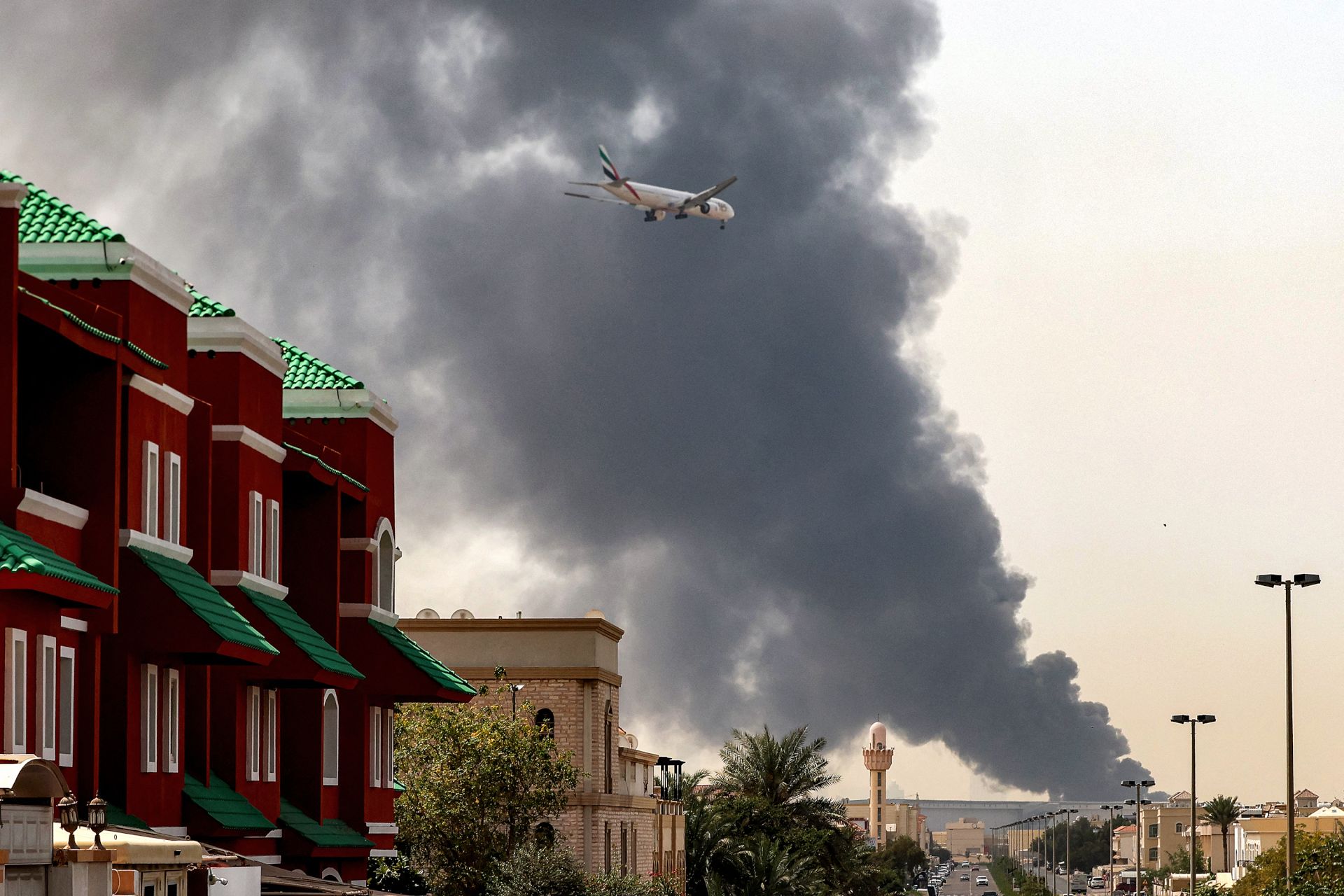
This is — or was, until the fragile ceasefire announced Tuesday — the fourth Gulf war since 1980. Yet it was also the first to be fought across all eight littoral shores at once. Oil platforms, refineries, ports, desalination plants and commercial vessels were all attacked. Fire was seen near a luxury hotel in Dubai. Panic spread across the region’s busiest airports. Debris from intercepted missiles fell into residential neighborhoods. In Dubai’s al-Barsha district, where I had dinner two weeks earlier, fragments struck a car and killed its passenger. In Abu Dhabi’s al-Bahia area, an intercepted missile fell on a vehicle and killed another civilian. In Bahrain, sirens sounded almost daily. In Doha and Dubai, parts of the city were evacuated following Iranian threats.
People across the region were thinking not only about missiles, damage and shelter, but about why this happened, who brought war into the Gulf itself, and what this will do to the region the day after it ends, and in the decades that follow. It is not only security arrangements or political alliances being tested, but whether the everyday ties that have held this region together can withstand a moment like this, when the war directly threatened some of its centuries-long connections.
I have spent much of my life in the Gulf, not continuously, but consistently enough that it has shaped how I see the region. I have studied it in depth on a personal level as well as through my graduate and postgraduate education. There is no precedent in recent history for what has happened now, and its consequences will be unique and severe. The end of this war will shape how the region functions, how it imagines its future and how its societies see one another.
In 2018, I moved to Qatar to pursue my doctorate in Gulf studies. It was not a casual decision. I remember clearly that several friends and colleagues advised against it. The region at the time, during the blockade on Qatar and rising tensions with Iran, they said, was too unstable, too unpredictable, too politically sensitive. It was not the obvious place to go. But I went anyway, largely because of an experience from a few months earlier that had stayed with me and shaped how I think about what exists beneath state politics in the Gulf.
When the blockade on Qatar was announced in June 2017, the reaction in the region was shock. I remember calling friends in Doha that morning and hearing a level of uncertainty I had not heard before. People were talking about their worries of empty shelves, about not knowing how long things would last, about their fears of possibly being in danger. There was real concern about how quickly daily life could be disrupted.
But within a day, the situation began to change. Iran moved quickly to supply the Qatari market, followed by a panoply of other countries, and in the span of a few days, perceptions about friends and foes shifted in ways that would have seemed unlikely just weeks earlier. Where there had once been Saudi and Emirati products, there were now Iranian ones. Flags above products in the supermarkets changed. Shops were thanking “friends of Qatar” through posters and advertisements.
I traveled to Doha a month later and saw it myself. Cafes were using Iranian milk, restaurants were serving Iranian produce and children were carrying Iranian juice boxes in their school bags. These were ordinary, everyday adjustments, not political gestures. The flag of a country that had long been viewed with suspicion became part of daily life.
That moment stayed with me because it revealed something fundamental about the region. Beneath the level of state politics, there exists a form of interdependence that does not disappear when relations break down. It adapts, it shifts and, in some cases, even reshapes how people see one another. These developments in Iran-Qatar relations did not erase conflicts, but they complicated them in ways that matter.
I saw the same dynamic again when perceptions across the Gulf shifted back just as quickly after the end of the blockade in January 2021. In the Gulf, perceptions can harden very fast. They can also soften very fast. That elasticity has historically prevented political crises from becoming permanent societal breaks. That is one of the reasons why I still do not think what is happening now has to become permanent, even if it is already the deepest break the region has seen in decades.
My experience, often as the lone Iranian among Arabs, has also shown me how much of the region has in recent times been shaped by distance rather than the direct interaction that was habitual up until recent decades.
In Doha, I had the opportunity to present my research in a TEDx booth as a doctoral student the year I arrived. The booth carried the title of my master’s thesis, “Effectuating a Cooperative Future Between Iran and the Arab States of the Persian Gulf,” printed in bold alongside the flags of the eight littoral states. This was during the blockade, and it drew a very intrigued crowd who lined up in front of the booth to take part in a survey I had prepared and to engage in a conversation with me.
A visitor said that his grandmother was buried in Iran. Another told me her name was Persian. And I remember one conversation in particular. A young Qatari said that he had never spoken to an Iranian before. These were not contradictions. They were reflections of the same reality: that proximity in the Gulf does not necessarily bring familiarity.
Even in places like Doha’s Souq Waqif — once known as Souq Irani — an Iranian vendor could be seen as local, not as Iranian. Iran’s internal diversity, including its Arab population, is often not part of how it is perceived from the outside. The idea that Arabs are part of Iran’s social fabric is lost on many.
For the member states of the Gulf Cooperation Council (GCC), there are, in most cases, more similarities than differences among their societies. These similarities are rooted in shared patterns of life across the Gulf, including language, family structures, trade, coastal and oil economies, and generations of movement across the water. What is often described as a “khaleeji” (Gulf) identity is a social and cultural continuum that long predates the modern state system and continues to exist beneath it.
Before the consolidation of state borders in the late 20th century, families, tribes and merchants moved across all shores of the Gulf with relative ease, including the northern Iranian shores. They intermarried, traded, built businesses together and maintained kinship ties that extended from one side of the water to the other. These patterns were later restructured through state-building and national identity formation, but they were not erased.
On the southern side of the Gulf, populations with Iranian origins remain embedded in societies like the UAE, Qatar and Bahrain. On the Iranian coast, Arab and Persian communities have lived alongside one another for generations. These are part of how the Gulf has historically functioned.
But while some GCC states have more homogeneous citizenry, Iran is a much larger and more internally diverse country. I grew up in a family that reflects that diversity, with relatives who are Persian, Arab, Azeri and Gilaki, and friends who are Bakhtiari, Kurdish and Baluchi. In Iran, interaction across these identities is part of daily life. Iranian Arabs are part of the social fabric of the country. Their dialect, culture, food and traditions are familiar across the land.
Kish, a small island in the Persian Gulf, is my second home. I traveled there almost monthly growing up. For many Iranians, especially given travel restrictions, Kish is not just a destination. It is one of the few accessible spaces where people encounter a different rhythm of life. The island’s local population is ethnically Arab, and much of its culture — its music, its food, its social atmosphere — is unmistakably khaleeji. While it is rarely described in those terms in Iran, what is referred to as “bandari” or “jonoubi” culture is, in many ways, part of the same coastal identity that exists across the Gulf.
At the same time, movement in the other direction has been just as important. I grew up traveling regularly to Dubai, often for extended periods during the summer or Nowruz, the Persian New Year. Dubai was a place that felt open in ways that were different from Tehran, but not entirely foreign. For many Iranians, Dubai has long functioned as a point of access to the world, to opportunity, to a different way of living away from the Islamic Republic.
I know Iranian families who moved to Doha, Dubai or Manama in the 1950s, ’60s and ’70s and built their entire lives there. For them, the Gulf is not a second home. It is home. I also know Iranians of my own generation who moved to the Gulf with ambitions not very different from those of my European friends who relocated from Paris or Rome. They went where they believed they could build something — careers, businesses, stability. I have close friends working as pilots and cabin crew for Qatar Airways, Emirates and Etihad. Others have launched startups. Many have built their families there. These connections are part of the region’s underlying structure.
Until recently, however, there was a strong negative connotation in how some Iranians spoke about Arabs, shaped by stereotypes that cast them as an inferior other. I grew up hearing some of these views. Yet over time, I also saw them shift. The steady flow of Iranians traveling to Doha, Dubai and Muscat began to change how people spoke about the Gulf. Many returned, not with hostility, but with a kind of reluctant admiration, particularly in terms of development and opportunity. Direct experiences almost always unsettle certainty. An Iranian who spends time in Doha or Dubai does not return with the same assumptions. A Gulf Arab who visits Tehran or interacts closely with Iranians does not leave unchanged.
On the other side of the Gulf, negative portrayals of Iranians remain widespread in public discourse. Sectarian language, cultural othering and political opposition persist, and while they had been toned down significantly since 2021, they are now back on the rise in recent weeks. At the same time, far fewer Gulf citizens have had direct exposure to Iran itself. This asymmetry matters. Where exposure is limited, perceptions also tend to harden.
Cultural engagement is uneven and often confined to narrow channels. There is also virtually no inclusion of Iran or Iranians in most things that are considered regional, whether in entertainment, cultural or sports events, or student associations and unions. Academic exchanges between Iran and the Arab states remain limited. I was among the first Iranians to officially graduate from Qatar University. This means the ties that do exist are often not formal frameworks and are thus more vulnerable.
For decades, even at moments of political tension, these informal connections continued to function. Trade adapted. People moved. Communities remained embedded across the Gulf. This is what has prevented political crises from turning into permanent societal breaks.
This time might be different. The scale, speed and visibility of the war placed the centuries-long connections under strain in ways the region has not experienced before. The rupture is real, and it is deeper than at any point in recent history.
But it is not yet permanent. Whether that balance can hold is now the central question. If these ties begin to fray beyond repair, the consequences will not be limited to this war but will reshape how the Gulf functions long after the war ends.
For years, there had been an implicit understanding across the region that escalation would stop short of this. The Gulf could absorb tensions, proxy confrontations, maritime incidents and even targeted attacks without crossing into direct, sustained strikes across all shores at once. That understanding has now been broken.
Each country has some experience with some form of conflict at home. The blockade on Qatar carried its own form of psychological strain, especially in its early days when uncertainty was at its peak. During last summer’s 12-day war with Israel, Iran attacked Qatar, which was followed by an Israeli strike on a compound in central Doha. Yet even then, few expected that alerts to seek shelter would become part of daily life. In the UAE and Saudi Arabia, the experience of the Yemen war had introduced the possibility of attacks, but the scenes witnessed in Dubai and Abu Dhabi, as well as parts of Saudi territory, were still not widely anticipated. In Kuwait, the memory of Iraq’s invasion in 1990 remains part of the national experience. Bahrain has seen episodes of internal unrest and external intervention, particularly in 2011, yet the scale and frequency of current threats introduce a different kind of exposure. Across the Gulf, the experience is new and unwelcome. It is also unprecedented, as none of the region’s countries, with the exception of Kuwait, had been bombed before.
Since Feb. 28, the language used across the region has shifted. There is now a tendency to again frame tensions in the Gulf as sectarian. Differences have existed for centuries without producing the level of division seen in recent decades. What has changed is how identity has been mobilized — how Iranian and Arab identities have been positioned against one another in political discourse, media and education. This was changing in the past few years. But over the past few weeks, such rhetoric has been quickly returning. This is one of the reasons I worry that the war could do more lasting damage than previous crises. It arrived at a moment when old stereotypes had begun to loosen and when, in some places, a more practical and less ideological relationship was beginning to take shape among societies. Social media was being used to familiarize societies, but it is now becoming an engine of hatred.
Ten years ago, in early 2016, Saudi Arabia’s execution of a Shiite cleric and the subsequent protests in front of its diplomatic offices in Tehran and Mashhad caused a rift between the countries that lasted well over seven years. Tensions rose, and public rhetoric became dangerous. At the time, while working on my master’s thesis in Washington on U.S.-Iran relations, I decided to change course to work on the Gulf. I wrote my thesis with a certain optimism, or at least with the assumption that even in a difficult region, cooperation could be imagined, studied and eventually built.
Two weeks before the much-anticipated Iran nuclear deal was meant to be implemented in January 2016, diplomatic relations between Iran and several Gulf states collapsed. Ties were severed or downgraded, and within days the region entered a period of maximum tension, expanding and extending into the tanker attacks off the coast of the UAE and the strikes on Saudi oil facilities in 2019. It then took years of back-channel dialogue, quiet mediation and gradual recalibration to bring relations to a minimal level of detente. Now, 10 years later, the recent war has not only undone all of that but brought the region to uncharted territory.
Back in 2016, flight routes were suspended, travel was restricted and Iranian residents faced uncertainty in their legal status. Some businesses lost their licenses. Many adapted by relocating within the region, leaving Abu Dhabi or Dubai and establishing themselves in Doha or Muscat. In 2017, the blockade on Qatar produced similar disruptions. I traveled from Doha to Dubai via Muscat, remaining on the same aircraft as it continued its route, because direct airspace was closed. Even during moments of tension, people find ways to adapt, but not everyone can or will. That also matters. Resilience is real, but it is not infinite, and adaptation has limits.
I have seen these shifts unfold in real time in the past 10 years, not only in official statements, but in conversations with friends, colleagues and counterparts across the Gulf. The tone is different today. There is less patience and less willingness to interpret events through the lens of ambiguity. The people of the region are viewing the war through the prism of their changed lives.
This is where the distinction between Iranian society, as represented by its culture and people, and the Islamic Republic becomes critical, and also where it is most at risk of breaking down. Iran is not the Islamic Republic. It is a country with a long history, a diverse society and deep ties to the region that long predate its current political system. Those ties — economic, social, cultural — are what have allowed the Gulf to function as a region even in periods of political rupture.
But the Islamic Republic was the state acting in this war. It is the actor that made the decision to extend the conflict across the Gulf, knowing the consequences this would have for regional stability. For many across the region, that distinction becomes difficult to sustain when the effects are immediate and visible. When infrastructure is targeted, when cities are placed under threat, when civilians are killed, the separation between state and society becomes harder to hold in practice. The longer this continues, the more likely it is that the distinction will erode in public perception.
The instinct after a war like this is to retreat — to reduce exposure, limit interaction and treat interdependence as a liability. It is an understandable response. In a region like the Gulf, however, it carries its own risks. In a space defined by proximity and shared systems, fragmentation introduces a different kind of instability that is more enduring. What this war risks is a deeper entrenchment of identity politics and a further erosion of personal connections. If this moment becomes the primary reference point for how Iran — and, by extension, Iranians — is perceived across the region, the effects will extend far beyond the war itself.
Even though diplomatic relations have not been severed, Saudi Arabia, Qatar and the UAE have already downgraded diplomatic relations with Iran by expelling the military attache and reducing embassy staff. Kuwait, Qatar and the UAE have arrested suspects linked to the Islamic Revolutionary Guards Corps or Hezbollah accused of operating within their countries. The UAE has already closed the Iranian hospital, university, school and social club, and is considering freezing billions of dollars of Iranian assets. There are already reports of entry restrictions for Iranians to the UAE, asset freezes and revocations of residency.
On the other hand, the fact that the war was initiated by Israel and the U.S. will remain part of how this moment is interpreted across the region. Despite Iranian attacks, some in the Gulf view the presence of U.S. military infrastructure in their countries as a factor that has drawn them into the conflict, shaping how responsibility is assigned. This does not erase anger toward Tehran, but it complicates it and leaves space for future recalibration at the societal level. It also matters politically because Gulf leaders do not want to remain trapped between Iranian escalation and American or Israeli military calculations, all while trying to pursue long-term national visions built on stability, growth and openness.
The GCC has never operated as a single bloc in its approach toward Iran. Each state has navigated its own strategy, shaped by its exposure to risk, its economic priorities and its tolerance for uncertainty. That diversity has allowed the region to absorb shocks without collapsing into a single, rigid posture.
At the same time, the Gulf states are not approaching this moment convinced that escalation is the best course. Over the past several years, most have recalibrated their approach toward Iran, moving away from confrontation and toward a mix of engagement, hedging and controlled deterrence. This was not a shift built around trust but driven by a reassessment of costs. Sustained confrontation had proven too disruptive, too unpredictable and ultimately incompatible with their development trajectories.
The 2023 Saudi-Iran agreement, mediated by China, reflected that recalibration. So did the multiple rounds of dialogue between Iran and various Gulf states before and after that agreement. These were attempts to stabilize the relationship at a level that would allow the region to function. That logic has not disappeared. If anything, the recent war has reinforced it.
This is part of why I do not think the current break is yet irreversible. The damage is severe, and unlike anything in recent memory, but there are still forces in the region working against a total hardening of the divide. One is the density of transnational ties. The other is the recognition among Gulf leaders that allowing the region to remain under the shadow of open-ended conflict would amount to sabotaging their own economic and social futures.
Across the Gulf, perceptions are hardening faster than in previous crises. The speed of this war, its visibility and the direct exposure of residents to its consequences are what make the current moment particularly consequential. Missiles are not only physical events; they are psychological ones. They reshape perception and create lasting memories. If those memories begin to define how Iran — and Iranians — are seen across the Gulf, the consequences will outlast the war itself. What concerns me most is not only what has been damaged, but what may fade in the aftermath. Until now, no conflict had the power to put a dent in these precious centuries-long transnational connections. But this is unlike any other conflict, and it will have its own unique consequences.
Become a member today to receive access to all our paywalled essays and the best of New Lines delivered to your inbox through our newsletters.