


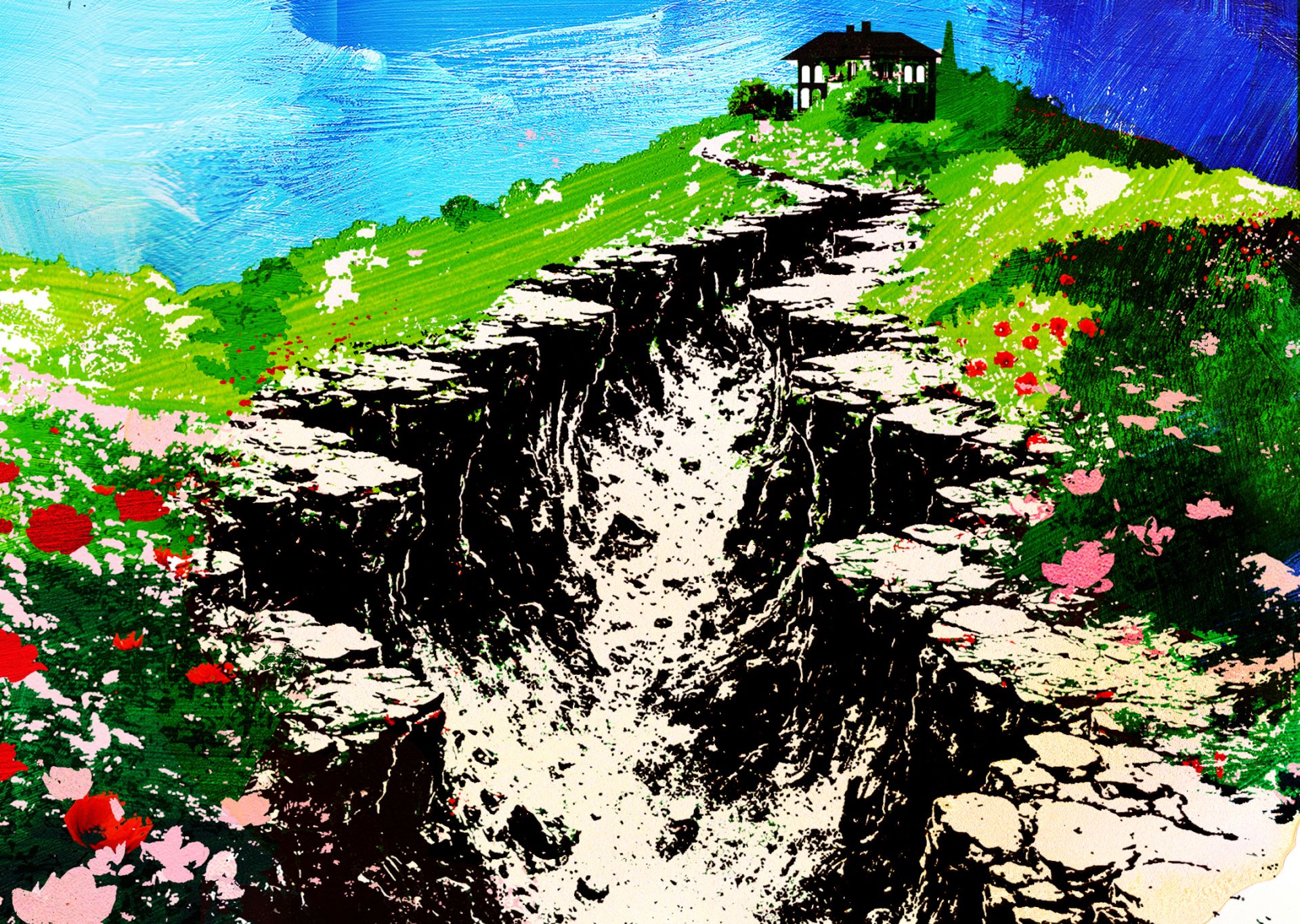
There is a patch of road snaking through Jabal Amel in southern Lebanon that makes you forget, briefly, what you were carrying when you got in the car.
In spring, the fields on either side of the road run riot with wildflowers, poppies and anemones pushing through the limestone, red and insistent. Cyclamens appear where the mountain closes in and the light turns cooler, tucked into shadow like something that prefers not to be seen. The warm air coming through the window smells of wild sage. The road narrows into sharp curves that ask for both hands, and you give them willingly, because this is the kind of beauty that makes demands.
The road descends toward the Litani River. Cross the bridge, and it climbs again. On one side, the mountain continues its ascent. On the other, an abyss. Across it, perched above the gorge on a sheer rock face a thousand feet above the river, is Beaufort Castle, or Qalaat al-Shaqif in Arabic, meaning castle of the high rock. The Crusaders who arrived in the 12th century called it Beau Fort: beautiful fortress. Different languages, the same observation. The castle has been held by Crusaders, Saladin, the PLO, Israel and Hezbollah. It has never been just a ruin.
At the bottom of the gorge is the Litani, the river that gives this region its shape.
Ahmad Kaabour, the Lebanese singer, songwriter and composer who died last month, spent his life mapping it differently. “Ya Rayeh Sawb Bladi” (“O You Who Are Going to My Country”) — one of his most famous songs, written during the civil war — sends greetings southward, toward the Litani, to the villages and people who live there. It is difficult to hear the song now without hearing how much has been stripped from that idea of the south, not only land, but meaning.
And the region has a name: “Bilad Bishara” (“Land of Good News”). Bishara in Arabic means exactly what the Greek word “euangelion” means — glad tidings, or the Gospel. People have been calling it that for centuries. You drive through the Land of Good News to get to Marjayoun.
I make this long drive from Beirut for a house perched on a small hill at the edge of the town, overlooking Mount Hermon. I have no roots here. I came to it the way you come to most things you end up keeping: through love, and then through what remains after.
That house sits south of the river, in the area of southern Lebanon that Israel occupied from 1978 until 2000. After the Gaza war started in October 2023, Hezbollah opened a front along the border, and the old geography of fear returned with it. A ceasefire took effect in late November 2024, but it never settled into peace. Israeli strikes continued, its soldiers remained in five positions along the border, and Hezbollah did not fully disarm as stipulated in the agreement. Last month, Israel told residents in the south to move north of the Litani. From my house, war looks like this: people killed, towns emptied, roads uncertain and ordinary life rewritten.
And in southern Lebanon, armies do not simply enter. They alter the imagination of return. Israel has now announced plans for a buffer zone south of the Litani, the same strip of land it previously occupied, the same land where the house sits. The zone would extend several miles deep, emptied of civilians and held indefinitely. Hezbollah’s weapons were supposed to prevent this. Instead, its decision to keep them, and to fire on March 2 in retaliation for Israel and America’s war on Iran and the killing of its supreme leader, gave Israel the pretext to formalize what had long been taking shape.
On a clear day, you can see the Israeli settlement of Metula from the house’s terrace. The house was built by my husband’s great-grandfather, who died eight years after he finished it, at 54. Eight decades later, my husband found it in ruin and restored it. He died four years after finishing the work, at 43.
During the first occupation, a man from a neighboring village who had been working with the Israeli army moved in. He knocked down an outside wall and turned one of the rooms into a garage. You can still see where the stones don’t quite match.
After my husband’s death, the house became mine to manage. He used to joke that he was the outsider here, born in Oklahoma City, Lebanese by ancestry and longing more than by any practical knowledge of how things worked, and I was the local, the one who knew which calls to make. I resented the inheritance of that work. There is a particular loneliness in caring for someone else’s dream: You love the person, but you’re always slightly outside it, pressing your face to the glass.
Since October 2023, the house has existed for me as a series of updates. A phone call to the caretaker, a brief answer, a hesitation on the line. I ask about the roof, the trees, the road. He tells me what he can. The rest is inference. Each call carries the same question I don’t ask directly: whether what I am trying to preserve is still there.
The question of what holds and what disappears is not only personal. It is also political.
Lebanon marks May 25 as Liberation Day, the date in 2000 when Israeli forces withdrew from the south after 22 years. The occupation ended. The weapons did not.
Prime Minister Rafiq al-Hariri had argued for years that this was how it would work: Remove the occupation, remove the cause, and disarmament would follow. He was not an idealist. He was rebuilding Beirut and understood that militias are not dismantled by confrontation but by irrelevance, by a state that functions well enough to make them beside the point. It was a theory of leverage more than idealism, and it was gaining ground. But it was also a threat. Hezbollah understood exactly what Hariri was building and what it would mean for them if he succeeded.
Israel’s withdrawal did not produce disarmament but a search for a new justification. Hezbollah found one in Shebaa Farms, a small, disputed strip of land at the edge of the Golan Heights, recognized by the United Nations as Syrian but claimed by Lebanon. A technicality became a cause, and so the argument for resistance did not disappear but was relocated.
After Hariri’s assassination in 2005, Lebanon had a brief moment that felt like an opportunity to rebuild a functioning state. Hundreds of thousands filled the streets in what became known as the Cedar Revolution. Syrian troops withdrew. And then the political class chose accommodation. In district after district, alliances were struck with Hezbollah, trading confrontation for seats, and what was presented as pragmatism soon hardened into structure. Representation became Cabinet presence, and Cabinet presence became veto power.
By May 2008, the logic was complete. Hezbollah turned its weapons on Beirut, not in resistance, but against Lebanese citizens and a government that had questioned its authority. The army declared neutrality and stood aside; Hezbollah took western Beirut in four days.
What Hezbollah built in the years that followed was not simply a militia that had survived its moment. It was a parallel system that required the weakness of the state it inhabited. It controlled the airport, the port, the border crossings, all vital to its operation. What enters the country, what leaves, what is taxed, what moves unseen.
There is anger among people from the south today at Israel’s bombs, at its presence, and at being reduced once again to terrain in a war beyond them. But there is also anger at Hezbollah from its own base. In videos on social media, many are accusing the party that claimed to defend and liberate the south of turning it into a permanent ground for someone else’s fight.
I want Hezbollah gone. I want it said plainly, because the rest of this argument can be misread. I want them gone because they hollowed out a state and called it resistance. Because they turned their weapons inward. Because they made sovereignty conditional. Because 4,000 Lebanese died in the last war. Because a young man, not much older than my son, who grew up in the south and had no other language handed to him, joined them. Because my house sits 5 miles from the border and I have not been able to go.
Hariri’s argument resurfaced after the November 2024 ceasefire: remove the occupation, remove the cause. But the history of the south suggests something else: The cause is never only removed but often replaced.
Israel’s justification for the aggression and the occupation is to disarm Hezbollah. But the instrument matters. An army that enters, that empties towns and formalizes buffer zones and lets its officials speak openly about biblical land claims, is not creating the conditions for disarmament. It is writing the argument for whatever reconstitutes from Hezbollah’s wreckage. The resistance narrative has always needed the occupation narrative. Feed one, and you feed both.
What tethers me to the house is not only love or obligation. My husband is buried in its garden, between two olive trees. It is the only place in Lebanon that holds any official record of his family’s presence there, not in documents, but in the ground. Lebanon does not pass citizenship through the mother, and his family had left before the state existed. Without his American passport, my son would have had no papers, no claim to the land. The house is what remains of their belonging to a place that has no other record of them.
I live in Cambridge, Massachusetts, but the plan was always to return once my son finishes school. Which means I am watching the violence from here with a particular helplessness that is different from ordinary distance. The people absorbing the consequences of both Hezbollah and the bombs are in Lebanon. I will be among them, eventually.
The house has outlived the men who built it and rebuilt it. That has always felt like a kind of promise. I am no longer sure what it promises.
I don’t know what condition it is in now; my caretaker has left the town. I don’t know what the trees look like this season, or whether the road that leads to it can still be taken. There are repairs waiting, as is the case with old houses. But the wait does not feel temporary anymore. It has started to feel like a way of measuring distance.
There is a line from Kaabour’s “Ya Rayeh Sawb Bladi,” written for this same stretch of land: “You who are going toward the Litani, carry my greetings.”
He spent his life singing about this land, its displacement, its stubbornness and its refusal to stop being loved by people who could not reach it. He is gone, and the song remains, and the south is again what it was when he wrote it: a place you ask a traveler to reach on your behalf, because you cannot go yourself.
It assumes visiting under occupation is possible. That the road holds, that there is a place to arrive, and people waiting to receive what is sent.
I find myself thinking about what happens to a place when even that becomes uncertain.
And so, I wait. To make the drive when the road opens. To take the curves with both hands, past the poppies and the anemones and the castle and the river at the bottom of the gorge, through the Land of Good News, until I arrive.
Become a member today to receive access to all our paywalled essays and the best of New Lines delivered to your inbox through our newsletters.