


The message arrived last summer during a visit to Tripoli. A close friend on Saif al-Islam Gadhafi’s political team approached me with a quiet instruction: “Your brother wants you to have a Telegram number.”
In the coded lexicon of the Libyan “Green” movement — those often silent parts of Libyan society still supporting a Gadhafi — “your brother” was the standard shorthand for Saif, just as it had once been for his father, Moammar. I created the account immediately and waited. Though we had met briefly in 2009 and 2010, I felt a professional necessity to see how 14 years of isolation had changed the man who was once the heir apparent.
A month before his assassination, the call finally came. “Are you prepared to visit your brother after tomorrow?” my friend asked. “Yes,” I replied.
We left at midday for Zintan. My friend had hired a driver who was a complete stranger — a layer of human camouflage to disguise our movements. I sat in the back in guarded silence, watching the barren land recede. This was once a green belt feeding Tripoli, but an invasion of cement had turned it into moving sand, leaving the city streets as dusty as if they were never paved. We turned toward the stark, rising silhouette of the Nafusa Mountains.
In Zintan, the atmosphere shifted to calculation. There were no GPS coordinates, only hushed phone calls for verbal directions to avoid a digital trail. We reached a modest rest area tucked away from the main road, where my friend dismissed the driver. Two men — Hassan and Mohamed — appeared as our car pulled away. Hassan wore the traditional white of the Libyan interior, while Mohamed was in jeans. Introductions were brief, stripped of titles or formalities.
They ushered us into a minimal reception room, with mats laid against the walls. I sat on the ground, waiting for Saif to materialize. Time in the Libyan desert doesn’t move like in Paris; it stretches. After 20 minutes of silence, the adrenaline faded into bone-deep exhaustion. I shed my “farmala” — an embroidered waistcoat — and lay down.
The irony wasn’t lost on me: I had traveled across continents to see the most wanted man in Libya, yet here I was, nearly asleep on a dusty floor. That stillness held until a whisper cut through my half-sleep: “Mustafa, wake up.” By the time I scrambled to my feet, Saif al-Islam was stepping across the threshold.
The lack of security was jarring. There were no metal detectors, and no one asked for our mobile phones — those “little devils” capable of summoning a drone strike. Yet here was a man defined by 14 years of evasion greeting us like a host at a casual retreat.
As we shook hands, I immediately felt the absence of the fingers on his right hand — the mark of the NATO rocket that found him in 2011. Before I could dwell on it, he pulled me into a deep embrace. “Of course I recognize him,” Saif smiled at my friend’s teasing, “despite the age.” He looked robust, his eyes carrying that old charismatic spark.
Still holding my hand, Saif led me out. “I am taking Mustafa with me,” he told my friend. “You ride in the other car.” As we drove into the vastness of the desert, I saw two Kalashnikovs on the seat to his left. Knowing I spend time in Paris, his focus soon shifted to global ironies: “What do you think will happen to Sarkozy?”
Only weeks earlier, the former French president had been convicted in a funding scandal, one that Saif first disclosed in 2011 during the NATO bombardment. We drove for an hour as the smooth hum of tires surrendered to the violent jolting of the desert track. Saif never spoke; no instructions were needed for this choreographed ritual.
We finally stopped in a shallow basin, sheltered by dunes and guarded by a lone, skeleton-white weeping broom tree (“ratam” in Arabic). There was no trace of human passage: no tracks, no litter, no spent shells. It was a pocket of the world that felt as though it had been waiting specifically for us.
Only then did I realize the second Toyota was a mobile kitchen, not just an escort. Hassan and Mohamed moved with a quiet efficiency that made my attempts to help look clumsy. “Do not,” my friend whispered as I reached for a crate. “They are professionals.”
Within minutes, a foldable table and chairs appeared, a gas stove was lit, and mats were rolled against the car to create a shaded lounge. It was a “last picnic” prepared with the eerie speed of a theater crew. We sat in the thin, silver shade of the lone ratam, my friend to my right and Saif directly facing me — a small island of domesticity in a sea of shifting sand.
In the still light of the afternoon, I truly looked at him. He was dressed for a casual outing: trousers and an undershirt in muted military tones, paired with heavy desert boots. As we stepped from the car, he had pulled on a boonie hat.
The sight was a jarring trip back to August 2011. He looked almost exactly as he did in those final images from Tripoli — leaning from a vehicle in olive-drab and camouflage. Yet, the continuity was fractured by what was absent: The expensive watch was gone, as were the fingers he once used to point toward a future that never arrived. “The engineer” was replaced by a hardened figure of the front lines, marked forever by the collapse of his world.
While the staff prepared lunch, I sat as a witness to “Green” continuity. Saif and my friend spoke in the shorthand of collaborators, an adviser briefing a superior. It was a stark reminder: While the world dismissed a ghost, here was a leader at the helm of a shadow state still breathing beneath the sand.
Saif suggested a walk. As we ascended a rugged hill, he kept me close, steadying me by the wrist as my expensive blue shoes — entirely the wrong choice for the “hamada” (rocky plateau) — suffered against the dry earth. At the ridge, a silhouette appeared. Saif asked with sharp curiosity: “What is that building?”
“An underground military warehouse,” Hassan replied, adding with nonchalance that it was the first depot they had looted when they were “mugharrar bihim” (duped). In the Gadhafi-era lexicon, the term referred to those led astray by propaganda. To hear a former Zintan rebel — one of the men who pillaged the state’s armories in 2011 — adopt this term while standing beside Saif was striking.
These men were no longer just guarding their former enemy; they were serving him, bound by a mutual sense of betrayal by the transition that followed. Yesterday’s existential enemies had become today’s indispensable allies. We turned west, walking toward the late afternoon sun, our shadows stretching across the desert until we circled back to the ratam where our journey began.
The walk was an arduous loop, much like the country’s own trajectory. When I questioned if the “Greens” remained a force, Saif stopped. With a joking smile that quickly turned to cold confidence, he added: “I can now move armored cars anywhere.”
Saif revealed he followed my work closely. In Libya’s fractured landscape, I am a recognizable face, often met in Tripoli with whispered warnings: “Be careful in this cursed land of the militias.” Standing in the hamada, I realized the binary of “Greens” versus “February” (supporters of the Feb. 17 revolution that overthrew Gadhafi) is a myth; the reality is a tangled web of shared histories. I have often argued that Saif was never a mere carbon copy of his father; even before 2011, he harbored misgivings about how the country was run.
By early evening, the desert was transformed. As Mohamed prepared rice and lamb, Saif stood at the edge of the basin, his gaze fixed on the sun’s crimson descent. “I love watching the sun set,” he murmured. In that light, he seemed less like a political heir and more like the painter he had once been — the artist outliving the politician.
While waiting for him to eat, I took two selfies against the dying sun. We avoided photographing one another, a silent agreement of the risks involved. In the desert, we were guests of a prince; on the road home, a single image with the “brother” would make us suspects for militias.
Only after the gold vanished did Saif join us. I watched him closely; despite the missing fingers on his right hand, he held his spoon firmly. It was the grip of a hand once destined to sign national decrees, now used simply to sustain its owner.
As we sipped tea, Saif pushed sand over the dying embers until the camp vanished. He beckoned my friend for a whispered exchange. In the twilight, the “brother” was replaced by the strategist. While the world treated him as a phantom, I suspected these whispers concerned the United Nations Support Mission in Libya’s “structured dialogue,” in which his advisers were then actively participating.
The contrast was profound: a man under an International Criminal Court warrant, standing by a ratam tree, micromanaging his team’s role in the U.N. peace process. He was negotiating Libya’s future from a mobile office of sand. The fugitive and the architect had become one.
The farewell was swift. As we turned back, I watched his red taillights lead us through the darkening dunes. He was going home — wherever that was. We eventually met our original driver, our “human camouflage,” at a Zintan roundabout. He had waited in total ignorance of where we had truly been.
Returning to Tripoli, the silence grew heavy. We left the clarity of the desert for the murky, militia-choked reality of the capital. We were back in the world of masks, leaving the “brother” behind in the shifting sands.
On Feb. 3, 2026, this “last picnic” was still settling in my memory when my nephew called. “He is dead,” he said. The news paralyzed me. The man I had embraced weeks earlier had been shot. In Libya’s information vacuum, I spent the afternoon in a fever of seeking confirmation, desperately trying to prove my grief wrong.
By evening, grief took a sharp political shape. The family made a symbolic decision: Saif would not be buried in Sirte. With Moammar Gadhafi’s grave still a state secret, Sirte was deemed too vulnerable to militia desecration. Reportedly, Khalifa Haftar, who rules much of eastern Libya in opposition to the U.N.-backed government in Tripoli, set unacceptable conditions for a burial there. By choosing Bani Walid — the “Warfalla fortress” that shielded him in 2011 — they placed Saif with the tribe that never wavered.
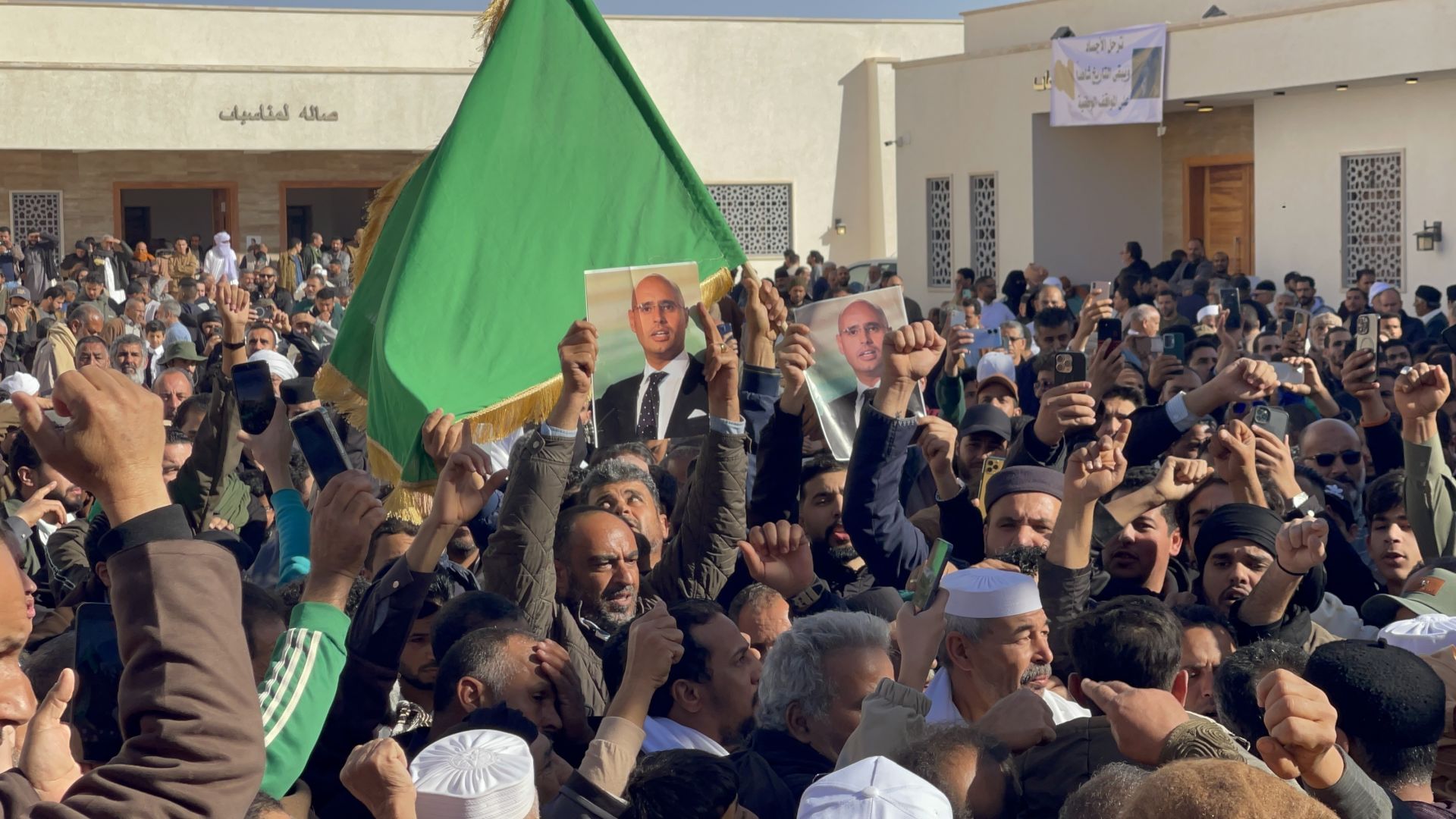
The man once under a death sentence in Zintan was now, in death, commanding a massive mobilization toward the valley. When I reached the northern entrance of Bani Walid on Feb. 6, the city had transformed. Towering over the road was a massive billboard of the “martyrs”: Moammar Gadhafi, Saddam Hussein and Saif’s brothers, Khamis and Mutassim. In this stronghold, these are icons of resistance. The air was thick with the collective breath of tens of thousands. In a country where “Green” identity had been suppressed for 15 years, this was more than a funeral; it was a massive, silent referendum.
The atmosphere was charged with the theater of the dead. Because Moammar’s grave remains a secret, many refused to believe Saif was truly gone. To prevent a riot of disbelief, a small group of dignitaries entered the morgue, returning to the masses with a grim confirmation: It was indeed him.
A man nearby, his face etched by the desert, whispered the essence of the day: “We were denied the right to say farewell to the father. Now, we have come for both.” The man I had sat with under the ratam tree was gone, replaced by a vessel for a generation’s unvented sorrows.
The “janazah” (funeral service and prayer) was performed at the Bani Walid airport — the only space large enough for the attendees. Afterward, a 6-mile caravan of dust and defiance wound through the rugged valley toward Al-Manasla Cemetery. This is sacred ground, home to the shrine of Saif’s great-grandfather. Though authorities urged the crowds to disperse, hundreds pushed forward to the very edge of the valley where the graves are perched.
Amid the crowd, I found my high school friend, Ahmed. As we stood among the headstones, he leaned in, whispering a decade-old secret. Pointing to a nondescript plot, he revealed it was the grave of Khamis Gadhafi, buried there as the city fell in 2011. To protect the body from the desecration that befell his father, the defenders of Bani Walid had dug a decoy grave inside the shrine, while burying Khamis outside — hidden in plain sight. In Libya, even the earth is a lie told to protect the truth.
As the crowd pressed toward the open earth, the final irony was laid bare. I watched as Ajmi al-Atiri descended into the soil to receive the body. A general of the 2011 revolution, al-Atiri was the man who had captured Saif in the desert 15 years earlier. Having intercepted him in the dunes, he had spent over a decade serving as Saif’s guardian against the shifting tides of vengeance.
Ahmed — himself a victim of militia imprisonment in 2011 — watched with weary realization. As if speaking to the general in the pit, he whispered: “Bury it, Ajmi; bury February in its final resting place.” To see Saif’s former captor acting as his final guardian, cradling him into the earth, was to witness the complicated soul of Libya. In that grave, the failures of the revolution were buried alongside the man.
The funeral‚ the referendum, was over. As the first shovels of dirt fell, the man I had shared a meal with beside the ratam tree was gone, returned to the valley that shielded him in life and would now hide him in death.
The international community may fret over “structured dialogues,” but the reality of Libya remains here, in the dust of Al-Manasla. It is a country of secrets, decoy graves and enemies who become brothers in tragedy. As green flags fluttered in the cooling air, I left knowing that while the “brother” was at rest, the country was still wandering. We had buried a man, but whether we had buried the ghosts of February remained to be seen. The desert had closed its hand.
Today, a haunting question looms: What becomes of this mass of support? Saif’s failure was neglecting to build a formal political structure. Now, the leadership is wide open. There is talk in Bani Walid of a delegation to Oman to ask Aisha Gadhafi, Saif’s sister, if the family will still “carry the torch.”
Yet even as the political future remains a desert mirage, the legal response has been uncharacteristically swift. In a country where assassinations are typically met with a silence that lasts until they are forgotten, Libya’s prosecutor-general has already issued arrest warrants for three suspects. Though no names or photographs have been released, the speed of this move — coming just a month after the shooting — is a startling achievement given Libya’s shambolic policing. It suggests that, for once, the standing of the victim is too great for the state to allow the case to simply vanish into the sand.
Meanwhile, the influence of Gadhafi-era figures imprisoned in Misrata since 2011 weighs heavily. Amid this, the valley’s youth — disadvantaged and angry — sense a plot to exclude them. They have paid too high a price to be sidelined now. Nothing, they insist, should be decided without them.
Become a member today to receive access to all our paywalled essays and the best of New Lines delivered to your inbox through our newsletters.