



In the 1830s, American painter Thomas Cole created a series of five paintings, “The Course of Empire,” to depict a civilization’s arc from its pastoral beginnings to imperial glory and then to ruin. Cole’s series, comprising “The Savage State,” “The Pastoral State,” “The Consummation of Empire,” “Destruction” and “Desolation,” was a grand allegory of how power leads to decadence and collapse. It was intended as a warning that even the mightiest empires can decay through hubris. Drawing inspiration from the fall of Rome and anxieties about his own young country’s future, Cole believed that “nations have risen from the savage state to that of power and glory, and then fallen, and become extinct.”
Today, across cities like Cairo, Bethlehem and Amman, street walls perform a civic function not unlike the one Thomas Cole once attempted on canvas. If Cole staged his cautionary tale for elite audiences in galleries, Middle Eastern graffiti sets its stage in the open air, for the masses. One is preserved behind velvet ropes as “high” art, the other dismissed as ephemeral or “low,” yet the divide is largely artificial. Both forms take the moral temperature of their times, capturing the pulse of civilization and its fragility in vivid imagery. Cole’s “Course of Empire” warned against the excesses and cycles of power; today’s street artists use concrete and spray paint to voice hopes and fears that might otherwise go unheard. When the space for public speech shrinks, the mirror simply moves from canvas to concrete, but the haunting question remains the same: What is the fate of our society, and will we heed its warnings?
In places where politics constricts the public sphere, graffiti carries a weight beyond aesthetics. Egyptian artist Ganzeer (Mohamed Fahmy), who rose to international prominence during Egypt’s 2011 revolution for his politically charged street art, noted that he “chose graffiti over other types of artistic expression because there was a need for alternative media. … Uncensored street art is the only way we can tell our story.” Shortly after Hosni Mubarak’s fall, Ganzeer painted a mural in downtown Cairo showing a lone boy on a bicycle, clutching bread, confronting a looming military tank — a simple but searing image of civilian life standing up to entrenched power. In other words, when official channels fail or censor the truth, “low” art rises to fulfill the classic role of “high” art, bearing witness and speaking truth to power. The venue and style may differ, but the underlying purpose converges. Cole’s refined allegories and a protest stencil on a wall both ask their viewers to contemplate the state of the world and the fate that awaits if we continue on our current path. Yet there is a crucial difference. Graffiti emerges in moments of intense political uncertainty, when the end is not yet known, whereas Cole painted with the benefit of historical distance, centuries after Rome’s fall.
That immediacy also shapes how street art is received over time. What begins as “low” art can later become celebrated as history. A painting in a gallery and a mural in the street can each become a cultural touchstone, treasured for capturing a pivotal moment or truth. In fact, the immediacy of street art, its ability to appear overnight in response to events, gives it a raw potency that even the finest oil painting may lack. This is where the abstract argument about “high” and “low” art collides with lived history. Across the Middle East, city walls have become open-air archives of dissent and hope. From Cairo’s revolutionary boulevards to the vast concrete barrier dissecting the West Bank and reclaimed as a canvas of resistance, to Amman’s stairways alive with cultural commentary, all these spaces show how art beyond the museum can shoulder the same prophetic weight that Cole once carried on canvas.
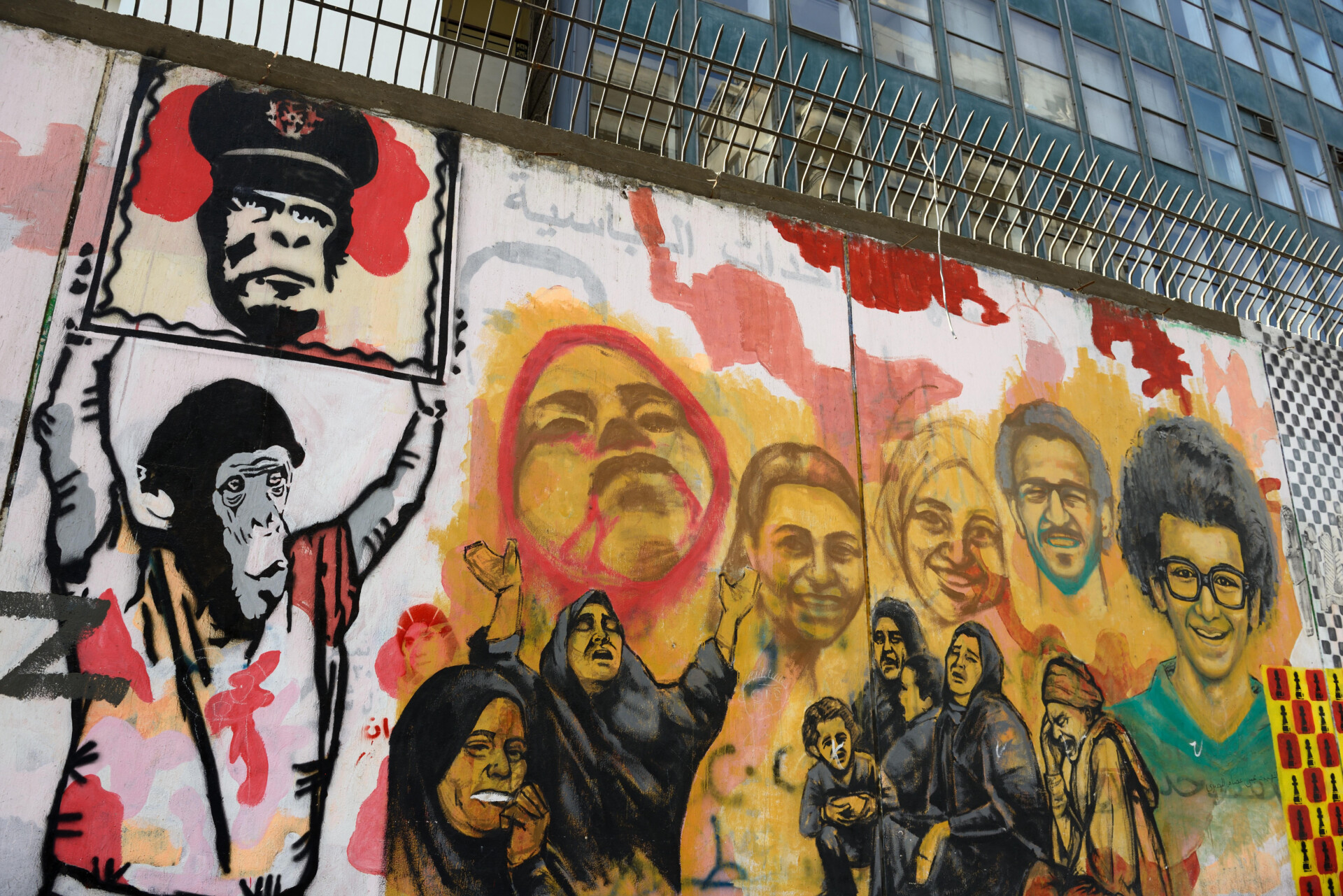
When mass protests erupted against Mubarak’s regime in 2011, the blank walls of downtown Cairo became a spontaneous newspaper and memorial for the people. Nowhere was this more true than on Mohamed Mahmoud Street, just off Tahrir Square, where some of the fiercest street battles between protesters and security forces occurred. What began as simple spray-painted warnings to fellow protesters (“Don’t go down this street, there are thugs here!”) soon evolved into elaborate murals chronicling the revolution’s unfolding story in real time.
The history of the uprising was literally drawn on the walls: portraits of martyrs with angel wings, pharaonic motifs casting modern tyrants as ancient villains, images of protesters with eyes bandaged after being blinded by rubber bullets. These paintings turned Mohamed Mahmoud Street into a public gallery that expanded with each clash and each loss. When security forces killed or maimed protesters, artists responded within hours; when officials painted the walls over in whitewash, students and activists returned by night to restore the memory. Layer by layer, the surface became a testimony of grief, rage and fragile hope. Authorities tried repeatedly to erase it by repainting, even demolishing sections outright, but each erasure only provoked renewal. In this way, the wall refused to stay silent, teaching passersby that public space could remember even when those in power wished to forget.
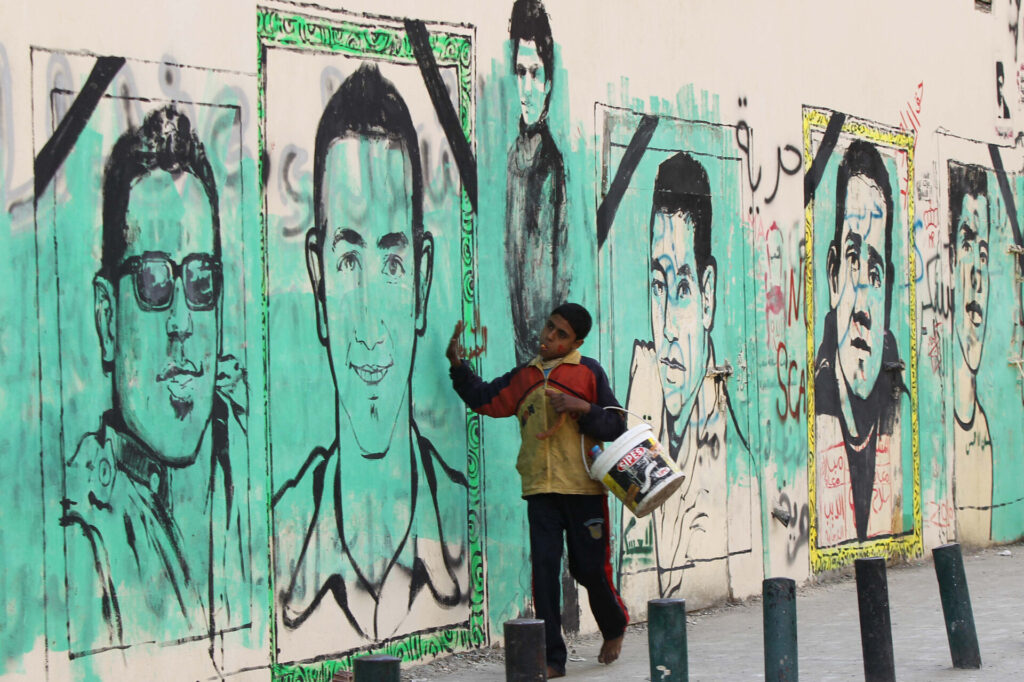
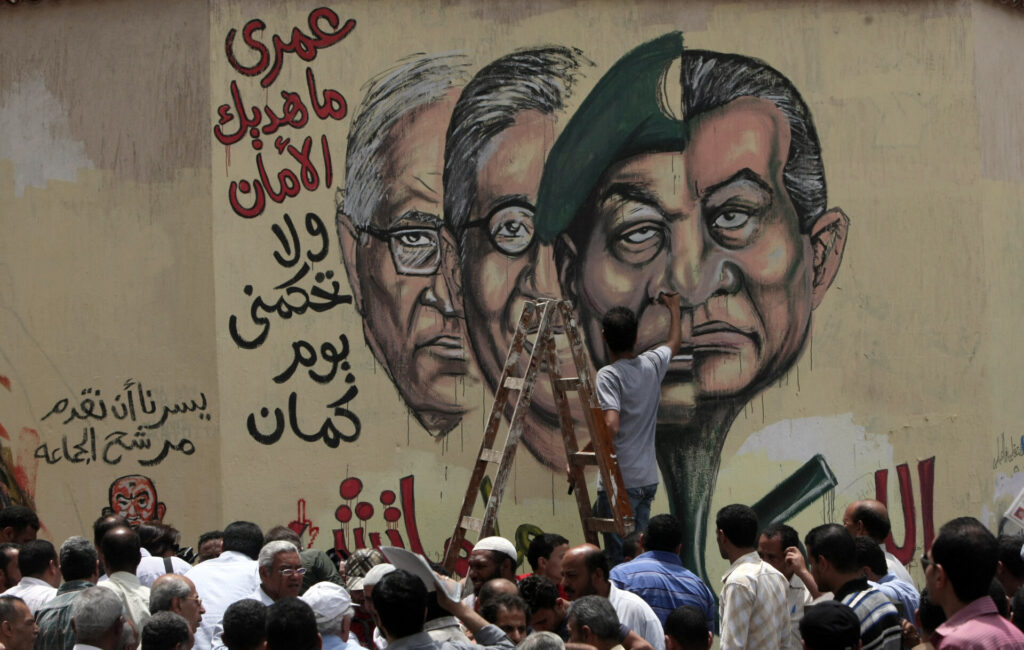
The revolution’s wall art voiced anger, not only at local tyranny, but at the broader structures that seemed to uphold it. While most murals focused squarely on domestic repression, the police, the military council and the continuity of authoritarian rule, many protesters understood these forces as entangled with international alliances and foreign support. On the walls, artists captured something more immediate and visceral: the sense that Mubarak’s downfall had not dismantled the system that sustained him. One of the most iconic murals on Mohamed Mahmoud Street split a single face into two halves, Mubarak on one side and Field Marshal Mohammed Hussein Tantawi, the military ruler who succeeded him, on the other. The message was clear. The revolution had removed a man, but not the machinery of power. In this way, the art sharpened the feeling that Egyptians were confronting, not just an individual dictator, but an entrenched structure, one fortified at home and, in the eyes of many protesters, reinforced from abroad.
The wall’s first rough warnings, arrows, stick figures and danger signs mirror the raw imagery of Cole’s opening canvases, where a young society first claims space and senses approaching change. The euphoric moment of Mubarak’s fall recalls the “Consummation” of people power. The violent crackdowns and state whitewashing feel like Cole’s “Destruction,” while today’s muted, controlled streets resemble his final “Desolation.” Yet unlike Cole’s static, museum-bound prophecy, Cairo’s murals continue to rewrite themselves. They belong to the people who fought and mourned there, keeping memory alive on concrete rather than canvas — in part because the gains of the revolution felt fragile, and the walls became a way to record what had been done and what was still being claimed before it could be undone.
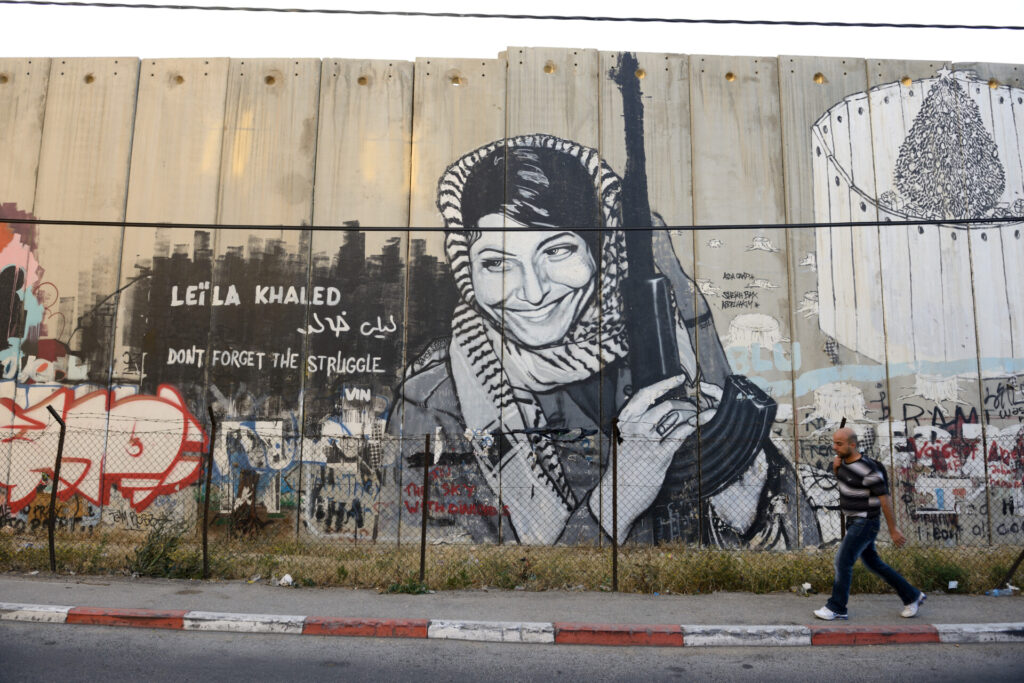
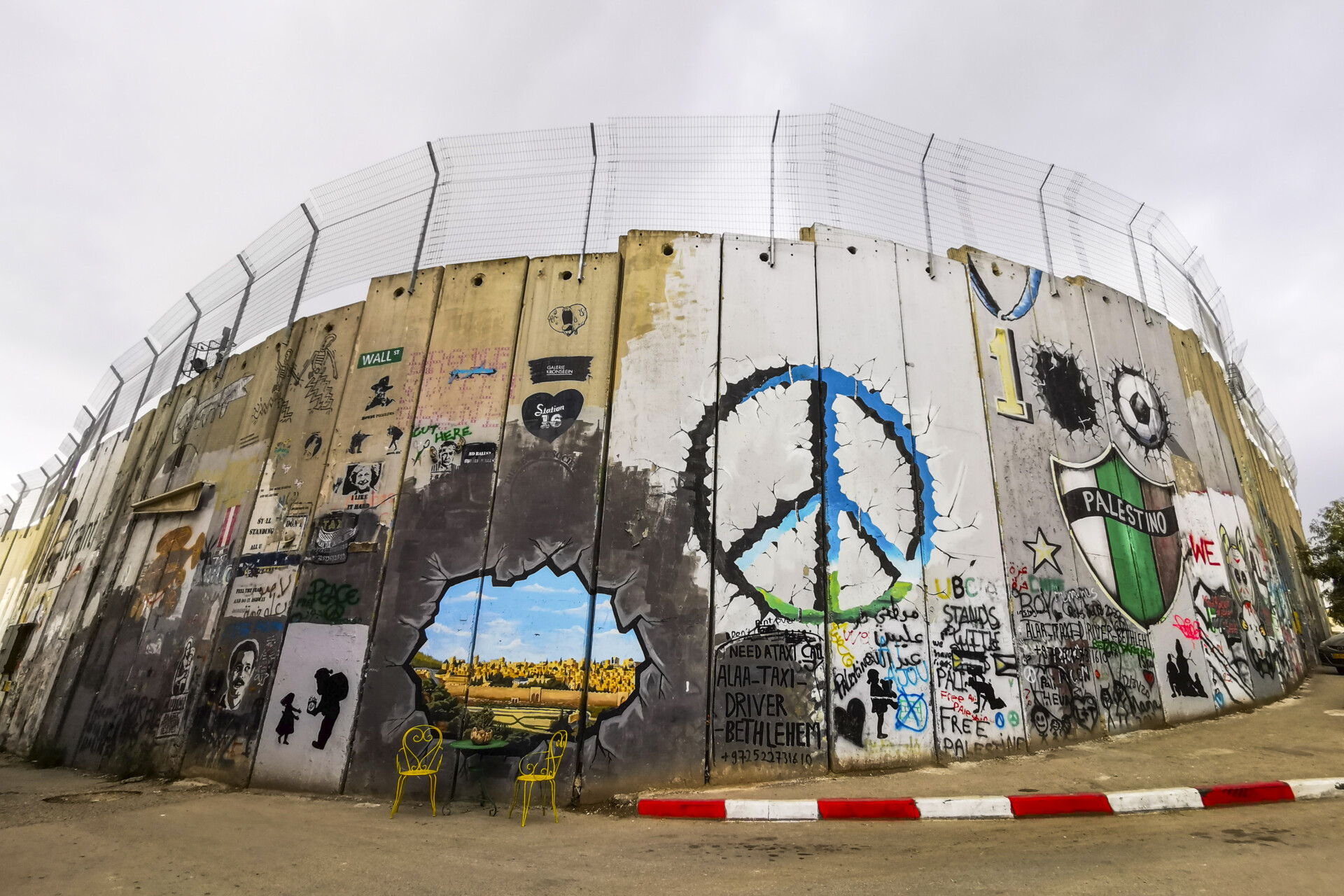
Perhaps nowhere is the power of graffiti to confront entrenched power more literal than on Israel’s West Bank barrier, often referred to as the “Apartheid Wall.” The vast concrete fortification winds for hundreds of miles through hills once lined with olive groves. It cuts through towns, fields and families, representing part of what architect Eyal Weizman calls an “architecture of control” imposed on the landscape. But what was meant to divide has become a vast, ungoverned gallery. Over two decades, Palestinians and visiting artists have covered its surface with color and defiance, transforming concrete into testimony.
Some of the most powerful images on this wall are not abstract slogans but enduring symbols of memory and return. Handala, the barefoot boy created by the Palestinian artist Naji al-Ali, appears again and again, his hands clasped behind his back as a symbol of political resignation in the region. Painted against the cracks of the wall, he becomes the child witness of an empire’s shadow, much like the canvases depicted in the earlier stages of Cole’s cycle, where innocence and landscape coexist before the arrival of conquest.
Images of keys and ladders occur again and again — old brass keys, symbols of homes left behind in 1948, and ladders propped toward the unreachable sky. They also echo Cole’s cyclical vision: Even after imperial grandeur and ruin, there is a desire to return and to rebuild. Other murals attempt to reclaim the very horizon this wall obscured. Banksy’s famous trompe l’oeil windows pierce the wall with the illusion of a crack revealing open sea, children digging toward a beach, a hole through which blue sky gleams. These scenes gesture toward the lost Arcadia, the pastoral calm that Cole painted before the empire’s rise. In Cole’s world, civilization’s walls rose to frame nature; here, art reopens them. What the painter in the 1830s warned against, the graffiti artist now undoes layer by layer, illusion by illusion, reminding viewers that the landscape still breathes beyond the wall.
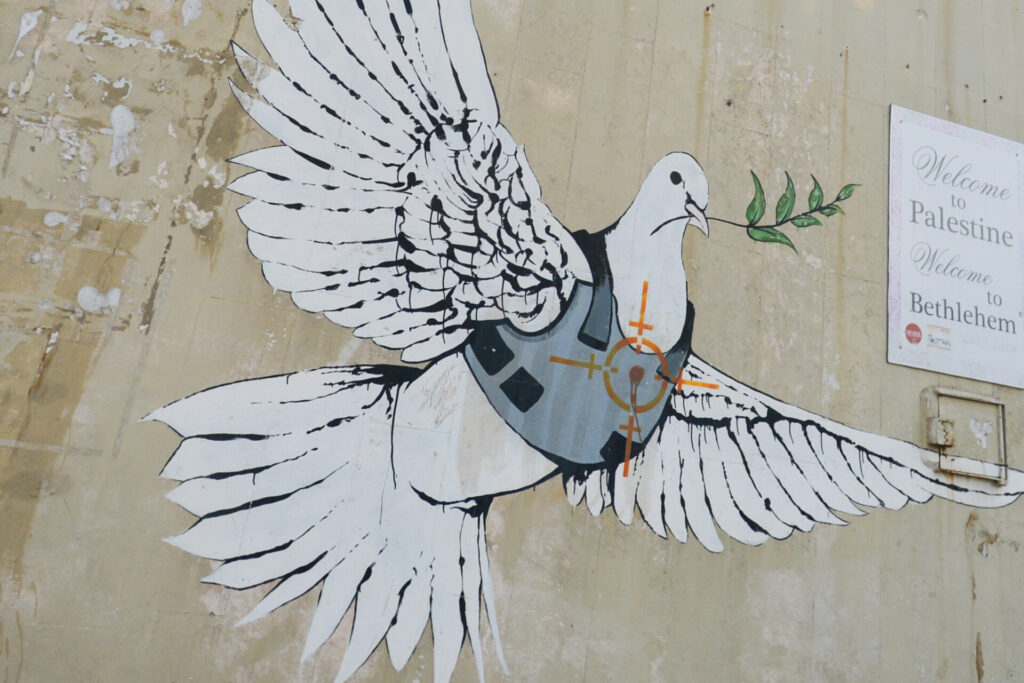
But not all the wall’s art dreams of peace. Banksy’s “Armored Dove,” a white dove in a flak jacket marked by a sniper’s red crosshair, captures the grim paradox of the present: Even peace must wear armor. The image recalls scenes of fire and silence from Cole’s “Destruction” and “Desolation,” in which peace survives only as a distant memory. Here, too, the dove’s vest mocks the empire’s logic of “security,” suggesting that the age of peace has transformed into an age of fear. Yet for all its grief, the wall blooms with human color. Graffiti of vines, flowers and children’s faces bleed through the gray, insisting that memory and life can outlast control. In English, Arabic and French, slogans call out, not only to Israel, but to the powers behind it, the alliances and aid that sustain occupation. It is a subtle echo of Cole’s own anxiety that his young America might become the very empire it once defied.
Through images like Handala, the keys and ladders, the trompe l’oeil vistas and the armored dove, the wall has been reimagined as a sprawling mural of resistance and remembrance. These artworks subtly weave together themes of “sumud” (steadfast resilience), memory and loss, along with a defiant critique of empire, old and new. Their effect is similar to that of a modern, living extension of Cole’s insights, a reminder that wherever walls rise and empires intrude upon everyday life, art will surface as a force that preserves hope, calls for justice and insists on humanity’s capacity to reclaim space. That many of these works remain unsigned is no accident. Anonymity protects their creators, for naming oneself can carry real risk, and the wall speaks less in individual voices than as a collective record of endurance.
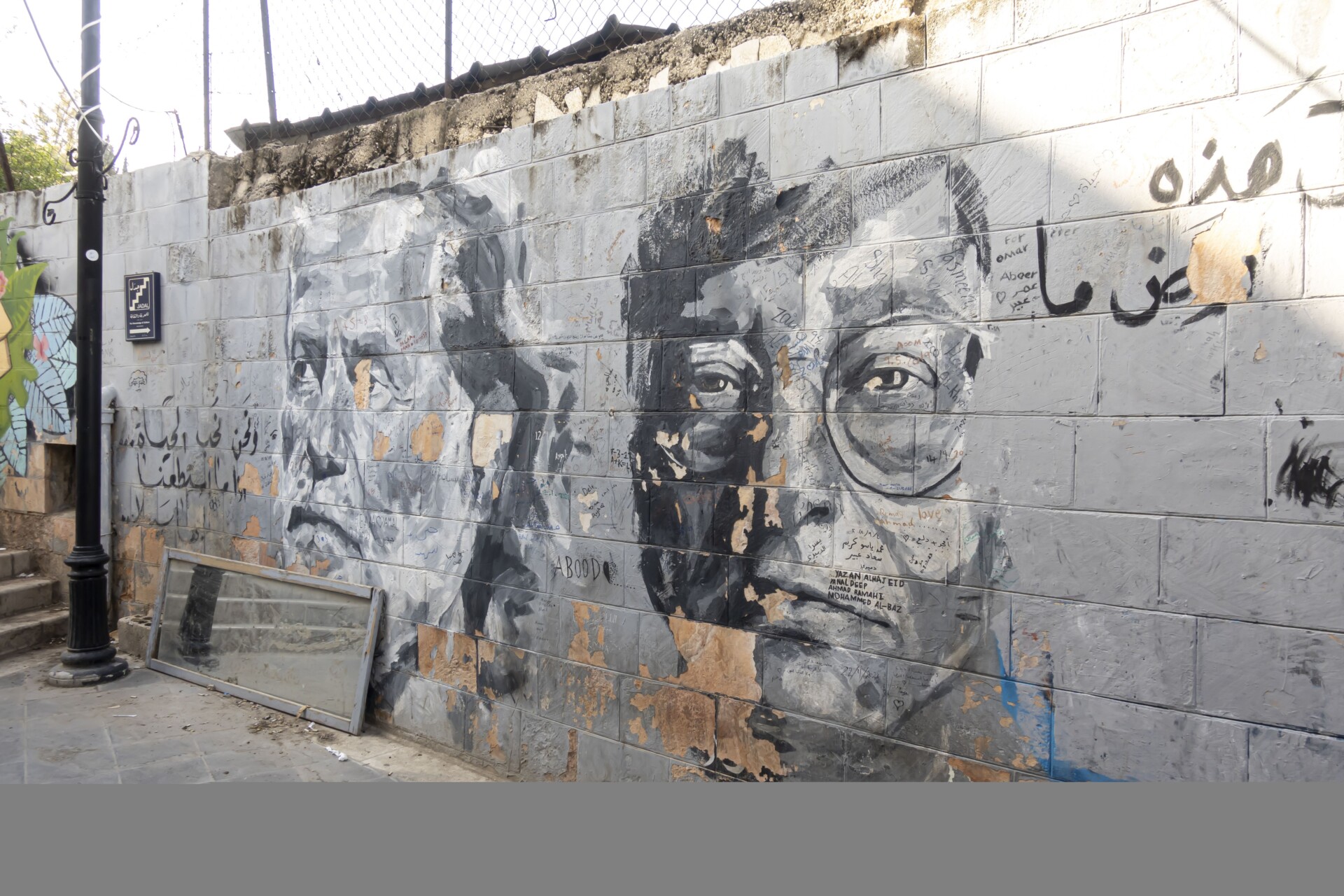
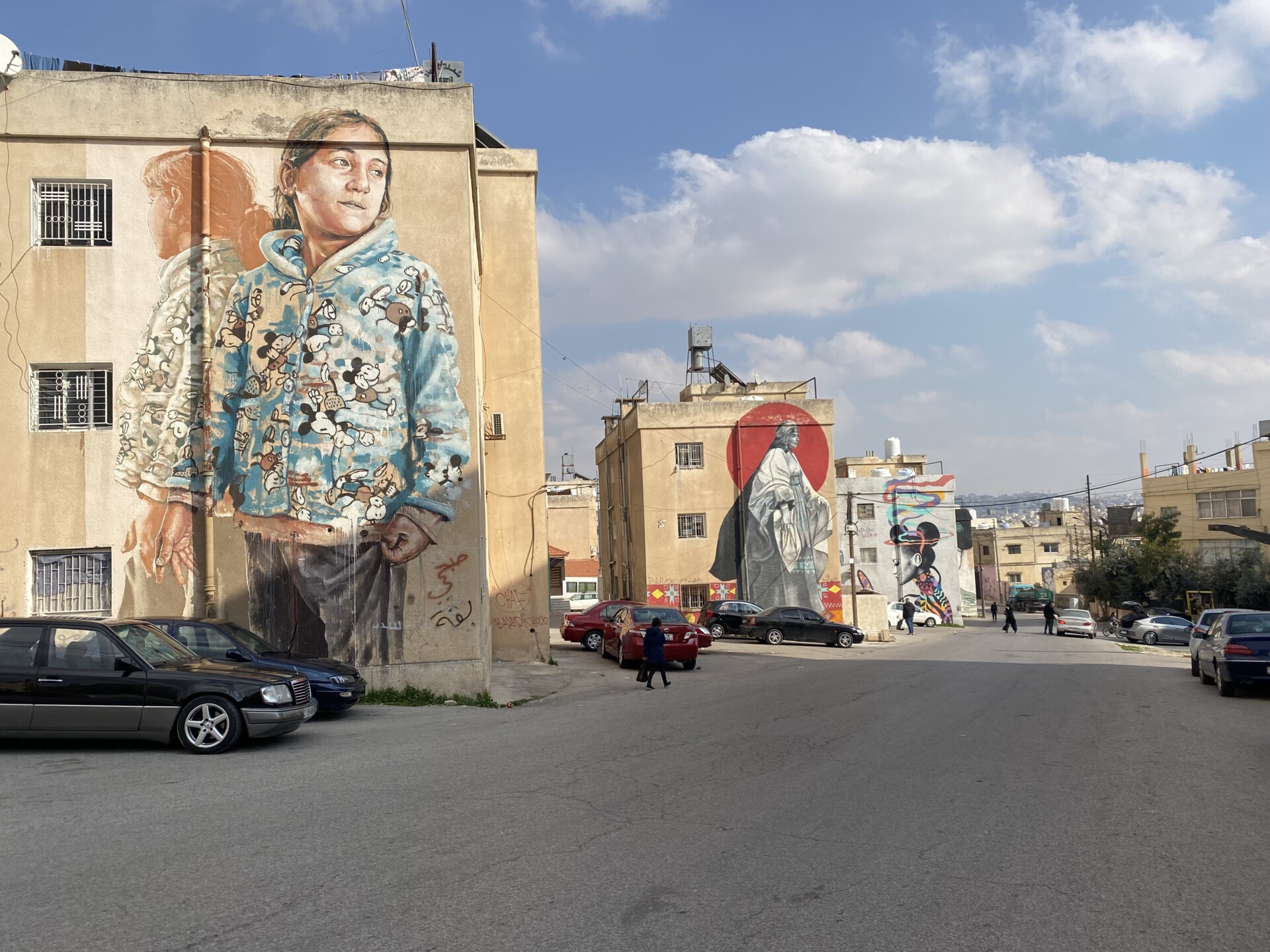
In the heart of Amman, this human habit of reclaiming space is brought to life in a steep outdoor staircase. The Al-Kalha stairs at the center of Jordan’s capital have been transformed into a vibrant gallery of history and identity. The stairs stand as one of the city’s oldest passageways linking the downtown market with the historic Jabal al-Weibdeh neighborhood. It is a living canvas that citizens climb every day. Murals of poets, film stars and folk heroes line the walls flanking each step. Short Arabic phrases meaning “We are here” or “The city is ours” appear beside portraits and bursts of color, small declarations of belonging that give the space a communal voice. What was once a dull, neglected stairway is now a shared storybook of Jordan’s culture — layered, rewritten and expanded in paint with each new artist’s contribution.
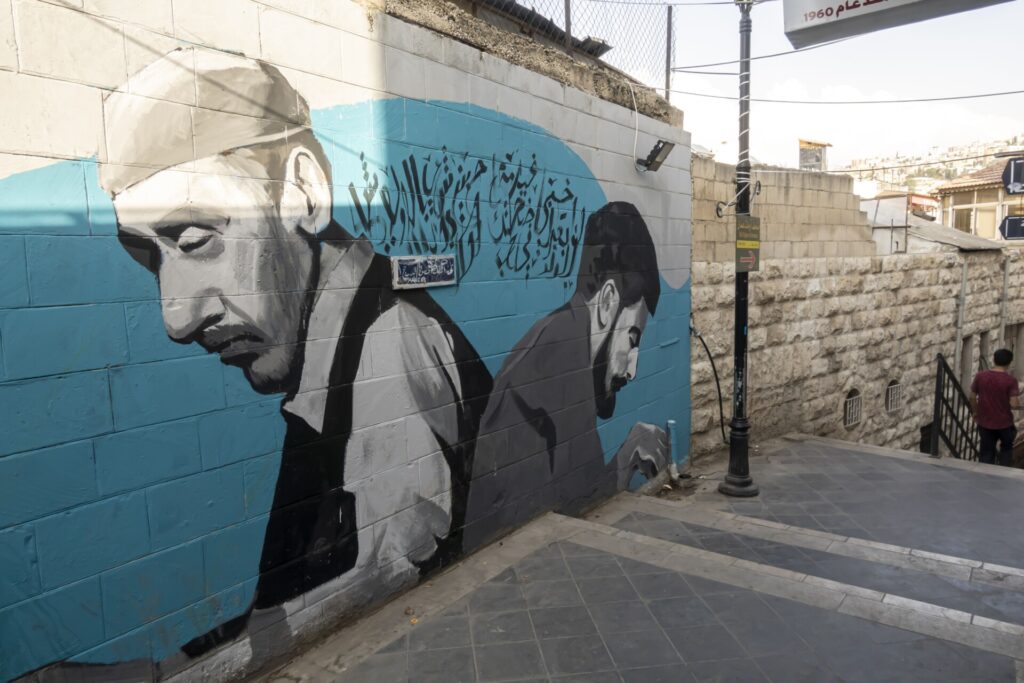
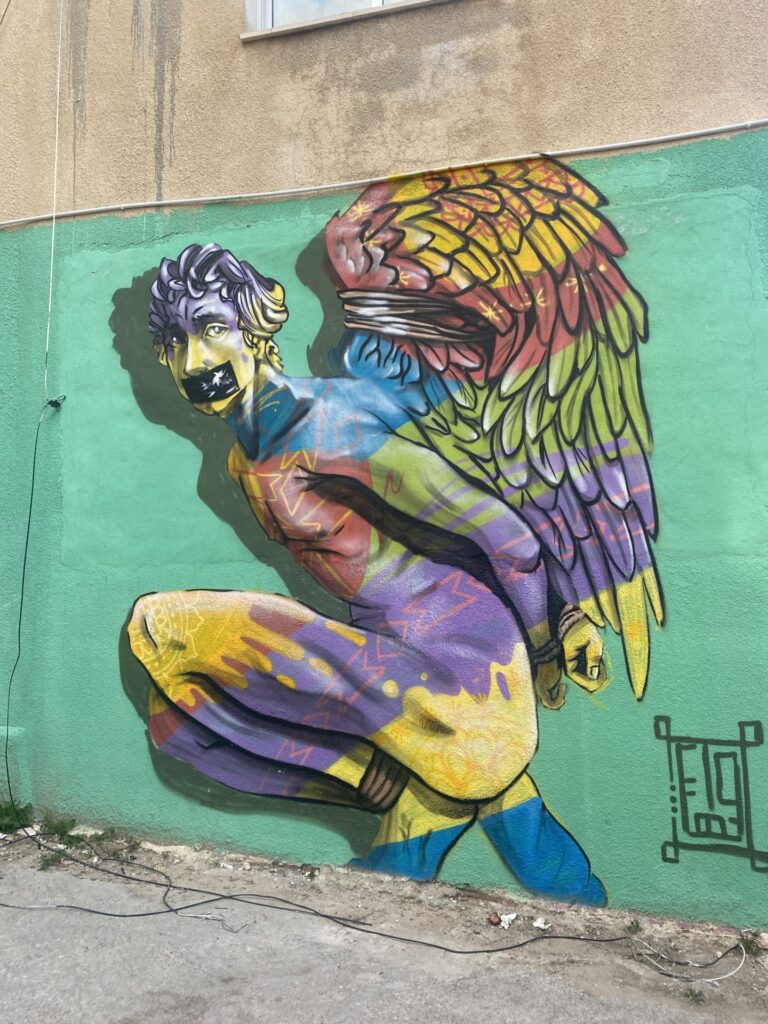
The art on the Al-Kalha stairs rarely shouts in open defiance. It doesn’t need to. At first glance, the tone is celebratory and nostalgic. Gentle portraits of beloved figures like the late Palestinian poet Mahmoud Darwish grace the walls, alongside playful imagery like angel wings painted for passersby to pose between. It’s easy on the eyes. Yet these murals are not naive about their setting. Jordan’s political space remains tightly managed by a monarchy long supported by Western powers. The country is a key U.S. ally in the Middle East. So beneath the cheerful colors on the stairway runs the quiet undercurrent of an anti-imperial narrative. Some murals subtly honor Palestine (Darwish’s verses or a map of pre-1948 Palestine), nodding to the majority of Jordan’s population. Other images remix colonial symbols: In one spot, a uniformed British Mandate-era bagpiper is painted with street-art swagger, reclaiming a military image once tied to foreign rule (Jordanians have ironically adopted the Scottish bagpipe, introduced by British forces in the 1920s, and made it part of their own tradition). And mixed among the images, brief stenciled phrases like “We remember” and “Still here” gesture toward persistence and rootedness in a region shaped by displacement and external power.
Jordan may sit in the shadow of colonial history and modern geopolitical influence, but this humble stairway declares a quiet cultural independence. Even the decision to beautify a once-neglected public staircase is a statement of agency. Every brushstroke says that this city is the residents’ to decorate and define, even though its borders and institutions were drawn by outsiders. It’s a softer but potent answer to Cole’s warning, insisting on the possibility of another future or an alternate ending to the cycle of empire.
The connection to Cole’s “Course of Empire” here is more subtle, yet still evocative. Cole’s series charted a landscape’s evolution from an untouched arcadia to the height of imperial grandeur and then to ruins. Amman’s Al-Kalha stairs present an inverse of that tale: a previously neglected urban space reborn as a communal art haven, a place where creativity triumphs over decay. Rather than glorifying emperors or battles, the murals on these steps elevate everyday cultural heroes and ideas. It’s almost a rejection of the imperial narrative of “glory.” In “The Consummation of Empire,” Cole painted a metropolis at its peak, crowded with monuments to showcase power. On Amman’s stairs, the “consummation” we see is a flowering of public art, a peak of shared creative energy rather than domination. The values of resilience, memory and solidarity celebrated here stand in contrast to the hubris that Cole warned would doom empires.
In one panel of Cole’s series, “The Pastoral State,” simple villagers live in harmony with nature, unaware of the grand empire to come. On the Al-Kalha steps, one can sense a modern pastoral vibe amid the city’s bustle — people lingering at a book stall by a mural, neighbors chatting on the steps, children adding their names in paint on a side wall. It’s a scene of ordinary life and grassroots expression flourishing in the shadow of the old imperial architecture of Roman, Ottoman and British-era buildings visible all around the city. Amman, just like Jordan’s borders, was shaped by colonial decisions, but the focus of the art is on claiming the present and future. In doing so, the city’s street artists answer the same question Cole posed about the fate of societies. Their answer is optimistic: Instead of awaiting ruin, they choose to create and rejuvenate. The “course of empire” in Amman is not a rise-and-fall cycle told in oil paint, but a cycle of continuous reinvention told in spray paint. And that, perhaps, is its own quiet revolution.
Nearly two centuries after Cole warned of the rise and ruin of empires, the arc he depicted is being reimagined across city walls. Cairo condenses that cycle into a single street, where hope, repression and remembrance are layered almost on top of one another. The West Bank confronts pastoral loss head-on, carving holes into an “architecture of control” to resist desolation. And in Amman, a neglected staircase offers a quieter answer, turning communal creativity into its own kind of consummation. Seen together, these sites offer more than a snapshot of a region; they represent alternative endings to Cole’s prophecy. They suggest that the measure of a civilization lies, not in its monuments, but in the people who insist on being seen, claiming space, remembering what was taken and painting themselves back into the landscape.
The task of holding a mirror to civilization has truly slipped out of gilded frames and onto concrete and stone. The medium may differ — oil pigment or aerosol, gallery or street — but the message echoed across time and space feels eerily consistent. These modern murals underscore a powerful truth about empire and memory. Empires always believe their monuments will last forever, but ultimately, it is the art, the stories and warnings expressed in paint that endure. The course of the empire is still being painted, not just by master artists in studios, but by ordinary people in the streets armed with truth and color. The only question is: Are we looking closely enough?
Sign up to our mailing list to receive our stories in your inbox.