


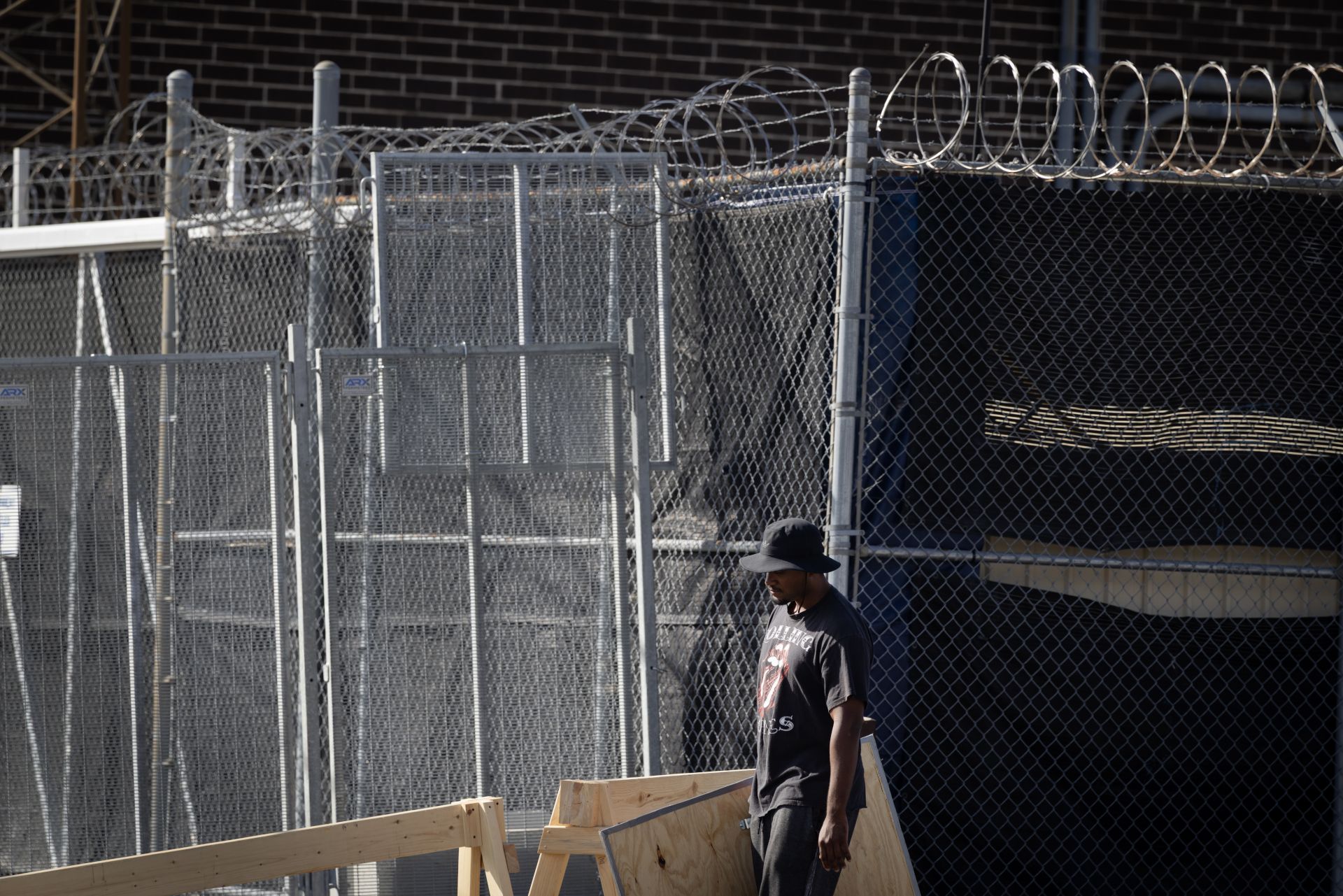
In late December and early January, the Trump administration transferred roughly 50 Cuban men from Immigration and Customs Enforcement (ICE) detention centers in the United States to the U.S. naval base in Guantanamo Bay, Cuba. These men had been held in Florida, Georgia, Louisiana and Texas, and Department of Homeland Security officials stated that the group included people who had “criminal histories.” At least some of these men had decided to “self-deport” and return to Cuba rather than continue suffering in ICE facilities. According to New York Times reporter Carol Rosenberg, many thought they were returning to Havana. Instead, they landed at Guantanamo Bay. Due to “an undisclosed maintenance problem” in other facilities on the base, the U.S. government housed them in a prison that once held al Qaeda suspects. Then, in early February, the Department of Homeland Security abruptly transferred these Cuban men to an ICE detention center in Mississippi.
It seems like a cruel irony that Cuban migrants in the United States were jailed at the naval base in Guantanamo Bay. After 9/11, the base became synonymous with the excesses of the “war on terror,” torture, unchecked executive power and the violation of rights. More than 20 years after the attacks of Sept. 11, 2001, the U.S. is weaponizing the legal and political apparatus it forged during the war on terror as part of its campaign against migrants in the United States.
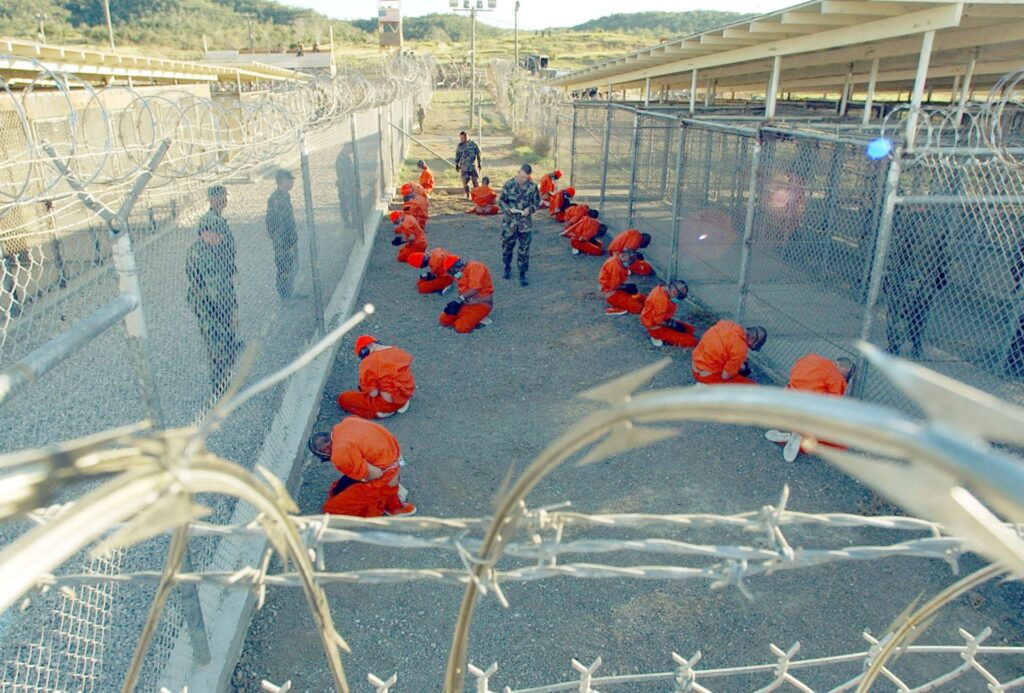
In January 2002, the U.S. transferred 20 men it had captured in the war in Afghanistan and flew them all the way to Guantanamo Bay in the Caribbean. The men were photographed shackled, dressed in bright orange jumpsuits and kneeling abjectly behind barbed-wire fences. Alleging that they were dangerous al Qaeda and Taliban members, the U.S. classified them as “enemy combatants” rather than prisoners of war to get around Geneva Convention protections. From the earliest days, human rights attorneys and activists called Guantanamo Bay a “legal black hole.”
The base’s legal ambiguity goes back to its 19th-century origins and U.S. imperial ambitions. U.S. Marines landed in Guantanamo Bay in 1898 during the Spanish-American War. Spain’s subsequent defeat signaled the rise of U.S. military power. The United States gained control over Cuba, the Philippines, Puerto Rico and Guam through the Treaty of Paris. Rather than independence, the Cubans found themselves under U.S. military occupation. Before the U.S. would withdraw and allow Cuban independence, it required Cubans to accept the Platt Amendment, which greatly restricted Cuban sovereignty and included a naval station. Under U.S. political pressure and duress, the Cuban government acquiesced. In 1902, the U.S. ended its occupation of the island, but the Cuban government also agreed to lease territory in eastern Cuba for a U.S. naval station in 1903.
The U.S. naval base in Guantanamo Bay was the first U.S. military base on foreign soil, and it established a novel legal framework. The lease stated that Cuba would maintain “ultimate sovereignty” over its territory, but that the U.S. would “exercise complete jurisdiction and control over and within said areas.” There is no date set for any renegotiation, and the U.S. continues to pay Cuba $4,085 per year to maintain its rights to the base.
The late Secretary of Defense Donald Rumsfeld famously dubbed Guantanamo Bay the “least worst place.” As legal and national security expert Karen Greenberg has written, “Neither U.S. nor international law clearly applied.” This ambiguity became extremely valuable, because the U.S. government would go on to argue that the men held there did not have any rights or protections under the U.S. Constitution.
And Guantanamo Bay was almost impossible to get to. Initially, the detainees had no access to lawyers, and to this day, family members cannot visit, journalists must gain government permission and protesters cannot show up at the gates.
Like Guantanamo Bay, many ICE detention centers are also isolated and hours away from legal support and community. For example, student activists Mahmoud Khalil and Rümeysa Öztürk were arrested in the northeastern U.S. and transferred promptly to detention centers in rural Louisiana. Even from New Orleans, it took lawyers three to four hours to drive just one way to visit their clients. Badar Khan Suri, another scholar the Trump administration is attempting to deport, spoke about the remoteness of the ICE facilities. Arrested in Washington, D.C., he was sent to the Prairieland Detention Center in Alvarado, Texas. He spoke about meeting Colombians, Nicaraguans, Guatemalans and people of many other nationalities there. “They were nowhere. Nobody knew where they were.”
Khalil, Öztürk and Suri were high-profile cases, but the practice of sending migrants out of state to detention centers in isolated locations is now the norm.
Making the connections between Guantanamo Bay and immigration courts even starker, lawyers representing migrants today, like lawyers for those at the detention facility in Cuba before them, are turning to habeas corpus, a legal tool of last resort.
Habeas corpus is a bedrock legal concept that protects people against indefinite detention. It has its origins in English common law, and it requires the state to provide an explanation for why an individual is being held. In other words, it’s a bulwark against arbitrary executive power and detention. Earlier this year, Secretary of Homeland Security Kristi Noem made a remarkable statement in front of Congress when she incorrectly defined habeas corpus as “a constitutional right that the president has to be able to remove people from this country.” Habeas corpus is, in fact, the opposite of enhanced presidential power.
Before 9/11 and the conversion of Guantanamo Bay into a detention center for alleged enemy combatants, habeas corpus was largely an academic question confined to constitutional law specialists. However, when the Bush administration asserted that people could be held at the facility indefinitely and without access to U.S. courts, the Center for Constitutional Rights, a nonprofit legal organization based in New York, filed a habeas suit. The organization’s attorneys insisted that the U.S. government could not detain people (even noncitizens) indefinitely without charges, even on a U.S. base in Cuba. They argued these men still had the right to bring their claims before a U.S. federal court.
The Bush administration argued the opposite. In Rasul v. Bush, government lawyers argued that “U.S. courts lack jurisdiction over claims filed on behalf of the Guantanamo detainees because they are aliens with no connection to the United States, and they are being detained outside of the sovereign territory of the United States.” They also stated that the U.S. had a national security interest in holding the detainees in its fight against al Qaeda.
In 2004, the Supreme Court ruled in favor of the detainees. The majority rejected the Bush administration’s argument and decided that the men held at Guantanamo Bay did indeed have the right to file habeas corpus claims. The decision explained that the key question was whether “the federal courts have jurisdiction to determine the legality of the Executive’s potentially indefinite detention of individuals who claim to be wholly innocent of wrongdoing.” The majority ruled that they did. This decision meant that detainees could file habeas corpus claims against the U.S. government in federal courts. Following the ruling, numerous lawyers volunteered to represent the detainees. The Supreme Court reaffirmed detainees’ habeas corpus rights again in 2008 in Boumediene v. Bush.
But despite the habeas victories, in practice the D.C. Circuit Court granted almost none of the detainees’ claims. By 2011, the courts had “rendered it more or less impossible for detainees to prevail on their habeas petitions,” Shayana Kadidal, a senior attorney with the Center for Constitutional Rights, has written. The U.S. government has transferred more than 700 men out of the Guantanamo Bay facility, yet almost none of them were released explicitly on habeas grounds.
After over 24 years and 780 detainees, there are still 15 men imprisoned at Guantanamo Bay. Three have been recommended for transfer, but remain imprisoned on the base. This is because one of the challenges for the government has been finding countries that will resettle released detainees under security arrangements. The U.S. government has returned many men to their home countries, but others have been transferred to third countries, including Uruguay, Cape Verde and El Salvador. Two have been convicted through the military commissions on the base. Meanwhile, seven other men are facing charges through the military commission system, but these proceedings are still in the pretrial phase. Finally, three men have never been charged with a crime nor cleared for release.
Today, immigrant attorneys are again turning to habeas corpus, because it is still one of the only legal tools remaining for individuals who are being held indefinitely or without charge. Since Trump reentered office in 2025, there have been thousands of habeas cases filed. In Minnesota alone, lawyers have filed more than 500 habeas petitions for immigrants in ICE detention since December 2025.
Immigration attorneys file habeas claims for multiple reasons, and their cases can be complicated. The Minnesota-based legal organization Advocates for Human Rights has filed a class action habeas suit claiming that its clients are being detained and sent to detention centers out of state without due process. “People disappear off the streets, and then it can be three or four days before anyone hears from them,” immigration attorney David Wilson told the media. “If they get picked up today, there’s a chance that they could be gone by dinner time.” A habeas claim helps a lawyer argue for a client’s release or bond hearing, so they can pursue their case outside of detention.
In other instances, immigration attorneys are filing habeas cases because their clients are being held indefinitely even after having won some protection. For example, a Syrian man named Kamel Maklad entered the U.S. after having lived in Venezuela for a decade. A Druze who had avoided military service in Syria, he would be at great risk if he returned there. He lost his asylum case in the U.S., but the judge granted him a “withholding of removal,” which meant he could be deported, but not to Syria. In the past, he would have been released and potentially allowed to work. This time, however, the government was waiting to see if a third country would accept him. The Department of Homeland Security kept him confined at the Eloy Detention Center in Arizona for over a year, even though his case had concluded. His attorney filed a habeas corpus claim in federal court, arguing that the government could not hold Maklad indefinitely. Ultimately, the habeas claim succeeded, but it required significant time, personal anguish and legal resources.
Other lawyers file habeas claims for immigrant clients who have been convicted of a crime, but who are being detained indefinitely because the government has not found a third country to which they can be deported. While these cases may seem less sympathetic than the deportation of children or migrants who have had no prior or minimal contact with the law, their cases still have serious habeas ramifications. Among the questions they raise is whether, once a person has served their criminal sentence, the government can continue imprisoning them indefinitely.
For example, in Louisiana, the American Civil Liberties Union (ACLU) has filed a habeas corpus suit for Oscar Amaya, a Honduran man who has been in the United States since 2005. In 2016, he was arrested and convicted of aggravated assault. He received a four-year sentence but was released after two years because of good behavior. Since he is protected under the United Nations Convention Against Torture, he cannot be deported to Honduras. As of this fall, he is being imprisoned at an ICE facility within the Louisiana State Penitentiary, known as Angola, the largest maximum-security prison in the country, with a long litany of human rights abuses.
Alanah Odums, the executive director of the ACLU of Louisiana, said in a statement, “Amaya already served his time for his criminal convictions. Keeping him locked up indefinitely in one of the most notorious prisons in America amounts to a de facto life sentence without any due process.”
Like in the Guantanamo Bay cases, habeas is a measure of last resort and an insistence on minimal due process. Immigration attorneys’ turn to habeas claims demonstrates how threatened the rule of law is in the U.S. As in the Guantanamo Bay habeas cases, the need to challenge the government on these grounds indicates the failure of due process and the erosion of the rule of law.
In 2002, the Bush administration minced no words about the men it had captured and brought to Guantanamo Bay. Air Force Gen. Richard B. Myers described the detainees as “very, very dangerous people.” Brig. Gen. Michael R. Lehnert said, “These represent the worst elements of the al Qaeda and the Taliban — we asked for the bad guys first.” We hear similar language today from the Trump administration about immigrants. In many ways going even further than the Bush administration’s rhetoric against alleged terrorists, President Trump maligns immigrants at large. For example, at a 2023 campaign rally, he said immigrants are “poisoning the blood of our country.” More recently, he referred to Somalis in the United States as “garbage,” and just last week he falsely labeled all the immigrants arrested in Minneapolis “hardened, vicious, horrible criminals.”
Yet despite the Bush administration’s assertions about the Guantanamo Bay detainees, it had very little hard evidence or information about the majority of them. While more than 200 of the over 700 men were Afghans, the detainees came from almost 50 countries across the globe, including Morocco, China, Sweden, Somalia and the U.K. During the initial months of the war in Afghanistan, the U.S. offered bounties for suspected al Qaeda and Taliban fighters. Foreigners in Afghanistan often did not have strong local ties, and so this often incentivized Afghan warlords to hand prisoners over to the Americans searching for terrorist suspects. In 2011, a team of lawyers at Seton Hall Law School analyzed the government’s data and concluded that the government’s evidence indicated that only a “small number of detainees … played important roles in al Qaeda.” The authors concluded that “the large majority of detainees never participated in any combat against the United States on a battlefield.”
Many of the released detainees have decided to tell their own stories, and there is a whole corpus of Guantanamo memoirs: “Witnesses of the Unseen: Seven Years at Guantanamo,” by Lakhdar Boumediene and Mustafa Ait Idir; Mohamedou Ould Slahi’s “Guantanamo Diary”; Mansoor Adayfi’s “Don’t Forget Us Here: Lost and Found at Guantanamo”; Ahmed Errachidi’s “The General: The Ordinary Man Who Challenged Guantanamo” — to name just a few. In these books, the men who experienced Guantanamo Bay tell their stories and challenge the U.S. government’s demonization of them.
In a similar vein, the Trump administration’s claims of immigrant criminality have little veracity. On the contrary, unauthorized immigrants commit fewer crimes as a percentage of the population than U.S. citizens. It also bears repeating that unauthorized entry into the country is a civil violation, not a criminal offense. Seventy-one percent of ICE detainees have had no criminal conviction, according to the Migration Policy Institute, a nonpartisan think tank. Because ICE is under pressure to deport more people, it has also begun arresting individuals at their asylum hearings or those appearing for regular check-ins. By definition, these individuals have been voluntarily complying with U.S. regulations. But that has not prevented them from being detained or deported.
Finally, the United States has also sought out third countries to take in migrants, as it has done with Guantanamo Bay detainees. The Bush, Obama and Biden administrations released many Guantanamo Bay detainees to third countries, where they were not citizens and where they had never been before, including Bermuda, Portugal, Ireland and Cape Verde. Some countries, like Ireland, seem to have accepted individual detainees to support U.S. efforts to close the detention center. Other countries like Palau agreed to accept a group of Chinese Uyghurs on “humanitarian grounds,” although the media suggested there might also have been economic and political incentives for the decision. In working to find third countries for Guantanamo Bay detainees, the U.S. needed to rely on its economic and political power and influence to convince third countries to accept them.
If this practice gained traction with Guantanamo Bay detainees, in 2025 it became the Trump administration’s go-to solution for migrants it could not easily deport to their home countries. But the Trump administration’s aims seem far more punitive. It has deported unwanted immigrants to third countries including El Salvador, Panama, Rwanda and South Sudan. In the most high-profile case, the U.S. transferred approximately 250 Venezuelans, including asylum-seekers, to El Salvador’s Terrorism Confinement Center, or CECOT. These men had no connection to El Salvador, and they suffered brutal conditions and abuse there. Noah Bullock, the executive director of Cristosal, a Central American human rights organization, said in a PBS interview in December 2025, “Disappearing people into the hands of a government that tortures them runs against the very principles that historically made the United States a nation of laws.”
Guantanamo Bay is rarely front-page news anymore. It has been largely forgotten, even though the 9/11 military tribunals lumber on, and 15 men remain imprisoned on the base. The Bush administration’s wars in Iraq and Afghanistan have faded into the rearview mirror. But I turn back to the war on terror and the unlawful detentions at Guantanamo Bay because they set the stage for ICE’s detentions and deportations today.
During the administration of George W. Bush, activists and lawyers worried that if people could be imprisoned indefinitely at Guantanamo Bay based on fears of terrorism without evidence, it would lead to the evisceration of rights and the crumbling of the rule of law. They were right.
Become a member today to receive access to all our paywalled essays and the best of New Lines delivered to your inbox through our newsletters.