


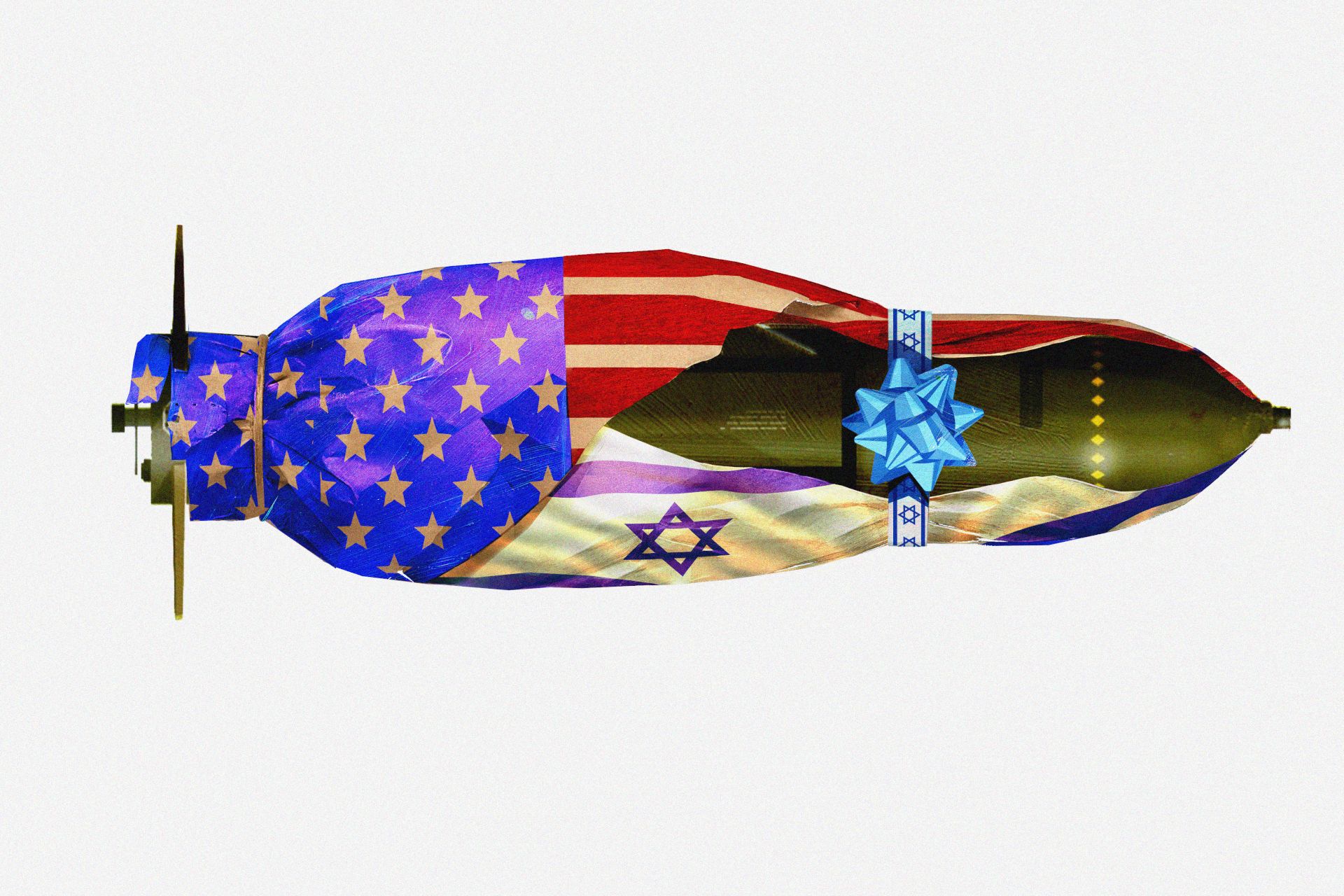
There’s a particular kind of vertigo that comes with receiving messages that you desperately seek as signs of life but whose content you dread. A week into the American and Israeli bombing of Iran, I found myself reading messages from friends and colleagues inside the country that I could not, at first, bring myself to answer.
“We are willing to pay the price for the Islamic Republic to disappear,” wrote a former academic collaborator from Tehran — a woman in her 30s who, only eight months earlier, in June, had vehemently opposed any military attack on her country. “We the people of Iran must be victorious over this regime or ourselves be destroyed.” Another friend in her 40s, also inside Iran, texted: “Two months ago, Iranians were singing and dancing on the graves of their loved ones, and they continue to celebrate the destruction of this evil regime in their midst.”
I had expected this from diaspora Iranians — those figures visible in Western capitals waving Pahlavi, American and Israeli flags, thanking Trump and Netanyahu for the bombs falling on their homeland. Many of them had pushed for war long before it arrived. What I had not fully reckoned with, despite the signals accumulating since the regime’s mass murder of protesters in the January 2026 uprising, was the degree to which this sentiment had taken root among people who would be living under the bombs themselves. I had told myself that once the destruction became real and proximate, it would clarify things — that the fervent desire for regime change would collide with the concrete fact of death and yield something more cautious. After more than two weeks of war and destruction, that reality has started to hit home with some. As it does so, it’s important to think about how Iranians ever got to the unimaginable predicament leading into the war.
As a former Middle East correspondent who spent years reporting from Iran, I know what the repression of the Islamic Republic and its induced desperation feel like. I saw how hard people worked to bring about change, and how a few of them, once abroad, embraced the idea of foreign intervention with a kind of self-serving rationality. What I found harder to absorb this time — and what I suspect troubled many others navigating similar conversations with loved ones in Iran itself — was not the raw fact of this sentiment but a philosophical demand that accompanied it: that those of us living in the relative comfort of Western cities should delegate our moral and political judgment to those directly in harm’s way. The mantra has long been that we should “amplify the voices of those seeking liberation in Iran.” Now, it seemed, some in the diaspora believed that if their families and friends in Iran supported war, they should, too, even if it went against their own beliefs.
This question — whether anti-war Iranians in the diaspora have any standing to hold their position against the voices of people who will suffer the war’s consequences firsthand — has come to organize much of the anguished debate playing out on Iranian social media. In a visibly tormented video posted 10 days into the war, the Los Angeles-based actor and influencer Tara Grammy shared that, despite her long-held anti-imperialist convictions, she had come to understand Iranians’ support for the war. The January massacre and images from Iran of people celebrating the bombs had changed her. The comment section mainly applauded in support, but one response, from the Iranian musician Azam Ali, posed the question that no one on the pro-war side has satisfactorily answered: Since you have made peace with the necessity of war, how much suffering are you willing to accept before you refuse to participate in it any longer?
It is not a rhetorical question. It is the question.
To understand how we arrived here, it is worth being precise about what “here” actually means — not just the current war, but the decades of political failure that have come to be framed as an inevitability rather than a catastrophe.
Before Iran came to be seen as an implacable enemy, the phrase most often used to describe U.S.-Iran relations in Washington think tank circles was “a history of missed opportunities.” In a little-publicized episode that analysts have described as the most significant among these failures in post-9/11 U.S. foreign policy, the George W. Bush administration summarily rejected a “grand bargain” from the Islamic Republic in 2003. The terms, conveyed through Swiss intermediaries, were stunning in their scope: full transparency regarding Iran’s nuclear program, an end to material support for Hamas and Hezbollah, acceptance of a two-state solution in Israel, cooperation against al Qaeda and a cessation of interference in Iraq. In exchange, Iran sought an end to sanctions, a shift in Washington’s rhetoric around regime change and the release of its frozen assets. Bush dismissed the overture out of hand and instead lumped Iran into the “axis of evil” alongside Iraq and North Korea — a designation that conspicuously ignored Iran’s quiet cooperation with Washington in Afghanistan after 9/11.
Reporting from Iran in those years, one could feel the weight of that rebuff in the texture of daily political life. Reform-minded politicians, students and journalists had labored, at considerable personal risk, to democratize the system from within through ideas, through the legal sphere, through widespread philosophical discussions — about the relationship between religion and democracy, tradition and modernity and whether Islamic governance could be reformed from within. Although the intelligence apparatus was fighting this current, and even killed intellectuals in what became known as the “chain murders,” the overwhelming majority of Iranians of all strata actively sought to liberalize their state. Emblematic of this were the architects of the 1979 hostage crisis, by then middle-aged, who were opening successive reformist newspapers. Iran had changed substantially from its days of revolutionary fervor, but the American political imagination remained stuck in 1979. For more than two decades, across multiple rounds of nuclear negotiations, the threat of military force was kept deliberately, performatively “on the table” — a posture that normalized the very outcome it claimed to be preventing.
The final serious blow to prospects for internal reform came when Trump, in his first term, unilaterally withdrew from the 2015 nuclear agreement. The deal, painstakingly negotiated over years of multilateral diplomacy, had created a framework that held Iran accountable to external verification while permitting a degree of economic and political opening. Its collapse — engineered by Washington, not Tehran — vindicated every Iranian hard-liner who had argued that American commitments were worthless. The maximum-pressure sanctions that followed enriched those entangled with the state apparatus while impoverishing ordinary Iranians — and further corroded the credibility of those who had argued for engagement.
Into this political vacuum came something more difficult to quantify but impossible to ignore: a systematic transformation of the Iranian information environment, particularly in the diaspora, that helped produce the pro-war sentiment we are now witnessing.
The right-wing media ecosystem that enabled Trump’s political ascendancy found, in expatriate Persian-language media, remarkably fertile soil. Platforms like Iran International — the most-watched Iranian satellite channel inside Iran — along with dozens of boutique YouTube programs and a sprawling ecosystem of social media personalities, have for years propagated a two-part message: The Islamic Republic is not a legitimate government but an occupying force, an Arabo-Islamic imposition upon the authentic Persian nation; and after its elimination, a democratic utopia awaits.
The parallels between Israeli media environments and the Iranian one are not accidental. There has long been a convergence between supporters of regime change and pro-Israel interests, with the Crown Prince Reza Pahlavi boasting close relations with the Israeli prime minister. The similarities in these two media spaces are a product of pro-Israeli messaging in the Iranian space. Iranians consuming this content frame the current conflict as an “existential war,” one requiring the regime’s total elimination. This is also the framing that has led more than 80% of Israelis to support the ongoing war — a population that has been persuaded, through decades of conflict and cultivated fear, that national survival requires all-out measures, and when it comes to Iran, and end to the Islamic Republic.
The anti-Islamic undercurrent beneath this rhetoric deserves closer attention than it typically receives. Much of the pro-war messaging draws heavily on pre-Islamic Persian identity, positioning the Islamic Republic as a kind of Arab invasion of an essentially different, essentially secular civilization. Exiled activist and media personality Masih Alinejad has described the Islamic Republic as “an occupying army set on destroying Iran like a Mongol invasion.” A member of my own family, responding to the news of Khamenei’s assassination, described him as “a blood-sucking invader whose ilk has occupied Iran.” The London-based Iranian rapper Hichkas is now a prominent pro-war and pro-Pahlavi figure who leads marches draped in American and Israeli flags. But 20 years ago, in the aftermath of the Iraq invasion, he was rhyming about “God, family and the Iranian [read Islamic Republic] flag.” The trajectory is instructive.
Israeli information operations have pursued this line. The Israeli Foreign Ministry’s Persian-language Instagram account posted an AI-generated video depicting an American and an Israeli woman pulling an Iranian woman from a pit in the ground, then helping her remove her hijab and become “liberated” in sisterhood with them. For non-Iranian viewers, the imagery is merely odd. For Iranians, it is a legible reference to the pre-Islamic practice, attributed to certain tribes in the Arabian peninsula, of burying unwanted daughters alive — a practice, it should be noted, that Islam’s Prophet Muhammad put an end to, and that Saudi Arabia proudly teaches in its own religious indoctrination. The Islamophobic argument and the historical reality are, as is frequently the case in such productions, in direct contradiction. But historical accuracy is not the point; the activation of existing stereotypes and anxieties is.
These messages have not landed in a neutral space. They have been received by people who have watched the Iranian regime pour their country’s resources into military programs and proxy networks across the region while Iran’s own population has slipped into deepening poverty; who have seen uprising after uprising met with lethal state violence; who watched thousands of their fellow citizens killed by their own government in January 2026. Grammy cited the killing of “40,000” protesters as her personal turning point. The number is still contested — the often-cited nongovernmental organization Human Rights Activists in Iran (HRAI) has verified 7,007 and is still reviewing 11,744 — though many observers and activists believe that it was much higher than what has been verified.
The division that has emerged — between those Iranians who will not support a war on their own country and those who have, through suffering and desperation, arrived at support for the war — is real and painful and will not be resolved easily. A friend in Tehran put it with bleak clarity: “We know this is a gamble. But what other way is there?”
That question deserves an honest answer rather than a comfortable evasion. The honest answer is that there is, at this moment, no clear other way — and also that the way being pursued leads, by every available historical measure, nowhere good. There is no precedent in the modern Middle East — or for that matter anywhere — for a war producing a quick and clean democratic outcome, as the architects of this one implied in their promises. And we know now, from interviews with former Israeli defense officials, that there were never any concrete plans for what would follow the destruction of the Islamic Republic — only, in their own words, “wishful thinking” that Iranians would spontaneously rise up and take over their government. Equally, Trump has been all over the place with his messaging, first telling Iranians that “the hour of [their] freedom is at hand,” then telling CNN he doesn’t insist on a democratic state, and that Iran could even have a religious leader as long as it treated the U.S. and Israel “fairly.”
This matters because supporting pro-war Iranians simply on the grounds that they are the ones in Iran — that their proximity to suffering confers a kind of moral authority that overrides other considerations — is not solidarity. It is a form of abdication dressed as deference. People speak from within conditions of political and economic desperation, with the promise of deliverance dangled before them by powers that have given them every reason, across decades, to know better. To amplify their voices without also holding accountable the governments that helped manufacture those conditions of desperation, that walked away from diplomatic openings, that funded the propaganda campaigns and that launched a war with no plan for what comes after — is not to honor their suffering. It is to participate in its exploitation.
Trump has already done what the architects of such rhetoric always eventually do: He collapsed the distinction between the Islamic Republic and the Iranian people. On a plane, in casual remarks, he said the United States military was doing what “should have been done during the 47-year period,” adding that Iranians “really are a nation of terror and hate.” The exiled activist Alinejad, who has spent years advocating for a belligerent foreign policy toward Iran — and whom the regime allegedly tried to assassinate — was reduced to tweeting a correction: “Mr. President, Iran is not a nation of terror and hate. The Islamic Republic is.” The distinction she was making had been eroded by the forces she had helped unleash. War does not know neat boundaries.
Those of us living in the U.S. — who have watched in real time the dismantling of democratic norms by this administration, who have witnessed Israel’s genocide in Gaza and its crimes in Lebanon, who inhabit daily an Islamophobic and Iranophobic political climate in which it is us, apparently, who are people of “hate and terror” — cannot in good conscience treat the current war as a vehicle of liberation. The president who made that remark also stated, without so much as an apology, that he “could live with” knowing that his military had killed more than 150 schoolgirls on the first day of the war. This came after Matt Schlapp, chair of the Conservative Political Action Conference (CPAC), said on “Piers Morgan Uncensored” that those girls were better off dead than being “alive in a burqa.” These are the powers in whose good intentions Iranians are being asked to trust.
The complete dismantling of a functioning state, however brutal and however widely despised, without any credible plan for what follows, will not produce democracy by miracle, but ruins by design. The minimum obligation of those of us outside Iran is to say so clearly, to refuse to amplify the war’s propaganda, however it is packaged, and to hold our own governments to account for a catastrophe that was not, despite what the maximalists insist, inevitable. It was a choice — a series of choices, some of them over decades, others more recent, made by our governments. Acquiescence in this political climate is not neutrality. It is complicity in a devastation that has already expanded beyond Iran.
Become a member today to receive access to all our paywalled essays and the best of New Lines delivered to your inbox through our newsletters.