


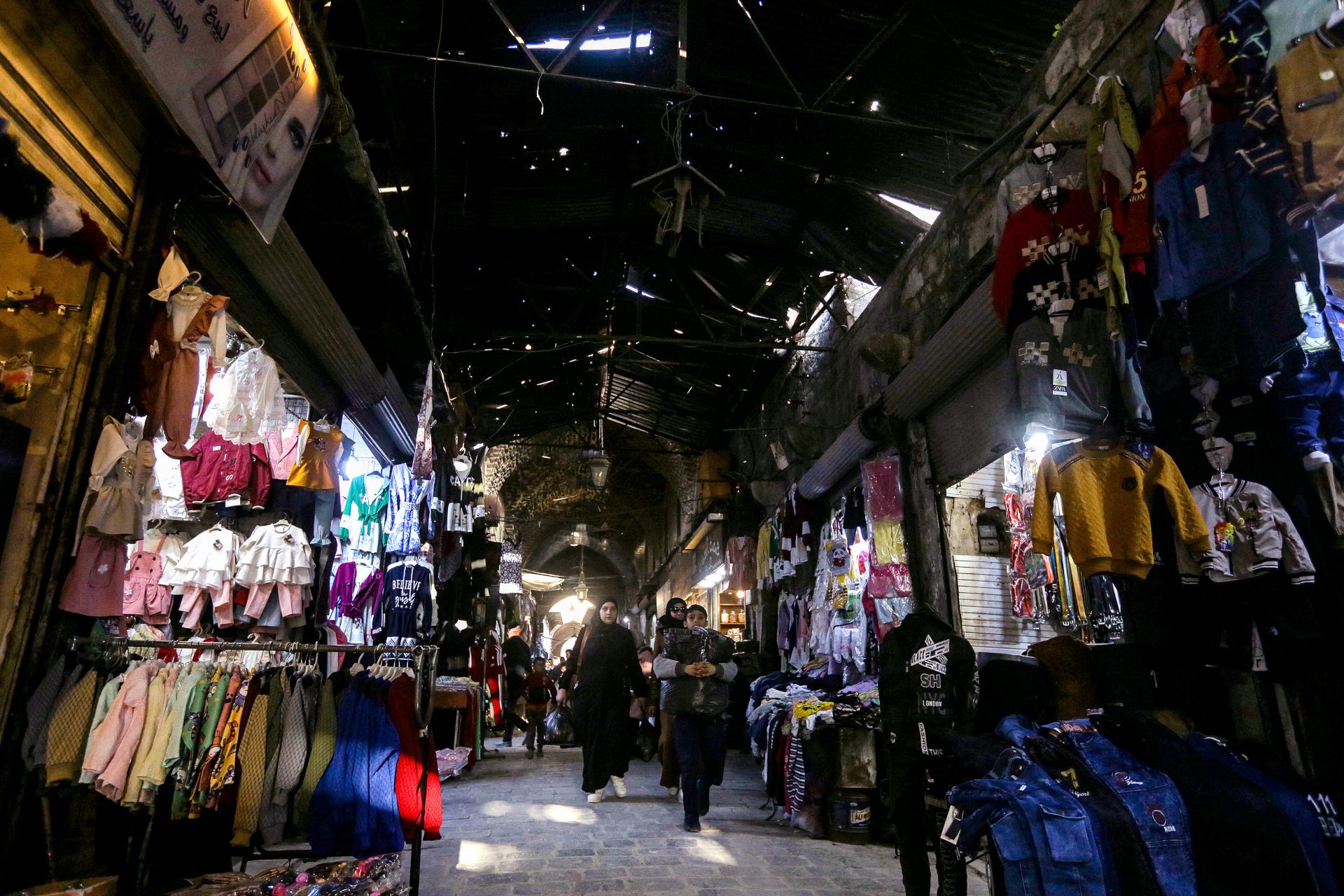
“Three or four years ago, all of this was just a pile of rubble,” said Samir. He was standing outside his newly rebuilt cosmetics shop, in the now bustling Souk al-Saqatiya, at the heart of the old souks in Aleppo. As he said this, four potential customers were trying on perfume recently imported from Turkey (under the Bashar al-Assad regime, many imports were banned). They paid with dollars, a crime for which they would have been imprisoned by the previous government. A lot has changed since Assad fell on Dec. 8, 2024, following 14 years of ruinous civil war.
“The souk was closed between 2015 and 2021, completely empty and destroyed,” said Samir, who asked that his full name not be used. “I traveled to Damascus and lived there. For the safety and for the money.” He slipped into his native tongue. “Aleppo was ‘medina mankubeh’” (literally “a disaster-stricken city”).
Syria’s second-largest city and its traditional economic center, Aleppo endured untold damage during the civil war. As one of the world’s oldest continuously inhabited cities, it has suffered from its fair share of crises throughout its 8,000-year history, the latest being a spurt of deadly fighting between government forces and those of the Kurdish-led Syrian Democratic Forces (SDF) in mid-January. But all pale in comparison to the willful self-destruction of the civil war. The four-year Battle of Aleppo (2012-16) — dubbed Syria’s Stalingrad for its brutal street fighting and constant bombardments — devastated the city. Hollowed-out buildings and concrete debris are ubiquitous, and rebuilding projects have been slow to progress due to a chronic lack of funds. In October, the World Bank published a report that put the estimated cost of damage across the Aleppo governorate at $31 billion, more than any other in Syria.
But despite all this, Samir knew he would return. “I had to come back because of my family, my neighbors, because I was brought up in the old city. My primary school was 100 meters from here,” he explained.
He was quick to note that this particular part of the souk was not razed by bombing, but by the magnitude 7.8 earthquake that hit southern Turkey and northern Syria in 2023. Two years later, the sensory overload has returned. Hawkers tout their wares, customers throng the narrow aisles, and the scents of soaps and spices waft through the enclosed space. “Compared to the last 10 years, now we are in heaven,” he said.
The Ancient City of Aleppo, parts of which date back to the 11th century, contains many of the jewels of Syria’s cultural heritage, including both the citadel and the magnificent Umayyad Mosque, and was designated a UNESCO World Heritage Site in 1986. It attracted hundreds of thousands of tourists annually and housed around 120,000 locals. At its center were the old souks: a covered maze, 8 miles long, subdivided into smaller souks or “khans,” otherwise known as caravanserais, each with its own traditional speciality. Before the civil war, one could find the finest Persian silk or Aleppine soaps within its confines.
Now, the population has dropped to an estimated 40,000, and a UNESCO report determined that 60% of the souks were significantly damaged, with 30% completely destroyed.
While state funds allocated for reconstruction are negligible, a few private companies and nongovernmental organizations have restoration projects underway. Foremost among them is the Aga Khan Trust for Culture (AKTC), an agency within the wider Aga Khan Development Network. Since it began working in the old souks in 2018, it has restored 277 shops, returning nearly all to their previous owners, one of them being Samir’s. “There was nothing here, and then they came and reconstructed all 19 shops on this stretch of the souk, and gave mine back to me. It was an act of charity,” he said.
Thierry Grandin, a French architect, has been assisting the restoration projects as a technical expert. He has lived in Aleppo, on and off, for 40 years and has directed a number of projects on historic houses in the city. He said the aim is to be as faithful as possible to the original. “First, we make an analysis of the stone [or rubble]. If we cannot reuse the exact stone, we will try to bring the same kind from elsewhere. For example, here [in Souk al-Saqatiya] we are using lime-based mortars just like the traditional way.”
In doing so, they are maintaining crafts that have been around for centuries. Stoneworker Samir Saeed explained that he “restores the old stone back to its original state. I inherited this craft from my father, who inherited it from his forefathers, who practiced these skills before him.” He can feel the connection to history. “I treat the old stone like it has a soul,” he said.
Zainab, a graduate of the School of Architecture at the University of Aleppo, works as the surveying and design architect for the project. “We are responsible for the funding, the studies of the site and implementation of the project,” she said. “We choose a contractor through a tender procedure who carries out the work. We know them intimately, their workers, engineers, architects, everything. And we think about every detail you can imagine. We decide stone by stone whether to use it, discard it or take it apart. Every decision is made together, as a team.”
And in doing so, they become archaeologists as well as conservationists. “The old city is full of surprises. Because you open a wall and remove the cladding, and suddenly you will find another wall or basement, which forces us to rethink our plans,” Zainab said, smiling.
Alongside reconstruction of parts of the old souk, the AKTC also conserves some of its historic buildings. One example is the striking al-Halawiya Madrassa, a site brimming with history. Grandin described how it has “columns from the sixth-century Byzantine period, parts from the Zengid and Ayyubid periods and an exterior that dates from the Ottoman era.” A historian’s dream, it provides the conservationist with numerous problems. He described how, “after initial excavation to remove the outer stones, we discovered that the original, Byzantine foundation level is 3 meters under the ground. First, we have the column on a pilaster, and then the base and then the foundation. Therefore, we now have to dig 3 meters down in each corner to retain the whole structure.”
While the site has survived for over a thousand years, in 2025 it is a shadow of its former self. The facades and arches now have wooden shoring to prevent wholesale collapse, and the walls are pockmarked with bullets. Grandin pointed to a newly installed wall and explained that “behind this brick, there is a beautiful mihrab. During the civil war, we asked the workers to cover it, because otherwise it would be stolen or damaged. It dates from the time of Nur ed-Din, around 1150 AD, later restored in around 1188 by Saladin.” The aim is to rehabilitate it into a fully functioning madrassa (a place of religious study), but when that will happen is unclear. For now, construction is on hold.
All across the old city, there are sites with similar stories, but there is little appetite to restore them to their former opulence. And while reconstruction of the souk has brought economic benefits and enticed former shopkeepers to return, Aleppo is a long way from reclaiming its place as Syria’s economic capital.
Grandin noted that while the old souks previously sold high-quality products, now they mostly sell household goods and street food. Hamad, who recently moved back into his clothes shop, bemoaned the postwar reality. “In general, it is a harsh life, concerning money and the financial status of the city. Economically, the situation is the same. And the people here are ignorant and illiterate. In 14 years, many kids didn’t go to school because of the bombing and forced displacement.”
There is general unease as the population waits to see the direction the country will take under the new regime, headed by the interim president, Ahmad al-Sharaa. “I am not pessimistic or optimistic,” Samir said. “In general, I do not like Islamic rules. Globalization is the solution to this country. Not religion.”
And his sentiments have only been heightened by recent clashes in the northern suburbs of Aleppo between Syrian government forces and the SDF, in which at least 30 people were killed. Grandin described how “there was indiscriminate shelling by Qasad [the SDF’s Arabic acronym] and significant destruction to the areas affected [Achrafieh and Sheikh Maqsood, two Kurdish-controlled enclaves], but it was over very quickly, and the number of casualties was low. Everyone was in their homes for a few days, but now everything is mostly fine, and life is coming back to the city.”
Over 150,000 residents were forced to leave their homes as a result of the fighting, but no fighting took place near the old city, and reconstruction projects were unaffected.
Aboude, a young Aleppine architect who has worked on private reconstruction projects in the old city, said that after 14 years of civil war, “we [Aleppines] have gotten used to fighting and bombardment, so it doesn’t hugely affect or scare us. Simply, caution was required in some areas of the city.”
“Construction and reconstruction were never stopped during all these years of fighting, and especially not now, as we knew it would be a short conflict,” he continued. Grandin, who himself worked periodically in the old city throughout the civil war, added that the return to work was necessary for his team, even under these circumstances. “When Aleppo started being bombarded [on Jan. 8], we sent everyone home to spend time with their families. But as soon as it finished [three days later], everyone came back. You need to go and work in these conditions. There is a time when they should go home, but as soon as it is finished, they should be active, and not thinking too much. The team asked to come back to work. It was a common choice, and in this case their work was a kind of therapy from the fighting.”
Nevertheless, the fighting adds to the uncertainty over the direction that Aleppo, with its complex confessional makeup, will take under the new regime. Zainab echoed this assessment, “I am not very happy and I am not very sad. I am just waiting. Waiting to see what happens.” There is a sense that the city is in limbo, stuck between the horrors of the past and a fear of being too hopeful for the future.
Although she is an architect, Zainab’s love for Aleppo stems not from its physical beauty but from its people. “What is the big difference for me? The community around us is not the same. Not the same magic, the same beautiful people,” she explained. “Now, a lot of people have come and they are not like us, whether they are conservative or open or whatever. For many years, me and my [Sunni] family lived side by side with Christians and Armenians. For example, when you enter a mosque, there was no difference between whether you were Muslim, Christian or Armenian — no one asked, no one made a problem over it. Now it has changed. Now everyone talks.”
Of Aleppo’s 3 million residents before the war, only 900,000 remain, according to some estimates. They are now outnumbered by an estimated 1.4 million internally displaced Syrians, who came to Aleppo from different parts of the country. As a result, it is not only the physical city that has to rebuild, but its social fabric as well. And, in many ways, this cohesion and sense of unity, built over generations, will take longer to heal. Grandin predicts that, “if you take the current children of Aleppo, it will be their children who will complete the reconstruction of the city.”
But for the average resident of Aleppo living in the current reality, the return of their city to its former glory is not on their minds. As Samir puts it, “I just want to live, to eat, to be safe. I do not care about who rules, who is in power — I just want to be, and bring up my children in peace.”
“Spotlight” is a newsletter about underreported cultural trends and news from around the world, emailed to subscribers twice a week. Sign up here.