

On Monday, Sept. 29, the lights inside the Al-Kindi Cinema in Damascus dimmed not for a screening of old Syrian classics and foreign dramas, but for something far more theatrical: a campaign pitch. One by one, candidates climbed to the podium flanking the stage, addressing the audience of voters, their peers in the city’s electoral college. The profiles were diverse: former activists, businesspeople, lawyers, ex-rebels. These were the contenders from the Damascus governorate, vying for a seat in the first parliamentary elections since the fall of Bashar al-Assad last December.
Over the following week, each candidate had to convince the 500-member electoral college, of which they are members, to grant them one of only 10 coveted seats allotted to the capital. With an indirect electoral process, their choices, the result of a week’s worth of negotiations, quiet lobbying and backroom deals, will help shape Syria’s political architecture.
The new People’s Assembly will have 210 members: two-thirds chosen by local electoral commissions, and the rest appointed by the interim president, Ahmad al-Sharaa, through a national selection body. Officially aiming to rectify the gender and religious imbalances resulting from the elections, the measure raises questions about the independence and powers of this new parliament. A two-thirds majority in the assembly is required to invalidate presidential decrees.
Originally set for Sept. 20, the elections were pushed to Oct. 5 due to organizational problems. In Hasakah, Raqqa and Sweida governorates, they are postponed indefinitely for political reasons, a reflection of the transitional government’s limited reach and the fragile state of national consensus.
On the first day of the candidate presentations, the red velvet seats of the Al-Kindi Cinema sat mostly empty. Of the 500 commission members expected, barely a fraction had shown up, a detail that would shape the week.
One by one, candidates took the stage. Some faltered through nervous speeches. Others launched into sweeping visions. One spoke of purchasing power, another of postwar reconstruction. A third invoked the uncertain future of the autonomous administration in northeastern Syria. A liberal vision seems to be prevailing nonetheless.
Some of them already seem to have their fans. Nizar al-Madani was formally introduced by the organizers, followed by applause, the only one to receive such an introduction. Questions followed as candidates debated their priorities and, more fundamentally, the purpose of a parliament in a country still emerging from authoritarian collapse.
The most heated exchanges, however, weren’t about policy. They were about logistics. The election’s organization, or lack thereof, was starting to cause problems. Angela Khouri, a dentist and Christian from the al-Midan neighborhood of Damascus, raised her voice from the floor. “Why are there barely a hundred of us here?” she asked, directing her question at the head of the Damascus electoral college, Oussama Fahiye. “How are we supposed to campaign when the voters aren’t even present?” It was a glimpse into the awkward reality of democratic transition.
Frustration deepened after candidates were banned from speaking to the media. Their only remaining channel: social media platforms. Candidates launched a WhatsApp group to coordinate, but by Monday, only 215 people had joined, less than half of the commission.
In order to share their program with those who were not present during their speeches, candidates handed out printed brochures outlining their platforms and quietly passed them around the room, or left them in stacks near the entrance.
Not everyone who spoke was meant to be there. One young man, who had taken the microphone to comment, later admitted he wasn’t even part of the electoral committee. “I just came here to watch a movie,” he shrugged. “At the entrance, someone asked if I was with the commission. I said, ‘Yes,’ and here I am.” He added: “Also, where are the youth?” His observation wasn’t misplaced. While many candidates had spoken of empowering Syria’s younger generation, the crowd skewed overwhelmingly toward middle age.
By Tuesday morning, the ban on speaking to the press was lifted — albeit quietly, and without much public announcement — reinforcing the impression of disorganization.
The idea for this week of open-floor campaigning came from candidate Abdul Salim Ramadan, a short, broad-shouldered former rebel fighter with a long graying beard. Alongside Maissa Halawi and Lama Fatouhi, two civil society veterans, he pushed for the initiative, fearing that, without direct exchanges, votes would split according to their neighborhood or background. “We needed a place where people could actually talk,” Ramadan said. “Otherwise, everyone would just stick to their camp.”
But even in this designated space for dialogue, it was hard to venture into the unknown. On Tuesday, the venue moved to the National Library in Umayyad Square. The move was intended to accommodate the entire 500-member commission. Still, most of the seats remained empty.
While official speeches continued inside, real negotiations were happening elsewhere. In the hallways, at coffee breaks, this is where deals were struck and promises made. Business cards were exchanged, voting pledges whispered and alliances formed.
There, two women from Jobar, a Damascus suburb reduced to rubble during the civil war, discussed their strategy. “Among our 10 votes,” one said, “we’ll certainly give some to candidates from our own neighborhood, such as Hisham al-Afyouni. That’s normal. We share the same priorities.” Another member of the electoral college, Yassin, agreed. “I know plenty of people here already,” he said. “So I’ll vote for them.”
Without a party law in place, formal political organizations are still banned from participating in the new assembly. According to Nawar Najmeh, head of the Higher Committee for the People’s Assembly Elections, it is necessary to “wait for the emergence of a genuine national identity and ensure that parties are not based on religious grounds or regional dynamics — it would otherwise divide us. In this transitional phase, we need cooperation, not opposition,” he asserted, underlining his position on the assembly’s role in the future.
Still, political movements continue to operate discreetly. Zaher Baadarani, founder of the Syrian Future Movement, was scanning the room and the candidates from the back of the hall, his American and Syrian flags pinned on his lapel. Son of a religious adviser to Assad, Baadarani fled to the U.S. early in the revolution. There, he built a movement that now includes important figures from Syria as well as the diaspora.
“The goal of our movement is to bring people together based on shared religious and national values,” he said over a coffee at the Sheraton, one of the last functioning luxury hotels in the Syrian capital, where he is currently based. He chose not to be a candidate for those elections, waiting to be able to take his party to the parliament. “We need a party law. Pluralism must be structured if we’re going to take it seriously,” said Baadarani, who leads an umbrella group of 35 political parties, none of which can run officially.
Munir al-Fakir, a candidate in the elections and deputy head of the New Syria Movement, chose a different path and decided to run without his party. But this prominent local figure, who spent time in the infamous Sednaya prison where the former dictatorship locked up many political opponents, is not worried. With his crisp suit and thick address book, he has no shortage of support.
By midweek, as alliances solidified and familiar names gained traction, independent candidates scrambled to keep pace. One of them revealed that a bloc of 70 electoral college members, candidates and noncandidates alike, had formed to back a diverse group, including a legal expert, an economist and a civil society activist. The goal, he explained, was broad representation. Still, with profiles spanning the ideological spectrum, the alliance’s longevity inside the assembly remained uncertain.
By Friday night, the final day of deliberations, turnout had visibly improved. The hall was fuller. The stack of campaign flyers at the entrance had grown, and the WhatsApp group now counted 410 members, a far cry from the 215 of earlier in the week.
Conversations had grown sharper and more strategic. On the faded burgundy sofas outside the main hall, groups clustered to exchange names, pledges and final calculations. A group of women candidates gathered near the coffee table. “I want at least five of the 10 people I vote for to be women,” said Hedyan Nehlawi, a schoolteacher and candidate. Alongside about 50 others, she had created a parallel WhatsApp group to coordinate female support, unsatisfied with the government’s promised 20% quota for women. “We want our voices heard in the assembly,” she said.
Angela Khouri, too, looked more at ease. “When I arrived, I didn’t know anyone,” she said. “But this week, I’ve met so many people who care about Syria’s future. It gives me hope.” Among her backers was Ghassan Hitto, founder of the Syrian Forum, a nonprofit organization, and former interim prime minister appointed by the Istanbul-based Syrian National Coalition in 2013. Though he resigned months later, his name still carries weight. He had drawn up his own list and was sharing it with others, comparing names and strategies in an open exchange of influence. Among the names were al-Fakir, the former Sednaya prisoner now running as an independent candidate, and al-Madani.
That night, negotiations stretched late into the evening. It was the final chance to secure alliances, trade promises and place bets on the next chapter of Syrian politics.
Saturday was a rest day. Sunday brought the vote. By 9 a.m., a line had formed outside the National Library. Just 10 months earlier, this same square had erupted in celebration as thousands marked the regime’s collapse. Today, it was a backdrop for Syria’s attempt at institutional rebirth.
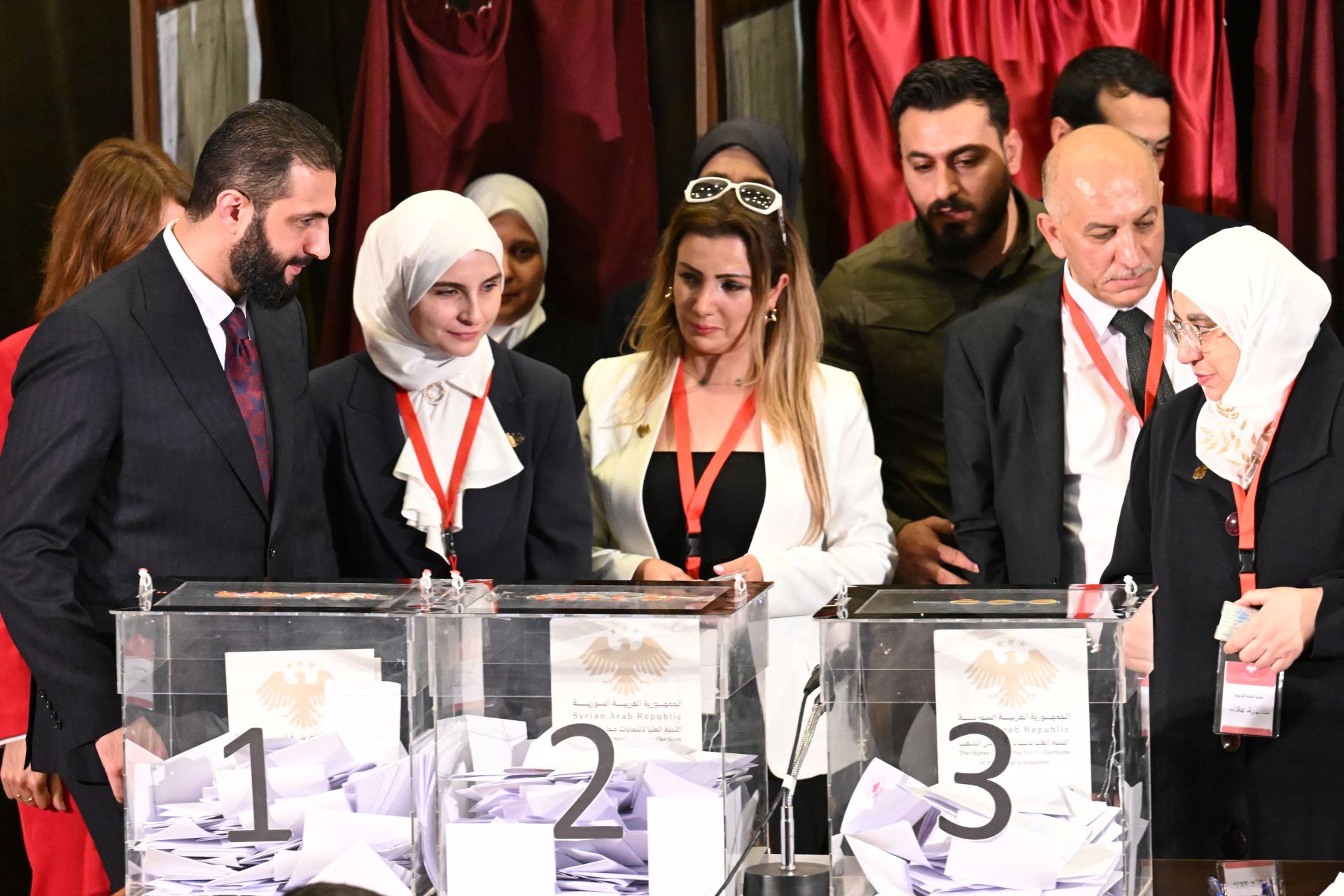
The conference hall had been transformed. Velvet-draped booths had been installed alongside transparent ballot boxes. Of the original 150 candidates, only 135 remained. The rest had withdrawn in favor of alliances or better-positioned contenders.
Each member of the electoral college stepped forward one by one, confirmed their identity and received a simple paper. On it, they would write the names of the 10 candidates they had chosen over the course of the week. Some took their time in the booths, double-checking spellings. Others moved quickly. The mood was a mix of solemnity and celebration. In the euphoria, one candidate leaned over to another and laughed: “I forgot your full name and couldn’t find you in the booth list — so I voted for someone else! Sorry!”
Today, the alliances are clearly defined. In a parliament where political parties were prohibited, these informal blocs filled the vacuum. In the second row of the room, a small group of seven candidates clearly identified themselves as a group. ”We are called the Damascus Alliance.”
Angela Khouri emerged from the booths smiling. “I’m so happy. What we did today is part of writing Syria’s history,” she said, hoping to be among those elected. “On Friday, we talked late into the night with the other girls. We made a promise to each other that each of us would vote for at least three of us. According to the count, I should be ahead.“
The atmosphere remained calm, even cheerful. Syrian observers roamed the room to ensure the integrity of the process. Around 11:30 a.m., word spread that al-Sharaa would arrive. His delayed appearance brought proceedings to a temporary halt. When he finally entered the room, a wave of euphoria followed, with every candidate wanting their photo taken with the president. The organizers took the time to show him the system that had been put in place before he addressed the room, calling the vote a “transitional milestone” on Syria’s path from civil war to renewal.
By late afternoon, all the ballot boxes were sealed. The votes were then counted on-site, in full view of photographers and election monitors, transparency being central to the day’s choreography.
While the Damascus vote concluded with visible enthusiasm, one election observer later declared: “The high committee’s management of the process was characterized by poor planning and unclear communication. No complete official timeline was published. Deadlines were constantly ignored.”
In the end, no women and 10 men with a rather liberal and moderate religious approach were elected in the Damascus governorate. Among them was al-Madani. “Some of them we didn’t see this week. People voted according to regionalism and factionalism,” a candidate, who chose to remain anonymous, reacted angrily.
The president’s nominations are to follow now, offering a second chance for women in Damascus to have a seat at the legislative table. But whether the assembly will emerge as a meaningful political force or remain a ceremonial gesture in a tightly managed transition remains uncertain. Yet for all its messiness, the week at the Al-Kindi Cinema and the National Library was something rare in Syria’s recent history: unscripted politics.
Still, even among the optimists, caution lingers. “We are still in the early stages of democracy,” Baadarani said. “At best, we are in a phase of ‘shourakratiya,’” he said, combining the word for democracy in Arabic and the Islamic concept of collective consultation. Whether that consultation can evolve into real accountability is the question that Syrians, and their new representatives, will now have to answer.
“Spotlight” is a newsletter about underreported cultural trends and news from around the world, emailed to subscribers twice a week. Sign up here.