


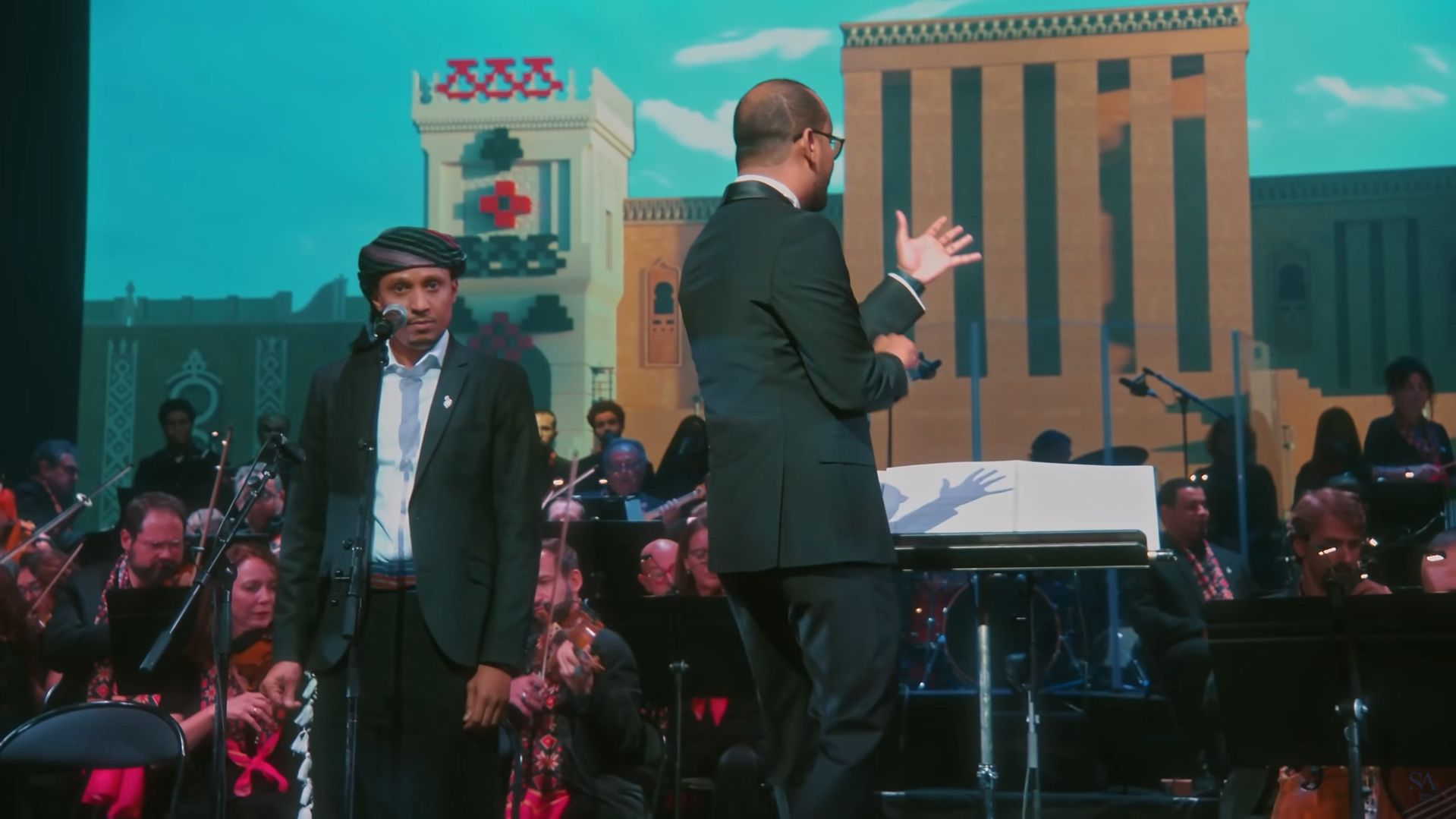
The set opened with a striking juxtaposition. On one side of the stage, men and women in sharp black suits played a medley of Western instruments — a flute, oboe and bass recorder. Opposite them, men in traditional Yemeni Hadrami dress answered with the ancient sounds of the mizmar and oud, backed by the deep, pulsing rhythms of Yemeni drums.
As the two groups traded melodies, six men in white shirts, embroidered waistcoats, long patterned futas, and ornate turbans descended onto the stage, three from either side, embodying the weight of Hadrami tradition. Behind them, the projection screen glowed with images of Yemen’s landmarks and the bold words “Hadrami Music,” signaling that a beloved song was about to be performed. Still, I could not guess what might follow until the conductor, a man poised at the podium in a dark suit and bow tie, motioned for the chorus to step forward. Their voices lifted into the air with the stirring refrain of “Sabouha,” a song that tells the tale of a young bride who falls in love and gets engaged to a man named Naseeb, only to have her father refuse the match. It’s a song of tragedy and nostalgia, one I grew up hearing. The performance was suddenly transformed into a living record of Hadrami heritage.
This set was one of several performed that evening in January at the Sheikh Jaber Al-Ahmed Cultural Centre in Kuwait, each blending the richness of Yemeni Hadrami musical heritage with the sweeping sound of orchestral arrangements. At the heart of it all stood the mastermind of the concert, 34-year-old Mohamed Salem Alghoom, a Yemeni-born maestro and an energetic composer who has created a new form of musical fusion. His main ingredient is simple yet powerful: songs and melodies drawn from Yemen’s vast musical heritage, reimagined through the textures of international orchestral instruments.
Alghoom told New Lines that his project, which he calls “Heritage Symphonies,” first debuted in 2019 with a similar concert in Malaysia. It showcases Yemeni melodies, he explained, particularly those from the southeastern province of Hadramawt, to the world in a new form. “I take traditional musical elements and reinterpret them through a modern, contemporary lens. I compose and rearrange these pieces into a universal format, something that resonates with audiences around the world, no matter where they come from.”
To simplify the concept, Alghoom likened it to food. “It’s like serving ‘lakham’ in a modern restaurant,” he said, referring to the classic Hadrami dish of salted dried fish. “We’re taking something deeply traditional and then adding these international touches — like presenting it on fine plates with fresh vegetables and fruits.” For him, the project is a way of offering a cultural experience that remains rooted in Yemeni tradition, but with a global twist.
After the concert in Malaysia, it took Alghoom three years to stage another major performance. In 2022, he performed at the Cairo Opera House with a similar, but broader, composition. This time, alongside traditional songs from Hadramawt, he wove in tunes from Sanaa, Taiz and other Yemeni regions, as well as melodies from the host country. All of these were blended into a single composition, enriched by the depth and range of orchestral instruments.
With each step, Alghoom grew more adept. In 2023, he brought his project to Paris, staging a concert that lasted more than an hour and unveiled yet another facet of Yemeni heritage to the world. This time, he collaborated with French musicians, blending their styles seamlessly on one of the city’s renowned stages.
At the city’s Theatre Mogador, a Yemeni singer in a white turban and traditional Hadrami attire stood at the center of the stage, repeating the refrain “Wadan Wadana,” a familiar Hadrami chant that evokes joy and musical kinship. Beside him, a French vocalist answered in her native tongue, while Western musicians in dark suits joined in with their instruments. From the podium, Alghoom’s baton set the tempo and shaped the rhythm, weaving French and Yemeni sounds into a single, vibrant tapestry of music.
I watched the three concerts on YouTube, observing the massive number of comments and likes, with some calling the effort a revival of Yemeni music. “You have lifted our spirits and given us hope that Yemen is still alive. You’ve achieved something remarkable — something even governments could not accomplish,” one commented on the Paris concert. “A hidden music form, once unseen, has now been brought to light. Yemeni music has been reborn in a new form,” another wrote.
One of the goals of this project is to offer a different image of Yemen and its people. In recent years, Yemen has often been portrayed through the lens of tragedy and destruction, Alghoom said. “Music is a powerful medium — one that can tell a different story. Through this project, I want to show the world that there’s another side to Yemen.”
Day by day, Alghoom explained, his journey expanded. After those early successes, his ensemble began to gain international recognition, and soon invitations were arriving from across the globe — some accompanied by what he described as “irresistible budgets.” Since the Paris concert, Alghoom’s ensemble has staged similar performances in the United Arab Emirates, Oman, Kuwait, Saudi Arabia and Qatar. On his desk now lie more than 20 invitations from international opera houses, festivals and cultural institutions eager to host the “Heritage Symphonies” in their own lands.
But he sets specific conditions before accepting an offer: The host venue has to be a renowned opera house or cultural institution, among the finest in the country. He also avoids performing twice in the same country — unless the offer comes with a substantial financial incentive. And the host country should be one where Yemenis can get visas. “Our goal is to show that even amid war and hardship, Yemenis are capable of producing artistic work of the highest quality. We’re striving to showcase as much of our country’s beauty as possible,” he said.
Alghoom, born in 1991, began arranging music at just 14, composing for local singers and television series in his hometown of al-Mukalla, the capital of Hadramawt province. “It started as a hobby, but soon it became a source of income. I had a piano and a computer, and I would play while composing directly onto the screen,” he recalled.
In those early years, his clients included wedding parties seeking custom songs, singers looking for fresh arrangements, composers of TV dramas, and even government officials commissioning patriotic music for national days and official celebrations. A turning point came in 2010, when he traveled to Cairo to study music arrangement. There, he shadowed professional musicians and trained directly on their instruments, gaining invaluable hands-on experience.
“That experience transformed my hobby into a business and gave me a deeper command of musical instruments,” he said. When he returned to Yemen, his work became not only more professional but also more sought after, attracting clients from across the country. He likened it to running a small shop: “I was like a shopkeeper who opens his doors every day, waiting for customers. People would come to me with their musical ideas, and I would arrange them into complete pieces.”
War broke out in Yemen in late 2014, after the Houthis seized control of the capital, Sanaa, and expanded across the country, triggering battles that left thousands dead, displaced millions and plunged the nation into what the U.N. once described as the world’s worst humanitarian crisis.
In 2015, the conflict struck perilously close to home for Alghoom. Al Qaeda in the Arabian Peninsula, exploiting the collapse of the Yemeni state, captured much of Hadramawt’s coast, including al-Mukalla, the city where he lived. The group banned music outright, lashing people caught playing instruments.
Fearing for his life, Alghoom abandoned his engineering studies and fled. He escaped to Tarim, his family’s ancestral hometown — a move that, though forced, would eventually prove to be a blessing in disguise. “I fled out of fear of being beheaded.”
Suddenly, he found himself jobless, out of school, and even barred from practicing his main profession: music. Yet his strong background — both his practical work in arranging music and his earlier studies in Cairo — helped secure him a place at a music school in Amman, Jordan. That period marked another turning point in his career, planting a seed that would later grow into a musical project reaching opera houses worldwide. During his time in Amman, he honed his skills in both composition and conducting.
Exploiting the musical environment in Amman, and with support from his colleagues, in 2015 he began picking up Yemeni traditional songs and folk chants from Hadrami music, fusing them with international instruments and showcasing them to his classmates and superiors. They were impressed by the initiative and encouraged him to continue to pursue his dream.
After years of crafting musical compositions in Amman and elsewhere, Alghoom finally brought his vision to the international stage in 2019, staging a concert in Malaysia. “I put my utmost effort into making the Malaysia concert a success, as it was the project’s first public appearance and we needed a strong debut.”
The reactions to the concert were overwhelming. Audience members approached Alghoom and his ensemble with words of praise. Hundreds more shared their admiration online, particularly on YouTube. “I never expected people to love this music so much,” he recalled. “Members of the orchestra who had performed with us said our melodies were beautiful. They asked about the instruments, like the mizmar, and even inquired about where Yemen is.”
The project relies on two types of musicians. The first are Yemenis who specialize in traditional instruments, as well as those who perform folk songs. Some are permanent members of the ensemble, while others rotate in and out. “My aim in changing some members of the ensemble who come from Yemen is to give local musicians the opportunity to perform on international stages and collaborate with world-renowned orchestras,” Alghoom explained. The second group consists of orchestral musicians, typically recruited from the host country, who can read sheet music and adapt their playing to blend with the Yemeni melodies.
The first step in creating a musical set is selecting a traditional song or melody — one deeply rooted in Yemeni culture and often tied to themes of love, peace, war or marriage. He also sometimes weaves melodies from popular regional songs into his work, blending them with the Yemeni mizmar and orchestral arrangements.
Alghoom then invests nearly 100 hours over three weeks to craft each five-minute symphony. After choosing the song, he prepares the arrangement himself. Once it is complete, he recruits Yemeni musicians who play traditional instruments and trains them on the new piece. At the same time, he sends the sheet music to orchestral musicians in the host country so they can prepare in advance. Finally, about five days before the concert, both groups come together for rehearsals to bring the music to life. “I take a brief nine-second traditional melody and expand it into a five-minute composition that captures the spirit of Hadrami and Yemeni music. My goal is to create something so powerful and evocative that wherever it’s heard, people will be moved to say, ‘Wow.’”
In addition to blending traditional Yemeni melodies with orchestral tunes, Alghoom also introduces familiar Western songs into his performances. On one occasion, he turned to the audience and asked if anyone was celebrating a birthday. When a few hands went up, he offered them a special gift. Both the Western instrumentalists and the Yemeni traditional players joined together to perform “Happy Birthday to You,” blending the familiar tune with the rich, powerful sounds of the Hadrami mizmar and other Yemeni instruments. The nationality and language of the audience often determine how a musical set is performed. For Arab listeners, Alghoom places greater emphasis on the lyrics, giving more space to the words within the orchestral arrangements. For non-Arab audiences, he focuses more on the music itself, sometimes softening the vocals, so the performance speaks through the universal language of melody and rhythm. “We communicate with the audience in a way they can understand,” he explained.
Like millions of Yemenis, the war uprooted Alghoom, displacing him from his home and forcing him to move his activities to Dubai. Some concerts were canceled when members of his team in Yemen were unable to secure visas on time. Ahead of a recent performance in Saudi Arabia, he had to arrange for more than 40 members of his ensemble to travel from Yemen by bus to Oman before flying them onward to Saudi Arabia, because no flights were available on Yemenia Airways, the country’s main carrier, which now operates only limited routes.
He also faces financial and bureaucratic hurdles. Because of the war, he cannot transfer concert earnings to Yemen through formal banking channels and sometimes has to pay his musicians in cash after each performance. On other occasions, international cultural institutions have invited his ensemble to perform abroad, only to withdraw their offers once they learned the group was from Yemen, citing the difficulties of securing visas.
While Alghoom’s orchestral reinterpretations of traditional Hadrami music have been praised for their innovation, they have also stirred debate over cultural ownership and the ethics of reworking ancestral sounds without clear attribution. Critics have accused him of distorting the heritage by adding instruments absent from the original compositions and of claiming credit for existing works after giving them orchestral arrangements.
He responded to criticism by stressing that each new musical set acknowledges its original sources. His project, he said, is designed to elevate traditional melodies and lyrics to an international stage by blending them with orchestral instruments, making them accessible to wider audiences. By introducing these works to new listeners, he argued, the original lyrics would gain greater popularity and be safeguarded from extinction. He pointed to the example of Abu Bakr Salem Balfaqih, the Yemeni-born Saudi singer who popularized Hadrami music across the Arab world. Balfaqih, he noted, had adapted folk songs and infused them with modern instruments — transformations that helped keep them alive and beloved for decades.
“I understand there are voices that want to preserve heritage exactly as it is. But this project isn’t meant for Yemenis — they can already experience their heritage in its original form. My goal is for non-Yemenis to hear and appreciate it, which is why I present it in a different format. Heritage, if not revitalized, risks fading away.”
Looking ahead, Alghoom hopes to see his project play a larger role in promoting music not only in Yemen and the Arab world, but globally. He dreams of receiving invitations from other countries to adapt their traditional melodies and folk songs, weaving them together with orchestral instruments. “The next step is to take this project global and turn it into a model for cultural exchange,” he said. “I want it to showcase not only Yemeni culture, but also the wider Arab heritage — reaching audiences across the world.”
“Spotlight” is a newsletter about underreported cultural trends and news from around the world, emailed to subscribers twice a week. Sign up here.