


In August this year, veteran Turkish journalist Fatih Altaylı, known as an acerbic opponent of the government, interviewed Ekrem İmamoğlu, the mayor of Istanbul, who is suspended from office on organized corruption charges. Both men were under arrest, awaiting trial in a high-security prison in Istanbul. Questions and answers were exchanged via lawyers. In a matter of months, Altaylı had gone from breaking the news of İmamoğlu’s arrest to being jailed alongside him.
Irascible and occasionally foul-mouthed, his brash form of journalism has made him enemies from the left, right and center in his decades-long career. From a misogynistic attack on a human rights defender to calling members of the Diyanet, Turkey’s fatwa-issuing religious authority, “perverts,” Altaylı is no stranger to controversy and litigation on insult charges.
In June, however, he was accused of threatening the life of President Recep Tayyip Erdoğan on his YouTube channel. Since his arrest immediately after the accusation was leveled, he has continued reporting from jail, and remains Turkey’s most-viewed commentator on the platform. In a country where journalists’ imprisonment has long since stopped causing a public outcry, Altaylı is pushing the boundaries of journalistic practice.
In the video that led to his arrest, Altaylı was commenting on a public poll in which 70% of Turkish voters said they opposed Erdoğan ruling for life. He mentioned Turkish society’s commitment to the ballot box, followed by a reference to Ottoman sultans who fell victim to assassination plots. Although the president describes the Turkish judiciary as independent and impartial, Altaylı’s arrest came hours after a social media post by Erdoğan’s chief adviser, anticipating his detention. Altaylı denies the threat allegation and says his words have been taken out of context.
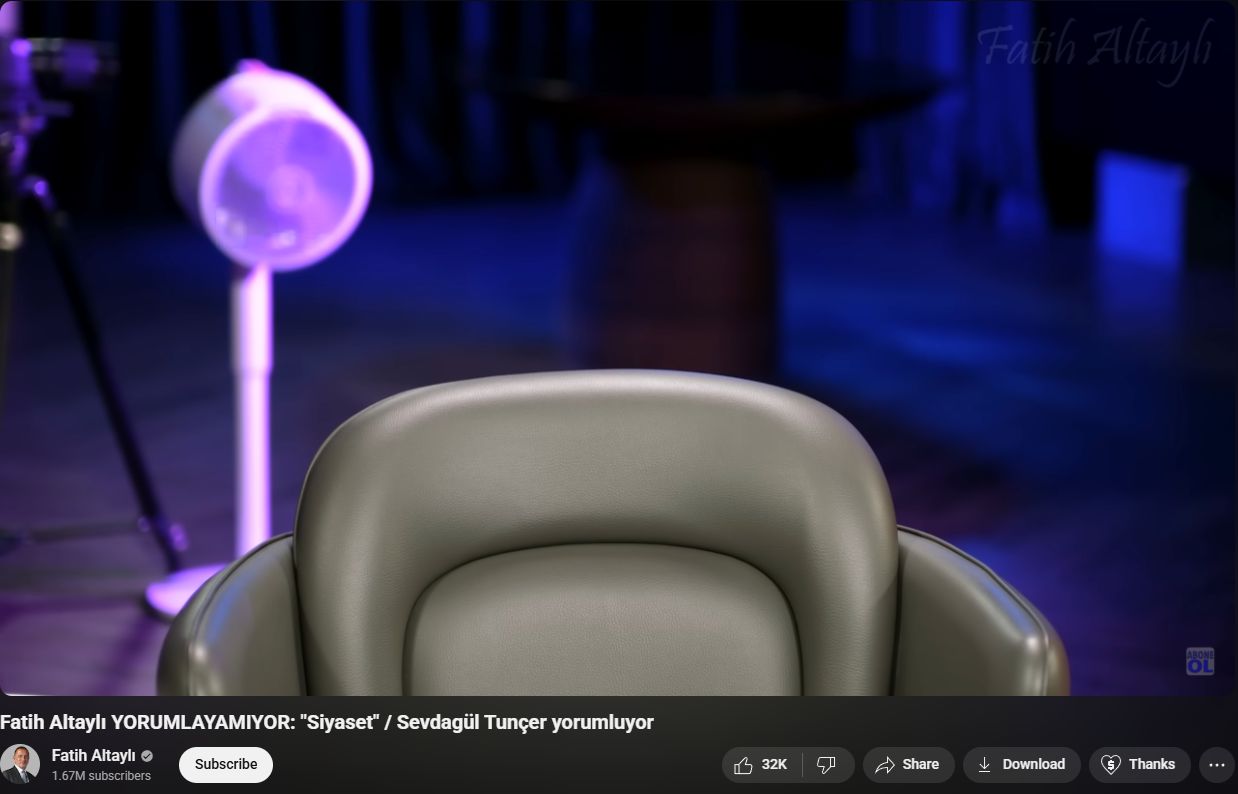
On the Monday following his arrest, his widely followed YouTube channel, where he had provided daily commentary on current affairs, posted a new video as usual. Only his chair appeared in the frame. His off-screen presenter, Emre Acar, who normally asks questions to Altaylı, reported the weekend’s incident, followed by a scrolling text of Altaylı’s statement at the police station. The last five minutes of the video showed nothing but the chair in silence. At the time of writing, it has been viewed more than 1.5 million times.
Since then, Altaylı’s letters commenting on life in prison as well as on political developments have been regularly read out by Acar with only the empty chair visible, simulating the usual format of the show. Alongside his ongoing criticism of the regime, his whimsical accounts of nonalcoholic Bellini concoctions, sunbathing in his cell’s courtyard and ironing shirts with a lunch box seem like an effort to prove that he remains defiant.
Altaylı’s scoops have continued from within the prison cell. It may seem odd that he’s able to get them, except that his fellow prisoners include numerous mayors of the main opposition Republican People’s Party (CHP) charged with having links to corruption and terrorism, including İmamoğlu. During frequent visits to the largest high-security penal facility in Europe, CHP leader Özgür Özel and his parliamentarians drop in to see Altaylı as well. Although inmates are not allowed to speak to each other, Altaylı reports the mayors’ reactions to breaking news relayed from their lawyers in neighboring booths, while treating visits by CHP lawmakers as a way to break more news. Recently, he interviewed former allies of the party’s previous chairman, Kemal Kılıçdaroğlu, reporting that the former leader was seeking his own reinstatement at any cost, a revelation that has been echoed by fellow journalists. Altaylı also sources his reportage from news material provided by his lawyer and the television in his cell.
Responding to popular demand from his followers, Altaylı’s show has been hosting a wide and politically diverse group of daily guests. After his prison letter for the day is read out, they take his seat, sometimes with playful unease, for an interview. From journalists who refer to him as “brother” to those expressing envy for his undimmed success, from an actor whom Altaylı lambasted from the same chair months ago to barely relevant politicians in want of popular attention, the broad array shows the gratifying attraction of public solidarity.
Although Altaylı’s largely secular, Kemalist and flag-waving followers are occasionally frustrated with some pro-Kurdish lawmakers or ex-ministers from former Erdoğan administrations, their continued support is an example of transcending social media-driven echo chambers. Gürkan Özturan, media freedom monitoring officer at the European Centre for Press and Media Freedom, says that a quiet consensus in favor of free expression still survives in Turkish society. In July, the month after his arrest, Altaylı’s viewership jumped by nearly 40%. Despite a slight dip in August, he is still Turkey’s most viewed independent journalist. Meanwhile, his corporate sponsors quietly withdrew support, and their logos disappeared from the screen.
Altaylı’s popularity behind bars attracts even total strangers who seek a voice through him. When he ran into fellow inmate Seçil Erzan, a former bank manager facing a 216-year jail term on charges of defrauding a group of celebrities, he didn’t recognize her at first. She later sent him a letter, via her lawyer, in the hope of getting some publicity. In another instance, the chairperson of two industrial complexes — an Erdoğan voter — visited him to talk about scores of companies exporting at a loss, facing insolvency, mass layoffs and market loss.
“What can I possibly do about it, brother? If you want, I can sit and cry with you,” replied Altaylı.
“We couldn’t explain ourselves,” said the anonymous source. “If you do it on our behalf, maybe they will hear.”
On Aug. 7, an Istanbul court issued an order to block access to Altaylı’s YouTube channel on national security grounds, due to his recent discussion of a controversial claim involving Erdoğan’s government ally, Devlet Bahçeli, and the leader of the separatist Kurdistan Workers’ Party, Abdullah Öcalan. To date, YouTube has not enforced the ban.
The antidemocratic tradition that resulted in Altaylı’s incarceration predates Erdoğan. While Freedom House declares Turkey “not free,” and labels the president as “increasingly authoritarian over the past decade,” restrictions on free expression are a broader phenomenon that also has roots in secularist, Kemalist elitism. In the late ’90s, a military coup unseated the Islamist prime minister, Necmettin Erbakan, and Erdoğan, the then-mayor of Istanbul, was imprisoned for reading a religious poem at a rally.
At the time, Altaylı was highly suspicious of the latter’s Islamist leanings and liberally used the buzzword “irtica” (reactionism), spread by the junta, that demonized all forms of political Islam. He joined the bandwagon that characterized the Islamic headscarf as a political symbol. In his column at a mainstream newspaper in April 1998, he failed to protest Erdoğan’s conviction on grounds of free expression, subtly condoning the penalty.
Once out of prison, Erdoğan roared back into politics in 2002 to upset the establishment parties at the ballot box and has ruled the country since then. However, Kemalist illiberalism is far from dismantled. Under the rule of Turkey’s most litigious president today, it is easy to forget that “insulting the legacy” of Mustafa Kemal Atatürk, the republic’s secularist founder, can lead to arrest more than 80 years after his death.
Following a decade in power marked by an economic boom, staunch support from the country’s liberals and unprecedented reforms to align Turkey with European Union accession requirements, Erdoğan faced the biggest test of his tenure in 2013. What started as an environmental sit-in in Istanbul’s Gezi Park evolved into nationwide protests against the government’s majoritarian, crony capitalistic rule. Mainstream television stations, owned by conglomerates with strong business links to the government, imposed a blackout on the events. Emboldened protesters flocked to social media for attention.
As the unrest grew, Erdoğan appeared live on the mainstream Habertürk channel with Altaylı, then chief editor of the Habertürk newspaper and a media linchpin. Confident as he always is, Erdoğan looked every inch the eloquent pragmatist, speaking with barely muted anger. As if with a genuine desire to learn, he asked Altaylı why people were protesting. Sitting right across from him, the journalist called into question the protest’s legitimacy but mentioned police brutality as motivation. Within the same discussion, he pushed back, albeit deferentially, on the president’s suggestion that the protesters were alcoholics. After the show, critics of Altaylı accused him of obsequiousness. Yet June 2, 2013 was perhaps the last time Erdoğan was challenged with tough questions live on camera.
Unable to put a lid on mass demonstrations, Erdoğan made sure that they never happened again. Today, censorship, arrests of protesters and internet restrictions are hardly news to Turkish citizens. As pro-government rhetoric has held sway over mainstream media, critical voices have been pushed toward independent journalism. Altaylı gave in only two years ago and left Habertürk, admitting that he could no longer call anyone “boss” in the media sector. Erdoğan, meanwhile, still appears on television, though in a form unrecognizable from his 2013 interview with Altaylı. Speaking to him across a Putinesque distance, his loudest defenders in the media ask questions that amplify his agenda, peppered with praise. According to a pro-Erdoğan columnist, following diplomatic visits, journalists board the presidential jet with some of their submitted questions edited out and the rest preapproved by Erdoğan’s office of communications. Elsewhere, 70% of their colleagues say they work under the shadow of detention.
Between earthquakes and man-made disasters, the cost of living crisis, erosion of civil liberties and the severe crackdown on the main opposition party that continues to damage the economy, headlines inevitably lose their shock value in Turkey. Many others who were jailed before Altaylı have been successfully silenced. Yet he has chosen to remain part of the conversation by underscoring his absence every day, hence the semiotic power of his empty chair. Along with the presenter’s opening lines, identical except for the number of days since his arrest, the fixed image of the chair is both a refusal to normalize his absence and a dogged attempt at relevance.
Make no mistake — Altaylı is no saint. Yet solidarity against antidemocratic practices casts a wide net in Turkey today. A decade ago, when the country was the world’s leading jailer of journalists, Altaylı infamously said that he had zero interest in visiting any of them in prison. With an outpouring of support from his colleagues now, it remains to be seen whether he’s changed his mind. What’s certain is that, deprived of freedom, he’s been redefining the very act of journalism in Turkey.
“Spotlight” is a newsletter about underreported cultural trends and news from around the world, emailed to subscribers twice a week. Sign up here.