

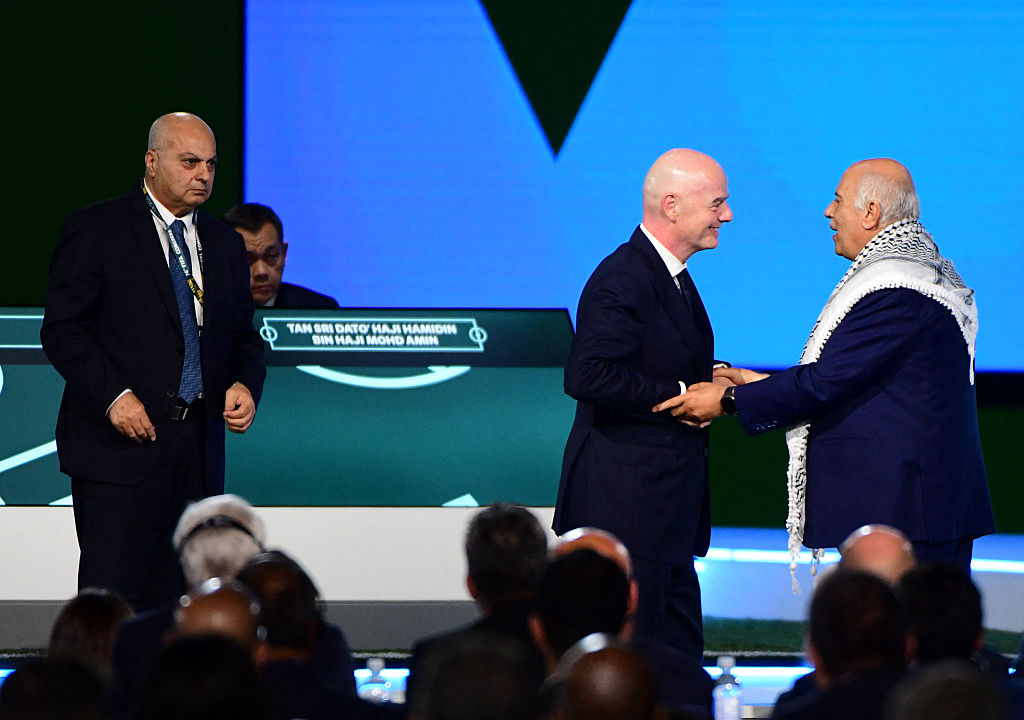
Gianni Infantino, the president of world soccer’s governing body FIFA, is no stranger to moments of full-fledged cringe.
There was the hobnobbing with Vladimir Putin at the 2018 World Cup in Russia, and batting away criticism of Qatar’s human rights record ahead of the 2022 edition with his oft-memed declaration: “Today I feel Qatari. Today I feel Arabic. Today I feel African. Today I feel gay. Today I feel disabled. Today I feel [like] a migrant worker.” Then there was the moment when he handed Donald Trump FIFA’s inaugural peace prize.
So it perhaps wasn’t a surprise when Infantino, who is seeking reelection next year (likely facing no serious opposition) and has sought to style himself as a magnanimous peacemaker, tried to force a handshake between the president of the Palestinian Football Association and the vice president of Israel’s soccer governing body during a FIFA congress in Vancouver. The gambit failed and backfired publicly.
First, some context. FIFA was holding its 26th annual congress in Vancouver this week ahead of the World Cup, which kicks off in June and is hosted by Canada, the U.S. and Mexico (officials from the Iranian federation were denied entry to attend the congress).
The Palestinian FA president, Jibril Rajoub, delivered a 15-minute address at the congress in which he called on FIFA to apply its own rules and statutes on discrimination and sanction the Israeli FA for multiple offenses, from killing Palestinian footballers and destroying sports facilities in Gaza to allowing Israeli clubs from illegal West Bank settlements to participate in the domestic league and competitions.
The Palestinians are appealing a FIFA decision in March not to sanction the Israeli FA over the settlement clubs. The global governing body cited the excuse that the “final legal status of the West Bank remains an unresolved and highly complex matter under public international law,” despite rulings by the International Court of Justice declaring settlements illegal. The Palestinian FA said in August last year that Israel had killed 808 athletes, half of whom were children, since it launched its war on Gaza. Of the 808, 421 were soccer players.
One of them was Suleiman al-Obeid, nicknamed the Palestinian Pele, who was killed in an Israeli attack while waiting for humanitarian aid in southern Gaza in August. He had scored 100 career goals and played in 24 international matches for Palestine. Israel also killed Hani al-Masdar, coach of the Palestinian Olympic soccer team; Nagham Abu Samra, a karate champion who was supposed to compete in the Paris Olympics; Hani Mesmeh, a FIFA international referee; and Muhannad al-Lili, a national team player. Majed Abu Maraheel, Palestine’s first Olympic flag bearer, died of kidney failure attributed to power cuts and medical shortages caused by the Israeli bombing campaign. Israel also bombed sporting facilities, including the Palestinian FA headquarters, and used one of the stadiums in Gaza as a detention center for Palestinians.
After Rajoub declined on stage to shake hands with Israel’s representative and hugged Infantino and kissed his cheek, the Italian-Swiss FIFA president took to the stage to declare that they would all work together “to give hope to the children.”
Asked about the onstage exchange, Palestinian FA Vice President Susan Shalabi said Rajoub told Infantino: “I cannot shake the hand of someone the Israelis have brought to whitewash their fascism and genocide.”
Infantino’s move, of course, undercut the point the Palestinians were trying to make: that FIFA ought to apply its own vaunted rules against discrimination and violence to Israel. Israel was allowed to compete in soccer competitions and the World Cup qualification campaign despite the genocide in Gaza, while Russia remains under sanction and barred from all competitions because of its invasion of Ukraine. This hypocrisy has drawn the ire of football fans and prompted some isolated actions of solidarity but little in the way of real change. Norway donated the proceeds from its home game against Israel in the World Cup qualifiers to humanitarian aid for Gaza, and the world’s most famous coach, Pep Guardiola of Barcelona and Manchester City, has spoken out in support of Palestinian rights on numerous occasions.
The World Cup is coming up in six weeks, and its legacy has already been tarnished by American militarism and xenophobia, as well as FIFA’s increasingly close relationship with Donald Trump, spearheaded by Infantino. In his delusions of grandeur, the FIFA president has sought to style himself a politico and peacemaker-in-the-making, one who hopes to capitalize on soccer’s supposed ability to bridge the gap between peoples and nations.
But Infantino’s gestures are performative and meaningless, seeking to paper over real cracks and fissures, over structural and institutional matters, over questions of war, peace and genocide, that sports will simply accentuate, not heal.