

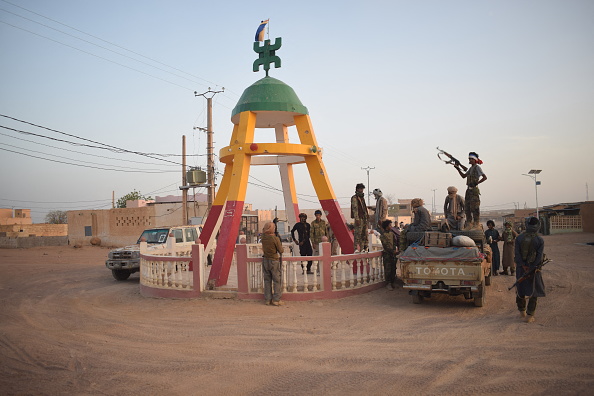
Last Saturday, videos began to circulate on social media across Mali of trucks laden with machine guns and armed men rolling into the outskirts of Bamako, the nation’s capital. Gunfire was heard at one of the country’s key garrisons just west of the city; a truck bomb exploded in another city, killing the defense minister; Russian mercenaries from the private security firm Africa Corps, which had been brought in by the military junta that has ruled this West African nation since 2020, were evacuated from their positions thanks to some diplomatic wrangling from Algeria. An unlikely alliance — the Tuareg separatist movement Azawad Liberation Front (FLA) and an al Qaeda-linked jihadist group known as JNIM — had dealt a stunning blow to the junta, one that may be the death knell for the regime.
“It was a groundswell, a major turning point,” Nasser Weddady, a Mauritanian-American analyst, told me on Tuesday, “but it was not a surprise.” The system that the junta had employed in recent years — unceremoniously booting the French military from counterterrorism installations in the country and instead inviting Russian paramilitary forces, first in the form of the Wagner Group then its offshoot Africa Corps, to tamp down on terrorism — “was just magical thinking. It didn’t work and was always destined to fail.”
In a wide-ranging interview, Weddady and I spoke about the complex sociological roots of Mali’s troubles — the severing of the pastoralist, nomadic Tuareg peoples of the Sahel from their natural communities during the decolonization of West Africa, a series of catastrophic droughts that collapsed the nomadic way of life and the pitting against one another of different ethnicities that has led to decades of violence spilling beyond Mali’s borders and into the broader Sahel. “The problem in Mali isn’t a religious one,” he said, noting that many western analysts focus on the fact that JNIM is aligned with al Qaeda and assume this is a sectarian conflict. Instead, “it is an ethnic and governance one.”
Weddady compared last weekend’s strikes to the Tet Offensive in the Vietnam War: “The real aim is not to win the battle, but to score a political point, showing that there’s no military solution, and to demoralize the adversary.” But if the FLA-JNIM alliance manages to topple the junta, a major question still remains: What does each side have to gain?
The FLA’s primary goal is to achieve an independent homeland for the Tuareg people, called Azawad. Weddady says this is unlikely: “There’s an African continental norm that was only reinforced the one time it was violated, with the independence of South Sudan,” he said. “The only ‘never again’ that holds in international relations is ‘no new African countries.’”
The future is still unclear for Mali, but Weddady sees a path forward that brings marginalized groups into the foreground and enables an end to decades of conflict. “The junta has failed,” he said, and the government needs to begin to take seriously the concerns of the people in the interior of the country. “They, too, are Malians — they are equal citizens and have equal rights.”
Watch the full interview: