

The US-Israel Attack on Iran Is a Wake-Up Call for the Gulf
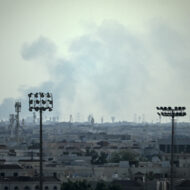
The retaliatory Iranian strikes on the Gulf after the joint U.S.-Israeli bombardment are surreal to behold, though not unprecedented, following the few limited attacks in response to the Israeli campaign against Iran and its leadership last year. The bewilderment of residents of the United Arab Emirates, Qatar and Bahrain as missiles sailed overhead or landed in their countries is exactly the sort of thing that has prompted American allies in the region to lobby incessantly, in a flurry of diplomacy over the past few months, to head off possible U.S. strikes.
There is of course a grand, tragic irony to the security architecture America built in the region in the aftermath of the first Gulf War: It was conceived to protect the Gulf states from Iranian aggression in the event of a war with Israel sparked by violence between it and Tehran’s regional proxies.
The Gulf states will now have to adapt to a world where America is the primary threat to regional security and stability.
Much of the Gulf’s identity over the past few decades has hinged on its reputation as an island of stability and peace in the midst of the firestorms raging around it. Now, the scenario these states have long feared is coming to pass because of America’s chaos agent-in-chief.
Rather than act as a bulwark against aggression, America is the reason they are being attacked, the reason they are a front line in a war that has nothing to do with them and that they used every tool at their disposal to head off.
What next? Well, that will depend on how long this new American adventure lasts. If the U.S. persists in its stated aim of regime change through a prolonged campaign, the Gulf states will likely come under increasing attacks that go beyond American air and naval bases to energy infrastructure, targets meant to make the war more costly. It is also likely that America will have helped lessen the growing animosity between the strongest two powers in the Gulf, Saudi Arabia and the UAE, which now have to contend with a more existential crisis than their competing interests in Yemen and Sudan.
Iran is waging war on at least four neighboring countries, besides the U.S. and Israel. Messaging from voices close to the Gulf states suggests that, for now, they are focused on absorbing Iranian attacks and hoping they don’t escalate much further. Tehran knows these countries won’t retaliate, and that they’ll effectively accept being hit, as long as the damage stays manageable.
The attacks already thawed the conflict between the UAE and Saudi Arabia, after weeks of tense rhetoric and refusal of mediation to resolve their differences. The Saudi crown prince, Mohammed bin Salman, called the Emirati president, Mohammed bin Zayed, to coordinate positions on the crisis.
And if the Iranian regime survives, perhaps this will lead the Gulf states into a closer relationship with it, one that acknowledges the reality of the glowering Iranian threat while warily eyeing the American bull in the china shop.