

Mexico Convulses After the Death of Its Most Wanted Drug Lord
On Sunday, Feb. 22, environmental activists from the group A Leap of Life Collective were doing field work in the Mexican state of Jalisco when several armed men stopped their vehicle. “We were forced out of our van, which they set on fire along with our cellphones and equipment,” read a statement posted on the group’s Facebook page. The assailants then used the charred vehicle to block the road.
The attack was one of dozens of violent incidents that erupted across the country after reports that Nemesio Oseguera Cervantes, “El Mencho,” known leader of the Jalisco New Generation Cartel (CJNG), had died en route to Mexico City. The Mexican army, with help from U.S. intelligence, had detained him during an operation with the presumed goal of capturing him alive in a town in Jalisco.
Oseguera Cervantes was one of the most wanted fugitives in both Mexico and the United States. He faced multiple superseding indictments in U.S. federal court for trafficking cocaine, heroin, methamphetamine and fentanyl into the U.S. In 2024, the U.S. State Department offered a reward of up to $15 million for information on his whereabouts, while Mexico’s prosecutor’s office had a standing offer of $1.8 million ($30 million pesos) from 2018.
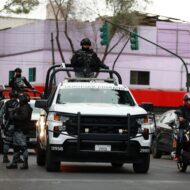
The shockwaves from Oseguera Cervantes’ death reverberated across Mexico. On Sunday alone, 20 of the country’s 32 states saw 252 “narcobloqueos” — violent road blockades carried out by organized crime groups using stolen vehicles set ablaze, a tactic used to obstruct government security operations — along with attacks on stores, banks and security forces, according to a Secretariat of Security and Citizen Protection debrief on Feb. 22. At least 70 people have been killed and more than 20 injured. Meanwhile, at least eight local reporters have been attacked, robbed or beaten while covering the events, according to Reporters Without Borders.
“What happened on Sunday revealed the most sophisticated model of criminal governance we have developed in Mexico — and probably at the continental level,” explained Rodrigo Peña, regional director of the Department of International Relations and Political Science at Tecnologico de Monterrey, one of Mexico’s leading universities in government studies, during an interview with New Lines. Particularly striking to Peña is CJNG’s “capacity to produce emotions like fear and uncertainty to manipulate the population, as well as its ability to control routes and even shape messages and narratives.”
The security crisis is also reverberating beyond Mexico’s borders. President Claudia Sheinbaum has indicated that her administration is weighing legal action against billionaire Elon Musk over his claim that she is beholden to the cartels her government says it is fighting. The tensions come as Mexico prepares to host matches in the 2026 FIFA World Cup, with Jalisco — home to one of the tournament’s key venues — expected to play a prominent role.
To many experts, the death of Oseguera Cervantes represents a victory for Sheinbaum’s administration — with a caveat. The so-called decapitation of a cartel tends to create more spikes of violence as new leadership is consolidated. As long as the potential wave of violence following the kingpin’s fall can be contained, it will be considered a win. Either way, the killing of Oseguera Cervantes represents a distancing from former President Andrés Manuel López Obrador’s security policy. Although “the President will never openly distance herself in discourse from López Obrador’s strategy,” said Peña, “there is clearly a massive gap.” The explicit difference, he explained, lies in the fact that Sheinbaum has openly said she will use intelligence in the contestation of territorial control with criminal networks, while López Obrador famously stated he would only fight “balazos con abrazos,” or bullets with hugs.
Even for those not directly affected by the blockades, the death of Oseguera Cervantes left a feeling of looming fear and uncertainty. Marlen Román Carrillo, a doctoral student, had just arrived in Mexico City to resume classes on Monday when she heard that a convenience store two blocks from her house in her home state of Morelos was set on fire. The incident left her thinking how “the web of organized crime is woven across the entire country, in everyday places, without us noticing,” she told New Lines. “I’m really scared.”