

Kashmiris, Drawing on Historical Ties to Persia, Are Donating Their Life Savings to Iran
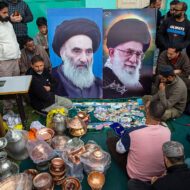
Opposition to the Iran war has taken various forms throughout South Asia, from protests and prayers to overt statements of support for the country and its people. Across the Kashmir region in India, people are parting with their most cherished possessions and life savings to donate to the Iranian Embassy — part of a campaign that taps into old cultural bonds with Persia. Collection centers have sprung up in both rural areas and urban neighborhoods. Perhaps most notably, the Iranian Embassy in New Delhi, having provided online banking details for Indians wishing to send money, is posting images of these efforts to social media. Tens of millions of dollars have reportedly been donated, though the embassy has not clarified what the donations are funding.
The donation drive follows mass demonstrations that erupted after the killing of Iran’s Supreme Leader Ayatollah Ali Khamenei. Thousands of people poured into the streets all over Kashmir, chanting slogans and reciting lamentations of grief. Men and women beat their chests in mourning and burned effigies of Israeli Prime Minister Benjamin Netanyahu and U.S. President Donald Trump. Kashmiris had not come out like this since 2019, when the Indian government repealed the region’s special status and imposed a months-long lockdown. In response, the authorities swiftly imposed restrictions to curtail the gatherings.
Almost a month into the war, protest rallies have morphed into a mass donation campaign in the Kashmir Valley. Images and videos circulating online show children offering coin banks containing the small savings they had set aside. Photographs show the clay banks being smashed open and their contents pooled together. In a viral video, a teary-eyed woman was seen parting with a piece of gold jewelry, a memento of her late husband who died almost three decades ago.
Women are lining up outside mosques to donate whatever they have — a pair of earrings, a gold ring or copper utensils from their kitchens. Brides are parting with their wedding gold. People are also donating livestock and motorbikes.
The story caught the Indian media’s attention, but coverage has framed Kashmir’s solidarity with the Islamic Republic through the narrow lens of the region’s Shiite minority, understating the centuries-old cultural ties with Persia.
Those ties go back to the 14th century, when the Persian Sufi saint Mir Sayyid Ali Hamadani arrived in the valley. He is credited with spreading Islam in Kashmir, but he left an imprint that went far beyond the spiritual realm, and continues to define Kashmiri identity to this day.
When Hamadani arrived in Kashmir, he brought with him hundreds of disciples, artisans and merchants, sparking a cultural exchange that continued for centuries. Persian language and literary traditions became a part of the local milieu, as did agricultural practices, arts and crafts.
The influence can be seen in the region’s carpet weaving, with rugs knotted by hand in intricate designs. Embroidery known as “kashida” can be found on clothing and in home decor. The metalwork known as “kandkari” features hand-engraved designs on copperware, often used at family feasts. Finely crafted “khatamband” woodwork adorns the ceilings of homes and mosques. Even the delicate papier-mache so emblematic of the valley carries this legacy.
The dried fruits and saffron that Kashmir is known for bear this influence, too, as do the dishes that feature in the famous “wazwan,” Kashmir’s elaborate multicourse feast that consists of slow-cooked meats and rich gravies.
Persian was the official language of the royal courts in Kashmir for centuries, until the Dogra rulers replaced it with Urdu in the 19th century. The region was also a vibrant center of Persian literature and poetry. Ghani Kashmiri, one of the most celebrated Persian-language poets from Srinagar, was widely read in Persia.
The influence is visible in the region’s architecture, too — in the Grand Mosque of Srinagar and its pyramidal spires, or the “khanqahs” (Sufi shrines) that anchor much of the valley’s spiritual life. (Among the most prominent is the “Khanqah-e-Moula,” Hamadani’s shrine and one of Kashmir’s oldest mosques, located along the banks of the Jhelum River in downtown Srinagar.)
This deep and enduring imprint led to Kashmir being known locally as “Iran-e-Sagheer” — Persian for Little Iran — a connection that is moving even the impoverished to sell their family heirlooms. The Iranian Embassy appears ready and open to collect their donations.