

Iran’s Supreme Leader Is Dead, but Its People Remain in Peril
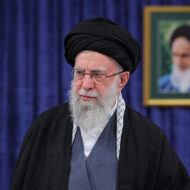
The series of strikes began in broad daylight just before 10 a.m. in Iran. Videos posted to social media showed that the Ministry of Intelligence building in Tehran was hit, along with a potential missile site in Zanjan in the country’s center, and a school in the town of Minab in the southern Hormozgan province where medical workers said that at least 108 people were killed.
As open-source investigators and analysts have been keeping an eye on the significant build-up of U.S. vessel, flight and defense assets in the Persian Gulf over the past few weeks, the sheer scale of movements indicated that military action was a near certainty. But many expected strikes to occur overnight in Iran under the cover of darkness, similar to the opening salvo of the 12-day war in June 2025 that targeted nuclear scientists and military commanders as they slept in their beds.
While the U.S. and Israel tried to frame that war as a necessary operation to stop Iran’s nuclear development, many analysts rightly viewed it as an attempt at regime change. With Ayatollah Ali Khamenei still alive, the operation was incomplete. Strikes on Iran were bound to continue until the death of the supreme leader.
In the clear light of day while in his compound, that finally happened. The U.S. and its partners killed Khamenei.
It’s widely known that Khamenei was spending his time in a fortified compound known as the Leadership House in Tehran’s District 11. One video showed thick gray smoke billowing into the sky from the direction of the compound. Satellite imagery showed multiple buildings that were destroyed.
Israeli media began confirming Khamenei’s death first, saying that Israel’s leaders had seen images of his body in the rubble. Then, on Truth Social, President Donald Trump first declared that Khamenei was dead.
“Khamenei, one of the most evil people in History, is dead. This is not only Justice for the people of Iran, but for all Great Americans, and those people from many Countries throughout the World, that have been killed or mutilated by Khamenei and his gang of bloodthirsty THUGS,” he wrote.
“The heavy and pinpoint bombing, however, will continue, uninterrupted throughout the week or, as long as necessary to achieve our objective of PEACE THROUGHOUT THE MIDDLE EAST AND, INDEED, THE WORLD!”
Late on Saturday, Iranian state television also confirmed Khamenei’s death.
A near-total internet blackout has once again taken hold in Iran. Connectivity has become a privilege. Only those with access to Starlink and other forms of circumvention have been able to connect to the outside world.
“It seems he died. Died. The murderer of our dreams died. The murderer of our youth died,” said one source from Tehran in a voice note. Their voice trembled and broke, using just seconds of connectivity to deliver the news.
Iranians have already been celebrating in the streets. In Karaj, a crowd line danced arm in arm as bystanders whistled and cheered around them. Cars revved their engines in support of a crowd in Abadan dancing and whistling as they held up a poster of a young Iranian killed in the most recent protests only weeks ago.
Others were more cautious, peering over the edge of uncertainty for what’s to come in a situation for which there is no precedent.
“They’ve known decapitation strikes would be coming and have contingency plans,” Alireza Talakoubnejad wrote on X. He pointed to what Iran might be thinking of next — whether it could meaningfully hit targets that would make “the enemy feel pain” or withstand sustained forthcoming strikes.
“They’ve had 25 years post-9/11 culminating to this moment to plan for this. The only way they don’t get totally Qajar capitulated is acting like a madman,” he wrote, referring to the pre-Pahlavi monarchy that ended in a bloodless coup led by Reza Khan, a Persian Cossack Brigade officer. Khan was then named shah by the Parliament, becoming Reza Shah Pahlavi, the father of the last shah of Iran.
Other Iran watchers also urged caution.
“As you read this, there is already a new Supreme Leader. We just don’t know who,” wrote Iman Jalali on X. “This isn’t Maduro. The government didn’t get overthrown. The system absorbed the hit. That’s what it was designed to do.”
“Every credible intel assessment says the same thing: a post-Khamenei Iran is more likely to get harder, not softer. More IRGC [Islamic Republican Guards Corps]. More dangerous. Potentially worse for the Iranian people than Khamenei himself,” Jalali added.
“Don’t breathe yet. There’s a long way to go.”