

The Gulf’s Neutrality Is Cracking Under Iran’s Escalations
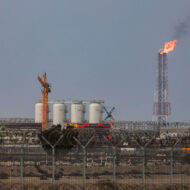
The Gulf states have been largely circumspect in their public reactions to the war in Iran and the aggression the Islamic Republic has inflicted on its neighbors in response to U.S.-Israeli bombardment. But that stance appears to be shifting in the wake of Tehran’s latest escalation, signaling a new phase in the war and the diplomatic efforts taking place in the background.
On Wednesday, Iran bombed Qatar’s Ras Laffan Industrial City, the beating heart of the emirate’s energy sector. In an official statement, Doha said that extensive fires had damaged the facility, a purpose-built industrial area 50 miles from the capital, built to exploit the world’s largest natural gas reservoir, the North Dome field that Qatar shares with Iran, which calls the field South Pars.
In the statement, Qatar decried the “brutal” attack, and went a step further than in its previous denunciations, which largely reiterated its neutrality in the war and its refusal to allow its territory to be used to bomb Iran. It called on the U.N. Security Council to assume its responsibilities for international peace and security and to put an end to the attacks on its territory. Qatar also ordered the Iranian security and military attaches to leave the country.
Earlier today, in response to attacks on South Pars, Iran had explicitly threatened oil facilities in Qatar, Saudi Arabia and the United Arab Emirates, saying it would attack them in response to the bombing of its oil infrastructure. Riyadh said today it had intercepted ballistic missiles aimed at its oil-rich Eastern Province.
The escalation of the attacks and the Gulf’s increasingly angry rhetoric are bringing to a head a key contradiction that has long plagued the region’s rulers: They spent much of the run-up to the war arguing against it (despite disputed reporting claiming otherwise), guessing correctly that their countries would bear the brunt of Iran’s response in a war they neither chose nor involved themselves in. But now that Iran is widening its assault on its neighbors, they also fear what comes next from an emboldened Tehran if America and Israel don’t finish the job.
This anxiety comes across in a recent Financial Times essay. It quoted sources familiar with Riyadh’s thinking as saying that Saudi Arabia did not want regime change in Iran but did want a weakened Tehran. “There is a cost to what’s happening, but to what extent do you want to say: ‘Let’s not stop now. Just give it another push,’” the paper quoted one source as saying. “You don’t want to end up in no man’s land.”
In a Wall Street Journal report, a senior Gulf official was quoted as saying that the only acceptable outcome of the war would be “an Iran so defanged and enfeebled that it could never imperil its neighbors again.”
The UAE’s foreign minister, Abdullah bin Zayed, pulled no punches in condemning what he described as “terrorist attacks” by Iran in the UAE and the Gulf, the first time he has used those words to describe the bombardment. Anwar Gargash, a former foreign minister and a top adviser to the Emirati president, was quoted by Bloomberg as saying that Iran had exposed itself as the region’s primary destabilizing force, and that Gulf states had grown “much more skeptical about Iran owning a nuclear program and owning a missile and drone program of the style that they do.” He went further, suggesting that the war would cause countries that had normalized ties with Israel to strengthen these ties, and could prompt others to open new channels. He also said his country would be open to partaking in a multinational coalition force meant to police the Strait of Hormuz, which Iran has closed.
The shift is subtle as well. As is often the case in the Gulf, it can be seen in the stories that media outlets do and do not cover. Qatar’s Al Jazeera, which has largely focused on portraying the war from Iran’s perspective, now publishes the responses to Iran’s attacks on its homepage, along with columns arguing that the massive missile attacks Iran has carried out on its Gulf neighbors constitute a strategic mistake.
Abdulrahman al-Rashed, a prominent Saudi columnist, has echoed that assessment of the war. He highlighted a possible future scenario in which President Donald Trump, having achieved some of his objectives, declares victory and leaves. But he argued that the U.S. president is not currently under popular and military pressure to do so. On the contrary, he argued, Trump seems committed to carrying on the war, which has so far succeeded in degrading Iran’s military capabilities. Al-Rashed argued that the Gulf states, despite American pressure, have no desire to join the war “as long as they do not have to,” and signaled that Iran has left the door open for future rapprochement despite its attacks.
Iran, on the other hand, is holding steady on its justification for the onslaught on Gulf nations, a strategy meant to exert pressure on the U.S. by maximizing pain for its allies. A day before Iran’s attack on Qatar, the Iranian foreign minister, Abbas Araghchi, told Al Jazeera that the escalations in the Gulf should not be blamed on Iran. “We did not start it,” he told the Qatari channel. “The United States started it and is responsible for all the consequences of this war — human and financial — whether for Iran, for the region, or for the entire world.”