

A ‘Friendly Fire’ Incident in Kuwait Points to the Peril of AI Systems
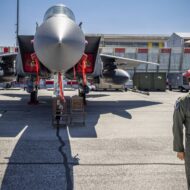
Kuwait’s “friendly fire” downing of three F-15 fighter jets on Sunday, which cost the United States nearly a quarter of a billion dollars in a matter of minutes, points to some potential blind spots in the operation of multibillion-dollar high-tech weaponry systems. Fortunately, the incident was not fatal, but it remains pivotal, particularly since it comes on the heels of a showdown between Secretary of Defense Pete Hegseth and leading AI tech firm Anthropic over the use of fully automated weapons that could be tasked with making fatal decisions without human input.
Though “friendly fire” is nothing new — by some estimates, up to 20% of all wartime casualties can be the result of these incidents — mistakenly shooting down a jet is rare for the U.S. and its allies because of air superiority in all wars fought since Operation Desert Storm in 1991.
“It’s puzzling to me how that could have happened,” a retired service member who served in Kuwait in the 1990s told New Lines on condition of anonymity, referring to Sunday’s incident.
He added that when the U.S. sells allies sophisticated systems like Patriot missiles, the weaponry is accompanied by U.S. personnel who oversee training, maintenance and operational support. “These weapons are very sophisticated, and we don’t just hand them over and tell the host nation to operate them without giving them the support they need to use and maintain them properly.”
Both the U.S. and Kuwait, which has purchased billions of dollars worth of U.S. weapons, have acknowledged the incident as friendly fire but have not yet given specifics on how it occurred, pending an investigation. A Wall Street Journal report published on Tuesday cites anonymous sources who blame the incident on a U.S.-manufactured, Kuwaiti-operated fighter jet, the F/A-18 Hornet, but the general consensus points to a Kuwait-operated Patriot missile as the culprit. Either way, the hardware and the training are provided by the U.S., which has so far this year provided $800 million of support for Kuwait’s Patriot air defense systems. Safeguards should have been in place to prevent such a colossal mistake.
The software embedded in a Patriot missile is programmed to recognize (and not target) other U.S. military or allied assets like fighter jets. The aim of Patriot missiles stationed in the Gulf is chiefly to defend against ballistic missiles from Iran, which behave and appear differently on military sensor data than an F-15, so it is not clear why the program would mistake the two.
“Also, when an object appears on radar, it pings its IFF,” explained the servicemember, referring to the “Identification Friend or Foe” communication protocol used by commercial and military aircraft when they communicate with the ground or other aircraft near them in the air.
Whether the culprit was an air-bound Kuwaiti-operated Hornet or a Patriot missile battery on the ground, did all three F-15 jets fail to transpond their IFF when detected by radar? Or was there an issue on the receiving end, with crew or software — or both — failing to recognize the IFF?
The fog of war can often be blamed in incidents of friendly fire, though it is more pertinent in ground combat, among infantry and artillery operators in the heat of battle. It is difficult to fault the fog of war in air-to-air or ground-to-air friendly fire incidents when the world’s superior militaries operate billion-dollar technologies. When these tragic failures have occurred in the past, there has been a swift attempt to identify the problem and implement lessons learned to avoid future mistakes.
In December 2024, a U.S. Navy ship mistakenly shot down a U.S. Super Hornet over the Red Sea, having misidentified the craft as a Houthi missile. (Both pilots ejected to safety.) During the Iraq war in 2003, a U.S. Patriot missile situated near the Kuwaiti border shot down a British Tornado, killing both pilots on board. In a separate incident that year, a Patriot missile shot down a U.S. Navy jet, killing the pilot.
Inquiries later found that failures occurred on all sides. The Tornado’s transponder failed to identify itself as friendly, and the U.S. crew operating the Patriot missile battery apparently lacked sufficient training as well as a necessary piece of equipment that might have prevented the incident.
Whatever caused the friendly fire mishap over Kuwait may not come to light anytime soon, as the Trump administration eschews transparency and the often defensive Hegseth prefers to go on camera and yell at members of the media in his version of masculine strength rather than answer their questions — or let the department’s media officer do the job.
We may never know whether Sunday’s incident was due to software or human error or both. But as AI appears on the cusp of dominating the supply chain in the defense industry, the scenario is a chilling reminder of the folly of failing to rein in judgment and error, be it machine or human.