


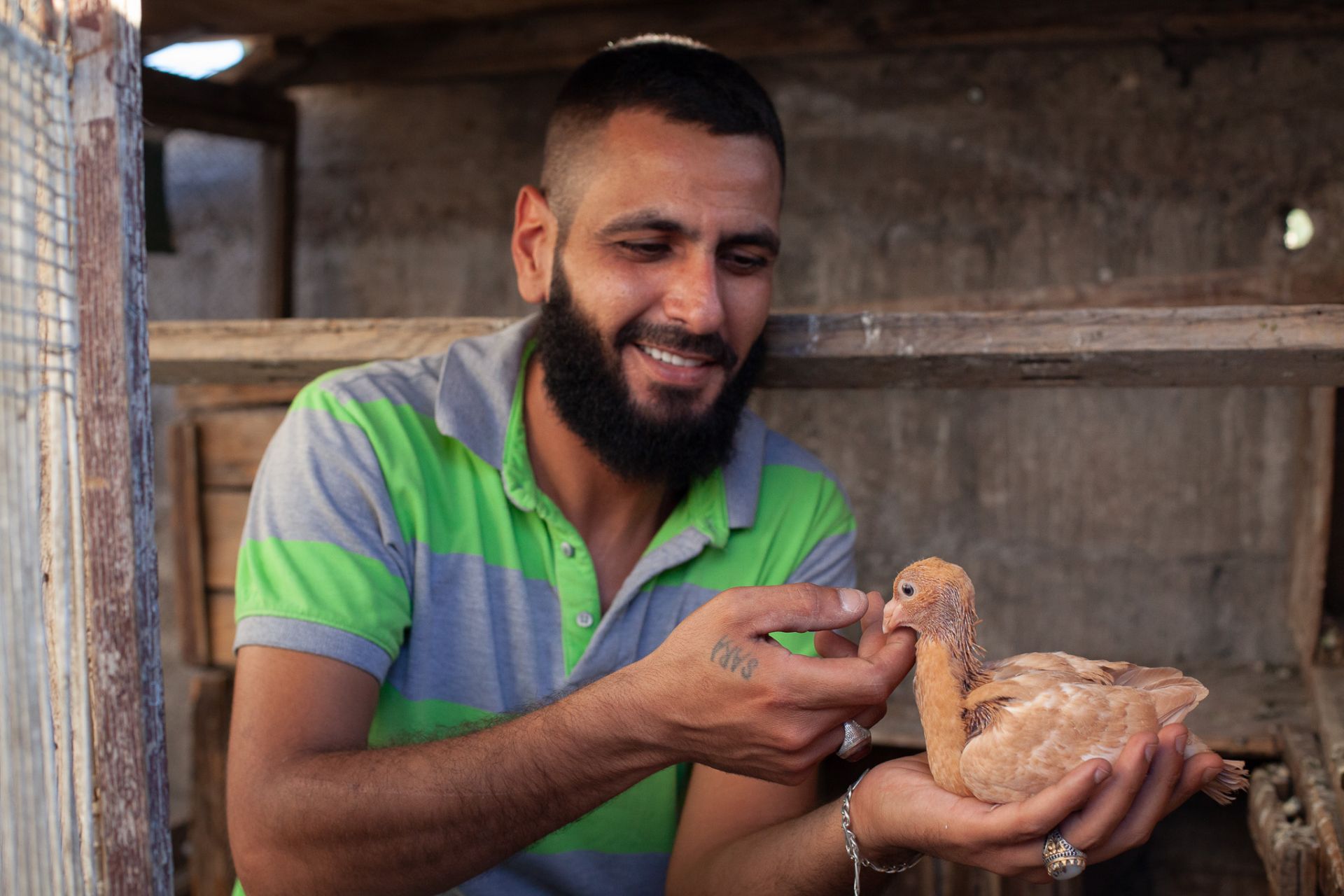
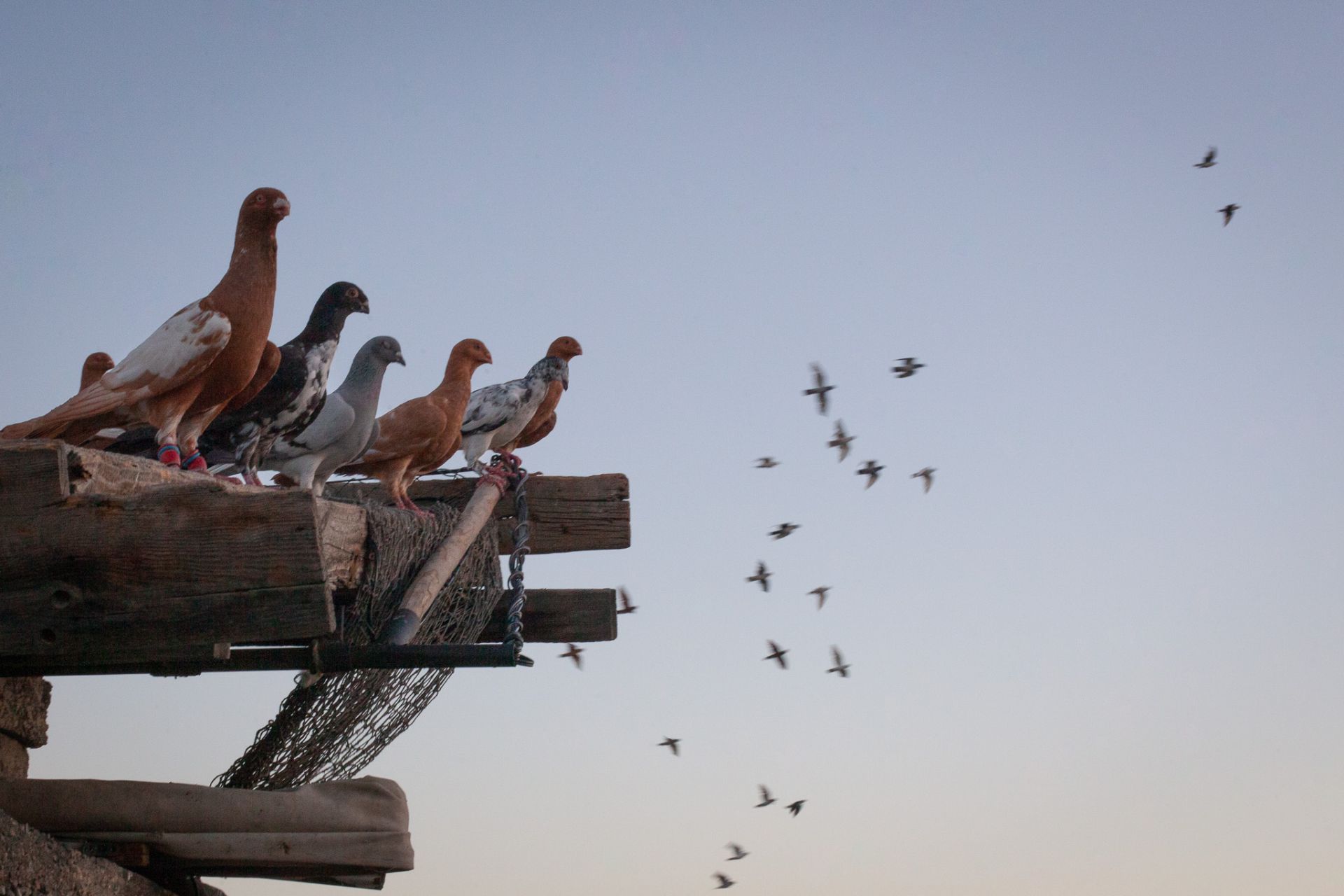
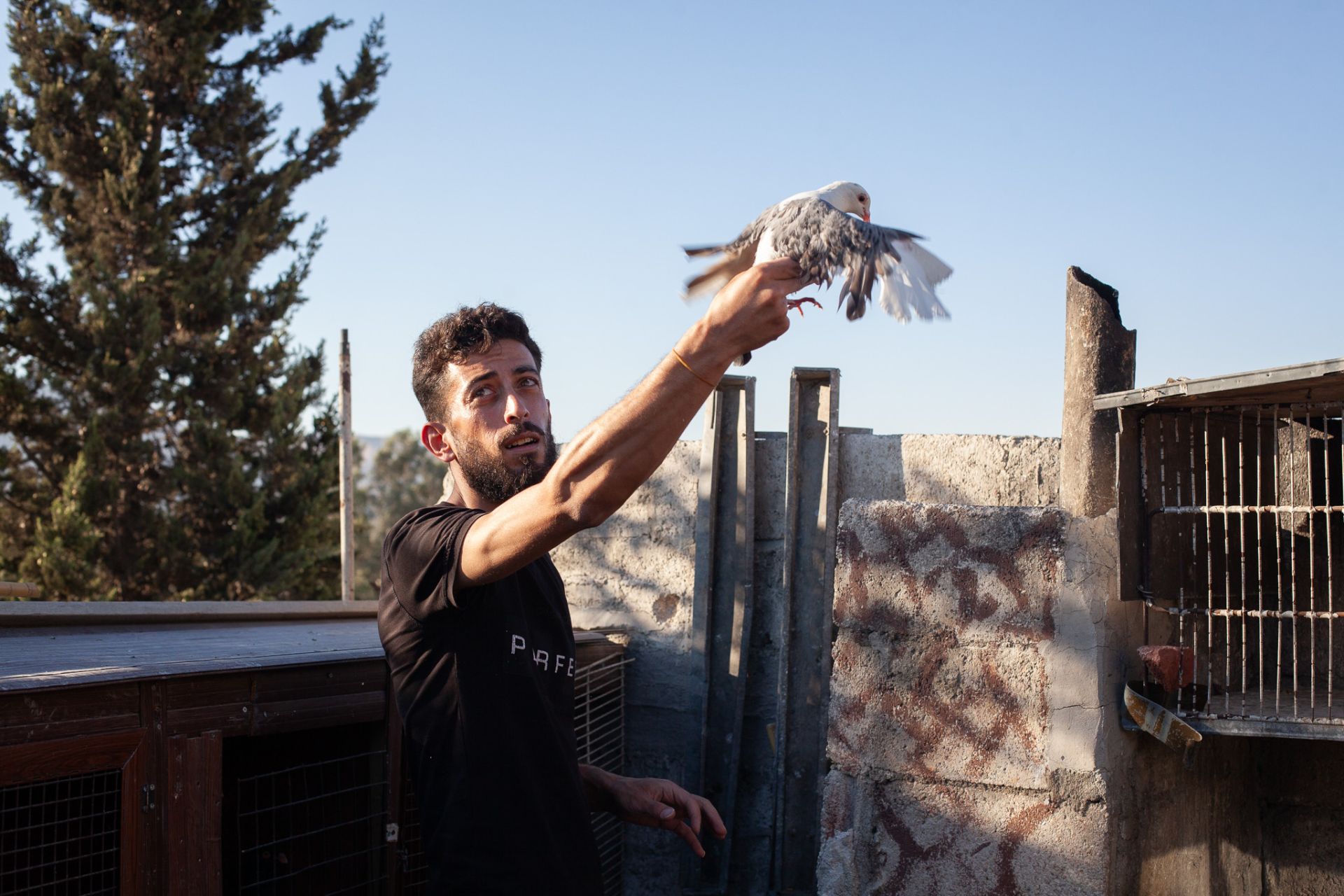
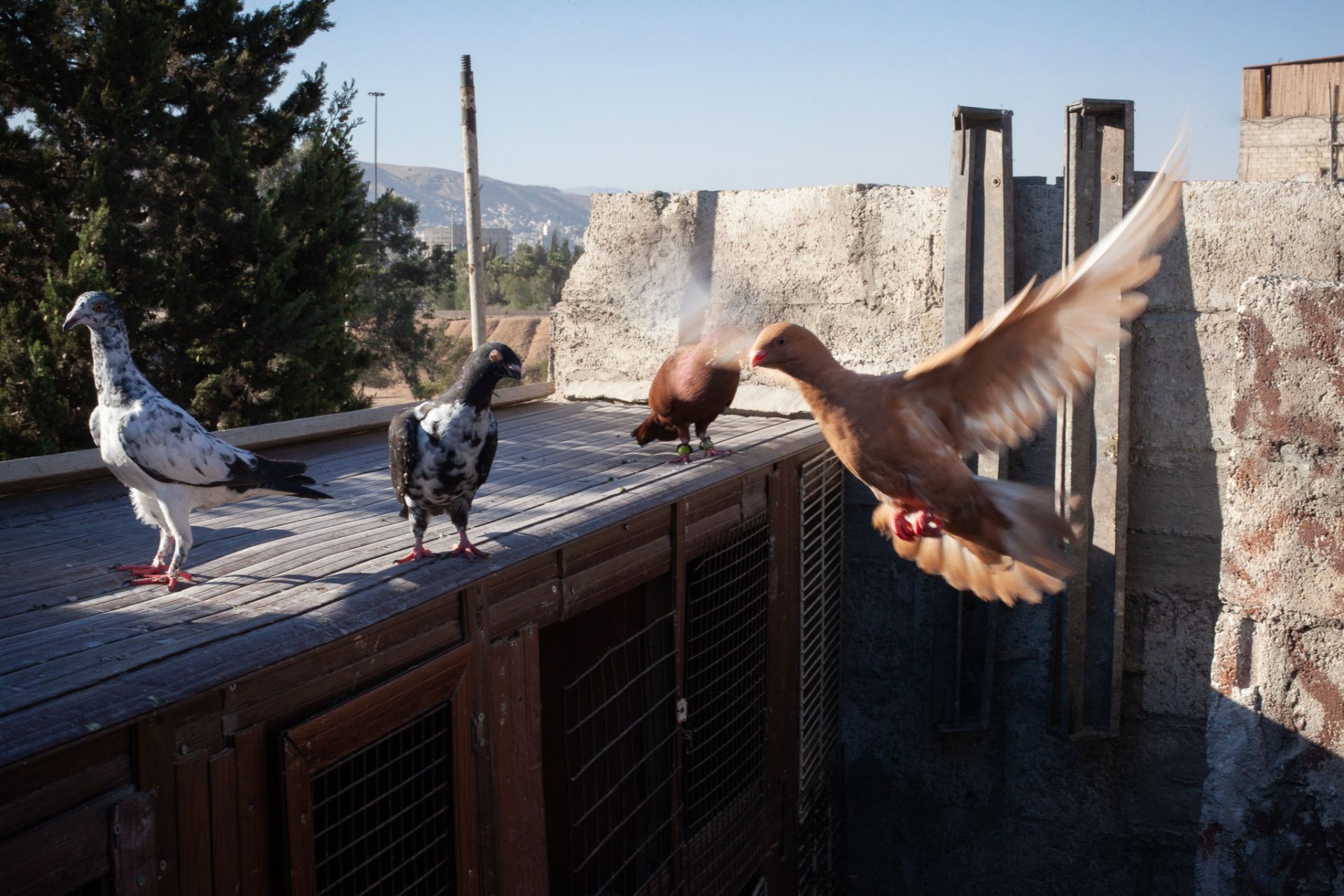

As Ibrahim Kilani unlocks the cages on his cluttered Damascus rooftop, the birds wait expectantly, and the air thrums with the sound of cooing. Dozens of them bundle onto the terrace floor, where they hesitate a while, like awkward guests at a party. But a sharp whistle blast from Ibrahim sends them skyward in a burst of color as their wings catch the setting sun.
Above the houses of Sayyida Aisha, a bustling and once revolutionary neighborhood on the outskirts of Damascus, silhouettes in tight formation trace arcs in the sky that crisscross and collide. It is a choreography as old and enchanting as the city itself. There are about six other flocks, each under the command of a pigeon fancier like Ibrahim, a “hemeimati” in local parlance, which translates as pigeoneer. And in Syria, these pigeoneers are renowned for breeding and flying the finest birds in the Middle East.
“Here is the Shami breed,” Ibrahim says, pointing to a pair of slender, charcoal pigeons still in their coop. They are of the dark “musawwad” variety, and as one of the original and most coveted breeds, each bird can fetch upward of $1,500. Ibrahim, who is quick with a joke and carries a ready smile beneath his dark beard, becomes serious for a moment. “This is ancient heritage,” he says.
The earliest recorded evidence of pigeon domestication appears in 5,000-year-old cuneiform tablets from Mesopotamia, making the shared history of man and bird as old as the invention of the wheel. Yet under the bombs and privations of the civil war, pigeon fancying almost disappeared from Syria.
For some, flying and raising pigeons are merely rooftop hobbies. For others, they are a lucrative enterprise steeped in rivalry. But for a pigeon fancier who persisted through the civil war, they represented a world he could escape to (yes, these hobbyists are always male), and a refusal to yield this last trace of his freedom.
Ibrahim squints as he spots his own flock circling back around. He shouts up a staccato order: “Tak! Tak!” The birds recognize their master’s voice and descend immediately. It seems simple enough, but Ibrahim is no novice: The 35-year-old has been training pigeons since he was 10.
A few of Ibrahim’s friends huddle onto the terrace to admire the avian performance. One of the men had recently returned to Syria after years exiled in Germany. He says that some refugees, unable to abandon their pigeons, took their best birds on that all-too-often deadly crossing to Europe.
These gatherings on Ibrahim’s rooftop had always been an important social event. “Some guys see this as a business project,” says Mohammed Kilani, Ibrahim’s cousin. “But we prefer to put down a chair and a shisha [water pipe] and just sit and watch the pigeons. It’s wrong to put a price on this.” In 2011, the outbreak of civil war forced their lives into a different rhythm and put an end to the rooftop meetings in Sayyida Aisha.
As the fighting encroached from the nearby suburbs in the east, Bashar al-Assad’s army set up checkpoints and posted snipers in high-rises overlooking the neighborhood. Gatherings of any kind were forbidden. If more than three people were seen together, it was considered a plot against the regime, and that meant automatic detention in Assad’s prison network, from which over 100,000 people never returned.
The door to the terrace opens, and a stocky, middle-aged man joins the group, introducing himself as Abu Abdullah. “This is my uncle,” Ibrahim says. “He’s the one who taught me the trade.”
Abu Abdullah owns most of the flock here, some 60 pigeons. Before the war, however, he had 500 — a collection that was the pride, and no doubt the envy, of Sayyida Aisha. When they became too expensive to keep, he sold most of them to take care of his family. “It hurt to sell them,” Abu Abdullah says. “But at the same time, we needed to eat. … We had to feed our children.”
Many pigeon fanciers across Syria were forced by necessity to sell their birds, creating a market that was as risky as it was rewarding. Smugglers would cross active war zones from rebel-held areas, bribe their way through the regime’s checkpoints and finally enter Lebanon or Jordan. With Syrian pedigrees in high demand there, some of the best birds for flying and breeding were valued in the tens of thousands of dollars. But Abu Abdullah and his nephew Ibrahim could not face letting all their birds go, and they kept raising them even as the war thickened around them.
Ibrahim points out a few bullet holes in the rusting, corrugated roof over the pigeon coops: the work of Assad’s snipers. In those days, he had to crawl from cage to cage, dragging a sack of grain behind him, to feed his birds. But if the snipers couldn’t shoot Ibrahim, they would shoot at his pigeons instead, well aware that they were adding insult to his injury in doing so. Despite the danger, and the exorbitant cost of bird feed, Ibrahim refused to stop doing what he loved. For him, the reason was simple. “You don’t stop being human,” he says. “And as long as this human being is alive, breathing, he will continue raising pigeons.”
In 2016, when intensifying urban battles made it too dangerous to stay in Sayyida Aisha, Ibrahim moved farther south to Sahnaya, on the outskirts of Damascus, taking the pigeons with him. Abu Abdullah and his immediate family were granted a visa to the United Kingdom, but he remained to take care of his mother, who was too sick to travel.
“We were in a psychological war,” Abu Abdullah says calmly between cigarettes and slices of watermelon. “There was no peace of mind, but we tried to find joy up here. This was a kind of escape for us.”
Two years later, after a truce was reached between rebel groups in Damascus and the Syrian regime, Abu Abdullah and Ibrahim returned home to Sayyida Aisha. But it was not until Assad’s fall in December that the evening gatherings on the rooftop were possible again, when they were able to fly their birds without fear.
When the news broke that Assad had fled and his army had melted into the night, Abu Abdullah felt like he was coming up for air. He had not seen many of his friends and neighbors in over a decade. “We came together, all the loved ones, for the first time,” he says. “And the children, the ones who live outside this area, now they have beards! You saw them and didn’t recognize them.”
The new Syria remains deeply divided, as waves of sectarian violence sweep through the country. But Abu Abdullah is holding out hope for the future. With his nephew, he has started to grow his loft of pigeons again. The men will drive hundreds of miles to cities like Hama and Idlib to meet breeders they trust, or eye some deals in the rebounding Friday pigeon market in Damascus. Abu Abdullah also carries with him the memory of how some of the birds he sold during the war never forgot their home. One of them returned after spending six years in a nearby town.
Though he taught Ibrahim everything he knows, Abu Abdullah had to learn by himself as a child, and in secrecy from his disapproving father. Society in general frowns upon pigeon fancying, perceived as a lowly pastime for rooftop snoops and an unworthy time and money sink that diverts a man’s resources away from his family and loved ones. Over the centuries, pigeoneers have come to be associated in popular folklore with theft, dishonesty and occasional violence, as they engage in what is known as “kash hamam,” or what one Canadian author, Marius Kociejowski, has described as “pigeon wars.” These “wars” involve no spectators, as pigeoneers train, fly and land their flock in formations that aim to lure away each other’s birds — sometimes in midflight — then lie about it to each other and to law enforcement. Violence has been known to ensue between pigeoneers amid high drama in back alleyways, leading to street fights and even stabbings and the occasional murder. One retired judge in Damascus lamented to New Lines that “the court docket used to be filled with the shenanigans of the pigeoneers,” stories of them taunting each other, claiming they’d eaten each other’s prized bird after having lured it away and so on. And courts of law have been known to reject the testimony of a pigeoneer, presuming him to be of an immoral character.
Alongside the sleazy reputation of some pigeoneers was also the self-described “gentleman pigeoneer,” who would eschew the low-level crime associated with the hobby. Ibrahim, for example, says that if he happens to lure away and catch a neighbor’s pigeon, he promptly returns it to its rightful owner. Nevertheless, given the social standing of this hobby, a pigeoneer is still liable to be fined or have his entire flock confiscated by the police if the neighbors complain.
With Syria’s war over, and a generation coming of age amid social media and digital entertainment, pigeon fancying as a hobby may be waning. Abu Abdullah laments that his grandchildren spend their evenings downstairs at home, glued to their phones. During my time with him on the rooftop, the kids never came up to see the birds fly or inquire about what we were doing.
Asked if he thought the children might one day change their minds and succumb to curiosity about the birds and how to make them maneuver in the city sky, he chuckled. “We’ll have to see.”
Become a member today to receive access to all our paywalled essays and the best of New Lines delivered to your inbox through our newsletters.