


The White House is haunted — not by the ghosts of Thomas Jefferson or Abraham Lincoln, but by the scandal-infested legacy of billionaire sex trafficker Jeffrey Epstein. Once described by Donald Trump as a man who “never dies,” Epstein’s shadow now looms over the presidency, even from beyond the grave. And it’s thrown the Trump administration into deep disarray.
There’s a clear reason for that. It’s a PR nightmare for anyone to have the kind of intimate, decades-long ties to the likes of Epstein — a sort of Gatsby-esque rapist and human trafficker who seems more like a James Bond villain than a real person — that the current president has. But for Trump, this eyebrow-raising relationship with the world’s most notorious pedophile undercuts the core political mythos that once made him so appealing to the MAGA rank and file.
“The idea of Trump as the only one who can take down the deep state is hugely important to his identity as a politician,” Mike Rothschild told New Lines. Rothschild is the author of “The Storm Is Upon Us: How QAnon Became a Movement, Cult and Conspiracy Theory of Everything” (2022) and “Jewish Space Lasers: The Rothschilds and 200 Years of Conspiracy Theories” (2023) — and, as he notes, is not to be confused with a member of the famous Rothschild family, Europe’s wealthy banking dynasty. “Trump sold himself as the ultimate outsider, the only person rich and courageous enough to fight back against elitist corruption and depravity,” Rothschild said.
This is exactly what makes Trump’s past friendship with the dead financier so radioactive: It punctures the very myth that made the president who he was to much of his base. Over the last several months, the administration has tried — and mostly failed — to distract the public from demands that it “release the Epstein files.” But no matter what was done, no matter how absurd, nothing has managed to bury the scandal.
In September, the assassination of right-wing activist Charlie Kirk on a college campus in Utah sent shockwaves across the country, not least because the gruesome killing was captured in real time and went viral on social media, where videos of the shooting were seen over 40 million times within mere hours. It seemed, for a moment, that Trump’s Epstein nightmare was finally in the rearview mirror.
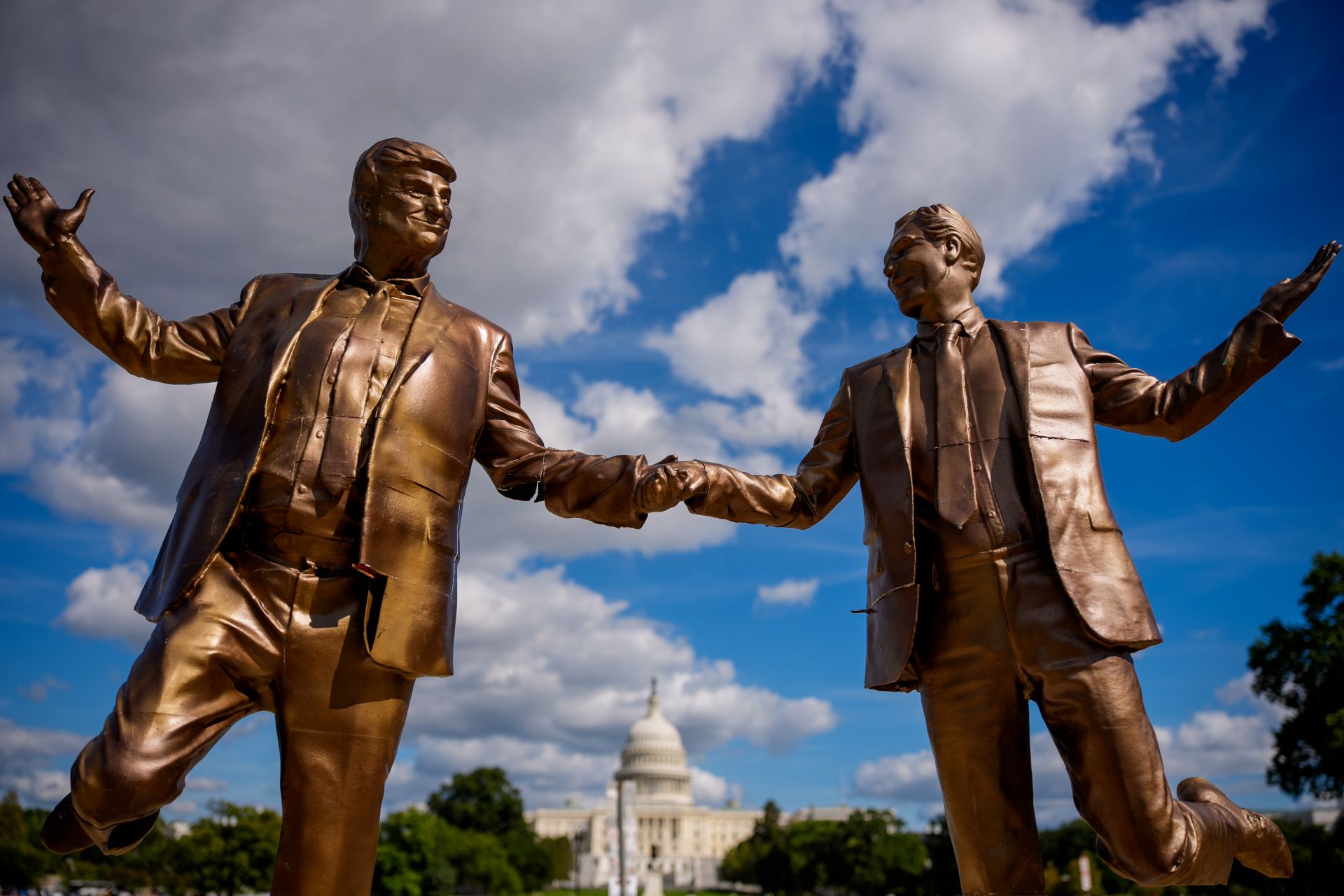
It wasn’t. A week later, while the president was visiting the British royal family at Windsor Castle, activists unfurled an enormous banner not far from where Trump was staying. On it was an old photograph of Trump and Epstein. A week after that, a bronze-painted statue appeared on the National Mall in Washington, depicting a frolicking Trump and Epstein, hand in hand, accompanied by a plaque emblazoned with the words “In Honor of Friendship Month, we celebrate the long-lasting bond between President Donald J. Trump and his ‘closest friend,’ Jeffrey Epstein.” The National Park Service wasted no time taking it down. But a few days later, the statue was back, as if to remind everyone that the scandal isn’t going anywhere.
Crafting a personal mythology is an old political strategy. In Venezuela, Hugo Chávez wasn’t just a president, but a red-beret revolutionary, a reincarnated Simón Bolívar sent to save the poor from the oligarchs. In Pakistan, Imran Khan played the role of righteous outsider: cricket star turned reformer, out to scrub the country of its corrupt ruling elites. And in Hungary, Viktor Orbán has cast himself as a gatekeeper of European Christendom: anti-Brussels, anti-immigrant and anti-Soros, he sold the idea that he and he alone could hold the line against liberal decay and globalist takeover.
Trump has played a similar hand — his manufactured political lore revolves around the narrative of a selfless crusader against an elite network of filthy rich, possibly devil-worshipping, child molesters.
Until now, Trump has courted conspiracy theories that fed into this political fiction. Though he rarely endorsed such theories explicitly, he routinely winked at them. In September 2022, he reposted an image on Truth Social showing him wearing a “Q” lapel pin alongside the slogan “The Storm is Coming.” QAnon, the belief prevalent in the extremely online MAGA-verse that a deep-state cabal of demonic pedophiles lies behind world events — and that Trump was tapped by military insiders to expose it all in a coming “storm” — has been integral to how a sizable chunk of his base came to perceive him.
This narrative portrayed Trump as an almost messianic figure waging war against an entrenched bureaucracy made up of sexual predators. And it all started when Trump and other MAGA elites slyly played political footsie with online conspiracy theories, like “Pizzagate” (more on that later) and QAnon, which were then supercharged by the mysterious death of Epstein.
In his bid to reclaim the White House in 2024, Trump made it a de facto campaign promise to release the so-called Epstein files. This played to his base and very much aligned with his political mythos. But that messaging shifted dramatically once Trump was actually back in Washington.
In sharp contrast to his team’s rhetoric on the 2024 campaign trail, Trump as president has adamantly dismissed the Epstein issue as a “hoax.” But even that narrative has been inconsistent; at other times, he’s alleged that the files are real, but nothing more than a libelous Democratic invention concocted by former FBI Director James Comey and former President Barack Obama to smear him.
And, in a seemingly desperate attempt to divert public attention, Trump’s administration has thrown out a grab bag of absurd distractions: calls to arrest Obama, or to switch the name of the Washington Commanders football team back to the Redskins, or the reigniting of Trump’s long-running feud with the comedian and talk show host Rosie O’Donnell.
But those are just decoys, examples of how Trump has been desperately lobbing media grenades to reroute the nationwide speculation about Epstein’s rumored “client list” and the administration’s suspicious U-turn away from it, which has been, as Rothschild told me, “a huge betrayal” of his base.
Trump, who once bragged that he could shoot somebody in the middle of Fifth Avenue and not lose any voters, has indeed benefited from a base whose loyalty runs deep — a base that’s described by critics as cult-like.
Until now, that is. For years, it has seemed like the MAGA movement had no red line when it came to Trump. But if we’ve learned anything from the last several months, it’s that if MAGA does have a red line, Epstein might be it.
On a recent episode of “The Joe Rogan Experience,” Rogan, who endorsed Trump in 2024, called the Epstein files “a line in the sand.” “We thought Trump was going to come in and drain the swamp. They’re trying to gaslight you,” the podcaster said.
Jacob Chansley, the shirtless, face-painted, horn-wearing poster child of the Jan. 6 Capitol riot, personifies this fissure within the base. Known online as the “QAnon Shaman,” Chansley was an ardent MAGA apostle who literally went to prison because of how far he was willing to go for Trump. But the Epstein files have corroded even Chansley’s love of the man who gave him a presidential pardon. Chansley described Trump as a “fraud” in an expletive-laden and since-deleted social media post.
If nothing else, the notorious QAnon Shaman serves as a political metaphor for today: Trump has finally crossed a line that even some of the most hardcore among his supporters can’t quite stomach.
Lauren Boebert was celebrating her 2022 primary election victory with giddy constituents at Warehouse 2565, a bar in Grand Junction, Colorado. I was there, waiting for the Republican representative to finish mingling with supporters so I could swoop in and grab a quote.
While waiting, a finger tapped my shoulder. I turned to find a paunchy, ruddy-faced man in a black T-shirt that read “We Are Q.” He asked if I was with the media. I nodded and told him I was. He grinned, fished a crumpled $20 bill from his jeans and said it was mine — if I could beat him in a wrestling match in the bar parking lot. His buddy would film it. The idea was that he, a self-described patriot, might go viral after beating me, the fake news, in a wrestling match. I politely declined the offer.
He continued to orbit me, offering to up the prize money by another $10, until, at last, Boebert strutted past us. The QAnon-clad guy approached her, shook her hand and thanked her for “fighting for the children.” She smiled courteously, and his shirt, it seemed, caught her eye, to which she gave him a knowing thumbs up. I managed to shimmy between them for my long-awaited interview.
“I say we put God, country and family first, right? And I certainly apply that in my life, but I said, you know, I want to live that out tonight and show everyone,” Boebert was telling me when her iPhone suddenly began to ring. “President Trump is calling me,” she then said and, to prove it, showed me her buzzing cellphone. The caller ID simply read “POTUS.”
Next thing I knew, my would-be wrestling partner in the black QAnon shirt and I were watching the cowboy hat-wearing, pistol-carrying Boebert scurry back to the stage, where she took back the microphone.
“Mr. President,” she began and raised her cellphone to the mic, “you are now on speakerphone.”
Trump’s voice bled through the bar’s sound system. “You have one of the greatest congresswomen, I think, in history,” he told us. “We love her. She’s special. Her family is special. And she had a big win tonight. She had a win that everybody dreams about. So, we love you all and take care of yourselves, and take care of her.”
The crowd cheered. Then, for good measure, Boebert cried, “They love you, Mr. President!”
A few days later, I found myself in a Grand Junction hotel lobby, assigned by an editor to cover another MAGA event. This time, MyPillow CEO Mike Lindell was in town to show his support for then-Mesa County Clerk Tina Peters, who was facing charges for voting machine interference. (Two years later, she was found guilty and sentenced to nine years in prison for breaching Mesa County’s election systems.)
A pair of women approached me before the event began. One was wearing a “Q” lapel on her shirt. The other had tattooed on her forearm a dramatic image of Donald Trump with bulging muscles, resembling Michael the Archangel, hoisting a sword defiantly skyward. Below the image, inscribed on this woman’s skin, were the words “Protector of our children.”
It was impossible not to spot the hues of QAnon at many of these MAGA-affiliated events and rallies. QAnon merch — things like T-shirts, flags, banners, pins, tote bags, beanies and bumper stickers — were regularly sold and worn at such events. When rioters stormed the Capitol on Jan. 6, 2021, it was no different — insurrectionists brought with them Q flags and banners while they tried to stop the certification of the election.
Sure, it’s all just political cosplay, but QAnon was not ultimately a fringe within MAGA, it was a pillar of the movement. For a good chunk of the base, the idea of elite, baby-eating satanists pulling society’s strings became a core piece of how they understood the world. And in that telling, Trump was seen as a dragon slayer.
Boebert first punched her ticket to Washington largely because voters in Colorado’s 3rd Congressional District saw her as fiercely antiestablishment and deeply pro-Trump. Her flirtations with QAnon certainly didn’t hurt her, either. “Everything that I’ve heard of Q, I hope that this is real, because it only means that America is getting stronger and better, and people are returning to conservative values, and that’s what I am for. And so everything that I have heard of this movement is only motivating and encouraging and bringing people together stronger, and if this is real, then it could be really great for our country,” she said in an interview with QAnon devotee Ann Vandersteel.
Rep. Marjorie Taylor Greene of Georgia — once a diehard, almost fanatical Trump ally in Congress — also embraced the QAnon conspiracy theory before running for office. “Q is a patriot, we know that for sure,” Greene has said. “There’s a once-in-a-lifetime opportunity to take this global cabal of Satan-worshipping pedophiles out, and I think we have the president to do it.”
Greene, though, has recently shifted gears. She’s become an outspoken ally of Epstein’s survivors, pressing for the files to finally go public. And in a November appearance on “The View,” she indicated that she didn’t buy into QAnon anymore. But it’s come at a cost. As she’s gone from fighting imaginary pedophiles to real ones, she’s found herself increasingly at odds with the very president she’d once defended with near-religious fervor. Trump called her a “ranting Lunatic” who’d “gone Far Left,” before officially yanking away his endorsement. Shortly after, Greene announced her resignation from Congress, a climax to their ugly, high-profile MAGA breakup spurred by the Epstein issue.
The rise of QAnon, it should be noted, coincided directly with the rise of Trump. It all started at a Washington pizza joint in 2016. That’s where the baseless Pizzagate conspiracy theory took root. After hackers leaked emails from John Podesta, Hillary Clinton’s campaign chair, during the presidential race, corners of the internet claimed the emails contained secret messages linking top Democrats to a child sex ring, with Comet Ping Pong — an unassuming pizzeria on Connecticut Avenue — bizarrely cast as one of the alleged hubs.
The theory quickly gained traction online, culminating in a shooter storming Comet Ping Pong with an assault rifle, claiming he was there to “rescue the children.” Trump’s silence spoke volumes, suggesting quiet approval, especially since the conspiracy targeted Clinton, his opponent.
Just before the 2016 election, Gen. Michael Flynn, a key Trump ally and future national security adviser, tweeted out wild claims about Clinton and her team. Some of Flynn’s tweets went as far as to claim Podesta took part in satanic rituals involving human blood, which helped fuel the Pizzagate fire.
By 2017, Pizzagate hadn’t faded, but metastasized. It merged with QAnon, which posited that the elites prey upon children to harvest adrenochrome in their blood that, as hypothesized by QAnon conspiracy theorists online, would maybe help the elites attain immortality.
QAnon’s genesis was in 2017 — Trump’s first year as president — when an anonymous, shadowy online figure known only as “Q” started posting cryptic messages in online forums like 4chan and 8kun (previously called 8chan). At the heart of Q’s claims was the idea that every major American institution was puppeteered by an evil occultist ring of ultrarich perverts.
Trump never disavowed these beliefs. Instead, he flirted with them. In an August 2020 press briefing, when asked about QAnon, he said: “I’ve heard these are people that love our country.” Independent researchers, including the Atlantic Council and Media Matters for America, documented hundreds of instances of Trump retweeting QAnon-affiliated accounts during his first term. And he often endorsed QAnon-associated politicians, like Boebert and Greene.
“Trump sold himself as a conspiracy theorist, the one who would say the things that other people only thought or whispered,” Rothschild told New Lines. “Many of the people who fell in with him were already longtime conspiracy believers, including some of his early hits like Obama’s birth certificate being fake and vaccinations maybe causing autism. Trump spoke directly to them, and gave them the approval they needed to become much more public with their beliefs.”
So Epstein’s arrest — and the mysterious circumstances surrounding his death soon after — unsurprisingly became a central focus among Trump’s base. To them, Epstein was bona fide, ironclad, undeniable proof that their worldview wasn’t merely the political version of “Dungeons & Dragons.”
The day after Epstein was found dead in his cell, Trump told reporters: “The question you have to ask is, did Bill Clinton go to the island? Because Epstein had an island. That was not a good place, as I understand it, and I was never there.” He then added: “So you have to ask, did Bill Clinton go to the island? That’s the question. If you find that out, you’re going to know a lot.”
Trump — who was still in power when Epstein was reported dead in jail — leveraged the online chatter about the sex offender’s strange death to his own benefit. He fanned those flames up until his reelection in November 2024. In a June 2024 interview with Fox, Trump tepidly suggested that he might release the Epstein list. Then, that September, during an interview with podcaster Lex Fridman, Trump leaned a little further into the narrative, saying that the Epstein list “probably will be” made public, and that he’d “certainly take a look at it.”
At a 2024 campaign event in Detroit, Donald Trump Jr. told a riled-up crowd that they were probably on an FBI watchlist simply for attending, before saying: “I am on every list except for the Epstein list. We haven’t heard anything about that one in a while.” Then, for good measure, he rhetorically asked the audience: “How is it that my father can be convicted of 34 crimes but no one on Epstein’s list has even been brought to light? I’m trying to figure out how that’s possible, right?”
“It’s almost like they’re trying to protect those pedophiles for some reason,” he bellowed.
This was but one example of Trump acolytes using the Epstein files as fodder before Trump assumed office again. Pam Bondi, Kash Patel and Dan Bongino each pushed, on numerous occasions, the notion that Trump would release the files.
Shandra Woworuntu told New Lines that all this posturing about the Epstein files has backfired spectacularly in the administration’s face. Woworuntu was born in Indonesia and came to the U.S. in 2001, expecting a job in hospitality. Instead, she was kidnapped and forced into the sex trade. She eventually escaped, helped convict her traffickers, and went on to found the Mentari Human Trafficking Survivor Empowerment Program, a nonprofit organization that helps survivors of human trafficking and sexual abuse reintegrate into society. Her work earned her appointments by Gov. Chris Christie to New Jersey’s Human Trafficking Commission in 2014 and by Obama to the U.S. Advisory Council on Human Trafficking a year later.
Woworuntu said that, unlike QAnon and Pizzagate, “most trafficking doesn’t happen in secret basements or political circles.” Instead, it happens in the mundane corners of everyday life, usually in marginalized, poverty-stricken communities that are especially vulnerable to exploitation. “As a survivor,” she continued, “I believe the fight against human trafficking must be rooted in truth, not fantasy.”
She described QAnon and Pizzagate as “political arenas,” adding, “Donald Trump’s battling elite sex traffickers is the central mythos within the QAnon conspiracy theory, which has deeply influenced parts of the MAGA movement.” But, Woworuntu said, Trump’s obvious Epstein ties make one thing clear: All his anti-trafficking talk was just that — talk.
It checked almost every box. Billionaire pedophiles? Check. A secret island where something akin to Stanley Kubrick’s 1999 film “Eyes Wide Shut” seemingly took place? Check. Powerful figures — Bill Clinton, Prince Andrew, Al Gore, former Israeli Prime Minister Ehud Barak, actor Kevin Spacey, Harvard law professor Alan Dershowitz and physicist Stephen Hawking — seemingly implicated? Check. The Epstein list, in other words, had all the makings of being the holy grail of right-wing conspiracy theories, if it weren’t for one debilitating flaw: Trump is apparently on it, too.
In fact, Trump’s friendship with the notorious sex offender spans decades. “I’ve known Jeff for 15 years. Terrific guy,” Trump said in a 2002 interview. “He’s a lot of fun to be with. It is even said that he likes beautiful women as much as I do, and many of them are on the younger side.”
Years later, Epstein claimed in an interview with journalist Michael Wolff that he was Trump’s “closest friend for 10 years.” Epstein would go on to say that Trump liked to have sex with the wives of his best friends. The first time Trump slept with Melania, Epstein also alleged, was on his plane, nicknamed by some the “Lolita Express” (a reference to the 1955 novel about a 12-year-old girl who is raped by the story’s middle-aged protagonist).
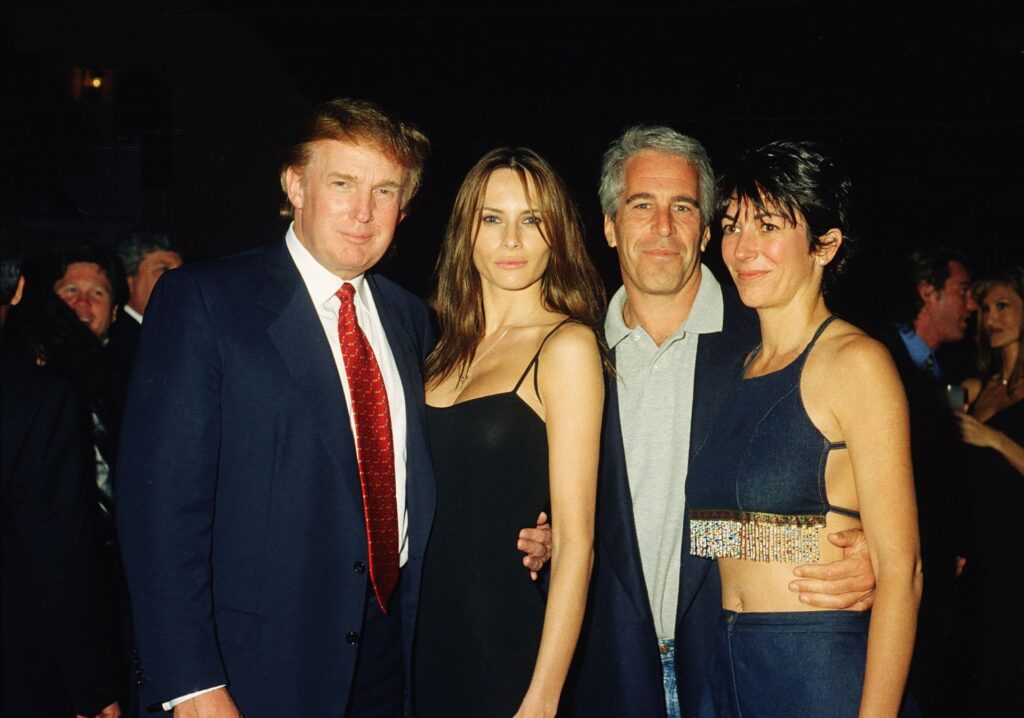
Trump, Epstein and Ghislaine Maxwell — Epstein’s girlfriend and partner-in-crime — were photographed and filmed together numerous times over the years. And according to evidence from Maxwell’s trial, Trump’s name showed up in Epstein’s flight logs seven times during the 1990s.
After Maxwell was convicted of sexually abusing minors and sentenced to 20 years in a federal prison in 2022, a reporter asked Donald Trump about whether he thought she might spill secrets about her and her boyfriend’s powerful friends. “I just wish her well, frankly,” Trump responded. Then, during the 2024 election cycle, Trump flew to campaign events in Montana, Wyoming and Colorado on one of Epstein’s former planes. These links to Epstein likely explain why, amid pressure to release the files, the administration has been, to put it one way, squirming.
In January, during his Senate confirmation hearing to be FBI director, Kash Patel vowed to expose Epstein’s high-profile connections. Less than a month later, Attorney General Pam Bondi told Fox News the Epstein list was “sitting on my desk right now to review.” Days after that, Bondi orchestrated a flashy PR stunt by handing out “The Epstein Files: Phase 1” binders at a White House event for MAGA influencers. On May 7, Bondi told reporters at the White House that, “There are tens of thousands of videos of Epstein with children or child porn and there are hundreds of victims.”
The narrative winds began to shift that same month, however, suggesting that for all Trump’s bravado and bluster over the issue, it was only ever an act of political theater. That’s because, sometime in May, Bondi reportedly told Trump that his name appeared multiple times in the Epstein files. That’s when the White House’s tune changed dramatically. In early July, the Department of Justice (DOJ) released a memo contradicting administration officials’ earlier claims that there was no client list after all — in fact, there never had been — and that Epstein had, indeed, committed suicide.
Soon after, The Wall Street Journal reported that Trump had once signed a letter to Epstein, complete with a cryptic message framed by a drawing of a naked woman. “May every day be another beautiful secret,” the letter creepily read.
Something fishy was afoot, and even some of MAGA’s most zealous knew it. Right-wingers began voicing dissent. And Trump, in a post to Truth Social, replied with the following: “My PAST supporters have bought into this ‘bullshit,’ hook, line, and sinker.” He then added: “All these people want to talk about, with strong prodding by the fake news and the success starved Dems, is the Jeffrey Epstein hoax. Let these weaklings continue forward and do the Democrats’ work, don’t even think about talking of our incredible and unprecedented success, because I don’t want their support anymore.”
All of this unfolded as Speaker Mike Johnson abruptly shut down the House of Representatives, dodging a potential bipartisan vote to release the Epstein files. Meanwhile, Todd Blanche, Trump’s former personal defense attorney and now the deputy attorney general, spent two days interviewing Maxwell from prison, prompting rumors of a possible presidential pardon for a woman convicted of trafficking underage girls.
It was revealed in late August that Maxwell, who obviously wants a pardon, had told Blanche that there was “no list,” and that she “never witnessed the president in any inappropriate setting in any way” and that “he was a gentleman in all respects.”
The convicted sex trafficker hasn’t been pardoned by the president — at least not yet. But since meeting with Blanche, Maxwell has been relocated from a Florida prison to a calmer, lower-security Texas facility, where she gets special meals and even time to play with a puppy.
Maxwell’s Trump flattery may help her get out of jail, but it hasn’t taken the heat off the administration. In fact, the scandal only spiraled further out of control in September, when Congress made a copy of Epstein’s lewd “birthday book” available to the public. Epstein’s estate handed over an electronic copy of the document to the House Oversight Committee. Bizarre is just one of many ways to describe it — a bound, three-volume book composed of personal notes for Epstein’s 50th birthday, all compiled by Maxwell and titled “The First Fifty Years.”
There’s a table of contents, which lists supposed contributors to the lurid and uncomfortably erotic 238-page book. Some of the names listed: Bill Clinton, Alan Dershowitz, Leslie Wexner, Lord Peter Mandelson and Donald Trump.
One of the book’s drawings includes a sketch of a young Epstein handing balloons to a group of children, labeled 1983. To the right is another drawing: of Epstein, albeit older, being massaged by four mostly naked women, labeled 2003 and “What a great country!”
On another page, there’s a photograph of Epstein. He’s seen holding a large novelty check for $22,500 with a “DJTRUMP” signature. The note quips that Epstein sold a “‘fully depreciated’ [woman] to Donald Trump for $22,500.” According to The New York Times, Joel Pashcow, a member of Trump’s Mar-a-Lago Club, authored that one.
“I don’t want it to be true,” a woman on X, whose profile picture featured herself clad in a red MAGA hat, wrote shortly after the birthday book was revealed, “but it really seems like Trump is part of this evil cabal of child molesters. It makes me beyond sick.” Her post, it should be noted, had hundreds of shares and even more likes.
Amanda Moore, a journalist who, as she put it, “went undercover as a Nazi for a year,” was deeply embedded in the MAGA world. Posing as a far-right Trump supporter, Moore attended numerous MAGA rallies and the Jan. 6 Capitol riot. She told New Lines that talk of “satanic pedophiles” and “hunting them down” was common, including on Jan. 6.
“It’s a core component of their entire belief system and their support for Trump,” Moore said over the phone. She thinks Trump really could have shot somebody in the middle of Fifth Avenue, or even “could’ve shot people’s parents” or “his supporters’ dogs,” and they still would have made excuses for him.
Enter the yet-to-be-released Epstein files, which, Moore said, sparked the first-ever instance of MAGA revolting against its beloved leader. “People are really upset. Really, really upset,” she said. “The rank and file are not happy. I’ve seen January 6ers I know who are just disgusted. Disgust is the sentiment I am hearing over and over again. This is not what Trump was supposed to do, they’re saying.”
Rogan — who hosted Trump just ahead of the 2024 election in a blockbuster episode that tallied tens of millions of views — has publicly grappled with the scandal. During an interview with Patel — who echoed the administration’s narrative that there were no files and Epstein really did kill himself — the episode hit an ironic note when, mid-interview, Elon Musk jumped into the discourse with a post on X: “Time to drop the really big bomb: @realDonaldTrump is in the Epstein files. That is the real reason they have not been made public. Have a nice day, DJT!”
“Jesus Christ,” Rogan said after reading the post out loud, as Patel began to flounder.
“I’m not participating in any of that conversation between Elon and Trump,” Patel immediately said. “I’m just staying out of the Trump-Elon thing, that’s way outside my lane. I know my lane and that ain’t it.”
In an even more recent episode, while speaking to a former CIA officer, Rogan reflected on both his sit-down with Patel and the Trump administration’s “Epstein file debacle.”
“The whole thing is nuts,” Rogan said. “And then [Patel] was like, ‘Well, we have a film, we’re going to release that film.’ And the film has a fucking minute missing from it. Like, do you think we’re babies?”
Rogan is one of many emerging voices in the MAGA world who aren’t pleased with the administration’s change of tune, to put it mildly. Greene is an even better example of a Trump devotee gone rogue. “If you tell the base of people, who support you, of deep state treasonous crimes, election interference, blackmail, and rich powerful elite evil cabals, then you must take down every enemy of The People,” Greene recently posted to social media, addressing Trump. She continued with: “If not, the base will turn and there’s no going back. Dangling bits of red meat no longer satisfies. They want the whole steak dinner and will accept nothing else.” Boebert also chimed in online. “We deserve the truth about the Epstein files,” she posted. “I’m ready for a Special Counsel to handle this.”
Laura Loomer, another staunch disciple of Trump, accused Bondi of “covering up child sex crimes.” She also warned in a recent interview that the Epstein files, as they’ve so far been handled by the Trump administration, threaten to “consume his presidency.” Even Alex Jones, the Infowars host and Trump toady, wrote on X in July, “Next the DOJ will say ‘Actually, Jeffrey Epstein never even existed.’” Jones also described the DOJ’s memo — the one that claimed there were no files and Epstein killed himself — as “over the top sickening.”
Andrew Schulz, an influential “podcast bro” and comedian, has also criticized the president. Like Rogan, Schulz hosted Trump on his podcast in the lead-up to the election. After Trump won, Schulz giddily credited the podcast episode for pushing the president to victory. But the Epstein scandal has made even Schulz change his tune.
“He is rebuking the base,” Schulz said on a recent episode of his show. “Like, almost like spitting in their face. They are asking for it. He campaigned on it. He puts Bongino and Kash in there, which might be the stupidest thing in the history of the world. Like, why would you put the two guys that have nonstop pounded the pavement, talking about how we’re going to expose this Epstein thing, and the second they get in there, they’re like, ‘you better shut the fuck up.’”
Ten months ago, UFC fighter Bryce Mitchell said he “would take a bullet” and “die for” Trump. But on Oct. 24, he posted a video to social media in which he said: “I’m not with Donald Trump no more. I don’t support him. I don’t like him. I think he’s a corrupted leader. Took me a while to come to that conclusion, but I’m finally coming to it. I do not like the guy at all.” The reason? Mitchell said it had to do with Epstein. “The first thing for me was he didn’t release the Epstein files — they’re even acting like they didn’t exist,” Mitchell explained, adding that he now thinks the president might be the Antichrist.
Glenn Beck and Tucker Carlson have both spoken at length about it, and videos continue to go viral of Trump supporters dousing their red MAGA hats in kerosene and torching them in an act of protest.
Meanwhile, Reps. Thomas Massie, a Republican from Kentucky, and Ro Khanna, a Democrat from California, have been trying to do what the White House won’t: release the Epstein files. Together, Massie and Khanna introduced the Epstein Files Transparency Act, legislation that would force the DOJ to “make publicly available in a searchable and downloadable format all unclassified records, documents, and communications, and investigative materials” that it has on Epstein.
To get things moving, Massie and Khanna initiated a discharge petition, which forces a vote on a bill. But it needed a majority of House members — 218 being the magic number — to sign on. Aside from Massie, few Republicans seemed willing to sign a petition that the White House described as a “hostile act” toward the Trump administration, though an unlikely trio of MAGA women — Boebert, Greene and Nancy Mace (a representative from South Carolina and otherwise ferocious Trump supporter) — each added their signatures.
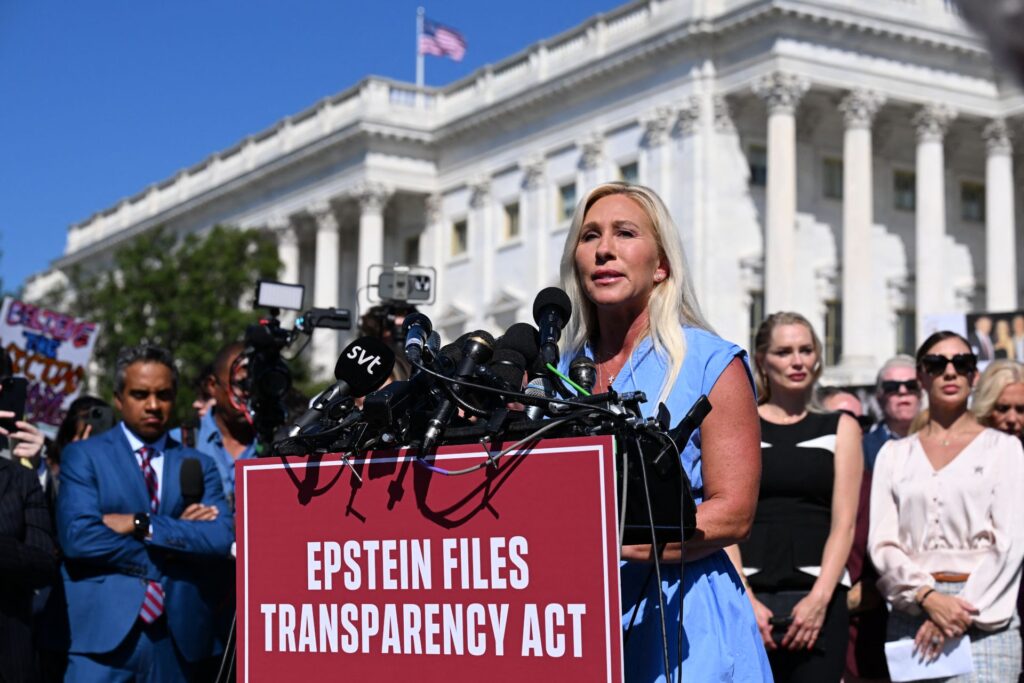
On Sept. 3, an hour-long news conference was held on Capitol Hill where Epstein survivors gathered to speak out, urging officials to sign the petition. Greene attended, publicly calling on other Republicans to sign, and vowing that she would disclose “every damn name” of the alleged abusers from the House floor. Greene’s relentless push to get the files released has, for the first time, soured her relationship with Trump, who has called her a “traitor.” Their clash finally culminated in her resignation, and she’s slowly become more scathing in her criticism of both Trump and the Republican Party. She recently said that the Epstein files have “ripped MAGA apart.”
Mace fled a meeting with Epstein victims during the lead-up to the conference on Capitol Hill. She was visibly shaken as she dodged reporters’ questions in tears while scurrying away. Later, Mace — who is a sexual assault survivor herself — wrote on social media that hearing the women’s stories triggered a “full-blown panic attack” that left her sweating, hyperventilating and shaking.
For months, the petition was just one vote away. Then came Arizona’s newly elected U.S. representative, Adelita Grijalva, who promised to clinch the 218th vote. “On my very first day in Congress,” Grijalva declared on Sept. 22, the night before her election, “I’ll sign the bipartisan discharge petition to force a vote on the Epstein files.”
But it took Johnson 50 days to swear Grijalva in. He insisted that not seating the Arizona Democrat for so long had “nothing to do with” the Epstein files. Instead, he claimed that the government shutdown was why Grijalva remained in a political purgatory for as long as she did. Critics, however, have pointed out that two Republican lawmakers, both from Florida, were sworn in during pro forma sessions earlier this year, a fact that undermines Johnson’s argument.
Regardless, Grijalva immediately made good on her promise by adding her signature — the last one needed to force a House vote — to the discharge petition on Nov. 12. Two Epstein survivors watched her sign as Grijalva’s Democratic colleagues cheered.
A vote to force the DOJ to release the Epstein files was looming, and Trump knew it. So that same night, Trump and some of his top aides huddled in the White House Situation Room. What exactly was said remains a mystery. Especially curious was the fact that Boebert was summoned to the Situation Room, a place usually reserved for high-stakes national security meetings, like the one that monitored the 2011 killing of Osama bin Laden. Why, then, were they meeting there? And why was Boebert invited?
When asked such questions on Nov. 12, White House press secretary Karoline Leavitt said, “I’m not going to detail conversations that took place in the Situation Room.” Boebert did, however, tell CNN that, among other topics, Epstein was discussed.
Many mainstream news outlets have suggested that, by pulling her into the Situation Room, Trump was trying to pressure Boebert to remove her signature from the discharge petition, which would prevent the dreaded House vote (though both Boebert and the Trump administration adamantly deny this).
On Nov. 18, the Epstein Files Transparency Act passed the House of Representatives 427-1. Of the 213 Democrats in the House, all had pledged to vote in favor of releasing the files. Only four Republicans, however, had planned to do the same — Massie, Boebert, Greene and Mace — until Trump, in a sudden twist, urged fellow Republicans to vote with them. “Mr. Trump was forced to make the pivot because he failed to sway three Republican women who had signed onto a petition,” The New York Times explained in a recent article, referring to Greene, Boebert and Mace.
House Republicans had spent months bracing themselves for a vote on the matter. Their base wanted the files released; the president wanted them buried. For Republican lawmakers, it was a Hobson’s choice. So when Trump reluctantly gave them the green light to vote in favor, the floodgates were opened and Republicans likely breathed a sigh of relief. (It’s been reported that, in private conversations, some Republican lawmakers told Trump that they’d have to vote for the bill if it made it to the House, otherwise they’d face the wrath of their constituents.)
“As long as Democrats and President Trump both are calling for the release, I can’t imagine anyone not voting to release,” Rep. Lance Gooden, a Texas Republican, told The New York Times. “I predict 100 percent will vote to release.”
Gooden’s forecast was largely correct, and it easily moved through the House. It passed the Senate the very next day with unanimous consent, before landing on the president’s desk. Late Wednesday night, away from any cameras, Trump signed the legislation to force the DOJ to release the files in the next 30 days — something he could have done on his own several months ago.
It was yet another sharp pivot by Trump, who quickly took to social media, where he called the whole ordeal a distraction. But buried beneath the headlines was a document circulated by Johnson, reportedly to Republican Congressional leaders. “It jeopardizes future federal investigations, and we have national security concerns regarding classified information,” Johnson warned, pointing to five specific “flaws” in the bill that his office had identified, one of which concerned national security. The little-noticed document raises an obvious question: Was Trump’s signature just a way to save face, and are his closest allies quietly planning to block full disclosure? After months of fighting tooth and nail to prevent the release of the files, it wouldn’t be surprising.
Bondi can, if she wants, black out parts of the files — perfectly legal under the bill if it’s deemed that something might “jeopardize an active federal investigation or ongoing prosecution.” And she’s already opened investigations tied to the files, a move that’s drawn suspicion from Democrats and Republicans alike, who now wonder whether this means more redactions, delays and files that, when eventually released, reveal only a fraction of the actual story.
Trump’s move has made one thing obvious: He understands just how threatening Epstein is to the story he’s been selling his base for a decade. It has exposed a rift between the man he is and the political myth he’s built, which has created a unique public relations nightmare for the president in recent months. He seems to recognize that.
“The recent political fallout over the Epstein files illustrates how these myths can backfire,” Woworuntu, the advocate for human trafficking survivors, told New Lines. It reveals the dangers of “weaponizing survivor trauma for political gain.” She also pointed out that, amid the online frenzy, the Trump administration has “quietly gutted anti-trafficking programs, slashed funding and weakened protections for victims and survivors.”
Steven Hassan once believed that former President Richard Nixon was an archangel. But that was back when Hassan, then a high-ranking member of the Unification Church of the United States, had surrendered his bank account to the church. When the Watergate scandal rocked Nixon’s White House, Hassan and his coreligionists prayed and fasted to “prove their loyalty to the president.”
The church was widely seen as a cult. It was a movement built around its founder, Sun Myung Moon, who proclaimed himself the Messiah and, together with his wife, the “True Parents” of humankind — in other words, the first progenitors of people free of original sin, unlike Adam and Eve. It involved mass weddings, where Moon personally paired off complete strangers, and fundraising marathons that, former members have said, ran late into the night with young recruits selling trinkets to meet ever-rising quotas. Hassan was so deep into the church (known as “the Moonies”) that he once said he was “ready to kill or die for” Moon — not unlike Mitchell’s willingness to “die for” Trump.
Since being “deprogrammed,” however, Hassan has made it his mission to help people escape “brainwashing.” He also authored the book “The Cult of Trump: A Leading Cult Expert Explains How the President Uses Mind Control.”
“People coming out of MAGA need to understand the mind control that got them believing that such a horrible person, who is a business failure, was the Messiah, and God was using him,” Hassan told New Lines. “They need to deconstruct how their minds got hacked. And I know, because I was in the Moonies in the ’70s and my mind got hacked. And I was a smart, educated person from a nice family,” he said. “So I’m trying to make it easier for people to leave and not feel too stigmatized, that they’re stupid or morons. I’m trying to tell people to stop calling them names and welcome them if they’re expressing disillusionment with MAGA.”
Moore, the undercover journalist who embedded herself in the American far right, echoed Hassan’s sentiment in a way. She told me that, for a base as entrenched as MAGA, there needs to be a catalyst to dislodge how they think. Epstein, she thinks, might be that catalyst. “Epstein seems to be the closest that we’ve come to that,” she said. “To have people sit back and wonder, ‘Well, if this is a lie, was this a lie, too? Was I wrong about this?’”
Now, with speculation churning that Trump may pardon Maxwell, Moore believes that “a lot of people are going to get hurt.” For victims of sexual abuse and trafficking, a Maxwell pardon would be, as she describes it, both “disheartening” and “traumatic.”
Woworuntu seconded this, telling me that “survivors deserve independent investigations, not political damage control” or “closed-door meetings that serve political interests.”
“I’ve been waiting too long to witness that the government of the United States, through the people, does the right thing. I’ve been waiting too long,” Woworuntu told me. “I believe Donald Trump is seeking information not to expose the truth, but to shield himself from deeper scrutiny regarding his long-standing ties to Epstein.” The recent meetings between Maxwell and Blanche only reinforce this concern, she said.
Nevertheless, Moore argues that some of MAGA’s most diehard supporters are, for the very first time, expressing skepticism about the movement’s political figurehead. “It’s bringing people a little bit out of the spell,” she said. “Even if the rhetoric stopped right now, I think the damage has been done.”
Become a member today to receive access to all our paywalled essays and the best of New Lines delivered to your inbox through our newsletters.