


Pam Markus wiped his brow with the back of his hand, his back aching after 10 straight hours of making ridges on his farmland in Riyom, a region in Plateau state in central Nigeria. The seasonal rains would be starting soon, and Markus wanted to ensure the farm was ready when they did. As the sun dipped behind the mountains, the sky flared purple and orange. The cool, dry harmattan wind coming down from the Sahara bit at his dark skin as he slung a sack over his shoulder and began the long walk home, hoping to arrive before the night fully descended.
Ngo Kaneng remembers her husband, Markus, weary but never losing the glint in his eyes, despite long days on the farm, which was the primary source of income for their family of six. That morning, “he said he was going to the farm to finish working before the rains,” she told New Lines, quietly. “That was the last time we saw him.”
Markus was halfway down the hill when a group of men on motorcycles sped across the road, sporadically firing rifles into the air. Screams followed as locals ran for cover. Then, a bullet came for Markus. He was shot dead, a victim of the increasing violence gripping central Nigeria, which has killed thousands and destroyed dozens of communities.
Although Kaneng had long vowed to keep her family together, the task of taking care of the family proved nearly impossible following the attack that killed her husband that night in 2024. The bandits continued to terrorize the area, seizing or destroying farmland and stripping communities of their livelihoods and sense of security. So when a neighbor offered to take her eldest daughter, 15-year-old Blessing, to the city to work for a friend as a house helper — cooking, cleaning and assisting the lady of the house — she agreed to the arrangement.
In less than a week, Blessing was shuffled out of Plateau state to Edo state, in the south of the country. For the first six months, her mother received monthly stipends from her daughter through her neighbor, which helped her run her home. She felt happy that she had made the right choice: Her daughter was safely out of the reach of the violence in Plateau state and was contributing to the family budget. Then, one afternoon, Blessing called her.
“I was at home when she called me that day, saying she wasn’t comfortable with her work,” Kaneng said. “I tried to understand what she meant, but she wouldn’t tell me what it was that made her uncomfortable. … But she had a tone that made me really worried.” It took Kaneng about a month of careful probing over phone calls before Blessing, now 16, eventually opened up to her mother.
“When my mother said I would go and live with a woman in the city, I thought it was for school,” Blessing told New Lines. “But when I got there, it wasn’t school. I ‘worked’ from morning till night. Sometimes, I just wanted to come home, but there was no way.” That “work,” Kaneng later learned, was in the sex trade. “I am her mother,” she said with regret. “I should have known something was wrong.”
As the security situation in central Nigeria deteriorates, a growing number of parents like Kaneng are handing over their own children — some as young as 2 years old — to traffickers who make lavish promises of education and employment, offering the means to escape the conflict-stricken regions for safer cities. But an increasing number are ending up in exploitative situations, including in the sex trade. With the government already stretched thin combating the violence, more children are slipping into the shadows and losing touch with their homes and communities, sometimes for good.
“Welcome to the home of peace and tourism,” reads a sign that welcomes travelers to Plateau state. For a long time, Plateau lived up to that promise. The state was peaceful and green, attracting domestic and foreign tourists as well as Nigerians from other parts of the country who settled there for its lovely hills, temperate climate and unique cultural heritage.
But in recent years, that has all changed. On any given afternoon in almost any rural community in the state, it wouldn’t be uncommon to find a trail of motorcycles and open vans driving through the town and carrying women weeping or singing mournful choruses. Their destination: a newly cleared piece of land somewhere in the bushes, with a freshly dug pit wide enough to hold the bodies of their kin and neighbors, killed in yet another attack. Among the dead are men who went to cultivate their land but never got to reap the harvest, mothers and children caught unawares in open fire, and entire families butchered over dinner before they could enjoy the meal set out before them.
While Nigeria in recent years has been battling Islamist insurgencies in the northeast and bandit attacks in the northwest, the conflict in Plateau state, which stretches back to the 1990s, is about political control and access to resources between indigenes and settlers, one that often wears ethno-religious colors.
Indigenous groups, who are predominantly Christian, claim ancestral rights to political control in the area. But migrants from the north of the country, like those belonging to the majority-Muslim Hausa ethnic group, contest that claim, citing their years of economic contributions. In September 2001, tensions in Jos, one of the main economic centers of the state, reached a breaking point over what seemed like a simple government appointment. When Mukhtar Muhammad, a Hausa Muslim man, was named poverty eradication coordinator for Jos North, many Christian residents saw it as a provocation. Soon, anonymous leaflets began appearing around the city, warning that Sharia law would be imposed on Plateau state. The tensions transformed into nearly two weeks of bloodshed and the killing of over a thousand people.
More than two decades later, the conflict has been carried forward by groups that are given different epithets: “herders,” “armed men,” “bandits” and even “terrorists.” A narrative has emerged that attacks in Plateau amount to a Christian genocide (even Donald Trump has waded into the debate, promising to come to Nigerian Christians’ aid if necessary). But the conflict is only marginally about religion, and local experts say its roots are complicated and its causes hardly fit into a single narrative.
“You can’t pick a cause of conflict in one region and generalize it. Certain conflicts have to do with mineral resources, others with land-grabbing or economic survival. It depends,” said Raphael Alifia, a conflict researcher at the University of Jos.
What is clear is the toll the conflict is taking in Plateau state. Over 11,749 people were killed in violent attacks between 2001 and 2025, according to a governmental fact-finding committee, with over 420 communities affected. Tens of thousands have been displaced, their ancestral lands abandoned and livelihoods upended in the largely agrarian and mining region.
In April, the Plateau state governor, Caleb Mutfwang, concluded “that these are terrorist organizations deliberately targeting our people. The land in question is very fertile — rich in food produce and mineral deposits. We’ve observed a pattern over the years: At the beginning of the farming season, communities are attacked and destabilized so that they can’t plant. If they manage to farm, another wave of attacks occurs during harvest.”
Meanwhile, the government has repeatedly been accused by various groups like Amnesty International of “issuing bland statements condemning these horrific attacks.” Amnesty added that the “consistent failure of the authorities to bring the actual suspected perpetrators to justice is emboldening impunity.”
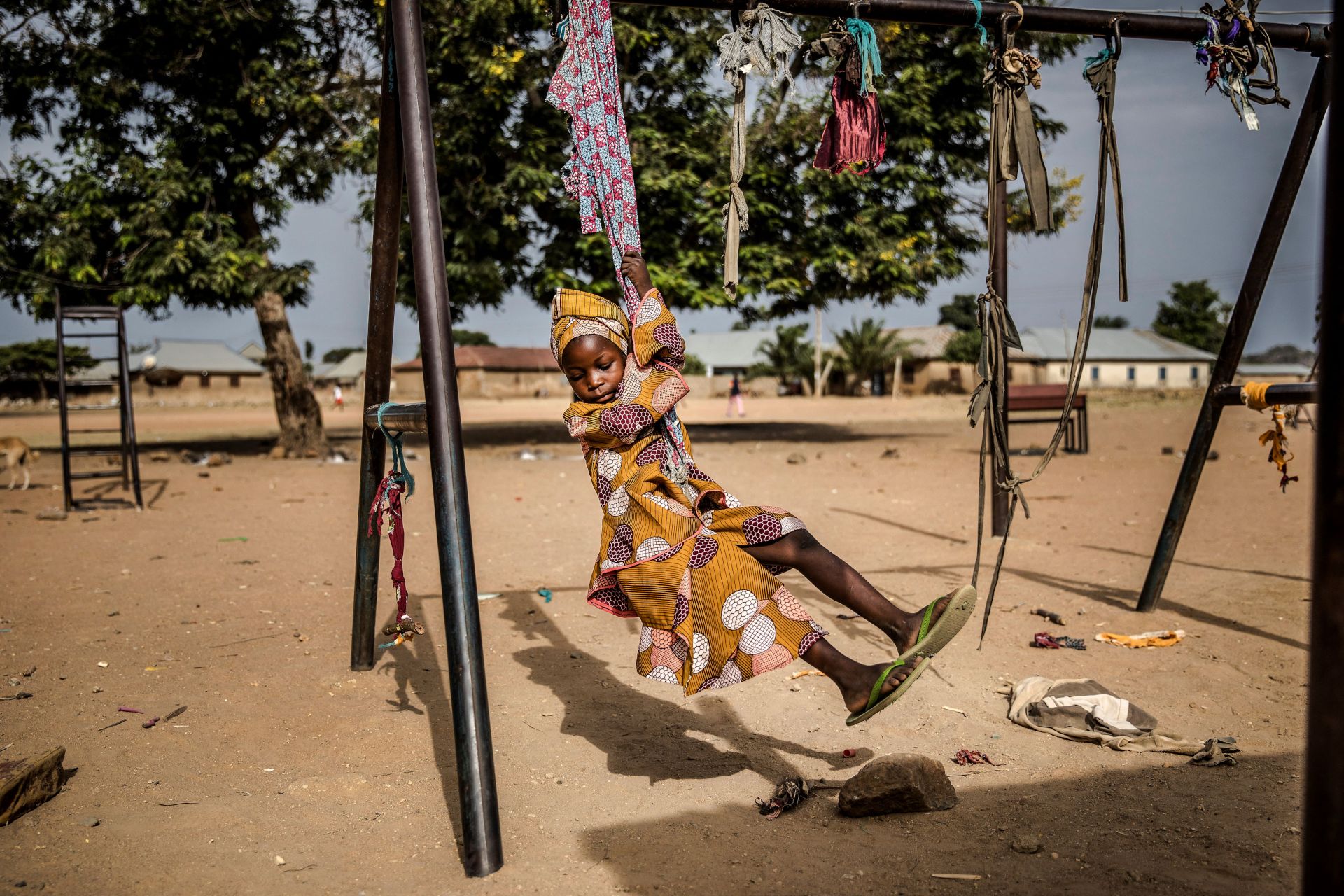
Camps began springing up in the state to accommodate the tide of displaced residents. Dusty encampments in unfinished buildings and mud huts host tens of thousands of women, children and men pushed off their land and stripped of their means of making a living. The camps provide security, but resources are scarce and amenities, including schools and child care options, are few. In those desperate conditions, a new slate of problems has arisen.
“Internally Displaced Persons camps are breeding grounds for recruiters,” said Pope Lasur, an officer at the Nigeria Security and Civic Defence Corps’ gender unit in Plateau state, which works on retrieving trafficked victims. With little support and no infrastructure for children, he explained, “parents are often overwhelmed, having maybe five or six children with them who don’t go to school, just roaming about the IDP camps.” Recruiters take advantage of the parents’ exhaustion and precarity.
“Because of conflict, people are being displaced from their livelihood. So even parents can barely feed themselves. And out of that desperation, they become vulnerable when somebody comes along with the promise of relocating their children to towns and putting them back in schools,” explained Dirmicit Pyentam, a program manager for the Plateau state chapter of Christian Women for Excellence and Empowerment in Nigerian Society (CWEENS), a nongovernmental organization that focuses on protecting the rights of girls and women.
Many parents don’t realize that sending their children to the city for work could pose such dramatic risks — or that doing so constitutes child trafficking. Across Nigeria, the movement of children from rural homes to cities is often treated as a routine cultural practice. Families believe that sending a child to an aunt, uncle or a well-meaning acquaintance will secure better opportunities than the village can offer. But as poverty deepens and insecurity forces more households into survival mode, this system has become vulnerable to abuse. Traffickers now hide under the same familiar language — “I will help train the child” — to move minors across states for street hawking, domestic servitude and, in some cases, sex work. They seize the children’s phones, if they have them, and threaten them with violence if they don’t do the work needed to “pay back” the cost of their journey at an exorbitantly inflated rate.
“In the eye of the law, ignorance is not an excuse,” Lasur warned. “The world has changed. What used to be normal, like sending a child to the city to ‘help out,’ is now one of the main gateways for trafficking.” Such exploitation is a growing problem across the nation. Nigeria ranks 38th out of 160 countries on the 2023 Global Slavery Index, with an estimated 1.6 million people in forced labor or bondage — not including child soldiers.
Pyentam says her organization has seen an influx of children being trafficked for sexual exploitation. In 2024, “out of 60 cases of trafficking,” which her organization managed, “40 were children,” she said.
As the conflict in Plateau state exacerbates the trafficking crisis, the local authorities are developing ways to combat the issue. They’ve identified motor parks — transit terminals where inter- and intra-city buses stop and where taxis pick up and drop passengers — as key sites for trafficking. In the hubbub and bustle of the busy motor parks, it is easy for a child to be squirreled away with an adult on a bus, ferried to an out-of-state destination without causing a stir.
Authorities have begun to plant informants at major parks to intercept traffickers before they move children out of the state. “We have insiders in the parks. Once they notice movements that don’t make sense — maybe a child who doesn’t know where they’re going — they call me,” Lasur said. “I go there, ask one or two questions, and if the answers don’t add up, we invite them to the office. It’s usually there that we find out the children are being trafficked. Someone is always waiting for them in another state.”
Lasur said the problem has grown beyond simply moving children from rural areas to cities; they are now finding that some are destined to be trafficked across the national border. “Some of the girls we rescued were heading to Ghana. A good number of young girls who leave here end up in prostitution rings,” he said.
Despite these incipient efforts, the problem persists. Solutions, including having motor parks register passengers using their national ID number or a bank verification number, so that they can be tracked, have been rejected by lawmakers, citing privacy concerns around tracking citizens’ movements. “Without political will, we’ll just keep recycling the same problem,” Lasur said.
But merely intercepting children en route to, or rescuing them out of, trafficking situations is only part of the equation. “Some of these rescued children have forgotten their background because their names were changed, and these traffickers worked on their minds and psychology. So some of them can barely tell you their family [name],” Pyentam said.
It takes her team days, sometimes weeks, to coax enough information out of children to begin finding out where, and to whom, they belong. The young survivors undergo trauma-informed therapy “to help them recover and at least give a hint about where they are coming from. From there, we proceed to do family tracing.”
The state’s Gender and Equal Rights Commission now works with community-based organisations, including CWEENS, to help track down families of trafficked children and reunite them where they can. In 2024, they were able to rescue and reunite over 100 children. But it is only a drop in the ocean of a much larger crisis. The United Nations Office on Drugs and Crime estimates that about 750,000 to 1 million persons are trafficked annually in Nigeria, and that almost half of those are under 18. And for those children left in limbo, whose families can’t be found, the question of shelter has become a pressing issue for the state.
“The only government shelter we have is an orphanage home managed by the Ministry of Women Affairs,” said Gideon Poki, director at the Gender and Equal Opportunities Commission, the government body responsible for promoting gender equality and protecting human rights. “For most of our rescue operations, we rely on NGO partners who give us temporary safe homes.”
This, he said, creates a major gap in the state’s response to trafficking, because most shelters are overcrowded and lack adequate resources to provide rehabilitation or reintegration support. “When a child is rescued, it’s not just about taking them off the street,” he explained. “They need trained hands to provide care and guidance to them before they are reintegrated into society. Without these, the cycle continues.”
CWEENS’ program manager, Pyentam, admits that, although the shelter was originally designed for women and girls, the rise in child trafficking has forced them to adapt. They initially balked at coed shelters, “but because of peculiar cases, we started taking in boys too.”
At first, the shelter only accommodated boys up to age 7, but last year they extended the limit to 12 to respond to the growing crisis. Older boys, however, are instead sent to orphanages, since there’s no dedicated shelter for trafficked boys in the state. “That’s another gap in the system,” Pyentam added. “We can’t just rescue them and have nowhere safe to keep them.”
As long as there are bullets flying in Plateau state, there will be child trafficking. For many parents, it is still a safer bet than waiting for their child to get caught in the crossfire or being left behind to burn in razed homes.
Noro Gandung, a volunteer in one of the camps for displaced people in Riyom, told New Lines the practice has now gone underground. “We’re trying to stop this giving out of children,” she said. “We put a rule in the community that everyone should stop doing that.” She explained that parents are becoming more secretive as awareness grows. “It will be hard for us to get them,” she added. She believes many parents now understand it is illegal, but desperation pushes them into silence — making it harder to identify families who have sent children away.
For Blessing, the road home was longer than the drive it took to return to Plateau state. Though she received counseling from the state’s Gender Commission, the months of trauma have closed her off, damaged her sense of self-esteem and made her wary of the world. For her mother, Ngo Kaneng, it was a bittersweet reunion. “I let her down, and I have lived with regrets ever since. No child should become a breadwinner at such a young age.”
Become a member today to receive access to all our paywalled essays and the best of New Lines delivered to your inbox through our newsletters.