

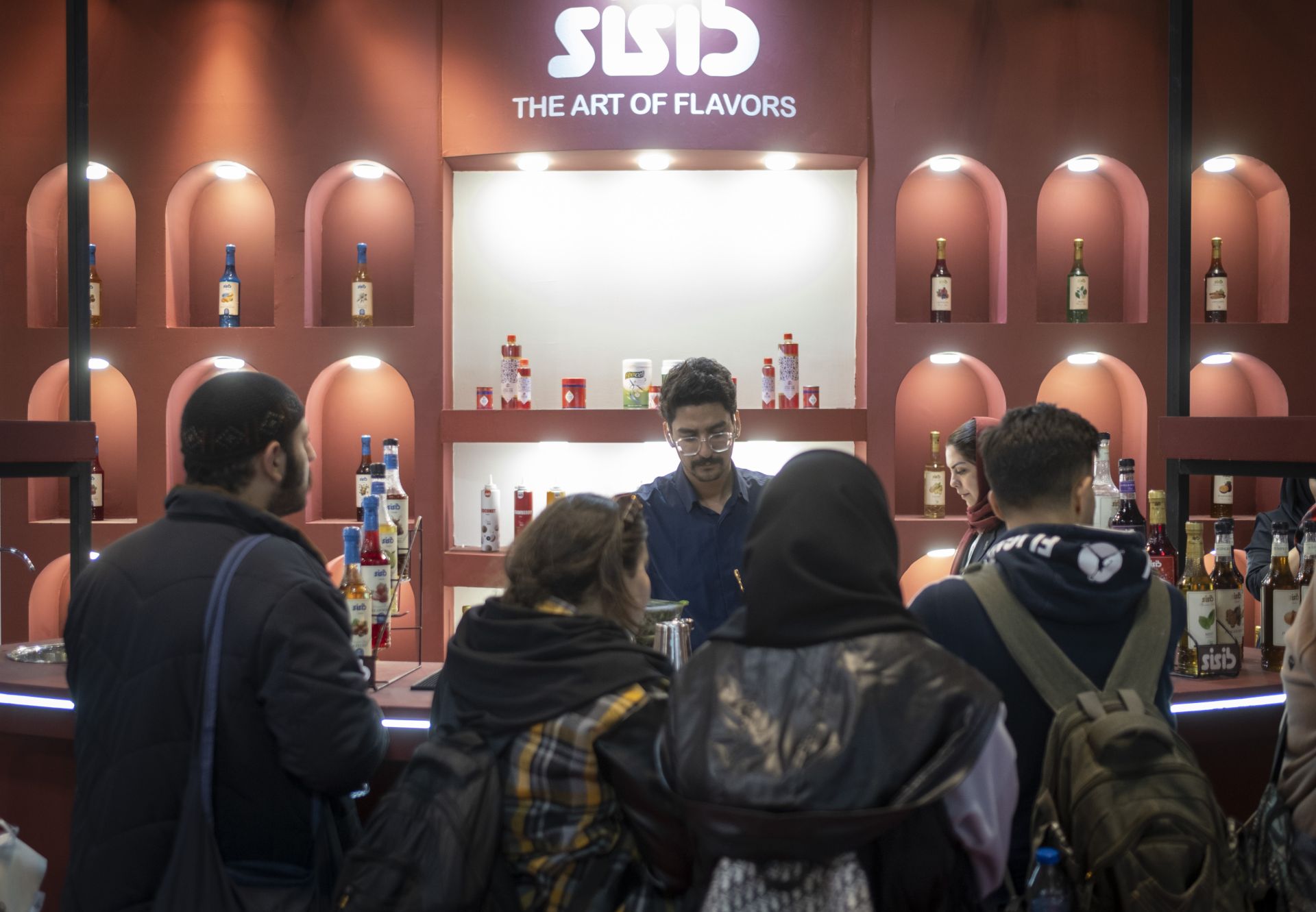
Against a backdrop of rapid social change and the stress of Iran’s political isolation, another quiet revolution is taking place in the capital city of Tehran — a renaissance in coffee culture, led by young Iranians. On a recent trip to Tehran, a young Iranian-American complained about the surplus of choice and the social pressure to order correctly in one of the capital’s innumerable niche coffee shops, where consumption of coffee has now become a status marker for individualistic young people searching for new avenues of expression.
“Everywhere I go, they hand me a coffee booklet. Not only are there 10 brewing methods I’ve never even heard of, but they also want me to choose the ‘line’ and ‘origin’ of my coffee,” the young expatriate complained. At least for young Iranians of his class, the search for an unpretentious, black coffee without milk had seemingly become impossible.
Over the past two decades, not only has the number of cafes in Tehran grown, but the range of brewing methods and types of coffee beans available has increased dramatically. Now, in addition to barista work, coffee roasting has become a popular career choice among young people. It’s rare to find a group of young friends in which at least one person hasn’t tried their hand at roasting or serving coffee.
In a country where alcohol is officially banned, coffee has become a lifestyle drink into which young Iranians are pouring their creative energies. The explosion of coffee culture among urban Iranians coincides with numerous other social changes that are upending Iranian society. As younger generations chafe against the limited vision of the ruling authorities, generational differences are expressing themselves in new forms of personal expression.
For decades, coffee in Iran was primarily a morning drink to help people wake up. This began to change in the 1990s, when the first cafes opened in major cities. The shift was partly inspired by the export of European cafe culture to the United States and other countries, and the popularization of Western television programs depicting cafes as centers of social life. Soon, chain cafes inspired by global brands like Starbucks, itself prohibited from operating inside Iran, began to become common features of urban life.
Gradually, cafes are now being recognized as a “third space” separate from the home and the workplace, though they combine features of both. Younger Iranians have begun to develop an image of themselves as coffee connoisseurs, priding themselves on the refinement of their taste. A growing sensitivity toward the quality of coffee beans, roasting and diverse brewing techniques has spread rapidly among young people, a shift that would have been incomprehensible to older generations of coffee drinkers.
Comparing coffee drinking in Tehran to wine tasting in Paris would not be entirely accurate. Still, similar sensitivities and rituals once reserved for wine drinking, as well as the expertise through which people signal their belonging to a social or economic class, have gradually seeped into Iranian coffee culture. The fact that buying and selling alcoholic beverages is banned in Iran, and that there are no bars or cafes openly serving such drinks, has also contributed to the cultural aura surrounding coffee.
There’s another similarity as well: Coffee was banned during certain periods in Islamic history. Even today, in countries like Afghanistan, its consumption is considered “haram” (forbidden) for certain groups, including women. The air of transgression still lingers faintly for Iranian coffee drinkers, even as their own religious authorities long ago made peace with the drink.
Amid the general economic pressures faced by many Iranians as a result of corruption, economic sanctions and government mismanagement, taking on a part-time job as a barista in a cafe has become an appealing option for many young people. The job is alluring partly because coffee-making has become a “performative art” showcased by young people on social media, similar to the cool factor enjoyed by bartenders in Western countries. The growing appeal of working as a barista is also being driven by the increasing number of cafes across the country, the ease of operating coffee machines, and the decent income the job offers to young people who are still exploring their career options.
On top of all that, a widespread belief prevails among Iranians that learning to brew coffee professionally can pave the way for migration to a foreign country, where they can find employment as baristas and kitchen workers.
Omid, a barista at a cafe on North Kargar Street in Tehran — a student-heavy area in the city center frequented by the working class — says: “My friend became a barista and easily found work in Turkey. I came to learn this job for the same reason — so I can migrate later. Honestly, working as a barista gave me something to talk about. Before I learned this job, I really didn’t know how to start a conversation with girls.”
Despite Iran’s increasingly sophisticated cafe culture, many people are still in the first wave of the coffee renaissance. This makes those with extensive coffee knowledge seem like rare experts who can flaunt their information.
Others, like Hana — a 20-something woman with piercings on her eyebrow and nose — describe their work differently: “Anyone thinking about working behind a coffee machine must first love coffee. You have to love the vibe before thinking about anything else. I took a course to learn how to open a cafe someday, and I also worked in one for a while. I think the only thing I want to do in life is create a space where people like me can gather. For a long time, I didn’t know what I wanted to do with my life and kept drifting through cafes. Then I realized maybe the thing that draws me to cafes could define my path.”
Aside from the abundance of affordable labor, another economic factor has been fueling Iran’s coffee boom. Due to a quirk of Iran’s state-directed economy, the production and sale of coffee can be quite a lucrative business. Coffee beans in Iran are imported as food products using government-subsidized currency at about half the market price. This has made importing coffee a highly profitable and low-hassle business in recent years.
The price of a cup of espresso in Tehran ranges from 50 cents to $2.50. Years ago, one cafe tried to introduce espresso-based drinks served with gold leaf in an effort to redefine the meaning of “luxury coffee” in an Iranian context. In a country where class divisions and poverty remain stark, the backlash against this menu item was so intense that the cafe had to backtrack. Yet the actual cost of producing a cup of espresso is far less than 50 cents, making it a lucrative business even when a low price is charged.
“The price of a cup of coffee reflects the space people sit in, the energy they consume, and the service they receive. If you make this same espresso at home, it might not even cost 20 cents,” one barista working in a cafe in Tehran’s affluent Jordan neighborhood said. “But people don’t come to cafes for the coffee — they come to socialize. The price of coffee is really the price of the opportunity to socialize. The fancier the neighborhood and the classier the cafe, the more expensive the coffee.”
For years, cafes in Iran have tried to replicate the social role of bars in urban life. Initially, this was mostly limited to decor — dim lighting, wooden furnishings, ambient design, cocktail names on menus and drinks served in glasses resembling those used for alcoholic beverages. The presentation all hinted at a subtle game beneath Iran’s cafe culture. Rather than provoking bans, the trend became fodder for media jokes.
Now, cafes have gone even further. Videos of live music nights or viral clips from grand openings evoke not just the vibe of a bar, but edge into the territory of dance halls and discos. DJ booths, pulsating colored lights, drinks served to standing guests and synchronized movement to fast-paced music bear little resemblance to the European cafe culture that spread outward, or even the traditional Middle Eastern cafe culture that turned cafes into spaces for public debate and local socializing.
Typically, right after videos of such gatherings at openings or parties go viral, the cafes involved are fined or shut down by the morality police. Sometimes, as recently happened in Qom and Tehran, the closures are permanent.
A cafe owner who was recently fined due to a viral video showing live music and dancing in his establishment said, on condition of anonymity: “People want something else. Something beyond the daily cafe routine. A good vibe that inevitably comes with the thrill of breaking the rules.”
The shutdowns and fines have been a successful marketing strategy. Not only do videos of such events spread quickly on social media, but the image of resistance and victimhood surrounding shuttered cafes creates a positive reputation once the seals are lifted, boosting business.
Still, the dominant cafe experience in Iran remains the “daily” kind. Semiformal and informal work meetings, introductions, reunions and friendships often take place in cafes. Moreover, cafes offer a kind of “outside” that isn’t quite “in the city.” While the streets can pose risks — harassment, phone theft or hijab warnings for women — cafes provide a calmer, safer space, thanks to their partly public and partly private nature. You’re among others, but not quite in the open public sphere; among people who feel familiar, but aren’t necessarily known.
A young woman wearing a T-shirt printed with Van Gogh’s “Starry Night,” seated at a communal table in a cafe in Vanak Square — the administrative center of Tehran — said: “When I walk down the street, I’m constantly anxious. The kind of anxiety only a woman in Tehran can understand. Worrying that the man approaching won’t catcall me, that the one behind won’t grope me, that the motorcyclist passing by won’t snatch my phone, and so on. In a cafe, you don’t have those worries. Of course, in crowded cafes you still have to watch your belongings, but the stress is much less. You can sit for hours, read a book, or browse YouTube — even if the cafe’s internet isn’t as good as at home. No one will bother you or ask what you’re doing here. No parents will show up and say, ‘Why have you been sitting at home all day? Why aren’t you doing anything useful? Why don’t you get a job?’ and things like that. I guess I keep coming back to the cafe because I feel safe here.”
This semipublic space has another charm that relates to consumption. For many, taking photos and sharing them on social media has become part of the “ritual” of cafe-going. And as the early risers who buy coffee to stay awake give way to those who see coffee as a pretext for socializing and unwinding, the images change as well. Black coffee comes with motivational captions. Matcha is often paired with romantic stories and healthy living. And “cinnamon spice latte,” which rivals Starbucks’ “pumpkin spice latte,” signals the arrival of autumn.
Sharing cafe content on social media is also a way of announcing one’s presence and inviting others to socialize. A young man in his late 20s, wearing shorts and carrying a gym bag, seated at a communal table in a cafe in western Tehran, said: “There’s no other place I know where I can meet new people. I come to cafes to step outside my usual social circle. Sometimes I search the cafe hashtag on Instagram to see what kind of people go to which cafes. In the photos posted from cafes, there’s always a group of people who seem to be having a great time. I try to come here to be part of that vibe — maybe even meet a friend or a girlfriend.”
Beyond those who use cafes for work and socializing, it seems that, for many, cafes are simply a refuge. For some, they are a place to escape from others who bother them at home or on the street; for others, a place to escape from themselves. A young man I met in a low-cost cafe in southern Tehran told me: “I never go home after work. I spend every evening in the cafe. I know some of the regulars and the barista, but unlike many people, I’m not here to socialize or seek new experiences. My apartment is small — it’s only good for sleeping. Here, the space is big and people are friendly. You get used to the noise, like you get used to everything else. It helps you forget the loneliness.”
To a considerable extent, the atmosphere of Tehran’s cafes is shaped by their geographic location. A cafe inside the Tehran Museum of Contemporary Art is nothing like one in a shopping mall in upper-class parts of the city, or on a busy downtown street, or in the middle of a discount clothing complex in a working-class neighborhood. Some Tehran cafes, despite their extensive menus and variety of beans, offer no seating or opportunity for drip brewing. Others, conversely, have very few espresso-based drinks and refuse to serve coffee in disposable cups with plastic lids.
Perhaps due to rising incomes and increased access to coffee, cafes in Tehran have recently become a common destination for both group hangouts and solitary escapes. Maybe the one thing all cafes in this city share is that there’s almost always someone behind the counter, smiling at whoever walks in — no matter how they look or what they need.
Alongside the police’s efforts to crack down on what they call “norm-breaking behavior in cafes” — a campaign that has led to the temporary and, in some cases, permanent closure of several cafes across Tehran and other cities — the police have recently warned that cafes will now be “covertly monitored” to prevent conduct deemed “contrary to Islamic values.” In practice, however, the atmosphere inside most cafes has not changed much. It appears that the police warning is unlikely to be effectively enforced, not only because of the sheer number of cafes but also because many behaviors considered “improper” by the authorities have become widely normalized. The new cafe culture has become so deeply rooted that it seems unlikely any force could easily shake it.
Become a member today to receive access to all our paywalled essays and the best of New Lines delivered to your inbox through our newsletters.